A strong outline is the cheapest place to find out whether your comic works. It's the point where you discover if the opening hook has enough pressure, if the middle drags, if the ending was earned, and if the whole thing fits the page budget you have. Long before dialogue polish or final art, the outline tells you whether the story can breathe in a comic format at all.
The Moment Every Comic Creator Hits
The first version of a comic usually lives as a single strong image. Maybe it's a hero standing in rain, a family argument at a kitchen table, or a last-panel reveal that flips the story on its head. That image feels complete until you ask the one question that matters in production, what happens on page two, page three, page four?
Early comics history shows why that question matters. Famous Funnies: A Carnival of Comics appeared in 1933, and Action Comics #1 followed in June 1938 as the first comic to present all-new material, launching the Golden Age of Comic Books. By the early 1940s, titles like Superman, Batman, and Captain Marvel were each reportedly selling about 1.5 million copies per month, while modern popular monthly titles hover around 100,000 copies according to the historical account in the History of American comics. That scale pushed comics away from short gag material and toward serialized storytelling that could hold momentum across pages and issues.
A comic book plot outline is the bridge between that first image and a finished sequence. It's not the script, and it's not the thumbnails. It's the document where you decide what happens, in what order, and why each scene deserves space before you start writing dialogue or drawing panels.
If a beat doesn't change the story, it's probably decoration.
That's the practical difference between an idea and a usable outline. The outline tells you what the comic is doing, not just what it's about. If you skip it, you often end up fixing structure in dialogue, and that's the most expensive place to discover pacing problems.
From Idea to Premise Before You Write a Single Beat
A usable outline starts with a premise that can carry pages. A cool ending isn't enough if you don't know who wants what, who stands in the way, and why the conflict needs to unfold in comic form instead of as a single illustration. The cleanest way to get there is to write the story in one sentence first, then pressure-test the sentence until the central conflict is obvious.
Start with four lines:
- Protagonist: Who is this story centered on?
- Want: What do they want right now, in concrete terms?
- Obstacle: What blocks them?
- Cost: What happens if they fail?
That simple frame keeps the premise from drifting into mood-only territory. It also helps whether you're making a gift comic, a memoir piece, or a genre pilot, because the outline has to support a character goal, not just a concept.
A strong practice is to write the premise in 25 words or fewer, then check whether you can still hear the story's engine. If the sentence sounds vague, the outline will usually turn vague too. If the sentence already implies conflict, reversal, and payoff, you've got something worth building.
The temptation is to begin with the ending and backfill everything else. That can work, but only when the throughline is already clear. If the ending is sharper than the premise, work backward until you can explain how the protagonist's choice creates the final result.
This guide to coming up with a book idea is useful here because the same discipline applies, a comic premise has to be specific enough to generate scenes, not just an atmosphere.
The Beat Test and the Three-Act Page Map
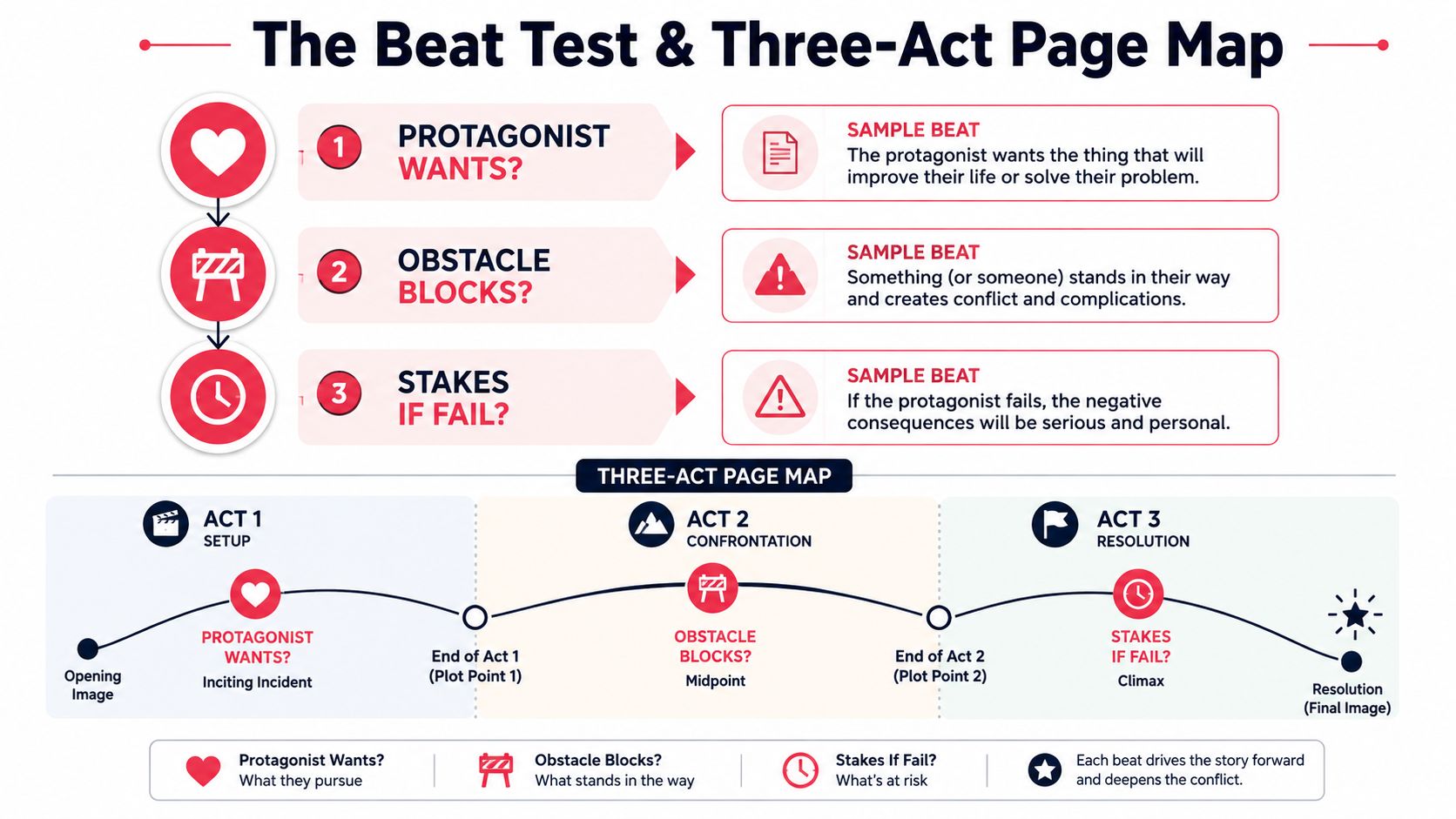
A good beat is doing real work. It should show what the protagonist wants, what blocks them, and what's at stake if they fail. If a beat can't answer those three questions, it's usually a filler scene wearing a plot costume.
In practice, this test trims the page budget fast. A scene where the hero chats, learns nothing, changes nothing, and leaves the same way they arrived is dead weight. A scene where they want one thing, meet resistance, and exit changed belongs in the outline.
The same logic is why a three-act shape still helps comic planning. The act structure isn't a cage, it's a pacing check. For a 22-page single issue, a clean working map is 4 pages for Act 1, 14 pages for Act 2, and 4 pages for Act 3. Other formats can use different page spreads, and common teaching frameworks use 25/65/10 or 20/50/30 as benchmarks rather than rules, but the point stays the same, the outline needs pages attached to story movement.
A sample 22-page issue shape
- Pages 1 to 4: establish the protagonist, the problem, and the first push into motion.
- Pages 5 to 18: complicate the goal, add reversals, and tighten the noose.
- Pages 19 to 22: force the choice, deliver the payoff, and land the final image.
That structure fits the way comic storytelling has evolved, from original-story books into serialized adventure, and it matches the Marvel method's emphasis on plotting before finished dialogue. Marvel's timeline notes that Stan Lee and Jack Kirby used a plot outline first, with Kirby drawing from that structure and Lee adding dialogue later, which is one reason this workflow remains influential in comics production according to the Timeline of Marvel Comics.
Practical rule: if you can't point to the page where the story turns, the beat probably isn't ready.
Turning Beats Into Pages and Panels
A beat sheet is still too abstract if you can't feel it on the page. Comics live or die on placement, what gets a splash, what gets a cramped inset, what should hit at the bottom of a page so the next turn lands hard. The outline has to become a page-and-panel budget before it becomes art.
Start by estimating how much room each scene deserves. A short confrontation might only need a few panels if the emotional turn is clean, while a reveal or action beat may need more space to let the reader process the visual change. The point isn't to calculate with false precision, it's to keep the story from being overstuffed.
For a four-page slice of a 22-page issue, the decision-making looks like this:
| Page | Narrative job | Panel thinking |
|---|---|---|
| 1 | Open with the hook and establish the problem | Fewer panels if the image is strong |
| 2 | Complicate the protagonist's goal | More panels if the scene needs tension building |
| 3 | Force a reversal or new obstacle | Leave room for a page-turn reveal |
| 4 | End on a choice, consequence, or cliff edge | Hold the strongest visual beat for the last panel |
Many outlines break at this point. Writers either cram too much plot into too few pages or stretch low-value scenes until the pacing goes flat. A page-aware outline fixes that by making every scene answer, “What does this page do that the next one can't?”
Useful check: if you delete a beat and the story still makes sense, that beat was probably just taking up space.
When you get specific about page count, the outline gets honest. If a scene needs six panels but the page can only hold four cleanly, you either compress the action or move the beat earlier. If a reveal only works with a page turn, you plan the turn instead of hoping the art stage will rescue it.
The same kind of page-level planning shows up in comic panel layout guidance, because layout and story timing aren't separate problems. They're the same problem viewed from different angles.
Outline First or Script First
Different comics reward different workflows, and the wrong starting point can make the process feel heavier than it needs to be. The choice is between locking story structure early or letting structure emerge from a full draft.
Outline-first works well when the comic depends on reversals, pacing control, or clear page budgeting. You decide the beats first, then add dialogue and panel detail later. That gives you flexibility, keeps the scene list clean, and makes it easier to see whether the ending is earned before you spend time on polish.
Script-first works better when the voice of the narration or dialogue is the core pleasure. In that path, you draft pages more fully, then pull structure out of the draft after the fact. It can feel faster at first because you're writing in a more familiar prose-like way, but it's easier to miss pacing problems until later.
Here's the blunt version:
- Gift comics and short personal pieces usually benefit from outline-first, because the emotional beat has to land without excess page drift.
- Memoir pages can start script-first if the voice is carrying a lot of the weight.
- Genre pilots and issue one concepts usually need outline-first, because stakes and reversals matter more than loose scene flow.
This guide to writing a comic book script is the right companion if you prefer to move from outline into full page writing. The important thing is to pick one method on purpose, not by habit.
The easiest mistake is pretending these workflows are interchangeable. They're not. If your story needs tight structure, start with the outline and protect the page budget.
Turning the Outline Into Pages With PersonalizedComics
Once the outline is solid, it can be fed directly into a generation workflow as story input. PersonalizedComics is one option that takes your photos and ideas, then generates illustrated comic pages with panels, speech bubbles, sound effects, and narration from the plot you provide. Its format fits this topic because the platform asks for story inputs that already look like outline material, protagonist, setting, tone, page budget, and beats.
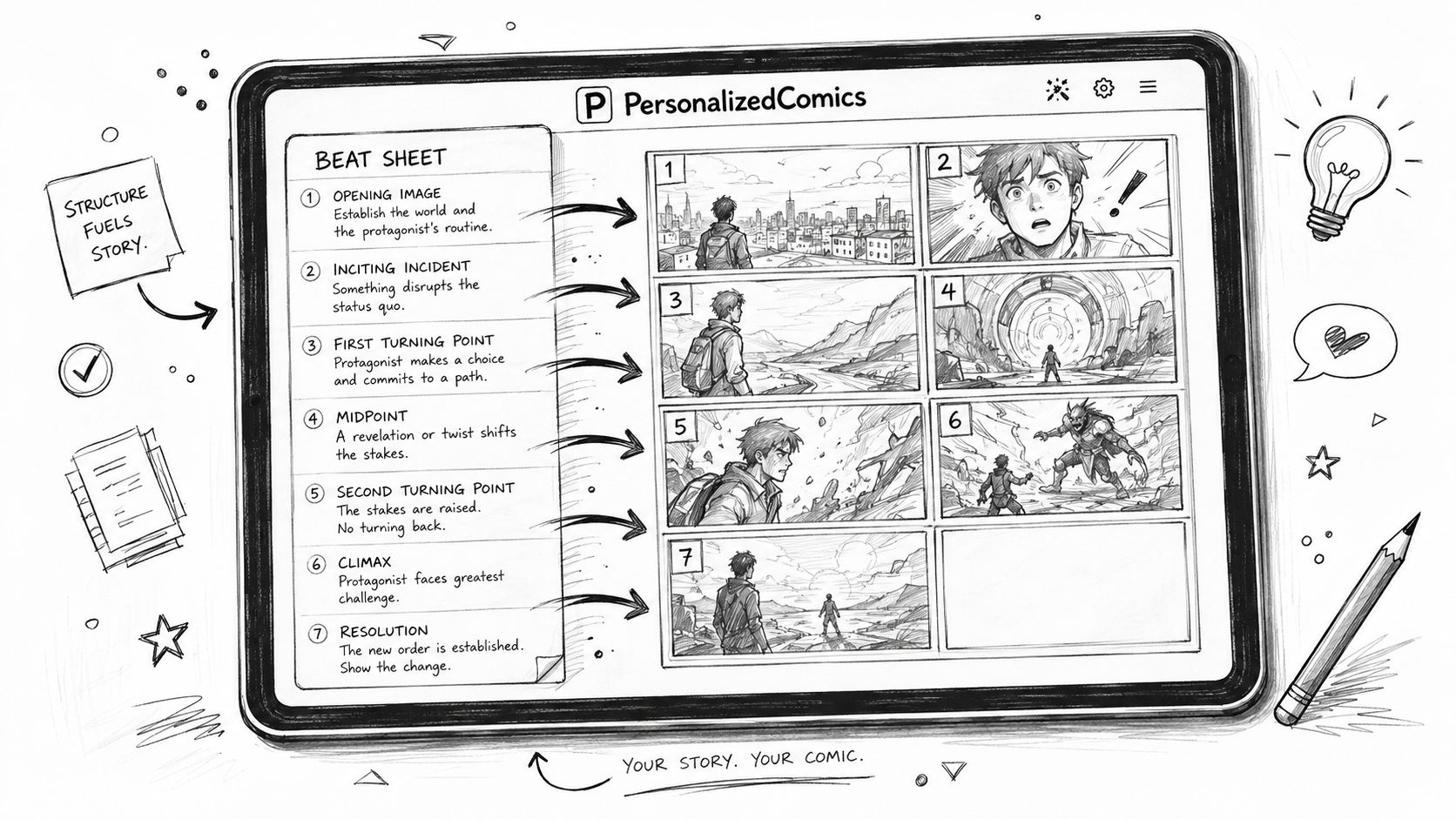
Use this prompt structure when you want to turn the outline into a finished comic page set:
Project type: [gift comic, memoir, prototype, pilot]
Protagonist: [who the story follows]
Setting: [where it happens]
Tone: [warm, noir, heroic, funny, etc.]
Page budget: [number of pages]
Beat 1: [opening hook]
Beat 2: [obstacle or complication]
Beat 3: [turn or reversal]
Beat 4: [ending payoff]
Dialogue notes: [short, direct, readable lines]
Visual notes: [style, costume cues, recurring objects, mood]
For a gift comic, keep the beats simple and emotional. A real person in a noir style works well when the premise is clean, for example, a surprise birthday detective story where the “case” is finding the missing gift and the payoff is the reveal. The outline does the structural work, and the platform handles the page assembly.
The platform also supports eight art styles, including manga, classic American, graphic novel, noir, watercolor, cyberpunk, retro pop, and fantasy. New users receive a free three-page preview comic, which is enough to test a first short comic without overcommitting. Since the workflow is page-based, the outline should already know how many pages the story needs before generation starts.
A Short Checklist Before You Start Drawing
Before you draft thumbnails, read the outline like an editor would. Check for beats you could remove without breaking the story, scenes that don't change the protagonist's position, and any ending twist that shows up too late to feel fair. Also check whether the page budget matches the amount of story you're trying to tell.
Use this quick removal test:
- Cut one beat mentally. If nothing breaks, that beat is extra.
- Look at the last act. If the payoff hasn't been seeded earlier, the ending will feel abrupt.
- Count the pages. If your middle is crowded, the comic will feel rushed before the finish line.
- Check the stakes. If failure doesn't matter, the scene reads like filler.
The best outlines aren't the fanciest ones. They're the ones that survive removal, reveal, and page count without falling apart. Take your own idea, map it onto the 22-page shape, and write the first issue today.
If you want to turn a finished outline into pages without getting lost in layout, panels, or lettering decisions, visit PersonalizedComics and build a comic from your own story beats. It's a practical way to move from premise to page, especially when you already know what each beat has to do.
Filed under Comic Craft