Why Manga Character Design Matters for Your Comic
A lot of first-time personalized comic creators start with the fun part, the scene, the costume, the dramatic pose. Then the pages come back and the character looks close, but not quite the same, and the mismatch pulls you out of the story. That happens because manga character design isn't just decoration, it's the structure that keeps the comic coherent from panel to panel.
The research backs that up. A 2023 study of 162 popular manga spanning more than 70 years found that manga character networks are usually protagonist-centered, meaning one lead character interacts with most of the others. It also found that boy-targeted manga have gradually become denser, less protagonist-centered, and contain fewer characters over time, while girl-targeted manga show the opposite pattern except for a decline in total character count, according to the study's network analysis. That matters here because the lead character isn't just the visual focus, it's the structural anchor holding the story world together, as shown in the network paper at arXiv.
For personalized comics, that means the character has to survive more than one flattering angle. If the face, silhouette, and core proportions drift, the story feels less like a single book and more like a stack of unrelated illustrations.
Practical rule: design for repeatability first, because the comic is judged by its weakest panel, not its best one.
That's why a working manga character design process starts with consistency, not polish. If you want a broader historical frame for how the medium developed, the origin of manga gives useful context, but the production question is simpler, can this character still read clearly after the third redraw, the tilted camera, and the expression shift?
Generate Your Character Concept and Profile
Start with the profile, not the drawing. Before the first line of a model sheet, define personality, background, role, age, gender, strengths, weaknesses, and motivations. That gives the character an internal logic, so the visual design doesn't become a random pile of cool choices.
A practical profile for an original hero might look like this. The character is quiet in public, impulsive in conflict, carries a family heirloom, hates being underestimated, and acts as the story's reluctant protector. That mix tells you what should show up in the face, posture, and wardrobe, without forcing you into vague “cool anime guy” territory.
The workflow that holds up in production is to move from profile to a model sheet with roughly 3 to 6 angles, front, profile, back, and three-quarter views, then add at least one full-body pose and expression studies. That recommendation is useful because it keeps the design from drifting between scenes and helps you catch contradictions early, before they get multiplied across pages. A straightforward walkthrough of that sequence is outlined in how to create your own characters.
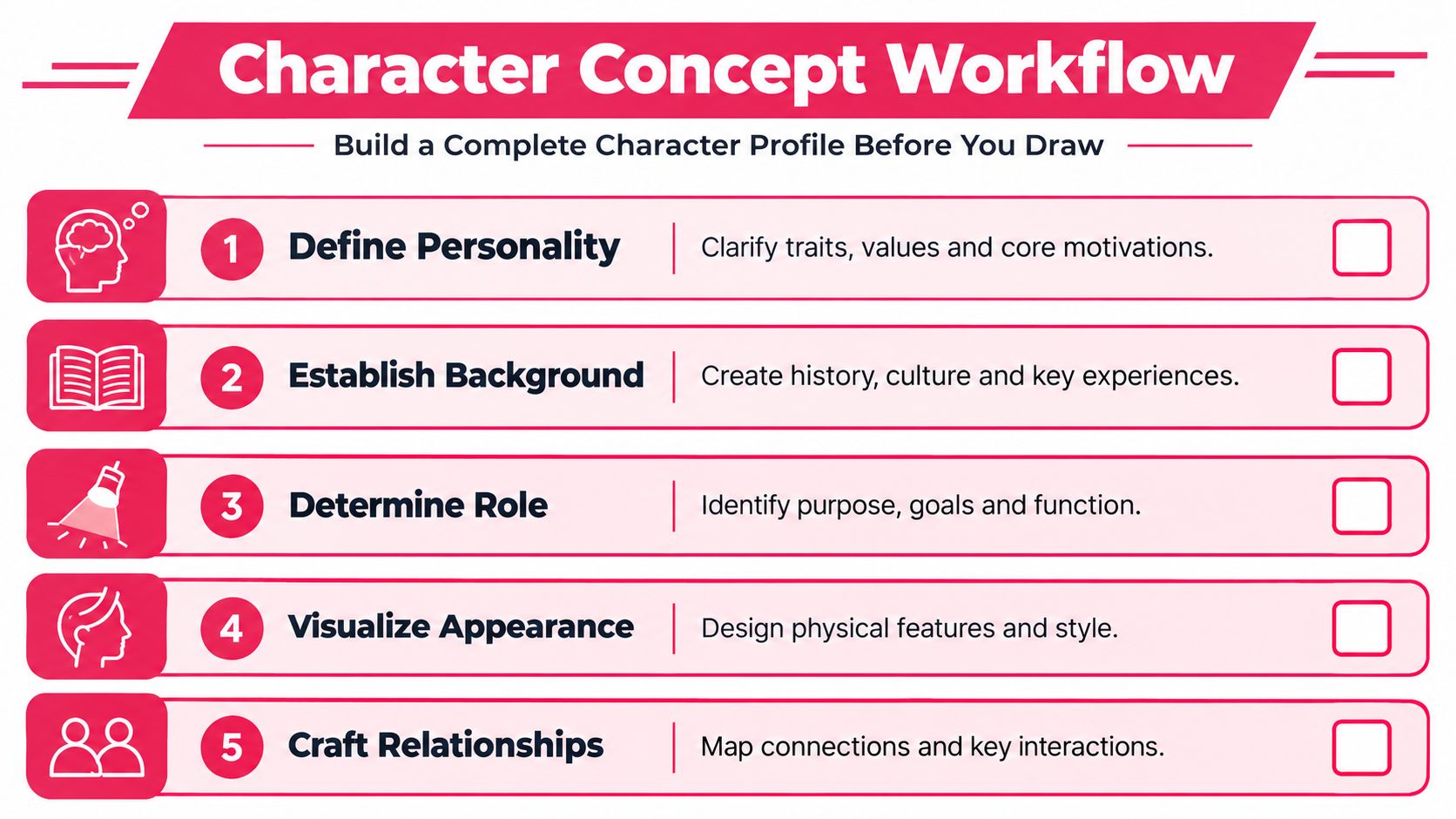
A clean way to build the profile is to ask five questions in order.
- Define Personality: Decide how the character behaves under pressure, because that affects posture, eyes, and mouth shapes.
- Establish Background: Choose the life history that explains scars, accessories, and emotional restraint.
- Determine Role: Clarify whether this person leads, supports, or disrupts the plot.
- Visualize Appearance: Lock in hair, face shape, and clothing logic before stylizing.
- Craft Relationships: Map how they relate to others, because manga identity often shows through contrast.
That profile becomes the script the visual design has to follow. Without it, every redraw becomes a guess.
Build Silhouette Anatomy and Turnaround
Silhouette is where a character becomes readable in a split second. If you shrink the figure down to thumbnail size and the outline still tells you who it is, you've done real design work. If the silhouette collapses into generic hair and limbs, the character will blur together with everyone else the second the page generator changes the framing.
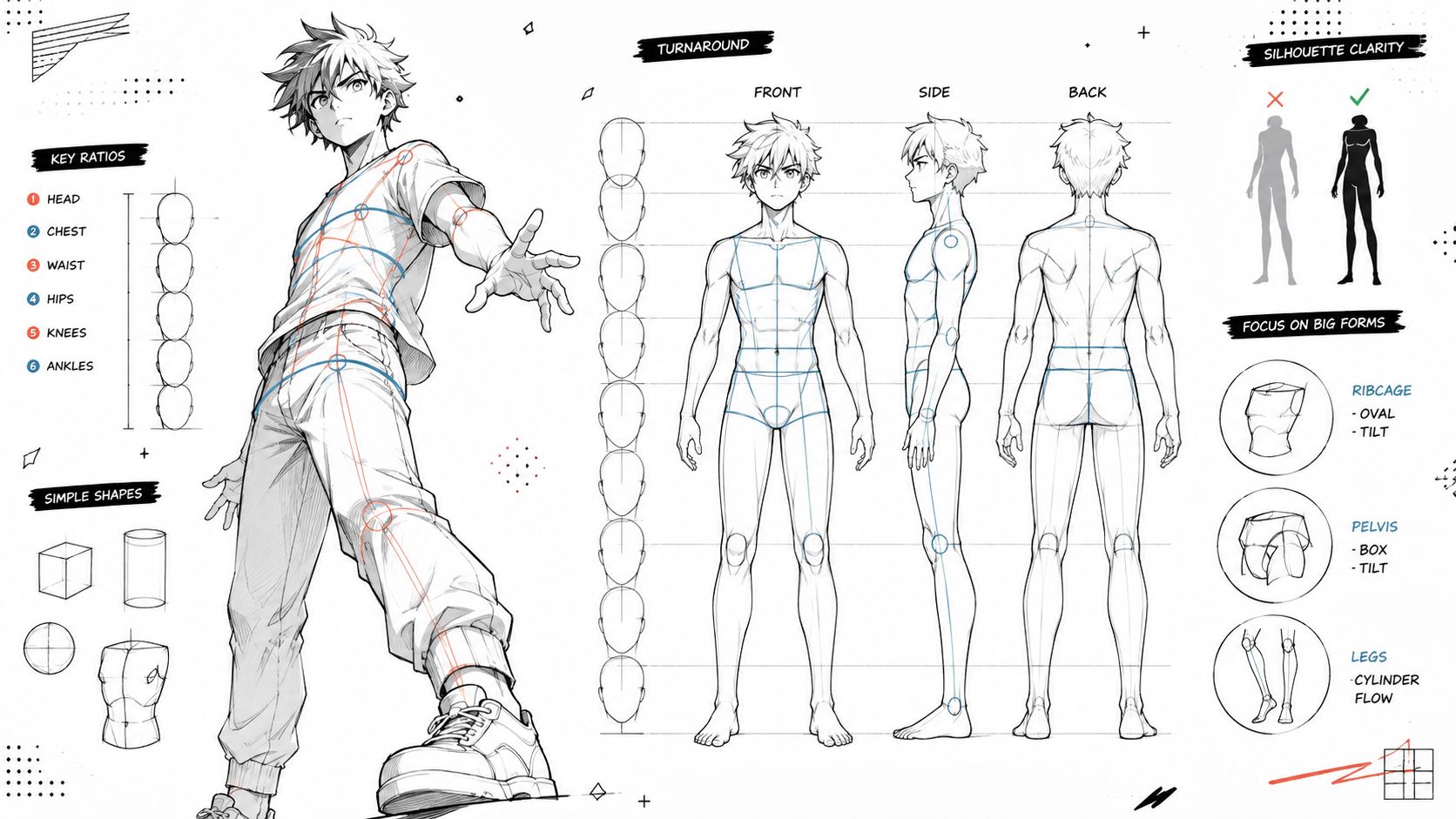
A useful turnaround sheet locks in proportion guide lines, so the body stays the same height and ratio from angle to angle. That means deciding how many heads tall the character is, where the shoulders sit, how long the torso feels, and what the hands and feet look like relative to the body. Industry guidance also recommends adding a color palette, props breakdown, identifying marks, and silhouette checks, because those constraints reduce continuity errors and make the character faster to redraw reliably in production litmemo.com.
The key trade-off is simple. More detail can make a single illustration richer, but it can also make the design harder to reproduce consistently across pages. Clean edges, strong negative space, and a small number of fixed anchors usually hold up better than busy ornaments that disappear or shift under automated rendering.
Keep the outline honest. If the shape only works in a hero pose, it's not a production-ready character sheet.
A strong turnaround doesn't need to be flashy. It needs to answer the boring questions every page asks, where the weight sits, what the jacket does from behind, and how the body proportions survive a side view. That's the difference between a design that looks impressive once and a design that can carry a comic.
Design Faces Expressions and Readability
The face is where readers decide whether a character feels cute, expressive, or flat. A study comparing manga creators and readers found that readers judge a character's kawaii appeal primarily by the face, while creators pay attention to a wider set of traits J-STAGE. For manga character design, that means the face isn't a detail layer. It's the main emotional signal.
That's why eye shape deserves so much attention. Large round eyes can signal openness or softness, sharper eyes can push a character toward intensity, and narrow eyes can suggest restraint or skepticism. The same logic applies to brows and mouth shape, because the face has to carry emotion even when the body is cropped out or turned away.
A useful practice is to build an expression grid with a few fixed expressions, neutral, happy, irritated, shocked, tired, and determined. If the character still reads as the same person when the mouth changes but the eye line stays stable, the design is doing its job. If every expression turns into a different face, the face design is too unstable.
Practical rule: simplify the parts that drift first, then preserve the anchors that make the character recognizable.
This is also where over-detailing hurts. Tiny lashes, decorative lines, and overly specific facial ornaments can look great in one frame and become a consistency problem in repeated redraws. In automated comics, clarity usually beats ornament, especially when the camera gets tight or the expression changes fast.
The face should not be the hardest part of the design to redraw. If it is, the rest of the pipeline will keep paying for that choice.
Style Wardrobe Posing and Angle Consistency
Wardrobe should support identity, not compete with it. The best costume choices do one thing well, they make the character instantly identifiable without depending on fifty separate visual tricks. A strong color, one signature accessory, or a distinct collar shape can carry recognition better than a crowded outfit that changes shape every time the pose changes.
This becomes critical when the camera goes low, overhead, or sideways. Most tutorials handle front, profile, and three-quarter views, but the harder test is keeping the same person readable when the head is turned, foreshortened, or partly hidden. In those moments, fixed anchors matter more than costume noise, because the viewer needs to recognize the face, hair mass, and body rhythm before they notice any small detail.
A practical pose drill is to redraw the same character in three conditions, standing straight, leaning forward, and looking back over the shoulder. If the silhouette stays stable and the face still feels like the same person, the design can survive movement. If the pose destroys the identity, the sheet needs simplification.
For real people converted into comics, the goal is recognizability, not perfect realism. That means preserving the features that matter most, often the hairline, eye spacing, or a distinctive outline, while stripping away extra complexity that breaks under motion. Cleaner silhouettes and stable anchors usually outperform layered accessories when a page generator starts changing angle and framing.
The more scenes a character has to survive, the more the wardrobe should behave like a system, not a fashion spread. The outfit's job is continuity.
Use AI Prompts and Export for PersonalizedComics
AI-friendly manga character design starts to look less like a sketchbook and more like documentation. The practical shift is toward machine-readable character sheets, where you separate what must never change from what can shift with mood, pose, or scene lighting. That matters because automated page generation needs clear instructions, not a vague “make them look cool” brief.
The newer workflow is to design for model-consistency first, style second. The clearest trend in the available guidance is the rise of turnaround sheets, proportion guides, dynamic poses, facial-expression grids, and props breakdowns so the character stays consistent across repeated rendering. A useful discussion of that production mindset appears in AI story generation based on prompt, and the same logic applies here, the prompt works better when the character sheet is explicit.
A prompt template can be built from stable descriptors:
- Identity block: name, age range, role, and core personality.
- Immutable traits: fixed hair shape, eye style, body proportions, signature marks.
- Variant traits: expressions, pose options, wardrobe changes, scene-specific props.
- Style block: manga line weight, shading preference, and energy level.
- Exclusion notes: what should not change, especially face shape and silhouette anchors.
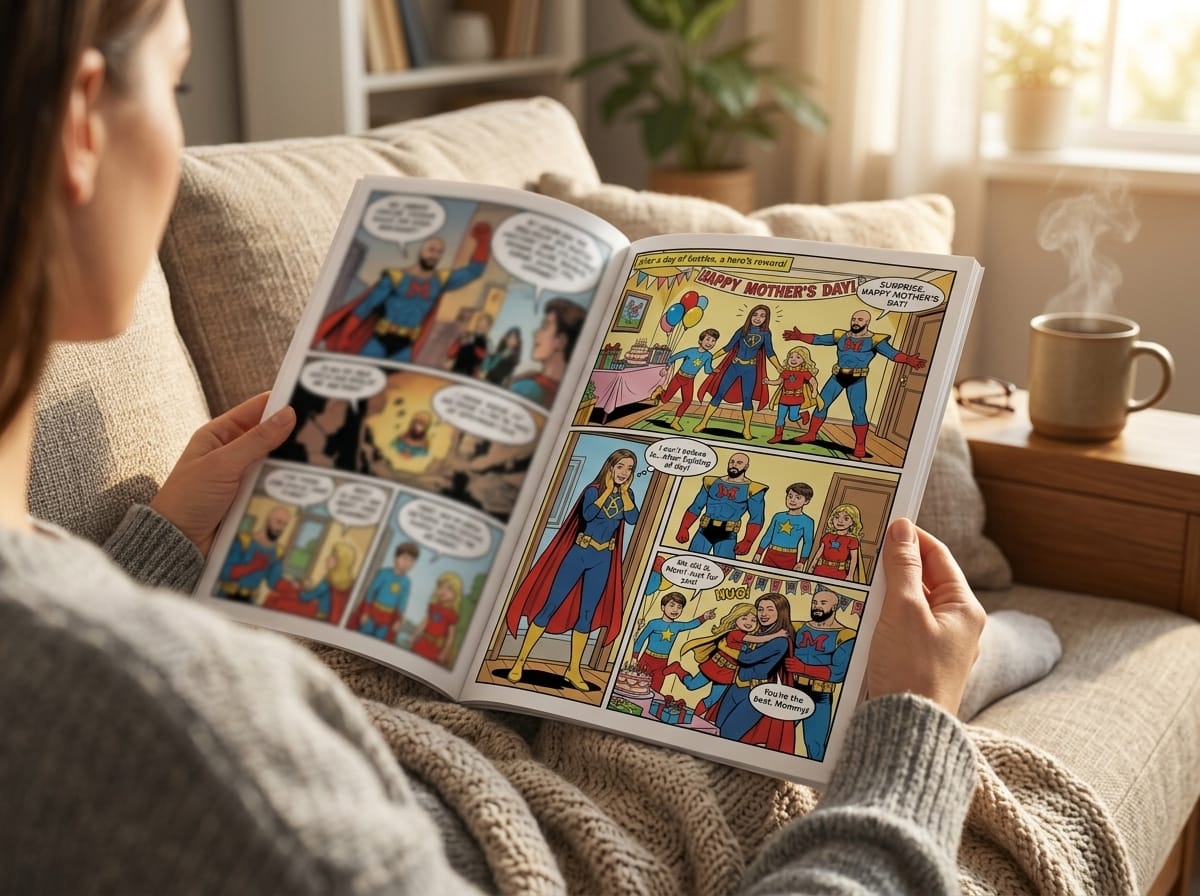
If you're exporting for a platform like PersonalizedComics, think in terms of keeping the design legible across full pages, not just one portrait. The system turns photos and ideas into illustrated comic pages, so the cleaner your documentation, the less likely the character is to drift when the pages get assembled.
The prompt should describe identity first, style second, and decoration last.
That order helps the AI hold onto the person before it starts chasing aesthetics. It's the difference between a stable comic lead and a collection of good-looking panels that don't feel connected.
Avoid Common Mistakes and Final Tips
The biggest mistakes are usually the easiest to prevent. Designers overload the character with accessories, skip proportion lines, or build a single glamorous hero shot and assume it will survive every panel. It usually won't, because automation exposes weak design choices faster than a hand-drawn page ever would.
The safer approach is to simplify. Choose a few fixed anchors, keep the silhouette readable, and protect the face from unnecessary complexity. That doesn't make the design bland, it makes it reliable, which is what a long comic needs.
A short checklist keeps you honest:
- If the face changes too much, reduce facial detail and fix the eye and brow structure.
- If the body looks inconsistent, lock the proportions with guide lines.
- If the outfit keeps drifting, cut it back to a few repeatable shapes.
- If the character disappears in motion, rebuild the silhouette before adding ornament again.
The strongest manga character design for personalized comics is the one that holds up after the tenth redraw, not the one that wins a single close-up. That's the production standard, especially when the book is being generated panel by panel instead of polished by hand.
If you want to turn your photos or original ideas into a manga comic with characters that stay recognizable across every page, PersonalizedComics can turn that workflow into finished panels, speech bubbles, and complete pages. It's built for exactly this problem, taking a character from concept to consistent comic output without requiring drawing skills.
Filed under Comic Craft