How to create your own characters starts with treating them like something that has to survive repeated use. A character in a comic isn't just a single drawing or a clever bio, it's a profile, a behavior pattern, and a visual identity that has to hold up across panels, poses, and revisions. The most usable advice in modern character guides leans in that direction too, with a profile-first approach that defines name, appearance, background, traits, goals, and quirks before the first scene is drafted, then tests the design through sketches, character sheets, and iteration so it stays coherent in visual storytelling (WikiHow guide on creating a character).
Why Most Characters Stall Before the First Panel
A beginner usually stalls at the exact moment the character has to do something twice. The first sketch looks promising, the name feels right, and the backstory sounds vivid, but then the second page arrives and the character no longer feels like the same person. Their expression changes too much, their clothes drift, their voice slips, and the whole project starts to feel loose.
That failure usually comes from building in the wrong order. Writers and artists often start with inspiration first, then try to patch in structure later, even though practical character advice treats the process like something you can repeat and check. The safer path is to lock down the basics early, name, appearance, background, personality traits, strengths, weaknesses, goals, and quirks, so the character can be repeated without guesswork.
Why profile first beats inspiration first
Inspiration helps, but it is not a workflow. A strong idea can still fall apart if nobody decides what the character wants, how they speak, what they wear, or how they look from the side. Comics and visual storytelling work better when the creator follows a repeatable pipeline instead of relying on a one-time burst of imagination.
Practical rule: If you cannot describe the character in a short profile, you will keep redesigning them every time you draw or write a new scene.
That profile-first habit matters even more in comics because repeated panels expose every inconsistency. A hairstyle that changes shape, a jacket that gains random details, or a personality that shifts from scene to scene breaks the illusion fast. Character guides also point in that direction, from prose-outline thinking toward reusable visual assets for serialized media, games, and comics (WikiHow guide on creating a character).
What the pipeline solves
The goal is coherence. You want a character who can be drawn from multiple angles, written in different moods, and still feel like the same person. That means you are not just inventing traits, you are designing a system that can be reused.
The rest of the process follows that logic. First you find a concept worth repeating, then you stress-test the personality, then you lock the visual markers, then you turn all of that into prompts or pages. Once you think that way, the blank page gets less intimidating because you are no longer asking for magic. You are building something that can hold up in production.
Finding the Spark and Locking the Core Idea
A character gets easier to make once the idea has an engine. The fastest way to get there is to stop asking, “What's cool?” and start asking, “What role does this character need to play, and what pressure will expose them?” That shift turns vague inspiration into something you can write or draw.

Three reliable ways to generate a character
Start with one of these three sparks.
- Combine two unrelated interests. A burned-out archivist who only lies works because the job and the flaw collide in a memorable way.
- Mine a private fear or wish. A teenage courier who delivers messages she's not allowed to read has built-in tension because the task and the temptation fight each other.
- Reverse-engineer from the plot. If the story needs someone to cross a dangerous threshold, build a character whose fear makes that crossing painful.
Archetypes help here because they give you scaffolding, not a cage. Hero, mentor, trickster, shadow, and threshold guardian are useful starting points, especially when you don't know what kind of energy the story needs yet. The trick is to use the archetype as a rough shape, then make it personal and specific. Personal can even mean four-legged: some creators build a whole comic around their pet, which is why a personalized comic has become a popular National Cat Day gift.
Lock the goal, the opposing want, and the visible flaw
A character feels real when their aims conflict. Give them a primary goal, then give them an opposing want that undercuts it. Maybe they want respect, but they also want to stay invisible. Maybe they want freedom, but they're addicted to being needed. That tension creates scenes.
A character becomes memorable when the audience can see what they want and also see what gets in their way.
Write a one-paragraph elevator pitch after that. Keep it plain. State who they are, what they want, what blocks them, and why the story can't work without them. If you can't do that yet, the design is probably still too broad.
If you're choosing a name at this stage, use a separate naming process instead of treating it as an afterthought. A name should fit the character's world, tone, and role, not just sound cool, and a dedicated naming pass helps keep that decision from drifting into randomness. For a focused naming workflow, see the guide on how to choose character names.
The end result should be a concept brief you could hand to an artist, a writer, or an AI tool without having to explain it twice. That's when the character stops being a pile of ideas and starts becoming something you can build on.
Building Backstory and the Relationships That Push Them
Backstory works best when it explains pressure, not trivia. You do not need a long chain of life events just because the page is blank. You need the moments that changed how the character reacts when someone challenges them, ignores them, or asks for something they do not want to give.
Interview the character in their own voice
A useful trick is to answer five questions in the character's voice. Do not write about them in third person. Let them speak.
- What do you want most right now?
- What do you refuse to admit about yourself?
- Who do you trust, and why?
- What still embarrasses or hurts you?
- What would you never do, even under pressure?
The point of this exercise is to surface the hidden logic behind their choices. If the answers sound different from your own voice, you have probably found something usable. If they all sound identical, the character still needs more distinction.
Balance the traits so the character does not flatten
One of the most useful warnings in character advice is to avoid one-note imbalance. A character with too many dislikes and no real attachment, or a personality built from only one harsh note, tends to feel artificial. Real people have contradictions, and comic characters need them too, as noted in WikiHow guide on creating a fictional character from scratch.
Use mixed influences instead of copying one real person. That keeps the design from becoming a caricature and gives you more combinations to play with. Guides on character creation also recommend mind maps and interview-style exercises, because those tools uncover details that do not show up in the first pass.
Make relationships do the heavy lifting
Supporting characters should push the lead into action. A skeptical sibling, an overprotective mentor, or a rival who sees through the lead's excuses can reveal more in one scene than a page of biography. Those relationships also connect the inner arc to the outer plot, because the character's growth becomes visible in the way they handle friction.
Useful shortcut: If a supporting character never changes the lead's choices, they are probably not active enough.
Write a short list of relationships that create different kinds of pressure, not just warmth. One should test the character's confidence. One should challenge their moral line. One should force them to reveal a soft spot. That gives you scenes on demand, which matters when you are trying to keep a comic moving without repeating the same emotional beat.
Designing the Look That Survives Every Angle
A character can look great in a clean concept sketch and still fall apart the moment you redraw it. Side views may break the hair shape. A crowded panel may hide the signature accessory. A slightly different art style may flatten the whole design. Good character design starts by planning for those realities, because the page will test the character far more often than a single polished illustration.
Start with silhouette, then lock the markers
Begin with one plain test. Can you recognize the character from a black shape alone? If the answer is no, the design is probably depending too much on small decoration. A strong silhouette comes from clear proportions, a distinct hair shape, and one or two features that interrupt the outline in a way you can spot fast.
Once the silhouette works, choose the markers you will keep steady. Hair shape, jacket cut, a signature accessory, a repeated color, or a distinct prop all help. The goal is a recognition kit, not a costume closet. That matters across repeated panels and AI-generated pages, where tiny shifts can make a character feel like a different person from one frame to the next.
Use a model sheet before you render anything polished
Move from concept to model sheet in passes. First define role, attitude, and motivation. Then lock the visual traits. Then test the design in front view, three-quarter view, profile, and an action pose. Guides on original-character creation recommend this draft-evaluate-repeat loop because it exposes weak spots before they spread through the rest of the work, as shown in WikiHow guide on creating and developing an original character and Instructables guide to making an original character.
A model sheet also gives you a practical reference for designing comic characters, which helps when the same character has to hold up in different panels, different poses, and different production steps.
Skipping the sheet usually creates revision churn later. If the design only works from one angle, every new panel turns into a redesign problem. If the design is packed with random details before the story function is clear, it may look busy but behave blandly.
Let style change what you prioritize
Different art styles reward different details. Manga often leans on strong expression, clear silhouettes, and line economy. Classic American comic inking may ask for bolder contour choices. Watercolor softness can make edges and color harmony more important than hard outlines.
The style does not replace the character design. It changes which parts carry the weight. In a high-contrast noir page, shape and shadow matter more than tiny costume ornaments. In a softer painted style, a controlled palette can do the recognizability work that line art usually handles.
Internal consistency matters more than decorative complexity. A character with fewer, stronger choices survives adaptation better than one with twenty competing visual ideas. That is why the best designs often look simple at first glance, then reveal their logic the longer you work with them.
Personality in Action How a Character Behaves on the Page
A character profile doesn't become useful until the character reacts. Readers and viewers don't fall in love with trait lists, they respond to choices, timing, body language, and the way a person talks when something annoying happens. That's where personality becomes visible.
Use a reaction shot to test the voice
Pick one ordinary situation and write the reaction in three layers. Try a stranger asking for directions, a friend canceling plans, or a locked door that should have been open. Then write what the character does, what they say, and what they think but don't say.
If the response feels flat, the character still needs sharper priorities. If the dialogue sounds generic, the voice hasn't separated from your own. If the body language doesn't match the words, the design is missing behavioral consistency.
Build two or three default mannerisms
Every character should have a few habits that show up automatically. Maybe they avoid eye contact when embarrassed. Maybe they tap a pen when thinking. Maybe they answer questions with a joke before they answer seriously. Those patterns help you keep the character stable across scenes.
Then break those habits on purpose when the story needs a turn. If the talkative character goes quiet, the silence means something. If the cautious one steps forward first, that moment carries weight. Readers notice that contrast because it shows change without needing a speech to explain it.
Behavior beats description. A sentence about bravery is weaker than a panel where the character stays in the room after everyone else leaves.
This is also the point where writers often discover whether the character can carry a comic. If you can write three different responses to the same small event, the character has range. If every response sounds the same, go back and sharpen the contradictions in the backstory and goals.
The end product should be a short behavior log. Keep it close. It becomes a reference for future scenes, especially when you're trying to keep voice and posture aligned across many pages.
Writing and Image Prompts Ready to Paste
A character can look finished on a sheet and still fall apart in production if the prompt does not hold the same facts together. The goal is to turn the character's stable traits into writing prompts for scenes, then image prompts that preserve the same anchors across repeated panels, different art styles, and AI-generated pages. If the prompt leaves out the locked details, the design drifts even when the wording sounds polished.
Copy-ready writing prompt template
Use a fill-in-the-blank scene prompt:
Character: [Name], [role], [one defining trait]
Situation: [ordinary or high-pressure event]
Goal in the scene: [what they want right now]
Obstacle: [who or what blocks them]
Behavior: [default mannerism, reaction, or voice pattern]
Tension: [what they're hiding or afraid to admit]
Outcome: [what changes by the end of the scene]
A template like this works because it keeps identity, pressure, and action in the same frame. It also makes the scene easier to write for an AI story generator based on a prompt, since the generator has clear signals about who the character is, what they want, and how they should react. Without that structure, the character becomes a generic figure moving through a generic scene.
Prompt keywords by comic style
Style words should change the image, not just decorate the prompt. Use the terms that steer the drawing:
- Manga: screentone, large expressive eyes, speed lines, clean linework
- Classic American: bold inks, dynamic poses, clear facial acting
- Graphic novel: textured shading, grounded composition, cinematic framing
- Noir: high contrast, venetian-blind shadows, moody lighting
- Watercolor: soft edges, paper texture, layered washes
- Cyberpunk: neon accents, reflective materials, urban glow
- Retro pop: flat color blocks, crisp outlines, bold signage
- Fantasy: ornate costume details, atmospheric setting, symbolic props
The character markers need to stay in every prompt too. Keep the same hair shape, accessory, palette cue, and silhouette language each time you generate a page. That consistency is what helps the character survive repeated panels and different rendering styles without losing identity.
A quick tuning loop
Generate the image or page, then check what changed. If the hair flattened, call out the hair shape again. If the color drifted, restate the palette cue. If the outfit picked up random extras, trim the prompt back to the locked markers and regenerate.
Short corrections usually work better than one long rewrite. A prompt that names the exact drift gives the model something concrete to follow, while a vague fix leaves the same problem in place. That habit saves time and keeps the character readable from one page to the next.
If you want a tool that turns those prompts into comic pages, PersonalizedComics can take photos or original character descriptions and generate illustrated pages with panels, speech bubbles, sound effects, and narration in different art styles. It gives you a direct path from prompt to page without rebuilding the workflow from scratch.
Turning Designs Into Pages with PersonalizedComics
A character sheet becomes useful the moment it can move from notes into pages. The name, role, visual markers, style choice, and scene log are not just planning material, they are the instructions a comic workflow can use. That is the point where a character stops living on a page of notes and starts working inside a story.
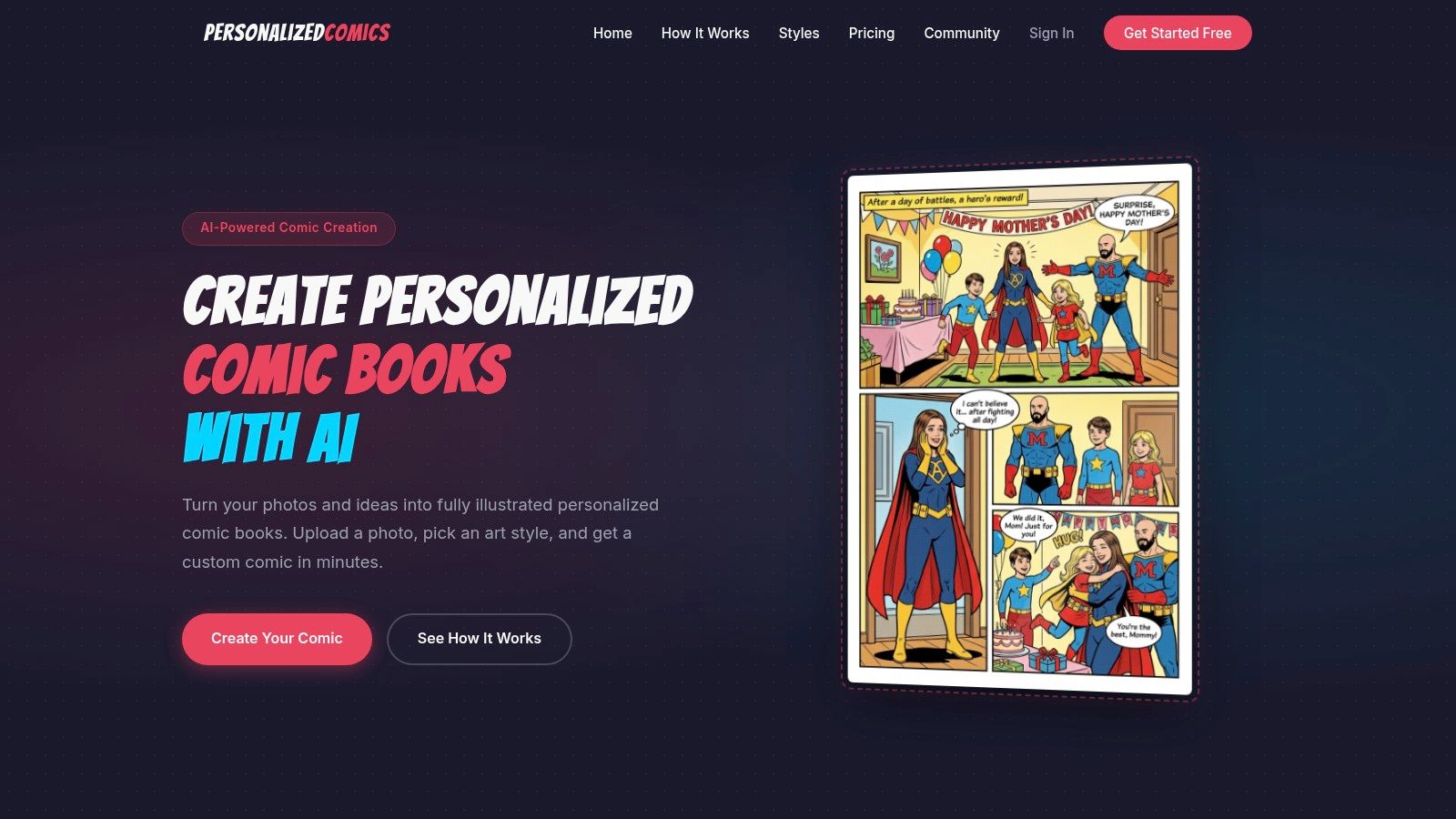
A platform like PersonalizedComics lets you upload photos of real people or describe an original hero, then turn that input into illustrated comic pages in styles like manga, classic American, graphic novel, noir, watercolor, cyberpunk, retro pop, and fantasy. The workflow is direct. You outline the plot, settings, and dialogue, then generate pages with panels, speech bubbles, sound effects, and narration that stay matched to the style you chose.
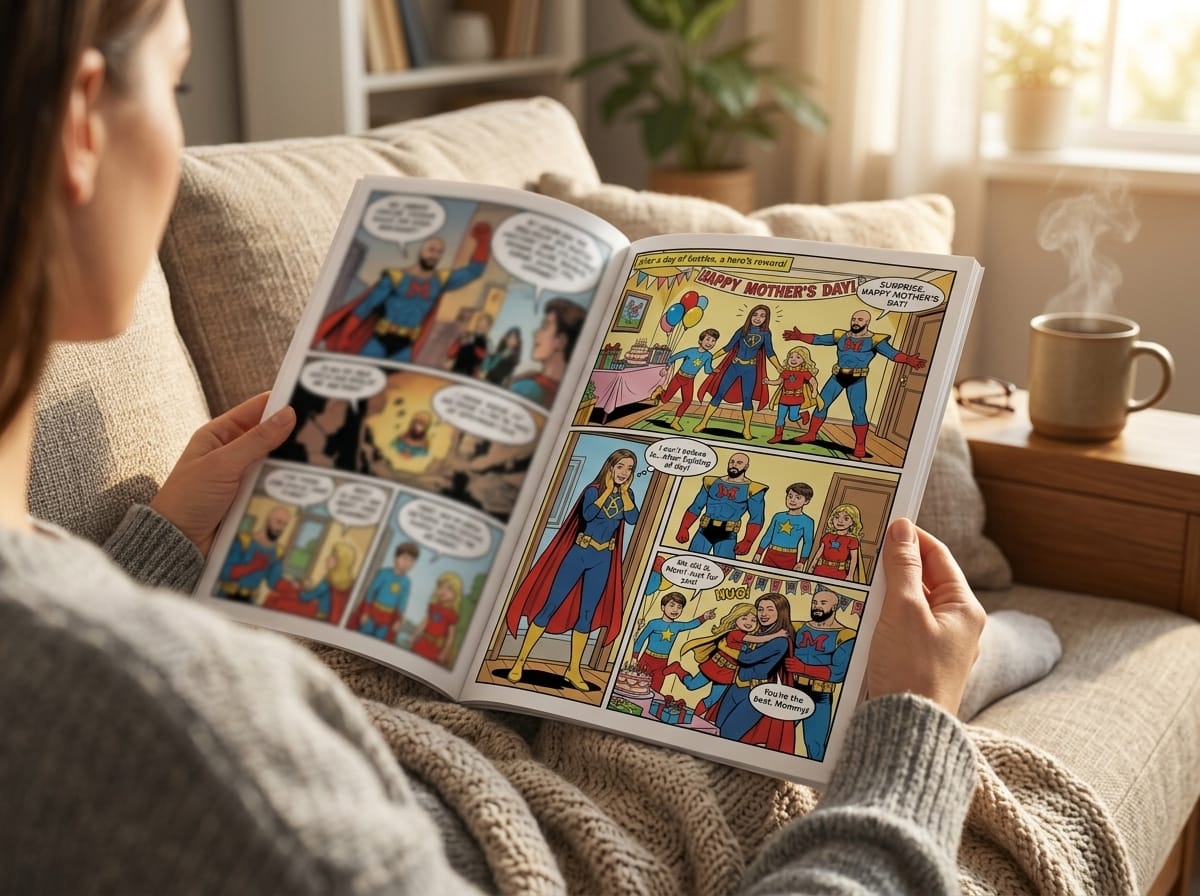
That matters across different kinds of projects. A parent can turn a family memory into a keepsake comic. A teacher can turn a lesson into a visual handout. A writer can test a graphic novel scene before building a full chapter. A cosplayer can make a visual reference from a character sheet. The comic only holds together if the character was designed clearly enough to stay recognizable through those uses.
If you want to turn a character sheet into a finished comic instead of another abandoned draft, try building one in PersonalizedComics. You can use your own photos or original character notes, keep the design consistent across panels, and generate a polished page that is ready to share, print, or refine into a longer story.
Character design gets even more personal when the character is someone you know. If you are turning a real person into the star of a comic this holiday season, our guide to Christmas gifts for grandpa shows how a custom comic fits alongside 24 other keepsake ideas.
Filed under Making Your Comic