These comic strip ideas for students move from personal storytelling and collaboration to curriculum content, advocacy, careers, adaptation, worldbuilding, and comedy. Each prompt includes a practical starting point, a production path, an extension activity, and an assessment focus. Comics have a long history in education. Research on comics as a teaching tool reaches back to the 1940s, and a review of K-9 studies identified 55 texts published between 1941 and 2019 from 14 countries, showing that comics are an established classroom medium rather than a novelty (ERIC review of comics in education).
You can use paper, presentation software, drawing applications, or an optional creation platform such as PersonalizedComics. The tool can turn photos or described characters into illustrated pages, but establish consent, privacy, and non-image alternatives before students upload photographs.
1. Personal Hero Origin Story
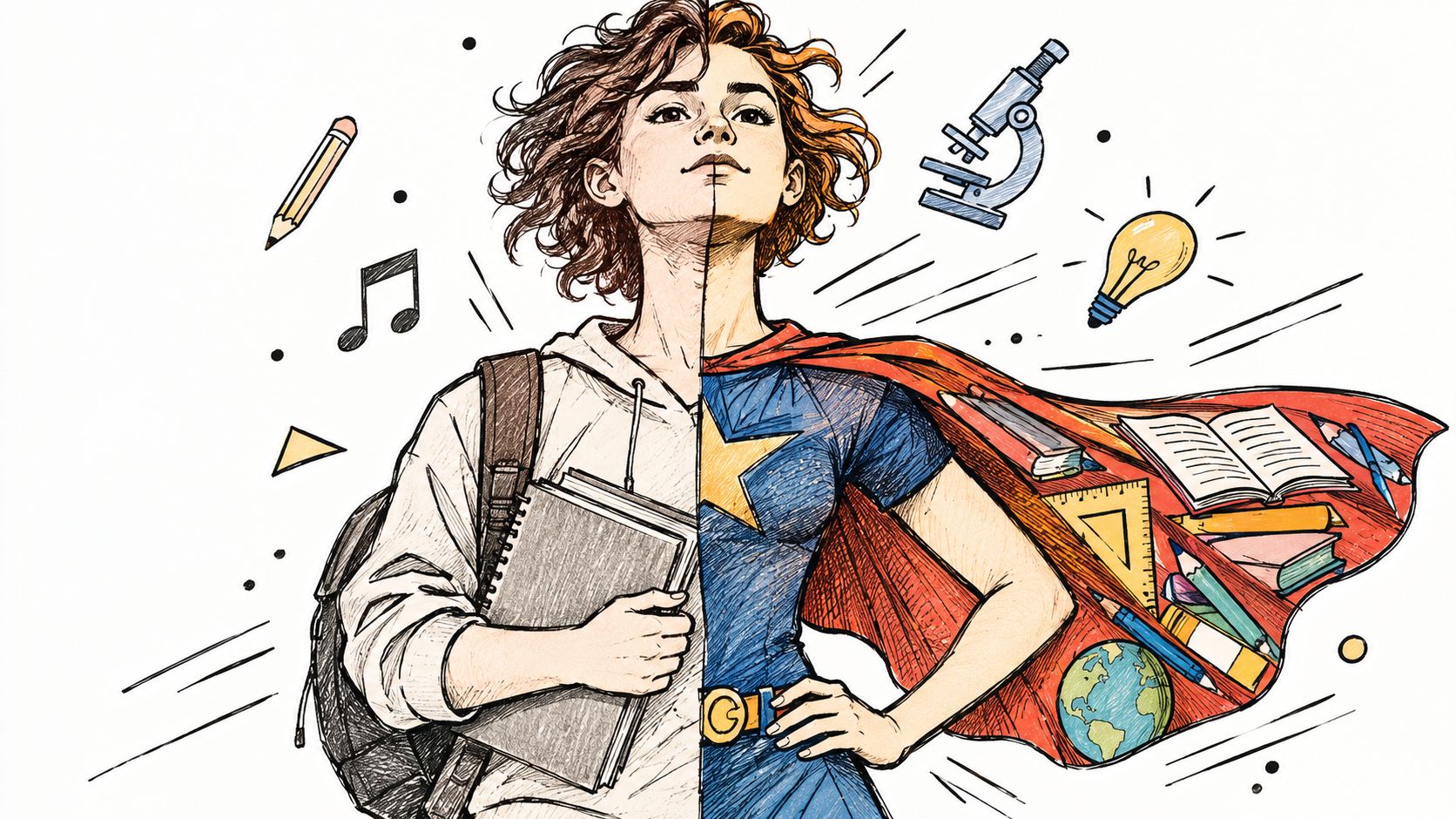
A personal hero story gives students a safe structure for writing about strengths, obstacles, decisions, and growth. The superhero element adds imagination, while the origin-story sequence keeps the narrative manageable. A student might create a hero whose “power” is explaining difficult ideas, calming tense situations, repairing objects, or noticing when someone needs help.
Start with a five-part planning frame:
- Ordinary life: Show the character in a familiar setting such as home, school, a club, or a sports practice.
- Discovery: Introduce the moment when the character recognizes a talent, value, or new responsibility.
- Training: Show practice, mistakes, feedback, or support from another person.
- First challenge: Present a realistic problem that tests the new ability.
- Hero moment: End with a choice or action that demonstrates growth.
Students can draft dialogue and captions before working on images. That order keeps the focus on narrative rather than on choosing costumes or backgrounds too early. A four-to-six-page origin story can support a class presentation, an art-program project, or a counseling activity focused on self-expression. Students who don't want to use personal experiences can invent a fictional character with a similar theme.
Production and extension
Ask students to identify one specific challenge rather than summarizing their entire life. “I was nervous about joining a new group, then I asked one question” gives the comic a visible turning point. Encourage students to use Manga or Fantasy styling if they want a stronger transformation from ordinary student to hero. Guidance on making a superhero comic can help students think about identity, character motivation, and visual change (superhero comic creation guidance).
Display finished pages in a classroom gallery or digital collection only after students choose what they're comfortable sharing. A small-group viewing session can work better than a public display for sensitive work.
Assess the sequence of events, clarity of the personal theme, character change, dialogue, and reflection. Drawing skill shouldn't determine the grade. Students can use collage, stick figures, typed captions, audio narration, or a partner illustrator.
2. Historical Event Recreation
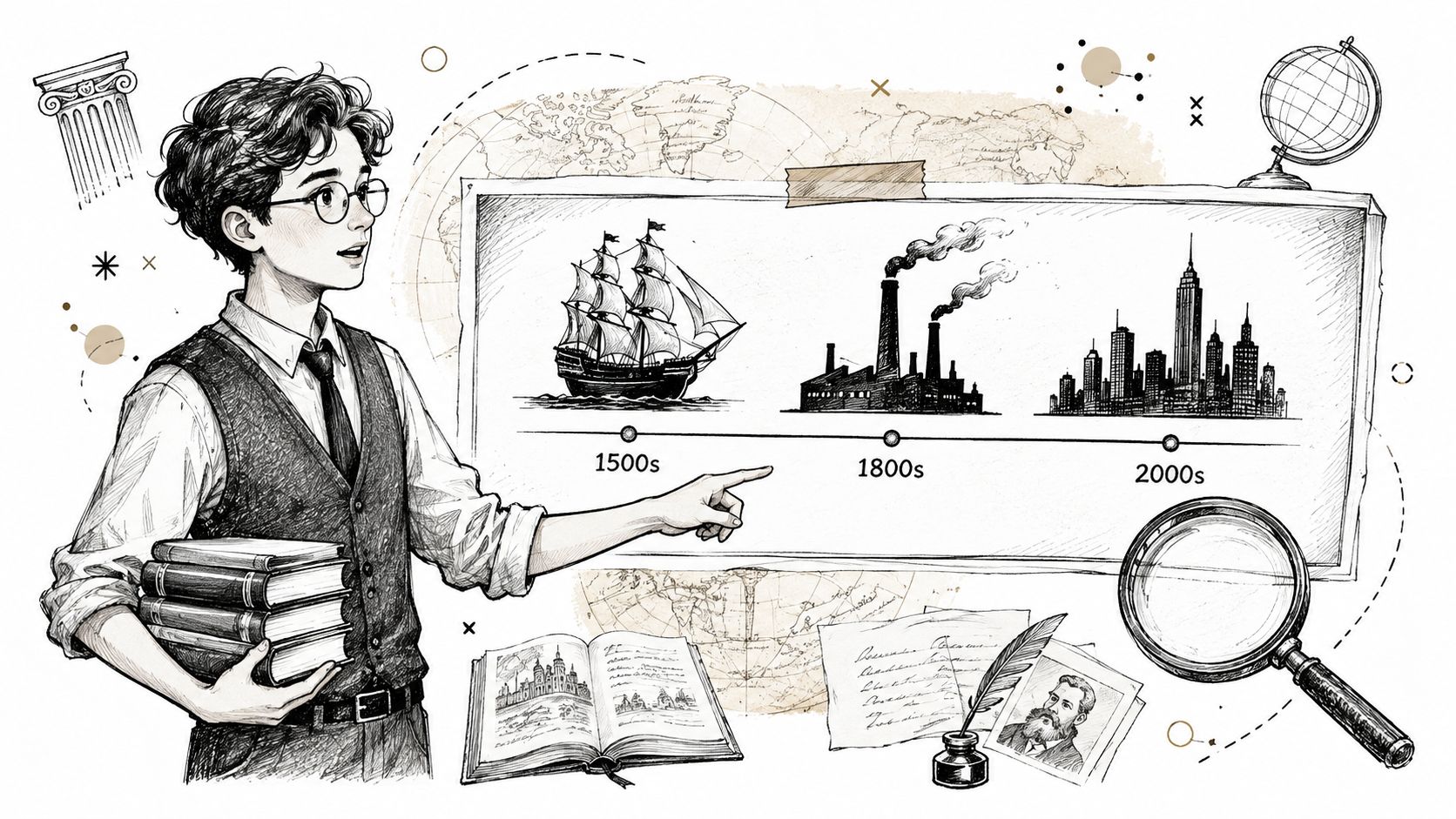
History becomes easier to discuss when students must decide what a reader needs to see, hear, and understand. Instead of copying a textbook paragraph, students reconstruct a moment through setting, sequence, character perspective, and carefully chosen dialogue. A middle school class might adapt a scene from a historical fiction novel, while a high school history class could represent a decision made during a conflict or social movement.
Begin with a source packet or a teacher-approved collection of books, archives, museum pages, and primary documents. Students should separate documented facts, reasonable interpretation, and invented connective material. For example, they can create dialogue that conveys a documented disagreement, but they shouldn't present an invented sentence as a direct historical quotation.
A useful planning page asks students to record:
- Context: What happened before this moment?
- People and interests: Who is present, and what does each person want?
- Evidence: Which details must appear for the scene to remain accurate?
- Perspective: Whose experience is centered, and whose voice is missing?
- Consequence: What changed because of this decision or event?
Make accuracy visible
Require students to place brief source notes beside panels or in an accompanying appendix. A companion paragraph can explain which details came from sources, which dialogue was condensed, and why the student selected that viewpoint. Students can also create two versions of the same event from different perspectives, then compare what each version emphasizes.
Mood boards help students establish clothing, architecture, objects, and tone before production. Style can support atmosphere, but it shouldn't replace research. A period-inspired Classic American or Noir look may shape the visual mood, while the source notes protect historical accuracy. Teachers can use narration guidance for comics to help students balance captions with dialogue and avoid placing every fact in a speech bubble.
Assess factual accuracy, use of evidence, perspective, cause-and-effect reasoning, panel order, and explanation of creative choices. If students are studying current events, use the same process with particular care around privacy, stereotypes, and emotionally difficult subjects.
3. Friend Group Adventure
This prompt works well when students need to practice collaboration without losing the pleasure of writing about familiar relationships. Groups can create a treasure hunt, time-travel story, superhero mission, or comic about a small everyday misunderstanding. The setting can be ordinary. A school hallway, bus stop, library, or cafeteria becomes engaging when the characters have a clear problem and distinct reactions.
Before anyone draws, ask each group to agree on:
- The shared premise: What happens, and why does it matter?
- The group roles: Who writes, storyboards, designs, checks continuity, and prepares the final presentation?
- The character boundaries: Which real-life details are acceptable to use?
- The decision points: Where can characters disagree, solve problems, or change direction?
Rotate roles during the project so one student doesn't control every creative decision. A student who isn't confident drawing might lead dialogue, research settings, edit captions, or manage the panel sequence. That division makes the assignment collaborative rather than a group drawing task.
Keep the humor safe
Students may want to add inside jokes or turn a friend into a villain. Set a rule that the joke must be funny with the participant, not at the participant's expense. Offer fictional antagonists, exaggerated robots, mischievous creatures, or a “misunderstood rival” instead of using a classmate's real insecurity as comic material.
Photo-based character creation requires explicit permission from every person shown. Students should be able to use invented characters, avatars, or written descriptions instead. Keep final comics in a private class gallery when the story includes personal information, and don't require students to share images outside the classroom.
The finished work could become a collaborative gift book, an end-of-year memory collection, or a serialized after-school club project. Assess shared planning, role fulfillment, respectful collaboration, character consistency, problem solving, and revision. Ask each student to submit a short contribution note describing what they created and how the group handled disagreement.
Practical rule: A collaborative comic needs individual accountability as well as a shared final product.
4. Social Issue Awareness Comic
An advocacy comic asks students to communicate responsibly, not just to make a serious topic look dramatic. The strongest projects begin with a focused question, such as “How can our school reduce food waste?” or “What can a bystander do when someone is being excluded?” Students then research the issue, identify the intended audience, and choose one action or idea for the reader to remember.
Provide a curated starting set of resources so students can approach a sensitive topic with support. Teach them to check who created each source, what evidence it uses, when it was published, and whether its language makes unsupported claims. Students can keep a research log containing the source, relevant fact, intended panel, and any question that still needs checking.
A simple four-part structure works across subjects:
- Situation: Show the problem in a specific context.
- Impact: Make the consequence understandable without exaggeration.
- Response: Introduce a practical action, resource, or change.
- Invitation: Give the audience a clear next step.
Protect students and subjects
Mental health, bullying, disability, climate issues, and public health can connect to students' lives. Offer fictional scenarios, private submissions, and alternative topics. Avoid requiring personal disclosure. When a comic addresses disability or another identity, ask students to examine whether the characters have agency, varied personalities, and respectful language.
Peer review should happen before publication or display. Reviewers can check accuracy, tone, readability, representation, and whether the proposed action is realistic. A Graphic Novel or Noir style may suit a serious subject, but visual intensity shouldn't overshadow evidence.
Assess content accuracy, source quality, audience awareness, ethical representation, persuasive structure, and visual clarity. A short presentation can require students to explain why they selected their message and how they revised it after peer feedback.
Independent classroom resources show comics being used for retelling, math, science, and social studies, making this format suitable for more than language arts (TeachersFirst comics resources). The teacher's main job is to supply the scaffolding that generic prompts often omit.
5. Career Exploration Comic
Students often know a job title before they understand the work behind it. A career comic turns an abstract aspiration into a sequence of tasks, decisions, setbacks, and skills. A student interested in software development might show a team defining a problem, testing a prototype, responding to a user, and improving the result. Another student might explore nursing, carpentry, animation, environmental science, culinary work, or emergency services.
Give students a research template with space for:
- Typical responsibilities: What does the person do?
- Work environment: Where and with whom do they work?
- Skills: Which technical and interpersonal abilities matter?
- Preparation: What education, training, practice, or experience can help?
- Challenges: What makes the work demanding?
- Meaning: Who benefits from the work, and what satisfaction might it provide?
Students shouldn't portray a career as a perfect day with no uncertainty. Encourage a non-linear path. A character might try one course, discover a different interest, receive advice, and move toward a new role. That structure helps students see career planning as exploration rather than a single irreversible choice.
Bring real voices into the process
Invite local professionals, family volunteers, career counselors, or college staff to provide job descriptions and answer student questions. If a guest can't visit, students can work from an approved interview transcript or public career resource. Ask professionals to respond to finished comics by identifying accurate details and correcting misconceptions.
Use a Professional or Graphic Novel style when students want a realistic tone. Visual labels can show tools, qualifications, workplace routines, and transferable skills without filling every panel with exposition. A class gallery can group comics by interests, such as health, technology, creative work, trades, public service, and business.
Assess research accuracy, understanding of responsibilities, realistic portrayal of challenges, communication of preparation requirements, and thoughtful reflection. Students can add a final panel explaining what they learned and what question they still have.
6. Book and Movie Adaptation Comic
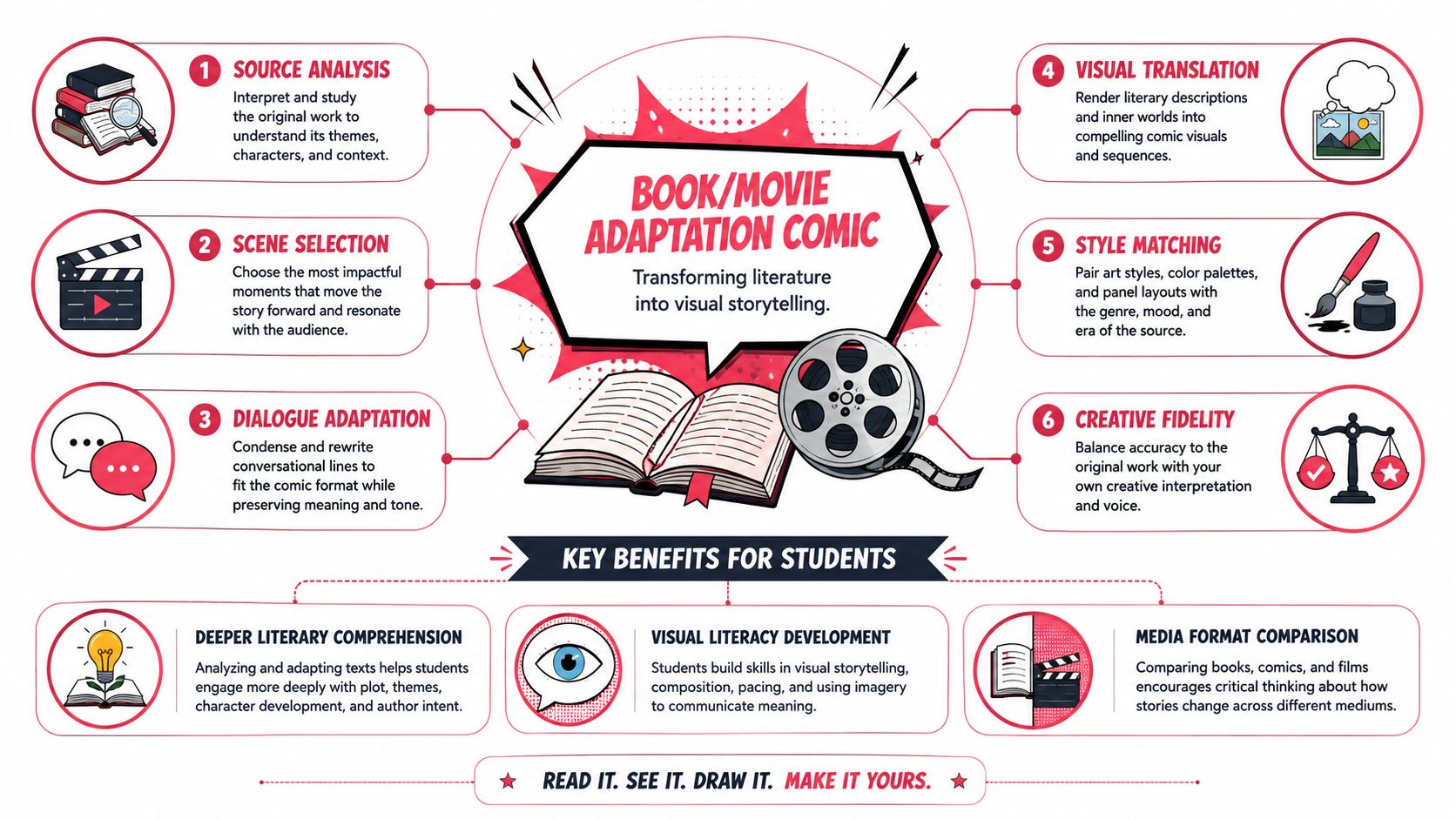
Adaptation forces students to make choices. A novel, play, or film can spend pages establishing a setting or revealing a character's thoughts, while a comic may need one image, a caption, or a carefully written line of dialogue. Students learn that changing media means changing technique, not merely shortening the original.
Start with close reading or viewing. Ask students to mark scenes that contain a decision, conflict, reversal, discovery, or emotional shift. They should choose a scene small enough to develop fully, rather than attempting to summarize an entire book in a few crowded panels.
A planning sequence might look like this:
- Select: Identify the scene and explain why it matters.
- Condense: Remove repeated information while protecting the central conflict.
- Visualize: Decide which details can be shown instead of explained.
- Script: Write captions, dialogue, sound effects, and panel directions.
- Compare: Explain what changed from the original and why.
Make the adaptation accountable
Students can adapt Shakespeare, a short story, a scene from a class novel, or a public-domain work. For copyrighted books and films, keep the project within the school's educational-use policies and don't present student adaptations as replacements for the original. A written reflection should identify the source, explain scene selection, and discuss at least one change in pacing, dialogue, setting, or point of view.
Invite students to create different adaptations of the same scene. One group might emphasize comedy, another suspense, and another a minor character's perspective. The comparison discussion becomes an assessment of interpretation rather than artistic polish.
Match the visual approach to the source only when it supports meaning. Noir may reinforce a dark mystery, while watercolor may suit a reflective or poetic scene, but students can also deliberately contrast style and content. Display the original excerpt beside selected panels so readers can see how words and images share the work.
Assess close reading, fidelity to the central meaning, purposeful condensation, visual interpretation, dialogue, and written explanation.
7. Fantasy Worldbuilding Comic
A fantasy comic gives students room to design a setting, but unlimited freedom can make the assignment difficult to finish. Start with one scene and require the world to reveal itself through action. A character who crosses a bridge, bargains with a creature, repairs a machine, or enters a restricted district can show geography, culture, rules, and conflict without a long information dump.
Students can prepare a compact world guide containing:
- Place: What does the environment look, sound, and feel like?
- Rules: How does magic, technology, or another unusual system work?
- Community: What do people value, fear, celebrate, or protect?
- Power: Who makes decisions, and who is excluded?
- Conflict: What problem forces the main character to act?
- Cost: What does the character risk by using a power or breaking a rule?
Ask students to write the rules before writing the climax. If a character can solve every problem with unlimited magic, the story loses tension. A clear cost, limitation, or social consequence creates meaningful decisions.
Build consistency through revision
A visual map can establish routes, borders, neighborhoods, or important locations. Character origin stories can connect personal goals to the world's history. In a creative writing class, students might serialize the project across several short installments. In a game design club, the comic can serve as the origin story for a game setting. Art students can develop a small world bible with symbols, costumes, architecture, and creature references.
Peer review should focus on internal consistency. Reviewers can ask whether the setting's rules stay stable, whether characters understand the world differently, and whether the conflict grows from the world rather than being placed on top of it. Fantasy and Cyberpunk styles can create distinct visual identities, but students working on paper can achieve the same effect through repeated shapes, color choices, labels, and panel composition.
Assess world coherence, character motivation, conflict, use of visual setting, originality, and revision. Students who find large-scale worldbuilding overwhelming can create one location, one rule, and one problem.
8. Dialogue-Driven Comedy Strip
Comedy strips give students a precise writing problem: make a reader understand the situation, recognize the character's voice, and reach the punchline in a small number of panels. Action can be minimal. The humor may come from a misunderstanding, an overly literal response, a failed plan, or an ordinary school routine taken too seriously.
Begin with a list of situations rather than finished jokes. Students might collect moments involving forgotten homework, confusing instructions, group-project roles, cafeteria choices, or a character who treats a minor inconvenience as an epic crisis. Then they can test several structures:
- Setup and punchline: Establish an expectation, then overturn it.
- Misdirection: Lead the reader toward one interpretation before revealing another.
- Wordplay: Use a phrase with two meanings.
- Escalation: Repeat a small problem until it becomes absurd.
- Character contrast: Put two people with incompatible reactions in the same situation.
Students should write the dialogue aloud. Spoken language often reveals sentences that are too long or voices that sound identical. They can storyboard pauses, reaction shots, silence, and the final panel before choosing a visual style. Guidance on writing effective comic dialogue can support lessons on voice, pacing, and speech-bubble economy.
Make the humor inclusive
Set clear boundaries around protected characteristics, appearance, disability, family circumstances, and personal mistakes. Observational humor about shared routines is usually safer than humor that targets a classmate. Students can invent recurring characters, which lets them develop familiar voices across a series for a newspaper, literary magazine, improv club, or classroom collection.
Peer feedback should ask three practical questions: Where did the reader understand the situation? Where did the timing slow down? Did the punchline depend on mocking someone? Assess dialogue quality, character voice, pacing, panel order, audience awareness, revision, and respectful humor.
8 Comic Strip Ideas Comparison
| Prompt Title | Implementation complexity | Resource requirements | Expected outcomes | Ideal use cases | Key advantages |
|---|---|---|---|---|---|
| Personal Hero Origin Story | Medium, photo-to-character workflow and narrative scaffolding | Student photos, privacy consent, story templates, art-style presets | Self-reflection, narrative structure, visual communication, SEL | English classes, art programs, orientation, counseling | Highly engaging; personal and confidence-building |
| Historical Event Recreation | Medium–High, research and accuracy checks needed | Reliable sources, citation templates, teacher fact-checking, period art styles | Historical comprehension, research synthesis, causal sequencing | History, literature, social studies, AP courses | Deepens understanding; strong assessment tool |
| Friend Group Adventure | Medium, coordination among multiple participants | Multiple photo consents, group storyboard time, collaboration templates | Collaboration, communication, group storytelling, social bonding | After-school programs, camps, bonding activities, clubs | Builds teamwork; produces memorable keepsakes |
| Social Issue Awareness Comic | High, sensitive content requires careful facilitation | Curated resources, fact sheets, peer review, age-appropriate filters | Persuasive communication, civic engagement, critical research | Health, environmental science, student leadership, community service | Promotes advocacy; creates shareable awareness materials |
| Career Exploration Comic | Medium, needs accurate career research and guest input | Career databases, interview templates, professional contacts, templates | Career awareness, planning, portfolio pieces, professional literacy | Career counseling, guidance programs, STEM outreach, vocational ed | Makes career paths tangible; supports future planning |
| Book/Movie Adaptation Comic | Medium, requires adaptation judgment and copyright care | Source texts/films, adaptation guidelines, reflection prompts | Literary analysis, visual literacy, cross-media interpretation | English/literature, film studies, book clubs, ESL programs | Deepens comprehension; develops media translation skills |
| Fantasy World Building Comic | High, long-form consistency and complex planning | Worldbuilding templates, extended project time, peer review, serial format | Complex storytelling, systems thinking, creative writing portfolio | Creative writing, advanced art, game design, enrichment camps | Unlimited imagination; strong portfolio/series potential |
| Dialogue-Driven Comedy Strip | Low–Medium, writing-focused with short format | Joke frameworks, examples, quick iteration tools, peer feedback | Dialogue writing, comedic timing, character voice, brevity skills | Creative writing, improv clubs, journalism, ELA, literary magazines | Accessible format; rapid iterations emphasize writing craft |
From Prompt to Polished Classroom Comic
Choose the prompt by starting with the learning objective, not the art style. If students need self-reflection, use the hero origin story. If they need evidence and perspective, choose historical recreation or social issue awareness. For collaboration, use the friend adventure. Career exploration fits advisory and counseling programs, while adaptation supports close reading. Worldbuilding suits creative writing and design, and dialogue-driven comedy gives language learners and writers a focused way to practice voice and timing.
Age, time, and privacy should shape the assignment. Younger students may need a short sequence with sentence starters and pre-drawn panels. Older students can handle source notes, multiple perspectives, career interviews, or an adaptation reflection. A short paper strip may be enough for a single lesson, while a multi-page comic needs checkpoints. Students shouldn't have to use personal photographs. Offer fictional characters, avatars, collage, typed panels, audio narration, or a partner role for students with limited drawing confidence, language barriers, motor differences, or other learning needs.
A repeatable workflow keeps any prompt under control:
- Define the objective: Write what students must demonstrate, such as cause and effect, source use, dialogue, or collaboration.
- Set the scope: Choose a panel, strip, or page limit that matches the available time.
- Draft the premise: State the main character, situation, conflict, and desired change.
- Write dialogue first: Keep speech purposeful and separate facts that belong in captions.
- Storyboard the sequence: Check that every panel advances the action or reveals information.
- Create the pages: Draw, collage, use classroom software, or work with an approved digital tool.
- Revise: Check clarity, accuracy, representation, spelling, bubble placement, and continuity.
- Share appropriately: Use a private gallery, small-group presentation, class anthology, or opt-in display.
A compact rubric can assess narrative structure, content understanding, visual sequencing, dialogue and captions, revision, and responsible collaboration. Weight the categories according to the objective. A history comic should prioritize evidence and accuracy, while a comedy strip should give more attention to voice and timing. Keep visual polish separate from drawing skill, and let students explain choices that aren't obvious from the final page.
PersonalizedComics is one optional way to streamline character and page creation. The platform offers eight art styles, including manga, classic American, graphic novel, noir, watercolor, cyberpunk, retro pop, and fantasy. Students can create characters from photos or text descriptions, then outline plot, settings, and dialogue for illustrated pages with panels, speech bubbles, sound effects, and narration. Signing up creates a free three-page preview comic, and the credit-based model doesn't require a subscription. Credits correspond to pages, and users can order optional high-quality physical comic books. Teachers should review the platform's privacy practices, obtain consent before using student images, and provide an equivalent non-photo workflow.
A successful classroom comic isn't defined by elaborate artwork. It gives students a clear audience, a manageable sequence, a meaningful problem, and a reason to revise. Start with one prompt, set a small scope, and let the finished pages show what students understand.
PersonalizedComics can help students turn original characters, classroom scenarios, research topics, and adapted scenes into illustrated comic pages without requiring drawing skills. Explore its eight styles, text or photo-based character creation, a free three-page preview for new users, non-subscription credit model, and optional printed books by visiting PersonalizedComics.
Filed under Comic Craft