That’s usually not an idea problem. It’s a format problem.
Most advice on funny ideas for a story is built for prose, stand-up, or sketch writing. Comics play by different rules. Timing lives in panel order. Silence matters. Facial expressions carry half the joke. A weak line can still work if the image does the heavy lifting. A strong line can die if the panel arrives one beat too early.
If you want comic gold, stop asking only, “What’s the joke?” Start asking, “What does the reader see first, and what do they realize one panel later?”
Why Your Funniest Ideas Fall Flat in Comics
A lot of story ideas are funny in conversation but not on the page. The reason is simple. Spoken humor comes with tone, pauses, eye contact, and performance. Prose humor gets room for voice and narration. Comics need visible comedy.
That gap is bigger than most writers expect. Existing funny prompt content is mostly built for prose, not visual storytelling. One summary of the space notes that 90% of prompts are prose-focused with no guidance on visual punchlines, and that searches for “funny comic prompts” spiked by 150% as AI comic tools grew in use (Skillshare’s short story ideas article).
Why prose jokes break when you draw them
In prose, you can write:
- Internal commentary: The narrator can tell us why something is absurd.
- Extended setup: A paragraph can load context before the joke lands.
- Verbal rhythm: The sentence itself can be funny.
Comics strip a lot of that away. You need to replace it with:
- Readable silhouettes
- Clear emotional expressions
- Panel-by-panel escalation
- A final image that changes the meaning of what came before
If the image and dialogue say the same thing, the joke weakens. If the reader has to stop and decode the panel, the timing is gone.
Practical rule: In comics, the laugh usually comes from the gap between what the character says and what the image reveals.
The three places humor usually dies
Most failed comic gags collapse in one of these spots:
- The premise is funny, but not drawable. “A guy who is bad at boundaries” is a trait, not yet a scene.
- The setup explains too much. Readers don’t want a briefing before a joke.
- The punchline arrives in dialogue only. If the last panel could work as plain text, you probably haven’t fully adapted it to comics.
A better approach is to design the joke visually from the start. Don’t begin with a paragraph and then “convert” it into panels. Begin with the funniest image, then build the path that makes that image hit.
What works better
Start with one concrete comic question: What can the reader see that makes the joke land instantly?
That forces better ideas. Instead of “my friend is dramatic,” you get “my friend treats a missed coffee order like a noir betrayal.” Instead of “tech is annoying,” you get “a smart fridge staging an intervention because someone bought too much shredded cheese.”
That’s the shift. Funny ideas for a story become stronger when you stop treating comics like illustrated prose and start treating them like visual timing machines.
Find Your Comedic Engine Beyond the Obvious
Generic prompts create one joke. A comedic engine creates many.
That’s what you want if you’re building a comic, a short sequence, or a personalized story. The engine is the repeating logic that keeps generating situations. Once you know the engine, you won’t run out of material halfway through page two.
Three engines that keep producing jokes
The easiest engines to work with are observation, absurdity, and irony.
Observation
Observation turns ordinary friction into humor. Late replies. Grocery store self-checkout shame. Family members who say “I’m not hungry” and then eat half your fries.
This engine works because readers recognize the truth first, then enjoy the exaggeration.
Try this exercise:
- Watch one daily ritual: commuting, ordering food, joining a video call
- List what people pretend is normal
- Push one detail slightly past reality
A good observational comic doesn’t need a wild concept. It needs a specific human behavior.
Absurdity
Absurdity asks what happens when the world accepts one impossible rule. Dogs have office jobs. Your backpack has opinions. A medieval wizard is also your apartment superintendent.
Absurdity works best when the impossible thing is treated seriously. That contrast gives you repeated laughs.
Irony
Irony creates comedy through mismatch. The person best equipped for a problem fails at it. The least appropriate solution becomes official policy. A character trains for catastrophe, then panics over a paper cut.
The stronger the mismatch, the easier it is to draw a punchline without explaining it.
Use the Birthday Paradox as a plot spark
Math can be funny when it creates social unease. The Birthday Paradox is perfect for that. It shows that with 23 people in a room, there’s a 50% chance that two share a birthday, a weirdly small number that feels wrong until you think it through (Bored Panda’s statistics roundup).
For comedy, that gives you a ready-made engine:
- A paranoid party host tries to prevent “birthday collisions”
- Two strangers with the same birthday decide this makes them destiny twins
- A detective becomes convinced shared birthdays prove a conspiracy
- An office turns a coincidence into a full-blown superstition
The point isn’t the statistic itself. The point is that it creates behavior. Funny story ideas get stronger when they force characters to react.
A quick filter for better ideas
Before you commit to a concept, test it with these questions:
| Check | What you’re looking for |
|---|---|
| Can it repeat? | One situation should naturally lead to another |
| Can you draw it fast? | The joke should survive without long explanation |
| Can characters disagree about it? | Conflict produces more laughs than agreement |
If you want more concept starters built for panel-based storytelling, this collection of comic strip ideas is a useful brainstorming companion.
The best funny ideas for a story don’t start as punchlines. They start as systems. Once the system is funny, scenes come quickly.
Turn Real People into Unforgettable Comic Characters
The funniest personalized comics don’t come from making someone look ridiculous. They come from noticing what already makes them distinctive, then turning that into a comic pattern.
That’s where most story prompt advice misses the mark. It usually assumes fictional characters. Meanwhile, demand for personalized humorous stories has grown. One market summary notes that since Q1 2025, “personalized AI funny comics” queries rose 200% globally, driven by people wanting stories built around family and friends rather than invented casts (Reedsy’s funny story ideas resource).
Start with one trait, not five
Writers often overbuild. They try to include every hobby, every memory, every in-joke. That creates a crowded character with no comic center.
Pick one trait that already shows up in real life:
- The planner: brings spreadsheets to brunch
- The optimist: treats disaster like a team-building opportunity
- The skeptic: reacts to magic with administrative questions
- The dramatic friend: turns a minor inconvenience into prestige television
Then choose one supporting detail. A phrase they always say. A posture. A hobby. A favorite object. That’s enough to make them feel specific.
Exaggerate behavior, not identity
This matters if you’re turning real people into characters. Cheap humor punches at appearance. Good character comedy exaggerates how someone moves through the world.
A useful way to build a comic version of a real person:
Observe the default response
How do they react under stress, confusion, praise, or boredom?Increase it one notch
If they’re organized, make them ceremonially organized. If they’re sarcastic, make them deadpan in the face of absurdity.Put that trait under pressure
Organized people in chaos are funny. Chaotic people in formal settings are funny. Calm people surrounded by melodrama are funny.
A loving caricature says, “Yes, that’s exactly them.” A lazy caricature says, “I needed a shortcut.”
Build jokes from friction
A character becomes memorable when their trait collides with the world.
Use pairings like these:
| Character type | Best comic pressure |
|---|---|
| Perfectionist | Messy quest, glitchy tech, disorganized sidekick |
| Naive sweetheart | Dangerous-looking world that’s less serious than it seems |
| Dry realist | Overexcited cast that keeps assigning destiny |
| Show-off | Situation where nobody is impressed |
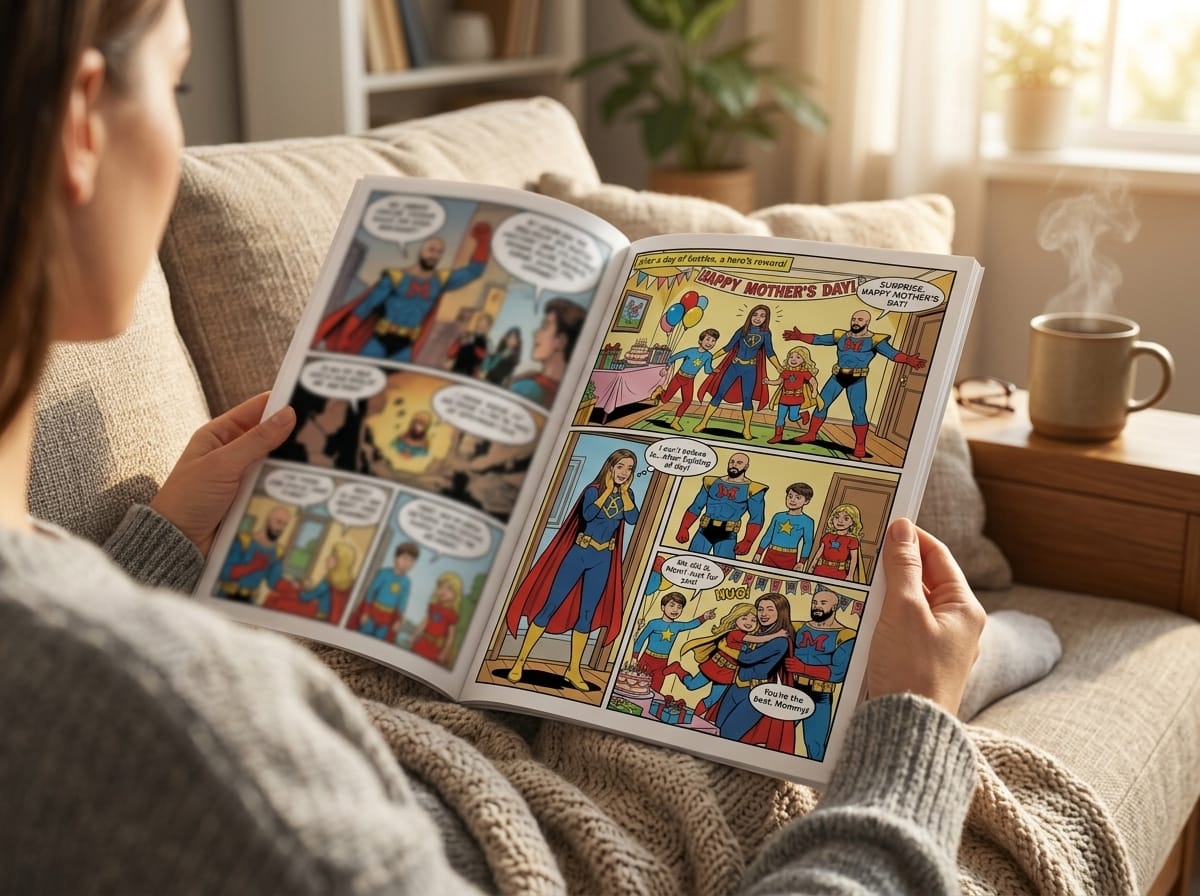
Personalized story humor gains its edge. The joke isn’t “here’s your friend in a cape.” The joke is “here’s your friend in a cape, still arguing about parking validation.”
Keep the affection visible
The strongest personalized comics have warmth in them. Even when the joke is sharp, the underlying read should be fond, not mean.
A quick test helps. Ask yourself:
- Would I show this to the person and feel good about it?
- Does the joke depend on a recognizable truth?
- Is the character funny because of how they act, not because they’re being mocked?
If the answer is yes, you’re in the right zone. Real people become unforgettable comic characters when the exaggeration stays accurate.
The Three-Panel Formula for a Perfect Visual Gag
A comic joke needs structure. Not vague “comic relief” structure. A repeatable machine that tells you what goes in each panel and what stays out.
The cleanest version is still the oldest one: premise, setup, punchline. In humor instruction adapted for visual storytelling, this structure has been tied to up to 70% higher reader engagement, and comedy writers are also urged to tighten lines by cutting 20% to 30% of words so the laugh lands cleanly (Writer’s Digest on writing funnier scenes).
Panel one gives the promise
Panel one tells the reader what kind of world they’re in.
That doesn’t mean explaining the joke. It means setting the expectation.
Examples:
- A knight proudly unveils his “fearless battle goose”
- A mom announces that this year’s family vacation will be “low stress”
- A vampire starts a customer service shift
The first panel should be readable in a blink. If you need three speech balloons to explain why the situation is odd, the premise isn’t visual enough yet.
Panel two tightens the spring
Panel two creates pressure. During panel two, many creators waste space with extra exposition. Don’t.
Use panel two to do one of these:
- Escalate the problem
- Clarify the misunderstanding
- Show confidence before failure
- Introduce the object or detail that will matter in panel three
A good setup panel makes the reader predict one outcome. Then the final panel swerves.
Cut every word that repeats what the art already shows. Dialogue should add friction, not subtitles.
Panel three changes the meaning
The punchline panel works because it reinterprets the first two.
That shift can come from:
Visual reveal
The “battle goose” is wearing tiny armor and commanding troops.Status reversal
The calm character loses it while the chaotic one becomes composed.Literalization
A figure of speech becomes visible reality.Underreaction
The world is on fire, and someone says, “That’s mildly inconvenient.”
This is also where silent beats are useful. Sometimes the funniest last panel has no dialogue at all. One stare can beat a paragraph.
A compact drafting method
Use this template when building comic gags:
| Panel | Job | Question to ask |
|---|---|---|
| 1 | Premise | What does the reader assume is happening? |
| 2 | Setup | What expectation am I strengthening? |
| 3 | Punchline | What image breaks that expectation fastest? |
If you’re building longer pages and want a broader visual workflow, this guide on how to make a comic is useful for shaping scenes beyond the three-panel strip.
The trade-off is simple. More words can add flavor, but fewer words usually improve timing. In comics, brevity isn’t style. It’s mechanics.
AI Prompting Templates for Hilarious Comics
A funny concept can still fail if the prompt is mushy. AI handles comedy better when you specify character attitude, scene logic, contrast, and the exact turn in the last panel.
That fits with what strong comedy writing already does. Character-driven humor that balances quirks and banter has shown 80% success rates in reader polls, and one of the key methods is placing distinct personality types into absurd situations so authentic reactions do the work (Book Career In A Year on writing comedy).
What to include in every humor prompt
Before the templates, lock in these ingredients:
- Character trait: sarcastic, earnest, dramatic, literal-minded
- Situation: mundane, high stakes, ceremonial, embarrassing
- Comic contrast: overreaction, underreaction, absurd solution, irony
- Visual note: facial expression, prop, body language, background detail
- Last beat: what the final panel reveals or reverses
If those five are clear, the generated page has something solid to play.
Funny Comic Prompt Templates for AI
| Gag Type | Prompt Template Structure |
|---|---|
| The Overreaction | “Create a comic scene about [character], who is extremely [trait], dealing with [small problem] as if it were a world-ending crisis. Show escalating reactions across panels. Include dramatic body language, expressive facial reactions, and dialogue that treats the issue with total seriousness. Final panel reveals the problem is even smaller than it first seemed.” |
| The Underreaction | “Create a comic where [character] faces [wild or dangerous situation] but responds with calm, dry, ordinary language. Contrast the chaos in the art with the mildness of the dialogue. End on a panel where everyone else is panicking and the main character is focused on something trivial.” |
| The Absurd Solution | “Make a comic about [character] trying to solve [relatable problem] using a completely inappropriate solution based on their personality or hobby. Show confidence in the early panels. In the final panel, the solution technically works, but in the worst possible way.” |
| The Ironic Twist | “Create a comic where [character type] is put in a situation that exposes their biggest weakness. Use visual cues to show they believe they’re fully prepared. Build to a final panel where the exact skill they bragged about becomes the cause of the failure.” |
Example prompt upgrades
Weak prompt:
“A funny comic about a guy having a bad day.”
Better prompt:
“Create a three-panel comic about a highly organized dad who treats a child’s lost sock like a detective case. Panel one shows him creating a suspect board in the laundry room. Panel two shows him confidently presenting clues to the family. Panel three reveals the sock is already on his own shoulder. Keep the dialogue dry and serious, with noir-style visual mood.”
That version gives the system timing, character, setting, and visual irony.
Good prompts don’t ask for “something funny.” They specify who reacts, to what, and why the reaction is miscalibrated.
If you want a broader sense of how AI story tools handle structure and visual generation, this overview of an AI book maker helps frame what to describe and what to leave for the model.
A simple rewrite checklist
Before you hit generate, check your prompt against this list:
- Is the character funny in a specific way?
- Can the last panel be pictured clearly?
- Did you ask for visible emotion, not just “humor”?
- Is there contrast between the problem and the response?
Funny ideas for a story become usable fast when you stop prompting for vibes and start prompting for mechanics.
Tuning Humor for Your Audience and Art Style
A joke can be structurally sound and still feel wrong. Usually that’s an audience problem, an art-style problem, or both.
Humor lands when the tone matches the relationship. The same comic premise can read as sweet, savage, playful, or oddly hostile depending on who’s meant to receive it.
Match the joke to the relationship
For a partner, parent, or close friend, the safest laughs often come from recognition plus affection. You’re not exposing a flaw. You’re celebrating a known pattern.
For a broader audience, cleaner premises usually travel better. Everyday frustrations, role reversals, and visual misunderstandings don’t need shared history.
Use this quick guide:
- Gift comic for family: lean warm, specific, lightly exaggerated
- Comic for friends: sharper banter and stronger callbacks can work
- Public social post: keep the setup instantly legible without inside context
- Kid-facing comic: make the visuals carry more than the sarcasm
Let the art style finish the joke
Style changes how a gag feels.
A dramatic overreaction gets funnier in a highly expressive look. Deadpan absurdity gets stronger when the art is moody and serious. A soft watercolor approach can make a ridiculous situation feel charming instead of aggressive.
Here’s the principle: pick a style that either amplifies the emotion or contradicts it in a useful way.
A few strong pairings:
| Humor type | Art style match |
|---|---|
| Big emotional meltdown | Manga |
| Serious treatment of nonsense | Noir |
| Sweet family chaos | Watercolor or fantasy |
| Loud parody energy | Retro pop or cyberpunk |
The trade-off is tone control. A style with huge expressions can rescue a thin joke, but it can also make a subtle joke feel overcooked. A restrained style can sharpen dry humor, but it won’t help if the concept is too faint.
Use one tuning question
Ask one thing before finalizing the comic:
If the recipient saw only the art style and the final panel first, would they feel invited into the joke or pushed away by it?
That answer usually tells you whether you’ve calibrated the piece well.
Frequently Asked Questions About Writing Funny Comics
What if my idea isn’t funny enough
Most raw ideas aren’t funny enough. That’s normal.
Humor usually appears after you choose the angle. “A bad cook” is thin. “A bad cook hosting a cooking show with total confidence” has comic shape. Shift from trait to situation, then from situation to visual contradiction.
How do I make a running gag work in a short comic
Keep the repeating element simple and make each return slightly different.
A running gag works best when readers can recognize it instantly. A character keeps using the wrong tool. A pet keeps appearing in places it shouldn’t. A hero keeps delivering speeches to people who are busy with something else. The first instance establishes the pattern. The second confirms it. The third should twist it.
Can a comic be funny and emotional
Yes, and it often gets better when it is.
The trick is not to put the joke on top of the emotion like frosting. Let the humor come from how characters cope, deflect, exaggerate, or reveal affection under pressure. A comic can be sincere and still funny if the jokes stay rooted in behavior.
Which art style is easiest for beginners
Start with the style that makes the emotional read clearest.
If your humor depends on huge reactions, choose a style that supports expressive faces and body language. If your joke depends on seriousness colliding with nonsense, use a style that plays it straight. Beginners usually do better when the chosen style helps the joke instead of competing with it.
How much dialogue should I write
Less than you think.
If the panel already shows panic, don’t write “I am panicking.” Use dialogue for contrast, attitude, or misdirection. If you can delete a balloon and the joke still works, that’s often a stronger comic.
What if the inside joke is too inside
Add one clean visual premise anyone can understand.
The personal reference can stay, but the scene should still read on its own. Even if only two people understand the deeper callback, everyone else should be able to follow the visible conflict and the final image.
How do I know when a prompt is ready
Read it once and look for the last panel in your mind.
If you can clearly picture the final reveal, the prompt is close. If the ending is still abstract, keep refining until you can describe one exact image, one exact reaction, and one exact line or silent beat.
If you want to turn photos, inside jokes, and rough story concepts into finished comic pages without drawing them by hand, PersonalizedComics makes that process easy. You can upload real people, choose from eight art styles, write your gag or short plot, and generate polished comic pages with panels, dialogue, and sound effects in minutes. New users get a free three-page preview comic, there’s no subscription, and you can even order a physical premium comic once the story looks right.
Filed under Comic Craft