It might be a birthday gift where your partner becomes the hero. It might be a funny story from a family trip. It might be a fantasy world you've been carrying around for years, except every time you think about making it, the same thought shuts it down: I can't draw.
That thought stops a lot of people before they begin. It also obscures the true skill behind comics. A comic is not a drawing contest. It's a storytelling format. You combine scenes, dialogue, pacing, and emotion so a reader moves through a moment exactly the way you intended.
If you're learning how to make a comic, start there. Start with the story, not the sketchbook.
Your Story Deserves to Be a Comic
A comic can hold things that plain prose sometimes can't. A raised eyebrow. A pause before a confession. A ridiculous costume. A silent panel that lands harder than a paragraph.
That's why comics work for so many kinds of ideas. They can carry jokes, memories, romance, action, and even hard subjects that would feel dry in another format.
Comics aren't just for superheroes
A lot of beginners think a comic has to be big and dramatic. It doesn't.
A comic can be:
- A personal gift for an anniversary or graduation
- A family story told from a child's point of view
- A classroom explainer that makes a hard topic less intimidating
- A short joke strip built around one strong punchline
- A prototype for a larger graphic novel
Comics also have a long record as serious teaching tools. The Cartoon Guide to Statistics, first published in 1993, helped make college-level topics like probability and regression easier to understand through humorous illustrations, showing how effective comics can be for learning, as noted in this review of The Cartoon Guide to Statistics.
That matters for first-time creators. If comics can help people understand difficult academic material, they can help you tell a heartfelt story or a funny one.
Communication is the Primary Job
When beginners say, "I can't draw," they're worrying about polish.
Readers care more about clarity.
They want to know:
| What the reader needs | What creates it |
|---|---|
| Who is this about? | A clear main character |
| What is happening? | Simple scene choices |
| How should I feel? | Expressions, pacing, dialogue |
| Where do I look next? | Good panel flow |
A stick figure with the right expression can be more effective than a beautifully rendered character doing nothing important.
Practical rule: If the emotion reads and the sequence is clear, your comic is already doing its job.
Start smaller than your imagination
Many first comics fail because the creator picks a giant story first.
A better starting point is one of these:
- One moment: "The day we got lost on vacation"
- One joke: "My cat believes she's the landlord"
- One transformation: "A friend becomes a sci-fi captain"
- One lesson: "How to survive your first day at college"
That's enough for a real comic.
You don't need industry training to make one. You need a story spark, a plan, and a way to turn that plan into panels. That's where most tutorials lose non-artists. They jump straight into anatomy, perspective, and rendering. You don't need any of that to begin.
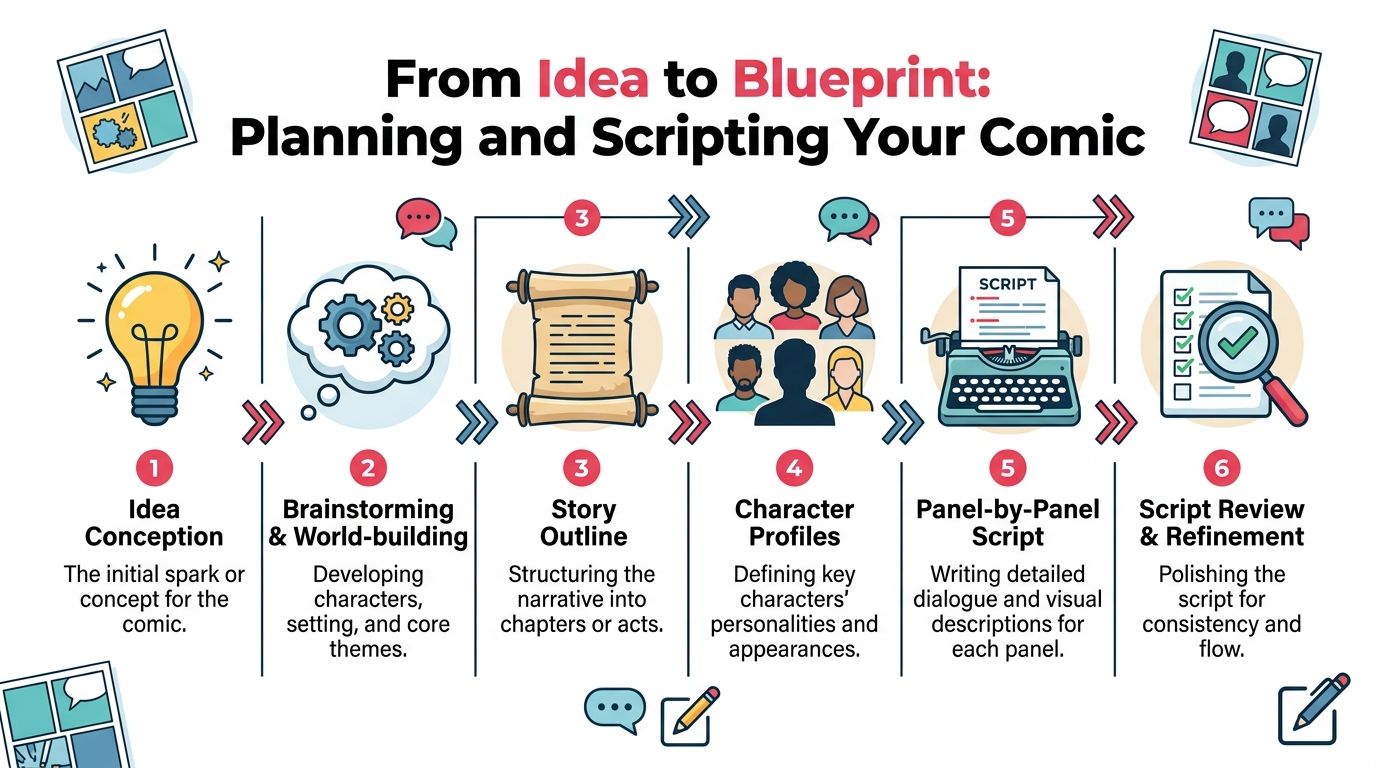
From Idea to Blueprint – Planning and Scripting Your Comic
Most unfinished comics don't fail because of weak ideas. They fail because the creator starts drawing too early.
A script gives your comic shape before you spend time on visuals. It answers the hard questions while changes are still easy. Who's in the scene? What does each page need to do? Where does the story start, turn, and end?
Professional experience shared in this comics scripting guide argues that starting with a complete script can increase completion rates by an estimated 3000%, because it prevents the common problems that cause 90% of amateur comics to stall after the initial concept phase.
Use a simple three-part spine
You don't need a complicated plotting system for your first comic. Use this:
Motivation and question
Show what your character wants and what problem exists.Methodology
Let the character act. They try something, fail, improvise, or discover something.Results
Show the outcome. Even a joke comic needs a payoff.
That structure works because it creates movement. A comic feels satisfying when something changes between the first panel and the last.
Here's a plain example for a short comic gift:
| Part | What happens |
|---|---|
| Motivation and question | A friend says they've always wanted to be a superhero |
| Methodology | They try "training" in everyday life, carrying groceries like mission gear, leaping puddles, giving dramatic speeches |
| Results | They save the day by doing something kind and ordinary |
That's a comic. It has setup, development, and payoff.
Turn the idea into a script
Start with a rough summary in prose. Don't worry about panel counts yet.
Write one paragraph for each of these:
Opening situation
Where are we, and why should the reader care?Middle movement
What changes? What action or complication appears?Ending beat
What's the image or line the reader should remember?
Then expand that summary into scenes.
A scene is one unit of action. Someone arrives, asks something, realizes something, fails, wins, or reacts. If a scene doesn't change the situation, cut it.
A good first script is not elegant. It's complete.
Choose your scripting style
Comic creators often work in one of two modes.
Full script
This is the most beginner-friendly method. You write page by page, panel by panel, with dialogue and visual notes.
Example:
- Page 1, Panel 1
Kitchen. Sam stares at a burnt birthday cake. Smoke curls upward. - Caption
Sam had exactly one hour to fix this. - Panel 2
Close-up on Sam's face. - Sam
"Okay. Nobody panic."
This method helps if you like clarity and want fewer surprises later.
Marvel Method
This starts looser. You describe the overall action of a page or scene, then refine details later.
Example:
- Sam tries three increasingly absurd ways to replace the cake. The tone should escalate from hopeful to chaotic.
This method is useful if you think visually and want flexibility.
For your first project, full script is easier. It forces decisions early.
If you want a practical example of the format, this guide on how to write a graphic novel script is a helpful reference point.
Build the script in layers
Don't try to write the perfect version in one pass.
Use this order:
- Draft the premise with one sentence
- Expand to a short outline with beginning, middle, and end
- Break the outline into scenes
- Convert scenes into pages and panels
- Add dialogue last
That last step surprises people. Dialogue often comes too early. When you write it first, you end up protecting lines that no longer fit the scene.
Common beginner mistakes
Writing too much per panel
A panel is a glance, not a paragraph. If a speech bubble feels crowded, split the moment into two panels.
Adding scenes that repeat the same point
If panel three and panel four both show "she's nervous," keep the stronger one.
Confusing movement with progress
Action is not the same as development. Running, shouting, and explosions don't matter unless they change something.
Leaving the ending vague
Even slice-of-life comics need a final beat. Give the reader a clear emotional landing.
Quick test: Read only your first and last page. If a reader can feel a change between them, your script has a spine.
A finished script doesn't trap your creativity. It protects it. Once you know what the comic needs to say, every visual decision gets easier.
Visualizing Your Story – Thumbnails and Panel Layouts
This is the part where many beginners tense up. They think visual planning means they now have to become an artist.
You don't.
You need to become a director.

Many comic tutorials put heavy weight on perspective, anatomy, and camera technique, which creates a barrier for non-artists. That leaves out an important truth noted in this discussion of comic-making gaps for beginners: storytelling and composition choices often matter more than perfect rendering.
Thumbnails are tiny decisions, not tiny art
A thumbnail is a small rough sketch of a page. It can be boxes, stick figures, arrows, and circles.
Its job is simple. It lets you test:
- where the reader looks first
- how fast the page feels
- which moments deserve more space
- whether a page is crowded
Draw each page small enough that you can't obsess over details. If you're tempted to shade hair or perfect hands, the sketch is too big.
A thumbnail might say:
- top panel, wide room shot
- two middle panels for reaction
- big bottom panel for reveal
That's enough.
Think in shots
Film language helps a lot when you're learning how to make a comic.
Establishing shot
This shows where the scene happens. A classroom, train station, bedroom, spaceship bridge.
Use it when the location matters or when the reader needs orientation.
Medium shot
This shows characters from a comfortable storytelling distance. It's useful for conversation and everyday action.
You'll use this a lot.
Close-up
This highlights emotion or an important object. A trembling hand. A smile. A key in a lock.
Use it when you want the reader to slow down and feel something.
Use panel size to control time
Big panels feel important. Small panels feel quick.
Here's a useful way to think about layout:
| Panel choice | What it often communicates |
|---|---|
| Large wide panel | Pause, scale, significance |
| Small stacked panels | Speed, repetition, tension |
| Tall narrow panel | Delay, suspense, vertical movement |
| Borderless image | Dream, memory, impact |
If a character opens a letter, don't give equal visual weight to every tiny action unless the delay is the point. Most of the time, one setup panel and one reaction panel are enough.
Guide the eye on purpose
Readers shouldn't have to guess where to look next.
Use these habits:
- Place speech balloons early in the reading path
- Keep character positions stable during conversations when possible
- Use directional body language so faces and gestures point into the next panel
- Avoid cluttered backgrounds when the emotion matters more than the setting
If a page feels confusing, it's a layout problem before it's an art problem.
A practical page exercise
Take one scripted scene and thumbnail it three ways:
- Fast version with many small panels
- Cinematic version with fewer larger panels
- Emotional version focused on expressions
Then ask one question: which version matches the feeling of the scene?
That habit teaches visual storytelling faster than trying to draw polished pages too soon.
For non-artists, this stage is freeing. You don't need to render muscles or master cityscapes. You only need to decide what the reader sees, when they see it, and how long they stay with it.
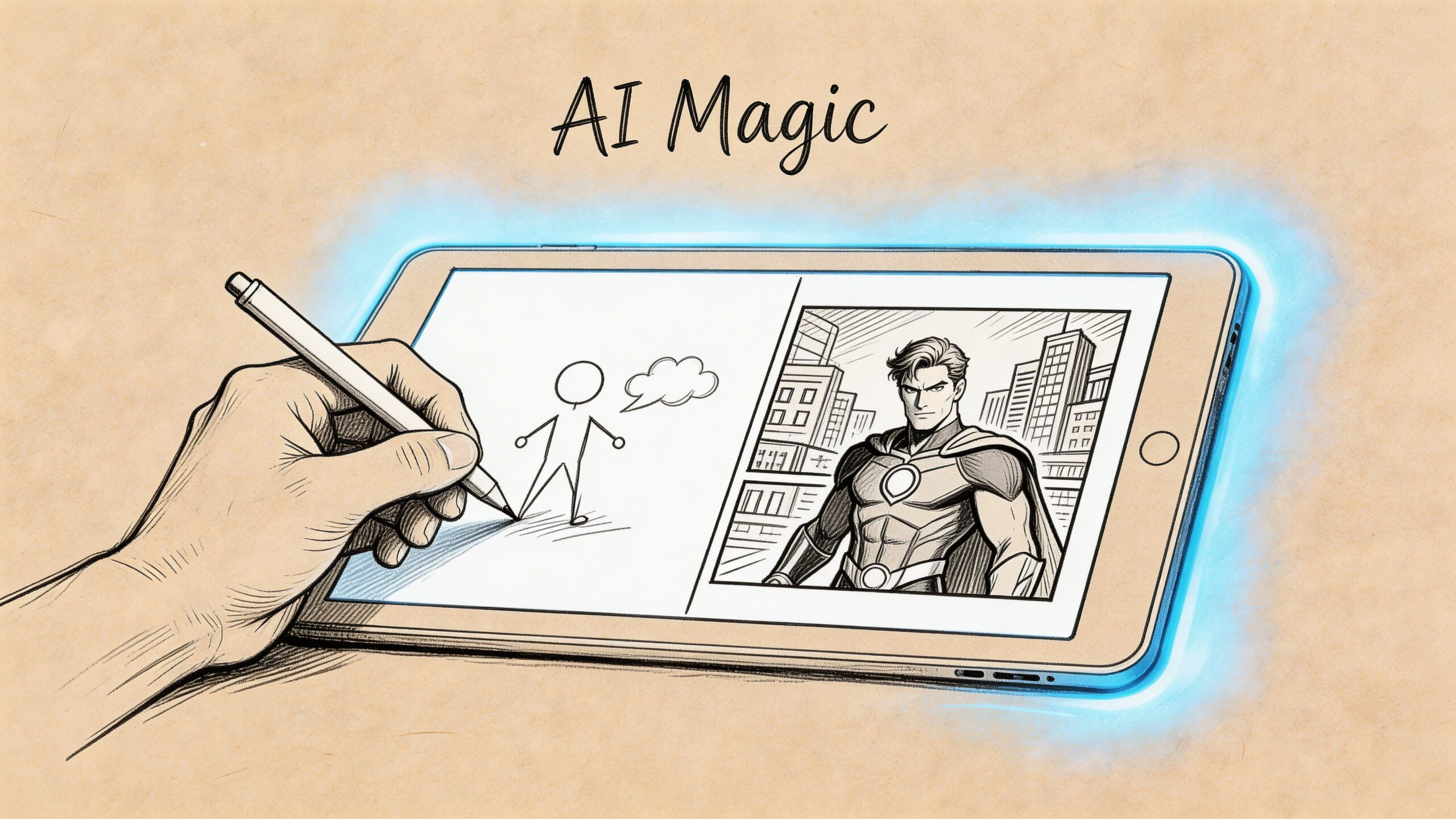
Bringing Your Comic to Life with AI Art
Once your script and thumbnails are clear, the biggest traditional gatekeeper is illustration. That's where modern AI tools change the process.
If you've ever wanted to make a comic but got stuck on drawing ability, this is the stage that opens the door again.
Start with style before you generate pages
AI works better when you make a few big decisions up front.
Pick the overall tone of your comic first. A family keepsake shouldn't look like gritty noir unless that's the joke. A heroic fantasy story shouldn't use a playful retro style unless you want that contrast.
Many platforms now let you choose from multiple visual modes. A tool like PersonalizedComics offers several professional art styles including manga, classic American, graphic novel, noir, watercolor, cyberpunk, retro pop, and fantasy.
That style choice acts like a visual rulebook. It keeps your pages from feeling random.
Build your cast
There are two ways to create comic characters with AI.
Use real people as the basis
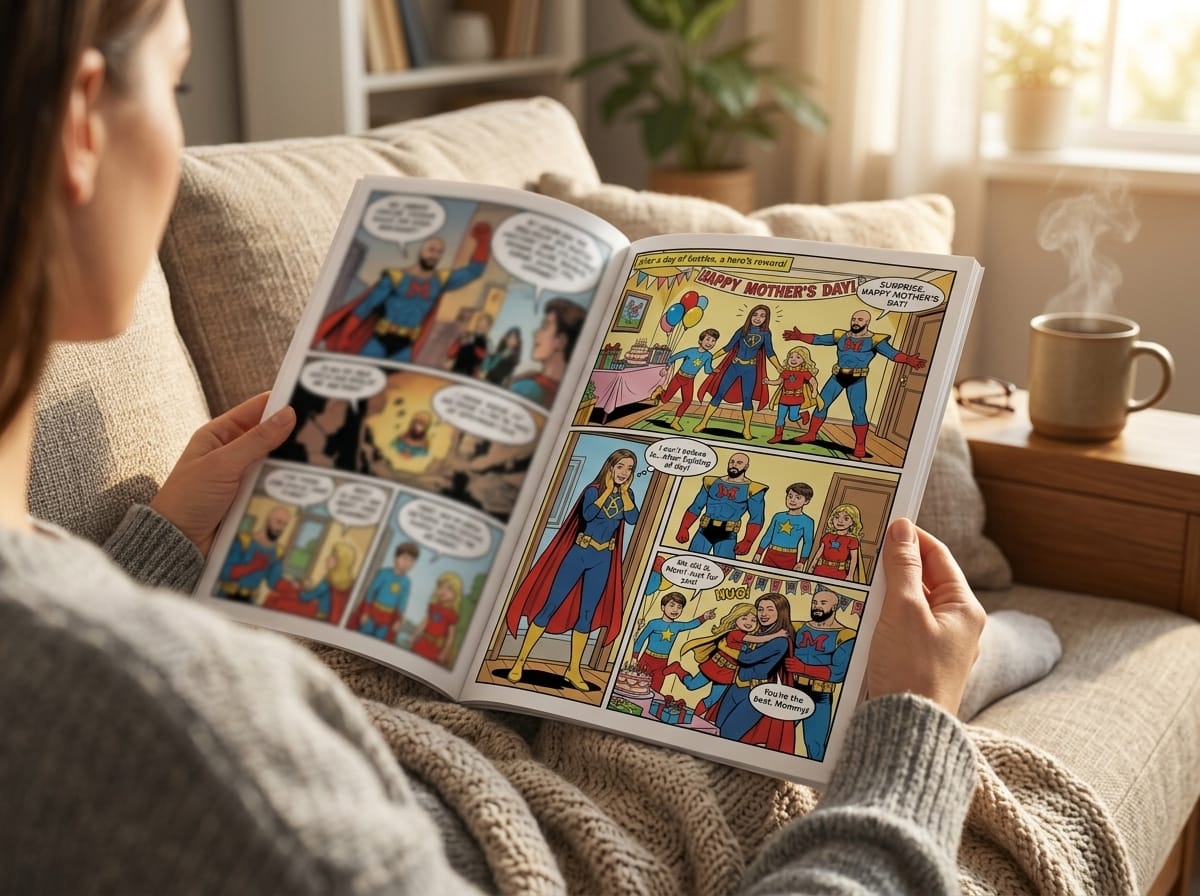
This is ideal for gifts, family stories, wedding comics, and friend-group adventures. You upload photos, then the system stylizes those people into comic characters.
This works best when you choose clear photos with visible faces and a consistent sense of who each person is in the story.
Describe original characters
This fits fiction projects. You write short character descriptions such as personality, clothes, age vibe, role, and distinguishing features.
Keep those descriptions tight. Instead of writing a paragraph, write the essentials:
- dark curly hair
- patched pilot jacket
- anxious smile
- always carrying a notebook
That gives the system more usable direction.
Feed in the story, not just prompts
A lot of people use AI image tools one picture at a time. That's fine for experiments, but comics need consistency across pages.
The better workflow is story-first:
- Add your plot summary
- Define the setting
- List the characters
- Enter scene-by-scene dialogue
- Review the generated pages
- Regenerate weak panels or wording
That process matters because a comic isn't just a collection of cool images. It needs sequence. The character should look like the same person from page to page. The tone should hold. The pacing should reflect your script.
If you want a broader look at the process of assembling a beginner-friendly workflow, this article on a create your own comic book kit is a practical starting point.
What AI is doing well for first-time creators
AI tools are especially useful when you need help with the parts that used to require a team.
They can help with:
- Character consistency across multiple pages
- Background generation for settings you can't draw
- Panel composition based on your story beats
- Speech bubbles and narration placement
- Style translation from plain-language ideas into finished art
That doesn't mean you give up control. It means you shift your effort. Instead of worrying about line quality, you focus on direction, choices, and revision.
How to get better results
AI output improves when your instructions are concrete.
Compare these two inputs:
| Weak input | Stronger input |
|---|---|
| "A hero enters a room" | "A nervous teenager in a homemade cape steps into a messy garage laboratory, looking amazed and slightly overwhelmed" |
| "They talk" | "Two friends sit on opposite sides of a diner booth. One avoids eye contact, the other leans in with a playful grin" |
Specific scenes produce stronger pages.
Keep your expectations realistic
AI is fast, but it still needs human judgment.
You'll still want to check:
- Facial consistency
- Whether the mood matches the scene
- If background details distract from the story
- Whether the page layout supports the intended reading order
- If the dialogue fits naturally inside the available space
Working rule: Use AI to remove the drawing barrier, not to remove your role as storyteller.
For people who grew up thinking comics belonged only to skilled illustrators or studio teams, this shift is a big deal. You can direct a comic without hand-drawing every line. You can make a keepsake, a classroom comic, or a prototype graphic novel by focusing on what matters most: character, scene design, pacing, and voice.
The Finishing Touches on Dialogue and Lettering
A comic can have strong art and still feel clumsy if the text is hard to read.
Dialogue and lettering control rhythm. They tell the reader how fast to move, where to pause, and which words carry weight.
Write dialogue for the ear
Good comic dialogue sounds like someone speaking under pressure, not someone delivering an essay.
That means:
- Shorter lines than you'd write in prose
- Clear intent in each balloon
- Fewer speeches per panel
- Distinct voices so characters don't all sound the same
Try reading each line aloud. If you run out of breath, the balloon is too full.
A useful filter is to ask, "Would this character really say all of this now?" In comics, people often need one sharp line more than three explanatory ones.
Use text for what art can't do alone
Don't make dialogue repeat what the panel already shows.
If the image shows a character crying, they don't need to say, "I am sad right now." Let the words add something else. Deflection, denial, humor, or the reason behind the tears.
This is stronger:
- Weak: "I'm angry because you forgot."
- Better: "Of course you forgot."
The second line lets the art carry part of the emotion.
Cut any line that only explains what the drawing already made obvious.
Make the page easy to read
Lettering isn't just decoration. It's navigation.
Keep these principles in mind:
Speech balloons
Place them so the reader follows them in a natural order, left to right and top to bottom.
Try not to make a reader jump across the panel to find who speaks next.
Narration boxes
Use them when a voice outside the moment adds value. They work well for time jumps, memories, or a strong storytelling voice.
If narration only repeats dialogue or visuals, cut it.
Sound effects
Use them to reinforce action and texture. A door slam, a crack, a buzz, a thud.
They work best when they feel integrated into the scene instead of pasted on top.
A quick polish checklist
Before you export your comic, review every page for these problems:
- Crowded balloons that cover faces or actions
- Tiny text that strains the eye
- Too many bold words in one sentence
- Balloon tails pointing vaguely between speakers
- Long monologues that stop the page cold
The goal isn't flashy lettering. It's invisible clarity. When the reader glides through the page without confusion, the lettering is doing its job.
From Digital File to Physical Comic Book
A finished comic still needs a format.
The right one depends on how you want people to experience it. Some comics work best as a digital file sent to friends. Others deserve to be printed, held, signed, gifted, and kept.
Digital sharing is the fastest path
If you want quick distribution, export your comic in formats that match the way people will read it.
- PDF works well for a full issue or short book
- JPEG or PNG works well for individual pages or social posts
- Mobile-friendly page sizes help if most readers will read on phones
Digital distribution has power. XKCD, launched in 2005, had over 1100 strips by 2011 and reached millions of readers online with a simple visual style, showing how strong ideas and consistent publishing can travel far even with minimal tools, as described in this discussion of XKCD and comics for teaching.
The takeaway for new creators is straightforward. You don't need a publisher or a print run to share your work.
Print changes the feeling
A printed comic does something digital files don't. It turns your project into an object.
That's especially important if your comic is:
- A gift
- A family memory
- A classroom keepsake
- A convention sample
- A personal milestone
When you prepare for print, check for practical issues like page order, margins, image quality, and whether text sits too close to the trim edge.
If you want help thinking through the process, this guide to creating and printing your own comic covers the main decisions clearly.
Choose the version people will read
Some creators overfocus on format and forget audience.
Ask:
| If your goal is… | Best first version |
|---|---|
| Fast feedback | Digital PDF |
| Social sharing | Individual image pages |
| A memorable gift | Printed book |
| Portfolio sample | Both digital and print |
You can always do both. Many first-time creators share a digital version first, then print the final polished edition once they're happy with the result.
A comic doesn't need mass distribution to matter. If one person opens it and feels seen, amused, or surprised, it has already succeeded.
Your Questions on Comic Creation Answered
Do I need to know how to draw to make a comic
No. Drawing is one way to produce a comic, but it isn't the only way. Strong comics depend on storytelling decisions, page flow, dialogue, and clear scene design. If you can plan a story and direct what each panel should communicate, you can make a comic.
How long should my first comic be
Shorter than you think.
A first project works best when it's small enough to finish. A brief personal story, a joke strip, or a compact scene teaches more than an ambitious epic you abandon halfway through.
Should I script every panel before making visuals
For beginners, yes. A complete script reduces confusion later and gives you a stable blueprint. It also makes revision easier because you're solving story problems before you worry about presentation.
What if my thumbnails look terrible
That's normal. Thumbnails are working notes, not art.
If they show panel order, rough composition, and the emotional focus of each beat, they're doing the job.
Can I use real people as characters
Yes, especially for gifts or personal projects, but use photos thoughtfully and make sure you have permission when appropriate. Keep character references clear and consistent so the final comic feels intentional rather than random.
What's the difference between style and story
Story is what happens. Style is how it looks and feels.
You can tell the same story as manga, noir, watercolor, or a bright retro comic. The emotional effect changes, but the underlying structure stays the same.
How do I know if a page is too crowded
A crowded page shows up in one of three ways:
- too much dialogue in each panel
- too many actions competing for attention
- balloons covering important expressions or objects
If the eye doesn't know where to go first, simplify.
When is a comic finished
A comic is finished when the reader can move through it clearly, understand the emotional arc, and reach the ending without confusion. It doesn't need to be perfect. It needs to communicate.
Can AI help without taking over the project
Yes. The healthiest way to use AI is as a production tool, not a replacement for your judgment. Let it help with rendering, consistency, and layout support while you stay in charge of the script, pacing, voice, and final choices.
If you're ready to turn an idea, memory, or inside joke into a finished comic, PersonalizedComics gives you a practical way to do it without drawing skills. You can choose from several art styles, turn photos into comic characters, generate full pages with dialogue and panels, and even order a premium printed copy when you're done.
Filed under Making Your Comic