Maybe it's been there for years. A fantasy quest, a memoir with sharper edges than prose can hold, a sci-fi revenge plot, a romance that only works when you can see the pauses between lines. You want to make your own graphic novel, but the same problem keeps stopping you. You can write. You can imagine scenes. You can hear the dialogue. You can't draw well enough to turn any of it into pages.
That's where most advice becomes useless. It assumes your next step is thumbnails, anatomy drills, inking practice, cleanup, and coloring. For many people, that isn't the next step. It's the wall.
Graphic novels aren't niche anymore. In the U.S., print graphic novel sales reached more than 31 million units in 2023, according to the Association of American Publishers, as noted in this overview of data comics and graphic storytelling. The audience is there. The format is established. What's lagged behind is practical guidance for people who can tell stories but don't want to spend years becoming illustrators first.
Mainstream how-to content still centers on drawing workflows, which leaves a real gap for writers, hobbyists, and gift-makers who want a complete process for making comics without hand-drawing skills, as described in this discussion of non-artist comic creation workflows. That gap is exactly where AI tools become useful. Not as a replacement for storytelling craft, but as a way to remove the production bottleneck that kept non-artists out.
From Big Idea to Unforgettable Story
The first mistake beginners make is thinking their graphic novel starts with visuals. It doesn't. It starts with a story engine.
A strong concept gives you three things at once. It tells you who the story follows, what pressure they're under, and why a comic is the right format for it. If you can't state those clearly, no art style will save the project.
Start with a premise you can sustain
A graphic novel needs momentum. A clever setup isn't enough if it can only support five pages.
Ask yourself these questions:
- Who is forced to change: Not who is interesting in theory, but who will make hard choices on the page.
- What can go wrong repeatedly: Good comics need conflict that can generate scenes, not just backstory.
- Why must this be shown visually: If the appeal lives in atmosphere, expressions, juxtaposition, action beats, or setting reveals, comics fit naturally.
If your idea still feels fuzzy, narrow it until it becomes playable. “A world where memories are taxed” is a premise. “A clerk who audits stolen memories discovers her own childhood was edited” is a story.
For brainstorming help, I like using prompts that force tension and specificity rather than broad genre labels. This collection of graphic novel ideas is useful for shaking loose a premise that already contains conflict.
Pick a structure before you expand
A lot of unfinished comics die from sprawl. The creator has scenes, lore, and character vibes, but no sequence.
Two structures work especially well for first projects:
| Structure | Best for | Watch out for |
|---|---|---|
| Three-act arc | A contained, single-volume story | A soft middle with no escalation |
| Episodic chain | Quest stories, investigations, travel narratives | Repetition that feels like stalling |
The three-act version is simple and dependable. Set up the character and problem. Complicate it until the old approach fails. Force a final choice that changes something meaningful.
An episodic structure works if each segment reveals new information or pressures the protagonist differently. If every chapter feels interchangeable, the story will drag.
Practical rule: If you can't describe your ending, your beginning is still too early.
Theme matters more than lore
New creators often overbuild worlds and underbuild meaning. You don't need a complex universe to make your own graphic novel. You need a clear emotional center.
Pick one thematic question and keep returning to it. Examples:
- What does loyalty cost?
- Can a person outgrow the role their family gave them?
- Is justice possible without mercy?
- What happens when nostalgia becomes a trap?
Theme keeps your scenes from feeling random. It also helps when you later choose visuals, because the world should reinforce the emotional logic of the story.
The non-artist advantage
Writers sometimes assume they're behind because they aren't drawing pages from day one. In practice, they often make cleaner story decisions early because they aren't distracted by rendering.
That's a real advantage. If you think like a writer-director first, you'll focus on scene purpose, page turns, mood, and clarity. Those are the parts readers remember.
The shift now is simple. You no longer need to become a full illustrator before your story can exist as a graphic novel. You need a strong concept, a finishable scope, and a workflow that translates story decisions into pages.
Mastering the Comic Script and Panel Flow
A graphic novel script is not a novel outline with dialogue pasted in. It's a visual blueprint.
That distinction matters. When your script is weak, the pages feel crowded, stiff, or confusing. When the script is clear, every later step gets easier, whether a human artist or an AI tool is building from it.
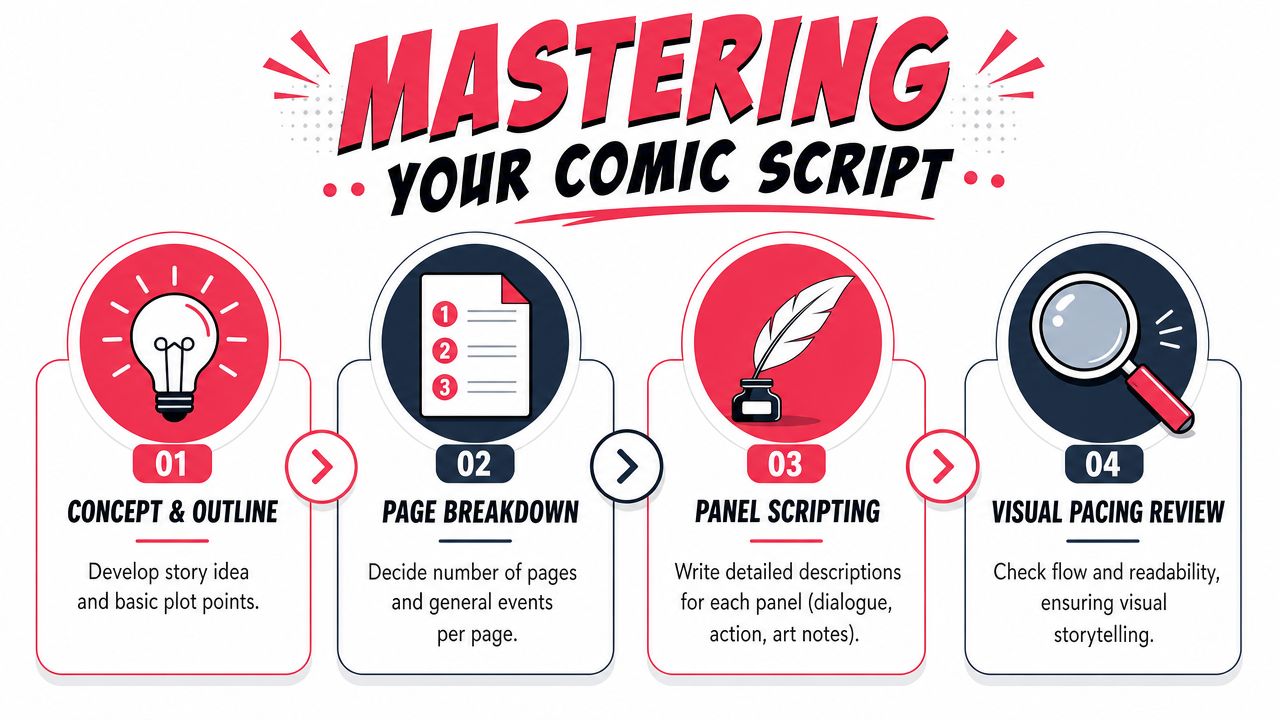
A practical creation workflow is to finish the script before drawing, then break it into page thumbnails. One process guide says a finished script can increase the chance of finishing by about 3000%, then creators move into borders, lettering, and page templates before final art, according to this comic-making process guide.
What a comic script needs on every page
A usable script usually includes four parts:
- Page number
- Panel number
- Art description
- Dialogue or captions
The art description should explain what must be seen for the story beat to land. Not every decorative detail. Not camera jargon for its own sake. Just the information that controls story and emotion.
Bad panel description:
- A cool cyberpunk alley with lots of details and neon and some trash and maybe rain and she looks sad.
Better panel description:
- Narrow alley at night. Neon pharmacy sign reflects in puddles. Mara stands under a fire escape, shoulders tight, clutching a torn envelope she hasn't opened.
The second version gives the image-maker something actionable. It also tells you what the panel is for.
A simple script template
Use something like this:
| Script element | Example |
|---|---|
| Page 12 | 5 panels |
| Panel 1 | Wide shot. Empty school hallway after hours. Lockers in shadow. One flickering ceiling light. |
| Dialogue | Caption: The building always sounded bigger at night. |
| Panel 2 | Medium shot. Jen crouches by a janitor's door, listening. She's trying to stay calm and failing. |
| Dialogue | Jen: You heard that too, right? |
That's enough structure for most projects. You don't need screenplay software. A plain document works fine if it stays readable.
For a deeper breakdown of format and examples, this guide on how to write a graphic novel script is a solid reference point.
Control pace with panel count
The number of panels on a page affects how time feels.
Use fewer panels when you want a moment to breathe or hit hard. Use more panels when you want tension, process, awkwardness, or rapid exchange.
A few reliable pacing choices:
- One large panel: impact, reveal, loneliness, awe
- Three to five panels: standard scene rhythm
- Many small panels: compression, anxiety, comedy timing, action fragments
Don't treat every beat equally. A character opening a letter might deserve one quiet panel. Reading the letter, reacting, denying it, and hiding it might need a whole page.
If everything gets the same panel weight, readers stop feeling emphasis.
Write for the turn
Comics have a tool prose doesn't. The page turn.
You can hide information until the reader physically advances. That's powerful. Use it for reveals, reversals, and emotional hits.
Good page-turn beats include:
- First appearance of a major setting
- A visual shock
- A confession
- The consequence of an action from the previous page
Don't waste the turn on filler. If page 8 ends with someone saying, “Wait, what's that?” page 9 should answer in a way that rewards the setup.
Keep dialogue shorter than you think
New comic scripts almost always carry too much dialogue. Writers hear full scenes in their heads and forget that balloons take space. Space is page real estate. Page real estate is pacing.
Trim until each balloon earns its place.
Try this test:
- Read the line aloud.
- Remove the setup words.
- Remove the repeated emotion.
- Cut anything the face or body can show.
Comics reward implication. Let expressions, silence, and panel order do part of the work.
What works and what doesn't
What works:
- A finished script
- Clear panel intent
- Dialogue written to fit visual space
- Page turns used deliberately
- Scenes built around change, not chatter
What doesn't:
- Starting art before the story exists
- Describing panels like a novel paragraph
- Writing every character thought as caption text
- Treating every page with identical rhythm
- Hoping layout problems will solve themselves later
If you want to make your own graphic novel and finish it, the script is where seriousness begins. It's the part often rushed past. It's also the part that saves the project.
Designing Characters and Worlds Without Drawing
Non-artists usually freeze here because they think “design” means sketching.
It doesn't. Your job is to make decisions. An illustrator draws those decisions. An AI tool interprets those decisions. Either way, you need to know what you're asking for.
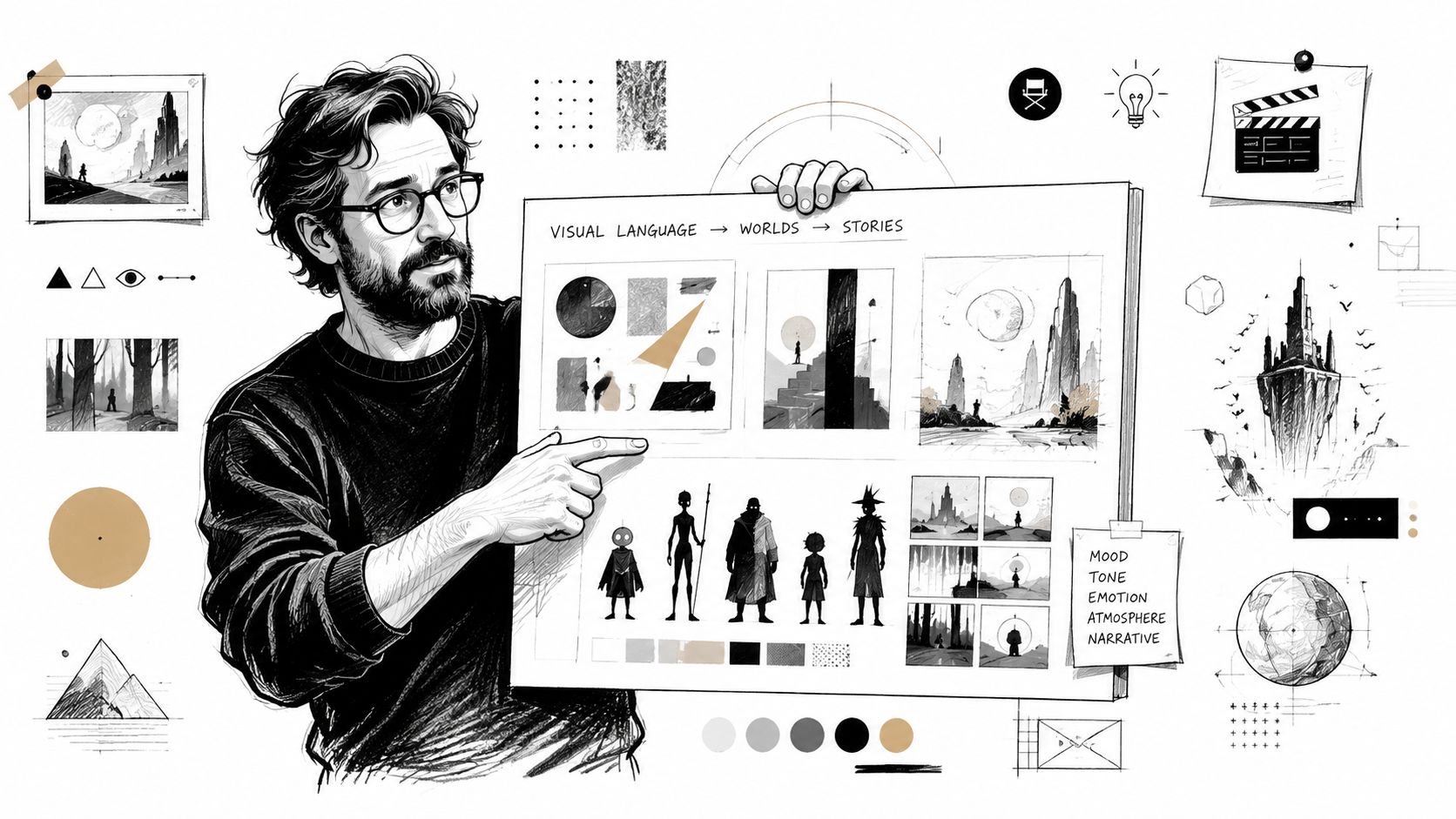
Build character briefs, not vague vibes
“Cool-looking detective” is not a character brief. It's a placeholder.
A useful character brief includes:
- Age range and physical presence
- Face shape and standout features
- Hair and silhouette
- Default clothing
- Gesture habits
- Emotional baseline
For example, instead of “tough ex-soldier,” try this:
Early forties, broad-shouldered but tired, close-cropped hair going gray at the temples, broken nose, heavy coat worn open, always scans exits before speaking, anger shows as restraint rather than shouting.
That gives you consistency. It also gives any visual system something specific to work from.
Design from silhouette first
Readers identify comic characters fast. Usually from outline before detail.
That means you should vary silhouettes across your main cast. If everyone has the same body type, same haircut, and same coat length, your pages become harder to read.
Use contrast intentionally:
| Character trait | Useful contrast |
|---|---|
| Tall and rigid | Short and compressed |
| Layered clothes | Clean minimal shapes |
| Soft rounded face | Sharp angular face |
| Controlled posture | Loose restless posture |
This matters even more when you aren't drawing by hand. Clear contrast gives generated visuals a stronger chance of staying distinct.
Treat settings like story devices
A setting isn't background decoration. It should affect behavior.
If your world is a flooded city, people move differently, store objects differently, and fear different things than they would in a desert outpost. If your story takes place in a luxury orbital station, even the hallways should communicate power, order, and surveillance.
Write a setting brief with these categories:
- Architecture
- Materials
- Lighting
- Color mood
- Social signs
- Wear and damage
A noir alley might use wet pavement, sodium glow, crowded signage, and cramped vertical space. A pastoral fantasy town might use hand-painted wood, uneven stone, warm windows, and visible craft marks.
Pick one visual language
Many beginner projects break apart because they combine too many influences at once.
Choose the dominant visual lane early. Manga-inspired, painted watercolor, retro pop, noir, classic American, realistic graphic novel, cyberpunk, fantasy illustration. You can blend influences, but one needs to lead.
Here's the trade-off:
- Manga-influenced styles often deliver expressive faces and kinetic motion.
- Noir styles give you mood and contrast but can flatten playful scenes.
- Watercolor styles feel warm and human but may weaken hard-edged action.
- Retro pop adds personality fast but can fight serious emotional scenes.
You're not just choosing what looks nice. You're choosing what supports the story.
The right style doesn't just decorate the script. It changes how readers interpret every scene.
Use references like a director
You don't need to draw references. Collect them.
Make folders for:
- Faces
- Wardrobe
- Props
- Architecture
- Lighting
- Color palettes
- Cinematic mood
The key is not to collect endlessly. Curate. Five sharp references for a character are better than fifty random ones.
When I direct non-drawn comic work, I want each major character to have a one-page brief and each primary setting to have a mood sheet. That's enough to keep visual decisions coherent without drowning the project in prep.
If you want to make your own graphic novel without drawing, this stage is your replacement for sketchbook exploration. You're not skipping design. You're translating it into words, references, and choices that can become pages.
The AI Art Studio: A PersonalizedComics Workflow
You've got a script, character briefs, and a clear visual direction. Then comes the moment that makes the project feel real. A page exists. You can read it, judge it, and improve it.
For non-artists, that shift matters more than any abstract advice. The bottleneck is usually not story. It is converting story into pages without spending years learning to draw or paying for a full creative team. AI helps close that gap, but only if you use it with the discipline a comics workflow still requires.
Set the visual system first
A lot of beginners rush into generating faces. I set the page language first.
That means choosing the art mode you want the whole book to live in before you generate characters or scenes. AI image systems respond differently to the same prompt depending on style. A quieter memoir scene in watercolor reads differently than the same scene in hard-shadow noir. Action also behaves differently. Some styles sell speed and impact well. Others carry intimacy better.
Commit early. Mid-book style changes usually create consistency problems that take longer to fix than they save.
Choose the right input for the kind of story you're making
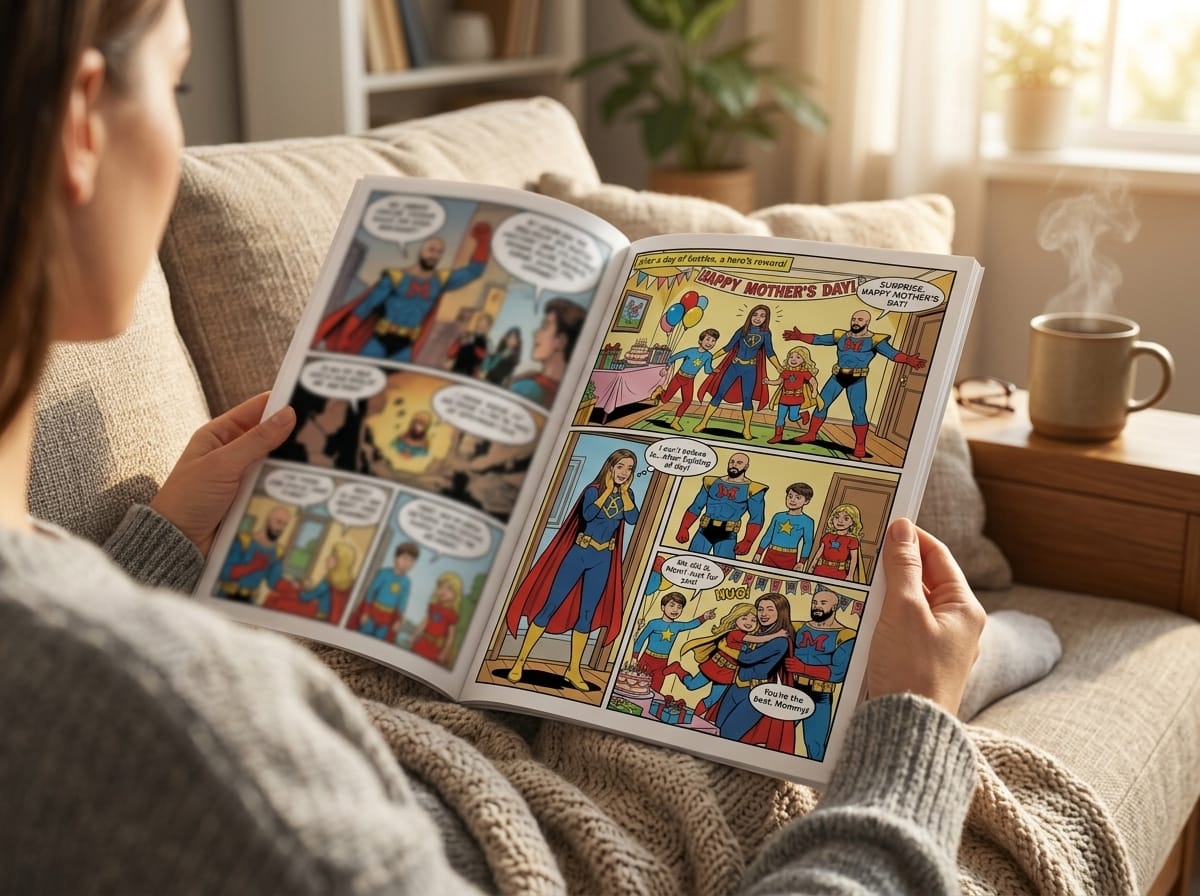
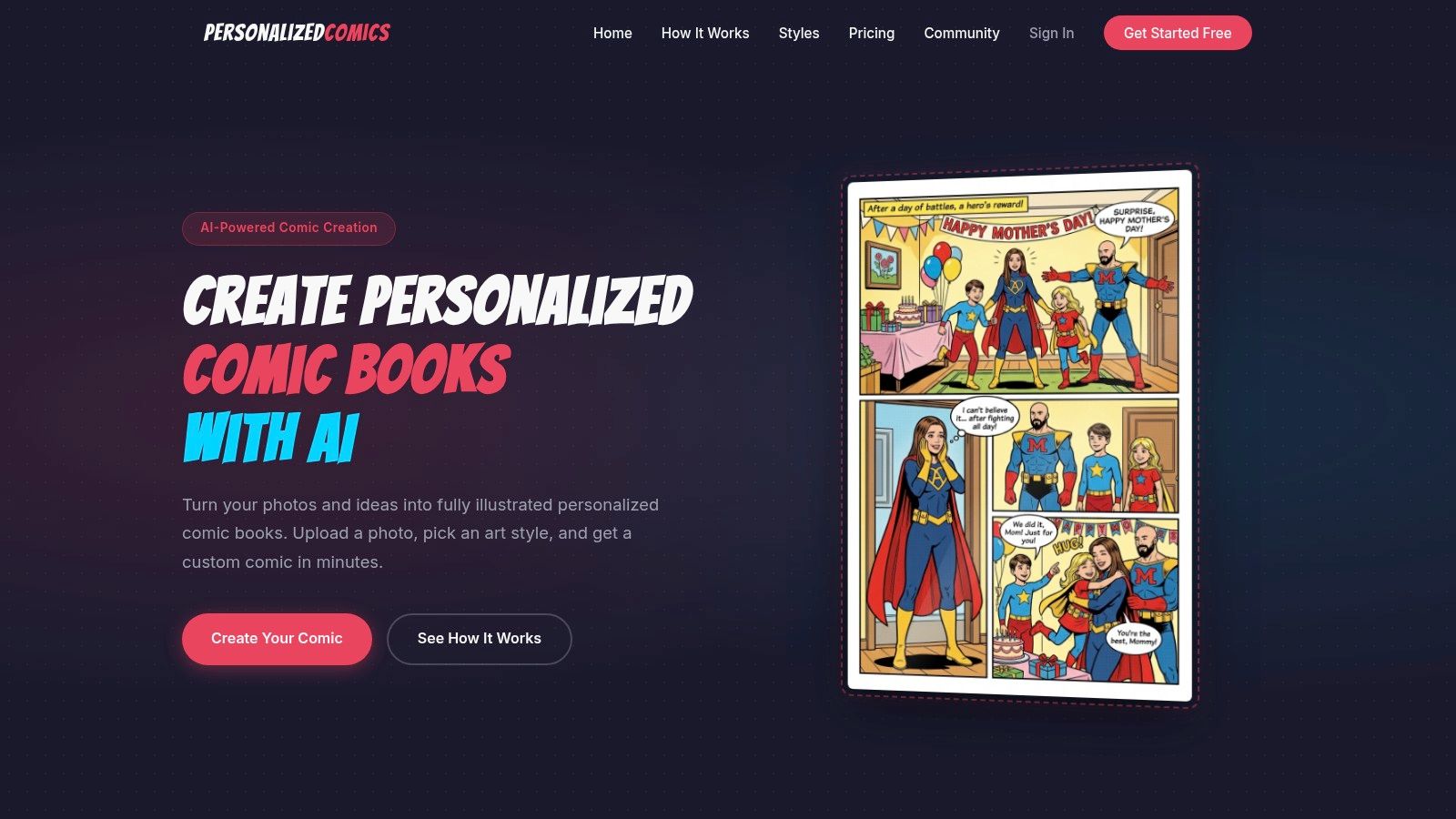
PersonalizedComics gives you two practical ways to build a cast. You can upload photos and convert real people into comic characters, or you can generate original characters from written descriptions.
That split matters.
Photo input works well for memoirs, family gifts, classroom projects, and autobiographical stories where recognition is part of the appeal. Text descriptions work better for fiction, especially if you want full control over costume, silhouette, age, and genre cues without being tied to a real face.
The trade-off is simple. Photo-based characters often feel more immediate, but they can limit how far you push stylization. Text-based characters give you more design freedom, but they demand clearer briefs and tighter wording to stay consistent.
Generate in pages and scenes, not in book-sized batches
AI is fast. That does not mean you should feed it fifty pages at once.
Comic storytelling depends on control of rhythm, reveals, page turns, acting, and continuity. Those are easier to manage when you build scene by scene and page by page. I usually work from the script with a production mindset: one page, one purpose, one review pass.
Include the information the tool needs:
- page number
- panel count
- who appears
- what changes emotionally on the page
- setting details that affect the image
- dialogue and captions
- any reveal that must land in a specific panel
A usable prompt brief can be very plain:
- Page 7
- Four panels
- A enters an abandoned greenhouse
- B is present but hidden until the last panel
- Wet glass, tangled plants, dim natural light
- Minimal dialogue
- Final panel reveals B holding the missing notebook
That level of direction usually gives the system enough structure to build a page you can judge.
Use AI for production speed, keep authorship in human hands
This is the part people misunderstand. AI can produce pages quickly. It cannot decide what matters on the page.
It helps with first-pass composition, character rendering, page assembly, and trying variations without redrawing from scratch. It does not know which glance should land harder, which line needs to be cut, or whether the page turn weakens the reveal. Those remain author decisions.
I've found the cleanest split looks like this:
Let the tool handle
- first-pass visual generation
- converting character inputs into comic art
- rough balloon placement
- alternate versions of the same scene
- quick tests of framing and mood
Keep control of
- story beats
- emotional emphasis
- line edits
- continuity between pages
- final page choice
That is the main advantage for non-artists. You skip the drawing bottleneck without handing over the storytelling.
Expect correction passes
The first output is rarely the final page. That is normal in comics and normal in AI-assisted production.
The common trouble spots are predictable. Expressions may read too flat. Props may change shape. Background details may drift. Dialogue may fit awkwardly inside the panel. Sometimes the staging is technically correct but dramatically weak, which is harder to catch if you are only looking at whether the page "looks good."
Treat each generated page like a rough. Review it against the script, mark what failed, regenerate or edit, then move on.
Fast production raises the value of judgment.
Why this workflow works for people who do not draw
Traditional comic production asks for a stack of specialized skills: writing, layout, penciling, inking, coloring, lettering, revision, and file prep. One person can learn them, but that is a long road. Hiring for all of them is expensive.
An AI-assisted workflow gives writers, hobbyists, teachers, parents, and first-time creators a workable middle path. You still need story sense. You still need taste. You still need patience. But you no longer need draftsmanship as the gatekeeper between idea and finished page.
That changes the project from “maybe someday” to “I can make this book now,” which is exactly why this approach has become so useful for non-artists building a full graphic novel workflow.
Polishing Your Pages Like a Pro
Generated pages can get you surprisingly far. They still need finishing judgment.
This stage is where the book stops feeling like a draft and starts feeling authored. You're checking readability, tone, consistency, and the small visual choices that readers may not consciously notice but absolutely feel.
Fix lettering before anything else
If the words aren't easy to read, nothing else matters.
Look at every page and ask:
- Does balloon order follow natural reading flow?
- Is any text too small for comfort?
- Do balloons cover important acting or visual information?
- Does the amount of dialogue fit the panel size?
Bad lettering makes a page feel amateur fast. If a panel carries too much text, don't just shrink the font. Rewrite the line. Cut it or split the beat across two panels if needed.
A useful rule is to protect the art's focal point. Don't let a balloon sit over the face, hand gesture, or object the reader needs to understand.
Add sound effects with restraint
Sound effects can energize a page, but beginners often overdo them. Every impact doesn't need a giant BOOM. Every motion doesn't need a SWISH.
Use SFX where sound changes the reading experience:
- A door slamming in a quiet scene
- A weapon firing
- A body hitting pavement
- Rain against metal
- Machinery humming in an otherwise still panel
Try matching the shape of the sound effect to the action. Hard blocky letters feel heavy. Jagged letters feel sharp. Loose curved letters feel softer or stranger.
Unify mood through color and contrast
Even when a system keeps style mostly consistent, scenes can drift in mood. One page may feel too warm, another too flat, another too bright for the moment it carries.
Check scene groups rather than isolated pages. A confrontation scene should feel visually related from start to finish. A flashback should feel intentionally distinct. If a horror beat arrives in the same cheerful palette as the previous banter scene, the impact weakens.
Use a checklist like this:
- Night scenes: Keep shadows and highlights coherent across pages
- Emotional peaks: Let contrast increase when the story tightens
- Quiet scenes: Reduce visual noise where possible
- Location changes: Give each place a recognizable color identity
Run a continuity pass like an editor
This is the least glamorous job and one of the most important.
Make a page-by-page pass for consistency:
| Check item | What to look for |
|---|---|
| Character appearance | Hair length, outfit details, accessories, scars |
| Props | Items appearing, disappearing, or changing hands incorrectly |
| Setting logic | Doors, windows, weather, furniture placement |
| Dialogue continuity | Names, timeline references, emotional progression |
I recommend reading the whole book in one sitting at least once. Not as the creator. As a confused first-time reader. Mark every place where you hesitate.
If you stop to figure out what's happening, the reader will stop too.
What polish actually does
Polish doesn't mean making everything glossy. It means removing friction.
A polished graphic novel reads cleanly. Characters stay recognizable. Dialogue feels placed, not stuffed in. Scene mood holds together. Important moments land with the emphasis they deserve.
That's the part people often underestimate when they rush to export pages. Finishing isn't when the book merely exists. Finishing is when the book reads the way you intended.
Printing and Sharing Your Finished Graphic Novel
A finished file isn't the end of the process. It's the start of distribution choices.
If you only want a digital comic, you still need to prepare files cleanly. If you want a printed book, technical sloppiness will show up fast. Blurry linework, inconsistent trim, misaligned pages, and awkward binding problems usually come from decisions made too late.
Why print specs need attention early
Print production rewards consistency, not improvisation.
Professional workflows commonly standardize page size, format, and resolution early. One creator reports scanning at 600 dpi in black-and-white line art, and another recommends keeping every page the same size and format to simplify printing and binding, as noted in this print-prep workflow guide.
That advice matters even if your book is AI-generated rather than scanned traditionally. The principle is the same. Keep page dimensions uniform from the beginning.
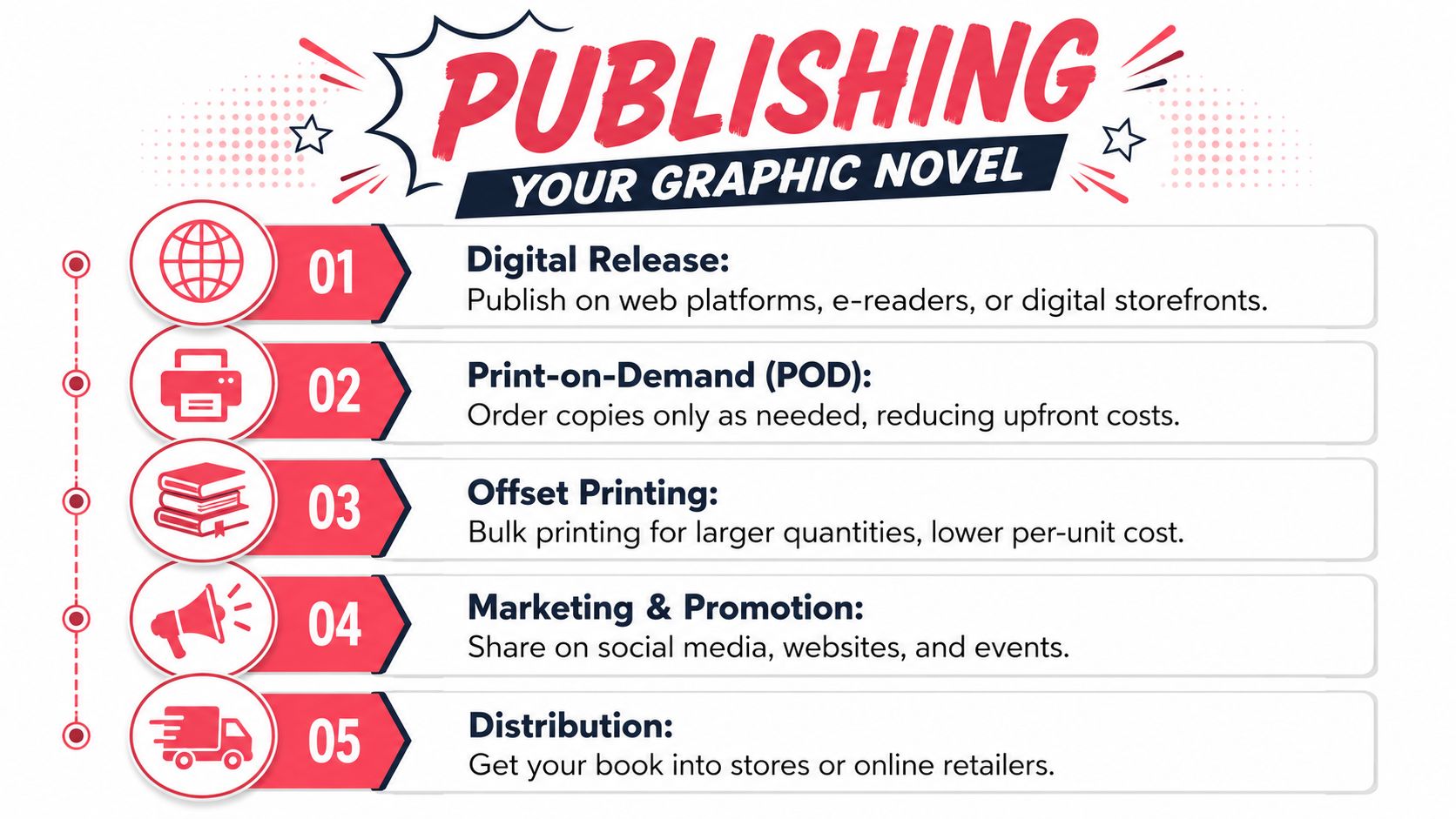
Choose between digital-first and print-first
Both paths work. They just reward different priorities.
Digital-first makes sense when you want to:
- Share a PDF with friends or beta readers
- Post pages on a site or social channel
- Build a portfolio sample
- Test whether the story works before paying for print
Print-first makes sense when you want to:
- Create a gift or keepsake
- Sell copies at events
- Make a physical proof for pitching or showcasing
- Enjoy the object as a book, not just a file
The mistake is treating print as a simple export afterthought. It isn't. Print is a manufacturing decision.
A practical print-ready checklist
Before you send files anywhere, confirm these basics:
- Page size is consistent: Every interior page matches exactly.
- Reading order is correct: Especially important if the book uses right-to-left manga influence or unconventional inserts.
- Margins are safe: No text too close to trim.
- Resolution is high enough for print: Avoid upscaling weak files at the end.
- Cover and interior are separated properly: Don't mix them into one accidental export.
- Double-page spreads still read well at the gutter: Important art shouldn't disappear into the fold.
If you want a more detailed breakdown of options and prep, this guide on printing your own custom comic book is a useful next read.
DIY print shops versus streamlined services
A local print shop gives you direct contact and proofing opportunities. That's great if you understand specs and want hands-on control.
Online printing can be easier for single copies or small runs, but you still need clean files. A service integrated with your comic creation workflow can reduce friction if your goal is convenience and a physical keepsake rather than production management.
What matters most is matching the route to the project. A one-off family gift doesn't need the same print path as a convention-ready indie release.
Sharing counts too
Don't ignore the digital version once print is done.
Export a readable PDF. Create sample page images. Pull a few standout spreads or character intros for sharing. If your project has any public life at all, those assets help more than dumping the whole thing online without context.
The final step deserves care because this is the version people experience. When readers hold the book or open the file, they aren't thinking about your workflow. They're judging the finished object.
Your Graphic Novel Questions Answered
A first graphic novel always raises a second round of practical questions. These are the ones I hear most often from people trying to make their own graphic novel without traditional art skills.
Frequently Asked Questions
| Question | Answer |
|---|---|
| Do I need to know how to draw to make a graphic novel? | No. You do need to know how to tell a story visually. That means writing clear scenes, controlling pace, defining characters, and making good editorial choices. Drawing is one route to finished pages, but it isn't the only route anymore. |
| Should I write the whole script before generating any art? | Yes. You can test a sample page early, but the full story should exist in script form before serious production starts. Projects fall apart when the visual phase begins before the narrative is stable. |
| How long should my first graphic novel be? | Keep it shorter than your ambition wants. A contained story is better than a sprawling unfinished one. A clean short book teaches you more than a bloated project you abandon halfway through. |
| What's the biggest mistake beginners make? | They start solving visuals before they've solved story structure. The second biggest mistake is writing too much dialogue for the space available on a comic page. |
| Can AI-generated pages still feel personal? | Yes, if the story, script, character choices, pacing, and revisions come from you. Personal work isn't defined only by hand-rendered lines. It's defined by authorship and intention. |
| Will every generated page be usable immediately? | No. Expect revisions. You'll still need to check expressions, page flow, continuity, and balloon placement. Fast production doesn't remove editing. |
| How do I keep characters consistent across pages? | Build strong character briefs, keep wardrobe and features stable, use the same reference inputs, and review pages in sequence instead of one by one in isolation. Consistency starts in prep, not cleanup. |
| What kind of story works best for a first project? | One with a clear protagonist, a contained conflict, a small cast, and a finishable ending. Mystery, memoir, romance, and contained fantasy all work well if the scope stays under control. |
| Should I publish digitally first? | Often, yes. Digital release lets you review the reading experience, share samples, and catch issues before spending money on print. If the book is meant as a one-copy gift, print-first can still make sense. |
| How do I know if a page is too crowded? | If balloons dominate the panel, if faces are covered, if action beats become hard to follow, or if you feel tempted to shrink text to make it fit, the page is crowded. Split the beat or cut the words. |
A final note on mindset. The fastest way to stall is to compare your first book to a veteran cartoonist's tenth. Don't do that. The win is not making a flawless masterpiece on your first try. The win is learning a repeatable process you can finish.
If you stay focused on structure, clarity, and revision, you can make your own graphic novel in a way that felt unrealistic not long ago.
If you want a practical way to turn a script, photos, or character ideas into finished comic pages without drawing them by hand, PersonalizedComics is worth exploring. It's built for people who want to create a custom comic or prototype a graphic novel with consistent styles, page-based credits, and optional print copies, while keeping the storytelling decisions in their own hands.
Filed under Making Your Comic