The indie comics market is not a tiny hobby corner anymore. A market report estimated the global comic book market at USD 19.05 billion in 2025, with a projection of USD 37.15 billion by 2033 and a CAGR of 8.9% from 2026 to 2033; it also placed Asia Pacific at 59.60% of regional share in 2025 and reported 4,661 U.S. comic-book publishing jobs in 2025 (Grand View Research). That scale changes the game. You're not choosing between “print or not” in a vacuum, you're choosing how to enter a professional market with uneven margins, multiple audiences, and different buying habits.
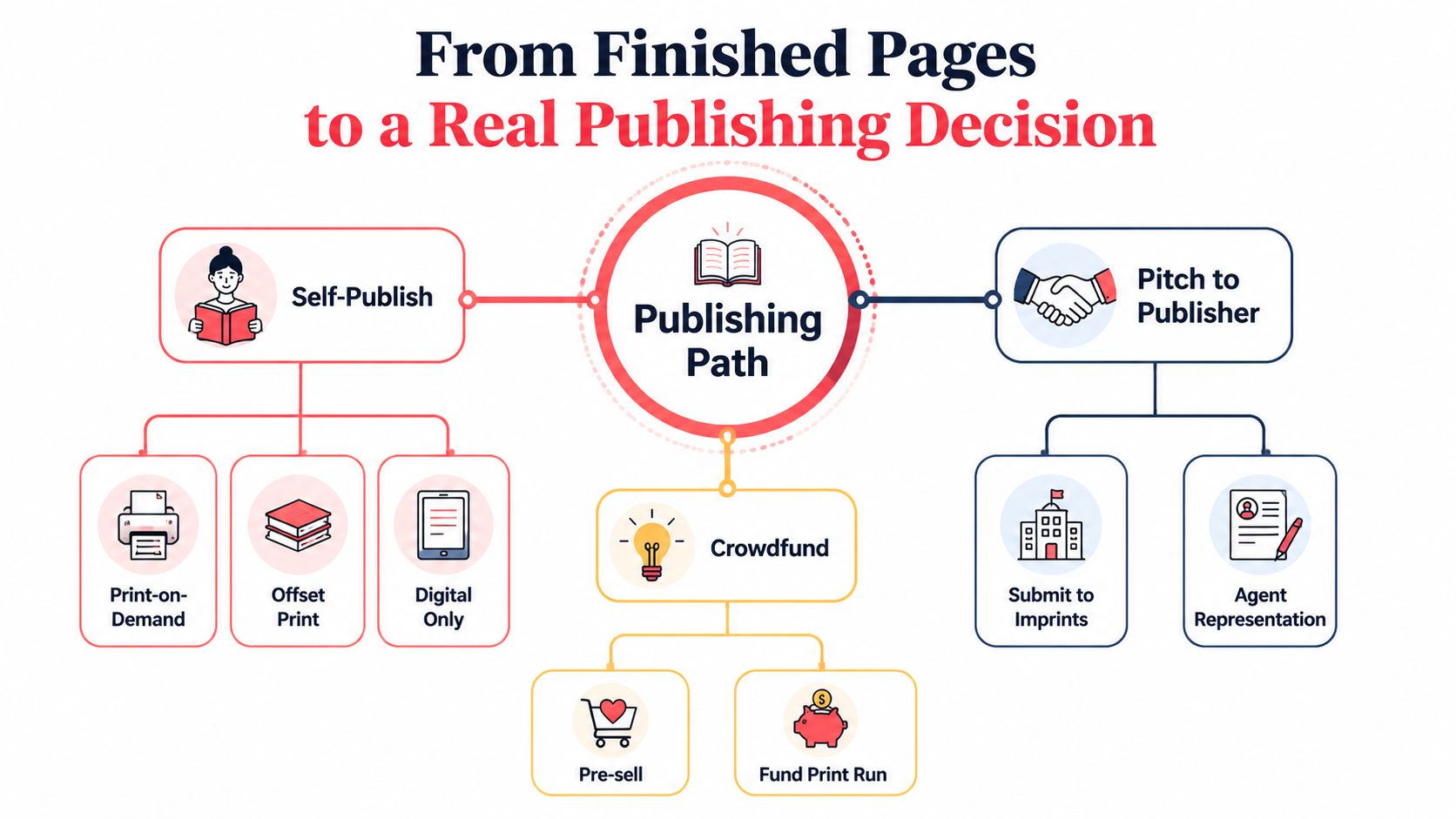
From Finished Pages to a Real Publishing Decision
The moment the last page is done, a lot of creators make the same mistake, they think the hard part is over. It isn't. The hard part is deciding whether your comic should exist as a digital-first release, a small print run, a crowdfunded launch, or a hybrid of all three. That decision shapes your deadline, your cash flow, and how much risk you carry before the first reader ever sees the book.
A creator-owned comics breakdown shows why the decision is commercial as much as creative. One estimate puts about 40 to 50% of the cover price in the hands of retailers, while another analysis says roughly 89% of the cover price can be absorbed by the retailer, printer, and distributor combined, leaving only about 11% for the publisher, creative team, and advertising costs (Jim Zub). That is why lean launches matter. If you print too much, you're not just sitting on inventory, you're sitting on money that's already been spent.
Choose the audience you can actually reach
A first issue doesn't need to go everywhere. It needs to go where your readers already buy, or where they're willing to click. If your audience is small but intense, a digital launch or a limited print drop can make more sense than a big storefront push. If your audience responds to physical books, conventions, and signed copies, print becomes part of the product rather than a nice extra.
Practical rule: publish for the channel your audience already trusts, not the channel you personally like best.
That's why so many indie launches begin with a narrow plan. You might release digitally to test demand, print only what you can store and ship, or use crowdfunding to pre-sell the first run before you commit to inventory. The mistake is treating publishing like a finish line. In practice, it's a routing problem. You're deciding how the book moves from your files to a buyer's hands, and every route has a different margin profile.
Preparing Print-Ready Files Without Costly Reprints
Bad files are expensive in a way that feels unfair until you've paid for a bad proof. The page looked fine on screen, the colors seemed close enough, and then the actual book arrives with a gutter that swallows dialogue or a border that got clipped by the trim. That's why prepress discipline matters more than layout aesthetics. A comic can be beautifully drawn and still fail the moment it hits production.
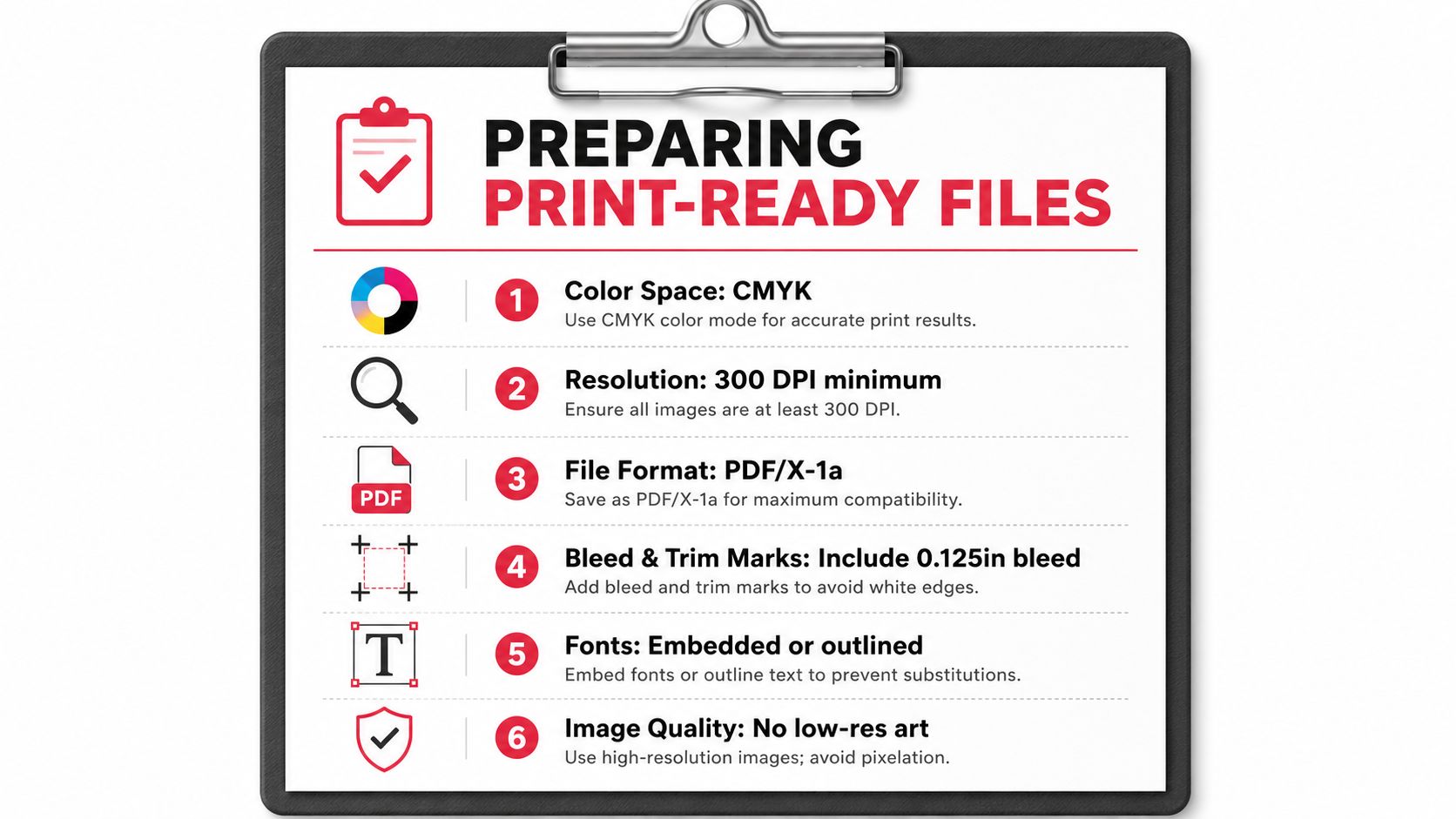
Start with the technical basics the printer expects. Industry guidance recommends CMYK for print, 0.125-inch bleed on all sides, and PDF/X-1a export for compatibility (stck.me). Use 300 DPI for raster art, keep trim and safety guides visible while you work, and make sure gutter spacing is consistent across the book. If your pages are built for a standard layout, that internal consistency saves you from surprises when the book is folded, trimmed, and bound.
Order proofs before you authorize a run
Proofing is where the theory meets the paper. Order proof copies on the final stock, then check for color shifts, gutter problems, trim errors, and black-fill artifacts before approving anything at scale. That step catches the mistakes that are hardest to notice in a digital file but easiest to regret after a full run.
A useful habit is to review the proof as if you were a stranger buying it in a shop. Read it under different light. Check every splash page, every page number, every dialogue balloon near the edge. If the book is meant to be handled, stacked, and sold, the proof should tell you whether the reader experience survives production. A comic that “looks close enough” on a monitor can still become a reprint problem in your hand.
If you're building a print edition with a fixed trim size, keep the page dimensions consistent from the start. A separate page-size reference can help you avoid layout drift, and this guide on comic book page size is useful when you're building files for print rather than improvising at the end.
Print on Demand Versus Offset for Small Runs
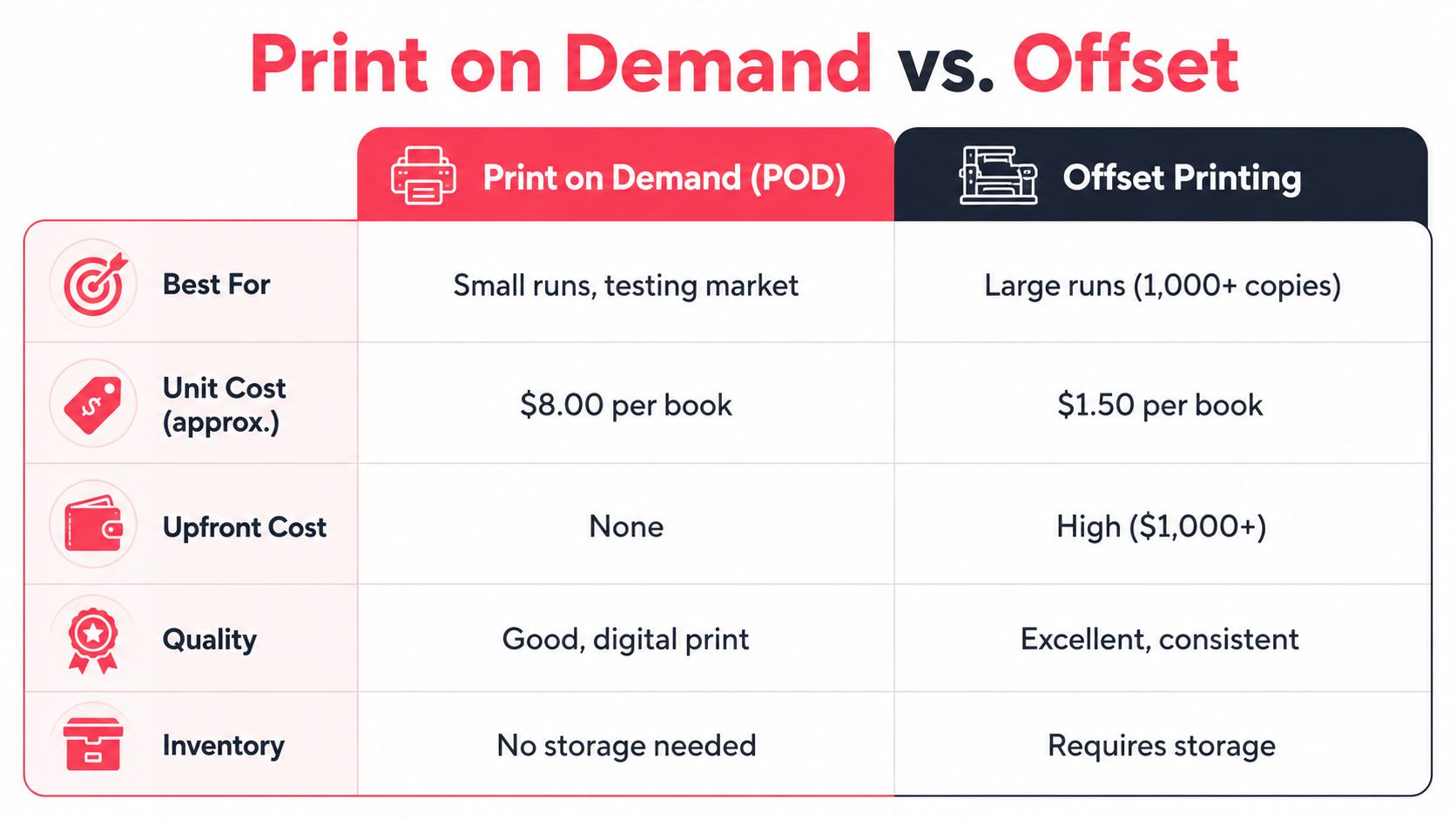
Print method is where first-time publishers often lose money by choosing the wrong scale for the wrong channel. Print on demand keeps risk low because you order only what you need, while offset printing usually makes sense once you have a sales path that can absorb boxes of inventory. The choice is practical, not philosophical. It comes down to cash flow, storage, and how quickly copies will move.
Unit cost is the pressure point. A small-run benchmark sits around $0.80 per copy, and it can climb to more than $1.00 when runs drop under 3,000 copies. That cost pattern is why many creator-owned publishers start with digital-first releases and conservative print budgets, then expand only after sales prove out. If your channel cannot carry the cost structure, the format will not rescue the title. It will only make every unsold copy easier to count.
Match the print method to the sales job
POD works well for small test runs, reviewer copies, and gift editions when you do not want stacked inventory in your apartment. It also fits a limited release strategy, including limited edition comic books, when the goal is to keep the print quantity tight and the order size predictable. Offset makes more sense when a funded run, a convention schedule, or a campaign has already shown demand. POD is the safer choice when you want to protect cash. Offset is stronger when you can carry inventory and reduce unit cost without betting the whole project on unsold stock.
Offset does not fix weak demand. It only makes strong demand cheaper to fulfill.
Channel mix matters more than paper pride. A shop-heavy plan needs different economics than a direct-to-reader plan. A crowdfunding campaign can support offset if backers have already prepaid the demand, while a quiet debut, or a title still finding its audience, often performs better with POD or a small digital run first. For the production side of the comparison, this chart on Print on Demand and Offset printing for book production lays out the trade-offs clearly. Use POD for testing, then move to offset when the inventory has a job before it arrives.
Creating Finished Pages and Locking Down Your Rights
Not every creator draws their own pages, and that's completely fine. A finished comic still needs finished pages, and there are tools that can help a non-artist get there without turning the process into a technical detour. One option is PersonalizedComics, which turns uploaded photos or written character descriptions into complete comic pages with panels, speech bubbles, sound effects, and narration. It offers eight art styles, including manga, classic American, graphic novel, noir, watercolor, cyberpunk, retro pop, and fantasy, so a creator can move from idea to printable pages without starting from a blank art board.
Finish the book, then sort the ownership
Once the pages exist, the rights work still matters. Copyright registration, creator agreements, and clear ownership terms aren't optional if more than one person touched the project. If you collaborated with a writer, artist, letterer, or designer, decide who owns the characters, who owns the likenesses used in the art, and what each person can reuse later. That clarity prevents arguments when the comic grows into a sequel, a compilation, or a separate edition.
An ISBN can also matter depending on how you plan to distribute the book. If the comic will live as a print edition, a digital edition, or both, decide that before you format the final files. A lot of rights confusion comes from creators rushing the creative finish and leaving the metadata, contracts, and edition strategy for later. That's backward. You want the ownership structure settled before anyone starts talking about pitch decks, stores, or licensing.
A comic with unclear ownership is harder to sell, harder to reprint, and harder to expand.
If you're drawing the book yourself, the same logic still applies. Keep your files, scripts, character references, and final exports organized so you can prove what was created and when. If you used AI-assisted assets, decide in writing how those assets are treated inside your project. Clean rights don't just protect you legally. They make the comic easier to publish again in another format later.
Choosing Digital Stores, Crowdfunding, and Direct Sales
Where the comic lives shapes more than visibility. It changes margin, customer data, and how much work you take on after launch. For most indie books in 2026, the practical answer is a mix of channels, because one channel rarely covers every job well.
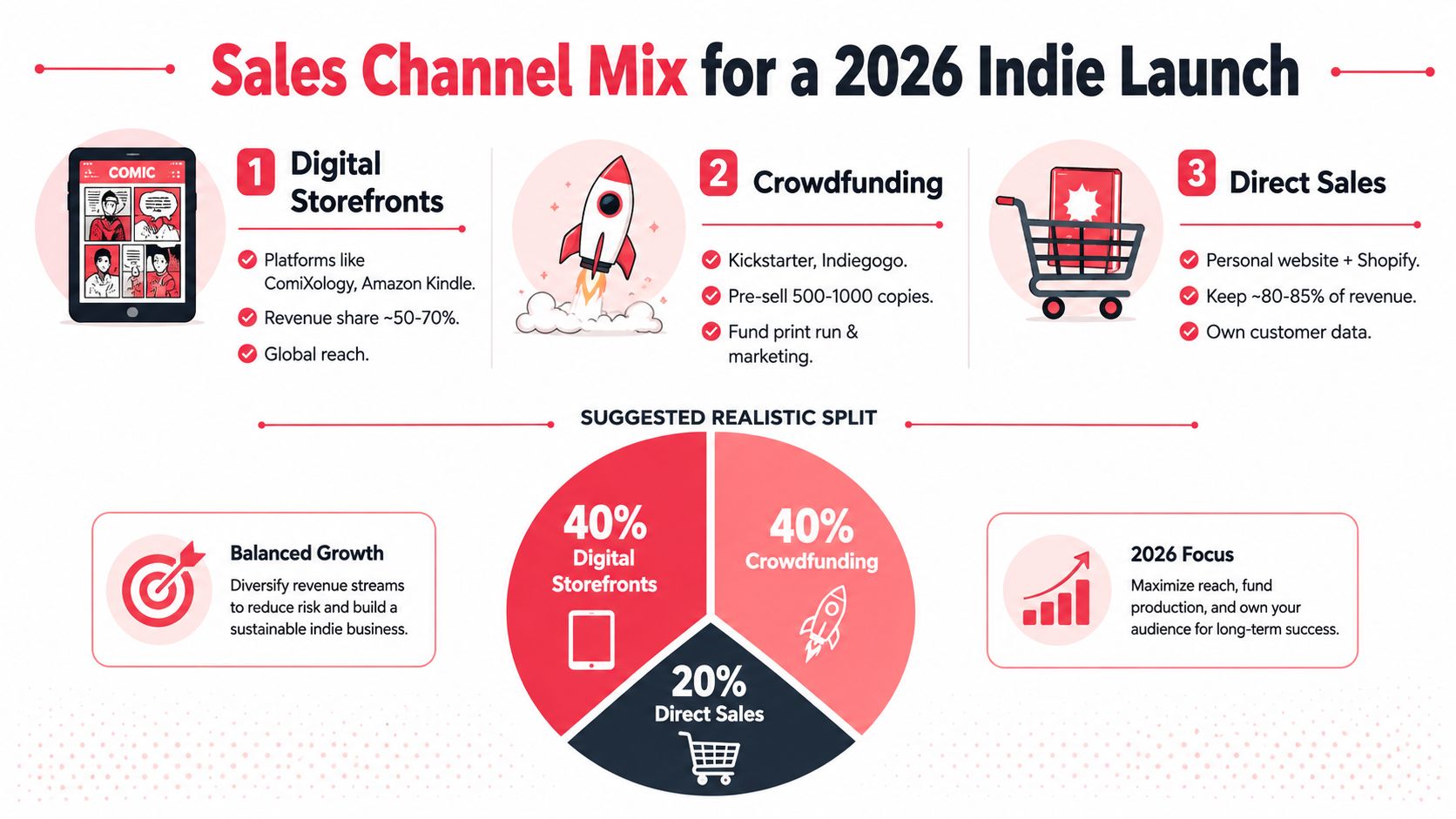
Digital storefronts, crowdfunding, and direct sales each serve a different purpose. Digital stores keep the book available and searchable without constant hand-selling. Crowdfunding can pre-sell inventory and help cover printing before cash leaves your account. Direct sales through your own site give you the most control over presentation and customer relationships, but they also demand the most day-to-day attention. The key decision is which part of the business you can run consistently.
Build a channel mix that fits your book
A realistic launch usually blends digital storefronts, crowdfunding, and direct sales instead of betting on one lane. Digital platforms help readers discover the book over time. Crowdfunding validates demand and brings in funds before production is finished. Direct sales keep the most control in your hands, but they only work if you can keep traffic moving.
The hidden cost is that each channel carries its own math. Proof copies, shipping, revision buffers, and wholesale discounts can squeeze a launch that looked profitable on a spreadsheet. A book aimed at collectors may need a different mix from a book meant for casual reading on a phone, because the buyer expects a different package, different timing, and a different price structure.
I use a production shortcut like PersonalizedComics when I need to get a book into the market without building every piece from scratch, but the channel choice still has to fit the title. A simple, clean production path can save time, yet it does not remove the need to decide where the book should sell first and where it should keep earning later. The same workflow can support a direct store, a crowdfunding campaign, or a digital release, but the margins and labor look different in each case.
If you want a practical view of how creators split those jobs, Reedsy lays out the basic trade-offs between print and digital publishing paths. For fulfillment, how much it costs to ship a comic book is a useful reminder that shipping can eat the profit you thought you had, especially once packaging and repeated mailings enter the picture.
Pricing, Fulfillment, and Shipping Without Losing Money
Pricing is where enthusiasm meets arithmetic. A lot of first-time publishers set a cover price by looking at other comics, then discover too late that their own landed costs eat the margin. Start with the landed cost, which means the print cost plus inbound shipping plus packaging. Then add a buffer for revisions and damaged stock. Only after that should you think about the cover price.
Build the price from the bottom up
If you sell to shops, wholesale discounts change the equation fast. The reader-facing price has to survive the lower amount you'll receive. That doesn't mean every comic needs a high cover price. It means the number has to be chosen after the economics, not before them. If the cover price only works in a best-case scenario, it isn't a real price.
Fulfillment is the next trap. You can self-ship from home, use a third-party logistics partner, or run a hybrid model where campaign rewards ship from the printer while your ongoing stock lives somewhere else. Each option has trade-offs. Self-shipping is cheap at first and exhausting later. A logistics partner can clean up the process but introduces storage and pick-and-pack costs. A hybrid can work well, but only if your inventory plan is simple enough to manage without losing track of what's already promised.
The cheapest shipping plan is the one you can repeat without mistakes.
That's why your pricing worksheet needs to include the boring details. Packaging material. Replacement copies. International shipping surcharges. Returned mail. If the comic is meant to exist as a business, those aren't edge cases. They're part of the product. Once you include them, it becomes easier to decide whether your title belongs in direct sales, shop distribution, or a crowdfunding fulfillment model that ships only once.
Marketing, Launch Tactics, and a Publishing Checklist
A comic launch works better when the audience has already seen the book before release day. That means the marketing starts before the store goes live or the campaign opens. Use the 30 days before launch to build an email list, share preview pages, line up a livestream, and pitch comics press or niche podcasts that already speak to your readers. Don't wait for momentum to appear. Build it with visible repetition.
Keep the launch simple enough to execute
The strongest launch plans are easy to repeat under pressure. A preview post, a reminder email, a live appearance, and a release-day push are enough if each piece is coordinated. If the launch depends on too many moving parts, you'll spend the week fixing logistics instead of selling the book. A clean schedule also helps you keep backers, readers, and shop contacts informed without overexplaining every step.
Use this final checklist before you hit publish.
- Finished pages: The issue is complete and read in order.
- Copyright filed: Ownership is documented.
- ISBN assigned: The edition is set up correctly.
- Proofs approved: Print samples have been checked and signed off.
- Pricing model set: Cover price and discounts are already decided.
- Channel mix chosen: Digital, crowdfunding, direct, or a blend is clear.
- Fulfillment tested: Shipping and packaging are workable.
- Marketing assets ready: Covers, previews, and launch copy are prepared.
Publishing a comic is the start of a longer relationship with the book, not the end of a creative sprint. If you treat the launch as a checklist item instead of a leap of faith, the whole process gets calmer. You stop guessing what comes next, and you start shipping with intent.
If you want a faster path from idea to finished pages, PersonalizedComics can generate complete comic pages from your photos or written concepts, then help you move toward a printable edition without starting from scratch. If you're ready to turn a story into a real comic workflow, visit PersonalizedComics and start building the pages you can publish.
Filed under Comic Craft