That's why so many writers are experimenting with ChatGPT now. Not because it can replace authors, but because it can help you get unstuck, think wider, and draft faster. The trick is using it like a collaborator with limits, not like an autopilot you trust blindly.
Writing a book with ChatGPT works best when you treat the model as a drafting partner, a brainstorming engine, and a revision assistant. It works badly when you ask it to produce a finished manuscript in one shot and hope the output is publishable.
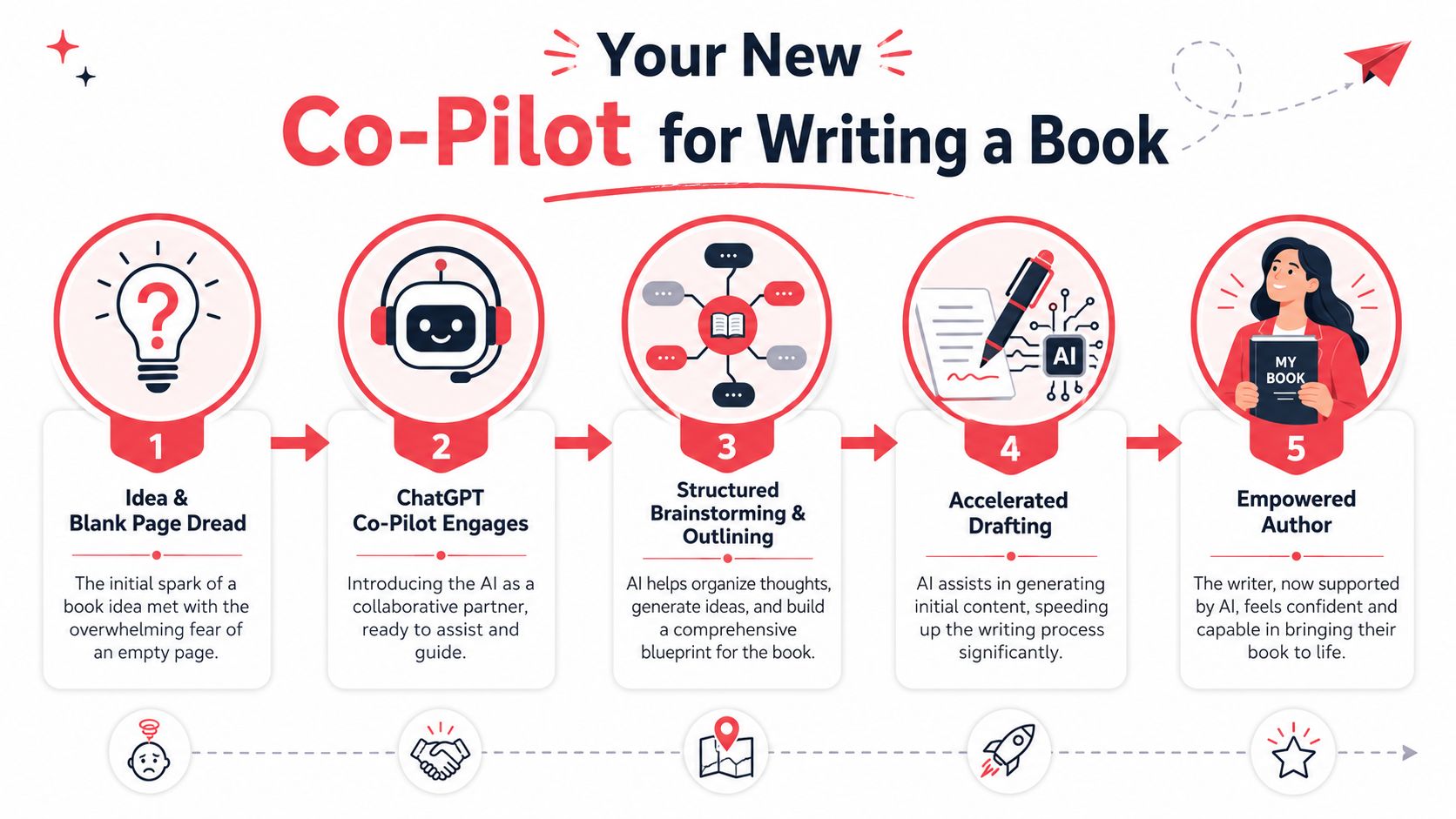
Your New Co-Pilot for Writing a Book
The blank page still exists. ChatGPT just changes what happens next.
Used well, it gives you momentum where writing usually stalls first: ideation, organization, and ugly first drafts. A 2024 review in PMC notes that ChatGPT can assist with literature reviews, outlining, summarizing findings, and grammar correction, while also warning that human review remains necessary because the system can produce inaccuracies. That matches what experienced writers have been seeing in practice for a while.
What ChatGPT is good at
When authors talk about writing a book with ChatGPT, they're often talking about very practical jobs:
- Breaking the freeze: asking for angles, chapter concepts, or better ways to frame the central promise
- Compressing raw material: feeding in notes, interviews, or research and asking for summaries
- Creating scaffolding: turning a loose concept into parts, chapters, scenes, or argument steps
- Generating rough prose: producing something to react to instead of staring at an empty document
That's why AI has become part of many author workflows so quickly. It shortens the distance between idea and draft.
What it is not good at
The mistake is assuming speed equals quality. It doesn't.
ChatGPT doesn't know which sentence carries your lived experience. It doesn't know which scene should stay quiet instead of becoming dramatic. It doesn't know whether a claim sounds true because it's well phrased or because it's correct. You know that, or you need to verify it.
Practical rule: Use ChatGPT to create motion. Use human judgment to create a book.
That's the partnership model that lasts. AI helps you surface options. You decide what belongs.
If you want a broader look at where AI fits into creative workflows beyond books, this roundup of AI tools for content creators is a useful companion.
Building Your Book's Blueprint with AI
Most weak AI-assisted books fail before the first chapter. The problem isn't prose. The problem is structure.
If your premise is fuzzy, your argument drifts. If your character motives are shallow, dialogue turns generic. If your nonfiction chapters don't build logically, the whole manuscript feels padded. ChatGPT can help here, but only if you ask it to work like an architect, not a ghostwriter.
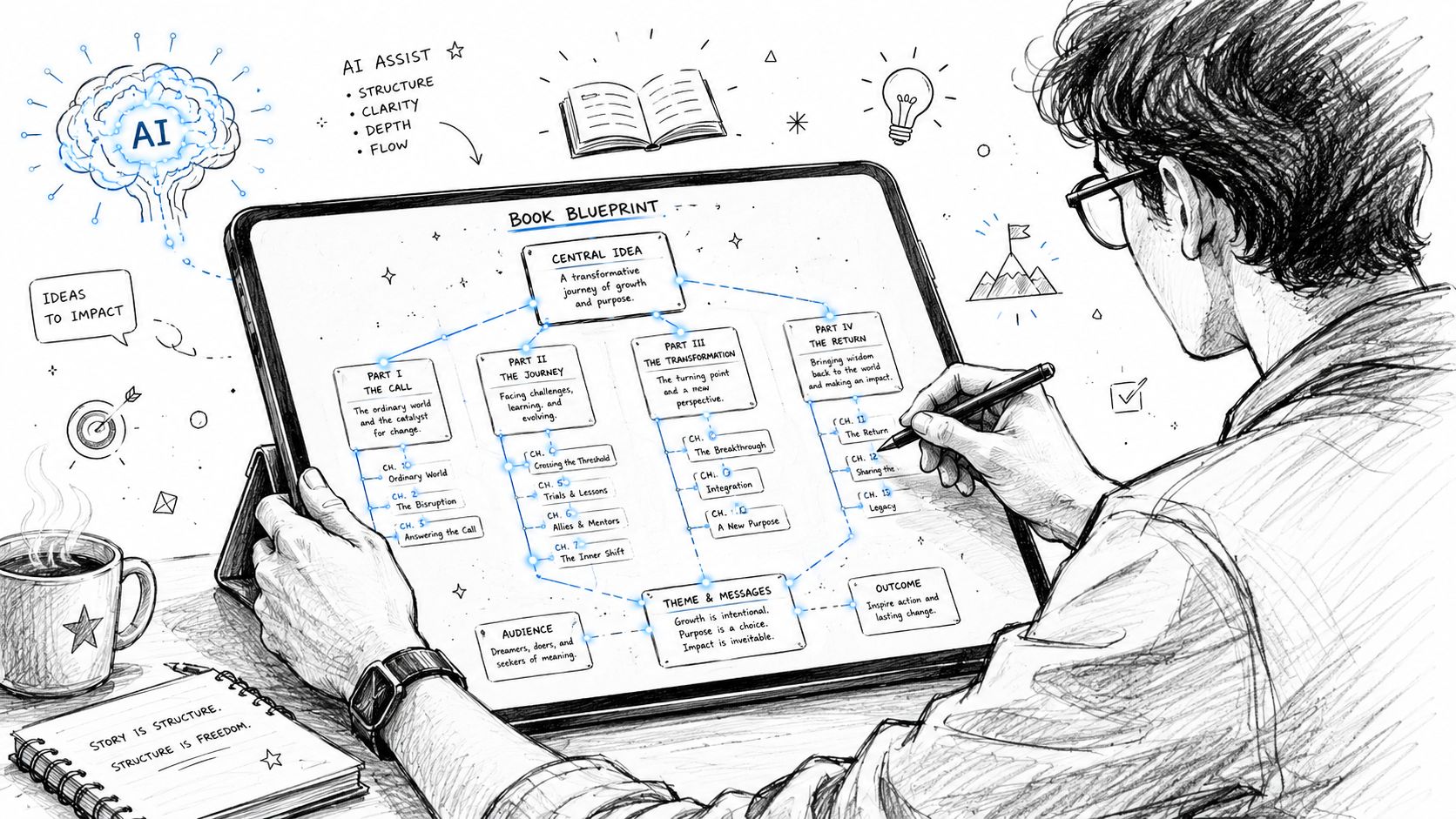
Jane Friedman notes that ChatGPT's release as a public “research preview” made AI-assisted drafting broadly accessible and pushed writers to experiment with idea generation, title brainstorming, and outline creation, while also finding that substantial rewriting is often needed to avoid generic phrasing in the result. Her discussion of that shift is worth reading in full at Using ChatGPT for Book Research.
Start with a one-sentence promise
Before asking for chapters, write one sentence that answers this:
What will the reader have, understand, feel, or be able to do after finishing the book?
For nonfiction, that sentence becomes your spine. For fiction, it becomes the emotional and narrative contract.
Then prompt ChatGPT with constraints.
I'm writing a book for [reader type]. The core promise is: [one sentence].
Give me 3 possible book structures.
For each structure, include:
- chapter sequence
- what each chapter must accomplish
- where the momentum might sag
- what should be cut if the book becomes repetitive
That prompt is stronger than “give me an outline” because it forces the model to think in terms of reader outcome and pacing.
Build character and world logic, not just lore
For fiction, writers often use AI to generate too much surface detail and not enough pressure. A fantasy city with six districts and a trade history is less useful than knowing who controls food, who enforces law, and what secret your protagonist can't survive being exposed.
Try prompts that test stress points.
Create a character sheet for this protagonist: [description].
Include:
- public identity
- private fear
- contradiction in personality
- what they want
- what they actually need
- what would make them betray their values
- how their voice changes under pressure
Or for setting:
I'm building a setting for [genre].
Don't give me decorative details first.
Give me the power structure, the economic pressure, the taboo, the source of public tension, and 5 plot problems that would naturally emerge from this world.
That approach gives you material that creates scenes.
Use AI to interrogate weak spots
A good blueprint answers “why now?” and “what breaks if this chapter disappears?” ChatGPT is useful when you turn it into a skeptical editor.
Ask:
- What's missing: “What major question would a smart reader still have after this outline?”
- What feels repetitive: “Which chapters overlap in purpose?”
- Where belief may fail: “What feels emotionally unearned in this character arc?”
- What could sharpen: “Suggest stronger chapter turns with more tension or surprise.”
Here's a compact planning table you can use before drafting.
| Blueprint element | What to define with ChatGPT | What you must decide yourself |
|---|---|---|
| Book promise | Variations, audience framing, chapter angles | The actual promise worth making |
| Outline | Sequences, alternate structures, missing transitions | Final order and scope |
| Characters | Backstory prompts, internal conflict options, voice traits | Emotional truth and specificity |
| World or subject map | Systems, pressures, dependencies, scene opportunities | Which details matter to readers |
| Chapter purpose | What each chapter should deliver | What stays, cuts, or combines |
If you're still at the “can I really do this?” stage, this piece on how anyone can write a book is a useful mindset reset.
Drafting Chapters and Dialogue with ChatGPT
The best drafting workflow isn't “write chapter five.” It's much narrower.
A practical method described by Esther Jacobs is a reverse-writing approach: start from the back-cover promise, create a structured outline, and then generate the manuscript in small sections instead of asking for a full chapter at once. She also recommends iterative follow-up prompts like “simplify this explanation” or “add an example” to improve draft quality, because this stepwise process reduces context overload and improves coherence. Her write-up on how she wrote a book in one week with ChatGPT captures that workflow clearly.
Draft scenes, not chapters
A chapter is too large a target. It often contains multiple beats, shifts in tone, transitions, and sub-arguments. ChatGPT does better when you define one unit of work at a time.
For nonfiction, that unit might be:
- a chapter opening anecdote
- a two-paragraph explanation
- a comparison section
- a practical example
- a closing takeaway
For fiction, it might be:
- one confrontation
- one reveal
- one transition scene
- one dialogue exchange with a clear power shift
Write a scene of about [your desired length] where Character A confronts Character B about [specific issue].
Context: [2 to 4 sentences].
The scene must:
- begin late, after the small talk
- include subtext
- avoid melodrama
- end with a changed power dynamic
Keep Character A's voice restrained and Character B's voice evasive.
That prompt gives the model enough shape to be useful without surrendering control.
Feed the model the right context
Most disappointing AI prose comes from weak setup. If you don't define voice, stakes, and purpose, the model fills the gap with average internet language.
Before each drafting prompt, provide:
Role in the manuscript
“This is section 2 of chapter 4. The reader already knows X but not Y.”Desired function
“This section should make the reader trust the method, not overwhelm them.”Voice guardrails
“Write in plain English. Avoid hype. Use short paragraphs. Don't sound academic.”Material to draw from
Paste your own notes, interview points, argument bullets, or earlier prose.
That last part matters most. The more your material leads, the more your book sounds like you.
Prompt templates that actually help
For nonfiction explanation:
Draft a section explaining [topic] for [audience].
Use this structure:
- open with the real problem
- explain the mistake people make
- give the better approach
- include one concrete example
Tone: practical, direct, experienced.
Avoid clichés and inflated claims.
For dialogue revision:
Rewrite this dialogue so each speaker sounds distinct.
Character A is concise and guarded.
Character B uses longer sentences and avoids direct answers.
Keep the meaning, increase tension, and remove any lines that sound generic.
[paste dialogue]
For description:
Describe this setting through the point of view of [character].
Focus only on details this character would notice.
Let the description reveal mood and hidden conflict, not just appearance.
Avoid purple prose.
Keep momentum with iterative passes
You don't need a perfect section on the first try. You need a useful one.
When a draft is almost right, don't throw it away. Push it.
Add a sharper example in the middle.
Simplify the second paragraph.
Make the argument less repetitive.
Rewrite this in a warmer voice.
Cut the generic opening and start with the conflict.
Turn this into a tighter scene with more subtext.
Those follow-ups are where substantial gains happen. The first output is often a sketch. The second and third passes create workable material.
What works and what fails
The contrast is usually obvious.
| Approach | Result |
|---|---|
| “Write a full chapter on productivity” | Bloated, repetitive, generic |
| “Draft a 400-word section on why busy founders abandon systems, then give one realistic fix” | Focused and usable |
| “Write a romance scene” | Familiar tropes, vague chemistry |
| “Write a scene where one character hides fear behind humor while the other notices but says nothing” | More specific emotional texture |
A rhythm that keeps the draft moving
A stable drafting loop looks like this:
- Prepare a mini-brief: one section, one purpose, one audience state
- Generate rough text: ask for a controlled chunk
- Interrogate the output: where is it flat, repetitive, or fake?
- Refine in place: revise with targeted follow-ups
- Paste into your manuscript only after judgment: never let the chat become the book itself
Good AI drafting feels less like outsourcing and more like directing a fast junior collaborator.
That's the mindset that helps. You're still the author. The model is helping you produce clay faster. You still have to sculpt it.
The Human Touch Editing and Refining Your AI Draft
Here, your book either becomes yours or stays machine-assisted sludge.
Raw ChatGPT output almost always has giveaways. The rhythm is too even. The phrasing is too balanced. The examples feel plausible but bloodless. Transitions announce themselves. Emotional beats arrive on schedule instead of earning their place. If you publish that version, readers will feel the distance even if they can't name it.
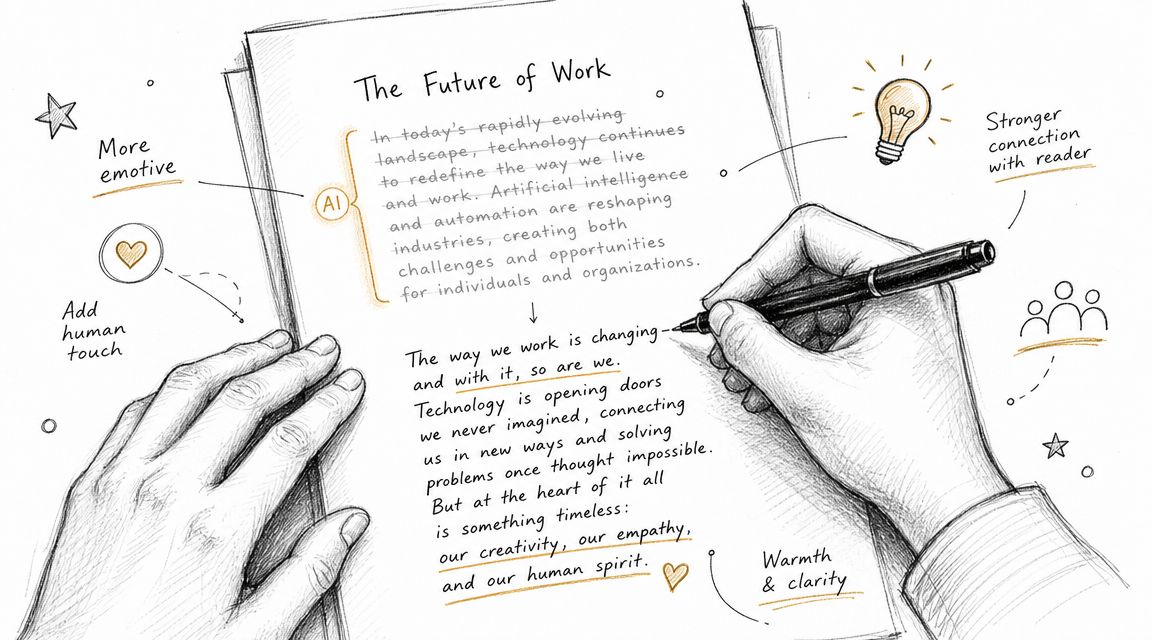
That's why untreated output is such a common failure. Guidance from experienced creators stresses that AI-generated text needs human editing for flow, originality, and accuracy, and one demonstration found that copied ChatGPT text scored 95% AI-generated on an originality scan, which is a useful warning about what happens when writers paste raw output straight into a manuscript. The discussion is covered in this video on using ChatGPT to write a book.
What your edit needs to fix
The line edit matters, but the deeper edit matters more.
Look for these problems first:
- Voice drift: sections sound competent but not recognizably yours
- Repetition: the same point appears in slightly different wording
- False confidence: claims are stated smoothly but need verification
- Predictable structure: paragraphs open and close in formulaic ways
- Thin specificity: examples could belong in any book by any author
Raw AI text is rarely the problem because it's ugly. It's the problem because it sounds finished before it has earned trust.
An editing checklist that actually catches the issues
Run every chapter through a human-led pass using questions like these:
Voice and originality
- Would I say this?
- Where does this sound like a polished average instead of a specific person?
- Which paragraphs need lived experience, sharper opinion, or a stronger example?
Narrative or argument flow
- Does this chapter move, or does it circle?
- What can I cut without losing meaning?
- Does each section create a reason to read the next one?
Factual trust
- Which claims require checking?
- Did the model introduce names, places, references, or details I didn't supply?
- Have I verified every nonfiction assertion independently?
Language texture
- Are sentence lengths too uniform?
- Do transitions feel over-explained?
- Are there stock phrases I need to replace with cleaner prose?
Add what AI can't supply
The strongest revision move is often insertion, not deletion.
Add:
- a moment you witnessed
- a mistake you made
- an observation that came from practice
- a phrase only you would choose
- a structural choice that reflects your thinking, not default AI symmetry
That's how the manuscript stops feeling assembled and starts feeling authored.
Rewrite at the paragraph level
Don't try to “lightly polish” weak AI copy. If a paragraph is generic, rebuild it.
A useful pattern is:
| If the draft has | Do this instead |
|---|---|
| Generic explanation | Replace with your own example or analogy |
| Flat dialogue | Recast each speaker's motives, then rewrite |
| Repetitive summary | Cut two-thirds and keep the sharpest line |
| Smooth but dubious claim | Verify or remove |
| Lifeless opening | Start later, with tension or a real observation |
One of the best ways to edit AI-assisted writing is to stop treating generated paragraphs as precious. They are disposable. Keep what serves the book. Rewrite what doesn't. Delete without hesitation.
Navigating Publication and Platform Rules
A polished manuscript still isn't ready to publish until you've handled the operational side.
At this stage, many AI-assisted authors get careless. They spend hours refining chapters, then rush the final mile. That's risky, especially if you're publishing through a platform like Amazon KDP, where disclosure, originality concerns, and quality issues matter after the draft is done.
A recent overview of AI-book publishing highlights those concerns directly. It notes platform warnings around AI-assisted publishing, recommends final checks for plagiarism and factual accuracy, and cites reporting that found hallucinations in up to 27% of responses and factual errors in 46% in one study discussed there. You can review that context in The Ghostwriters Agency's article on whether ChatGPT can write a book.
Use AI for publishing support, not final trust
ChatGPT can still help in the publication phase. It's useful for:
- Title exploration: generating subtitle variations or contrasting title angles
- Book descriptions: drafting blurbs in different tones for testing
- Back-cover copy: compressing your promise into short persuasive language
- Cover briefing: helping you write a cleaner design brief for a human designer
Those are support tasks. They benefit from speed and iteration.
They still need review, because publishing metadata is part of the reader experience. A weak subtitle or generic blurb can make a strong book look forgettable.
A practical pre-publish review
Before uploading anything, run a final quality-control pass.
Read the whole manuscript outside the chat tool
Export it. Print it if needed. Problems stand out more clearly when the text leaves the generation interface.Check every nonfiction claim
If a detail came from AI and you can't verify it, cut it.Scan for accidental duplication
AI drafts often restate the same idea in different language across chapters.Review for originality and overfamiliar wording
If a section sounds like generic online advice, revise until it has a distinct voice.Review platform requirements directly
Policies change. Read the current submission and disclosure rules on the platform where you plan to publish.
Treat compliance as part of editing, not a bureaucratic afterthought.
What responsible AI-assisted publishing looks like
Responsible publication is simple to describe, even if it takes work.
- You control the manuscript: AI helps draft, but you make the decisions.
- You verify facts: especially in nonfiction.
- You rewrite heavily where needed: especially anything that sounds canned.
- You check marketplace rules before upload: don't rely on outdated summaries.
- You publish only what you're willing to stand behind as the author.
That last point is the test that matters most. If a reader questions a line, a scene, or a claim, your name is on the cover.
From Book to Comic with PersonalizedComics
Once the book is finished, there's a creative next step many authors don't consider until much later. Adaptation.
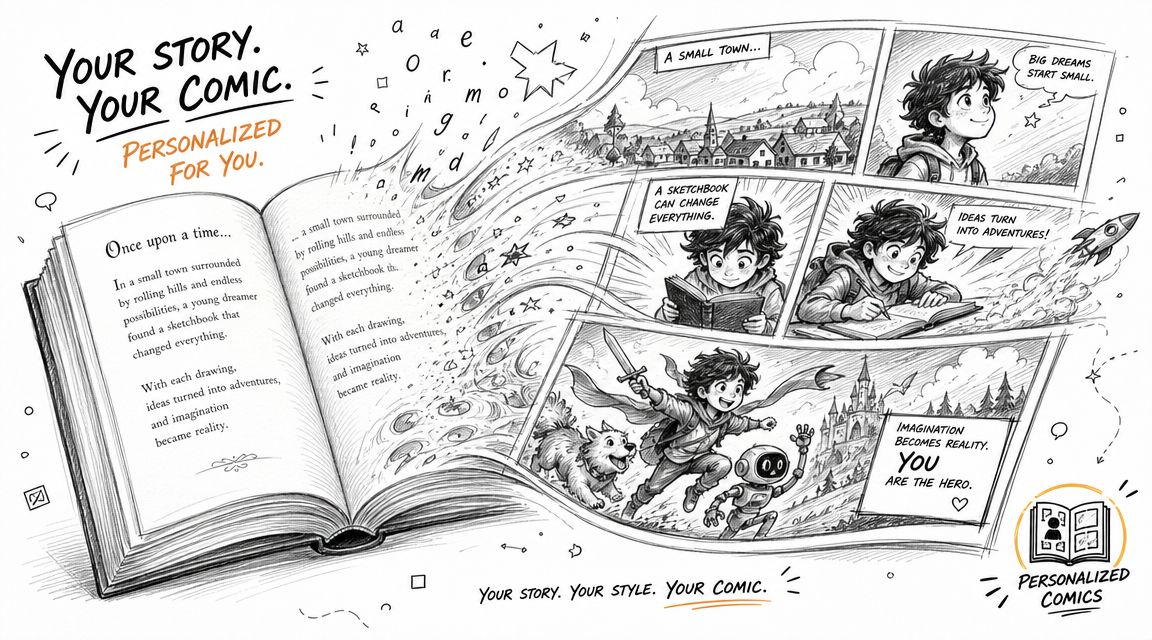
A completed manuscript already contains the raw material for a visual version of the story: character descriptions, scene beats, dialogue, emotional turns, and memorable settings. That makes a book a strong starting point for a comic adaptation, whether you're working from fiction, memoir, or even a how-to concept with a strong narrative thread.
How the adaptation usually works
Take a novel chapter with one strong turning point. Instead of treating it as prose, break it into visual beats.
A scene like “the protagonist discovers a hidden letter, misreads its meaning, and confronts her brother” becomes:
- panel setup in the room
- close-up on the letter
- reaction shot
- confrontation dialogue
- final panel with emotional fallout
That conversion process is often easier than writing from scratch because the story decisions are already made. You're not inventing plot anymore. You're selecting moments.
What translates best from prose
Some parts of a book adapt immediately:
- Character descriptions become design prompts
- Dialogue becomes speech bubbles
- Chapter beats become page sequences
- Setting notes become environmental cues
- Internal conflict becomes narration captions or visual contrast
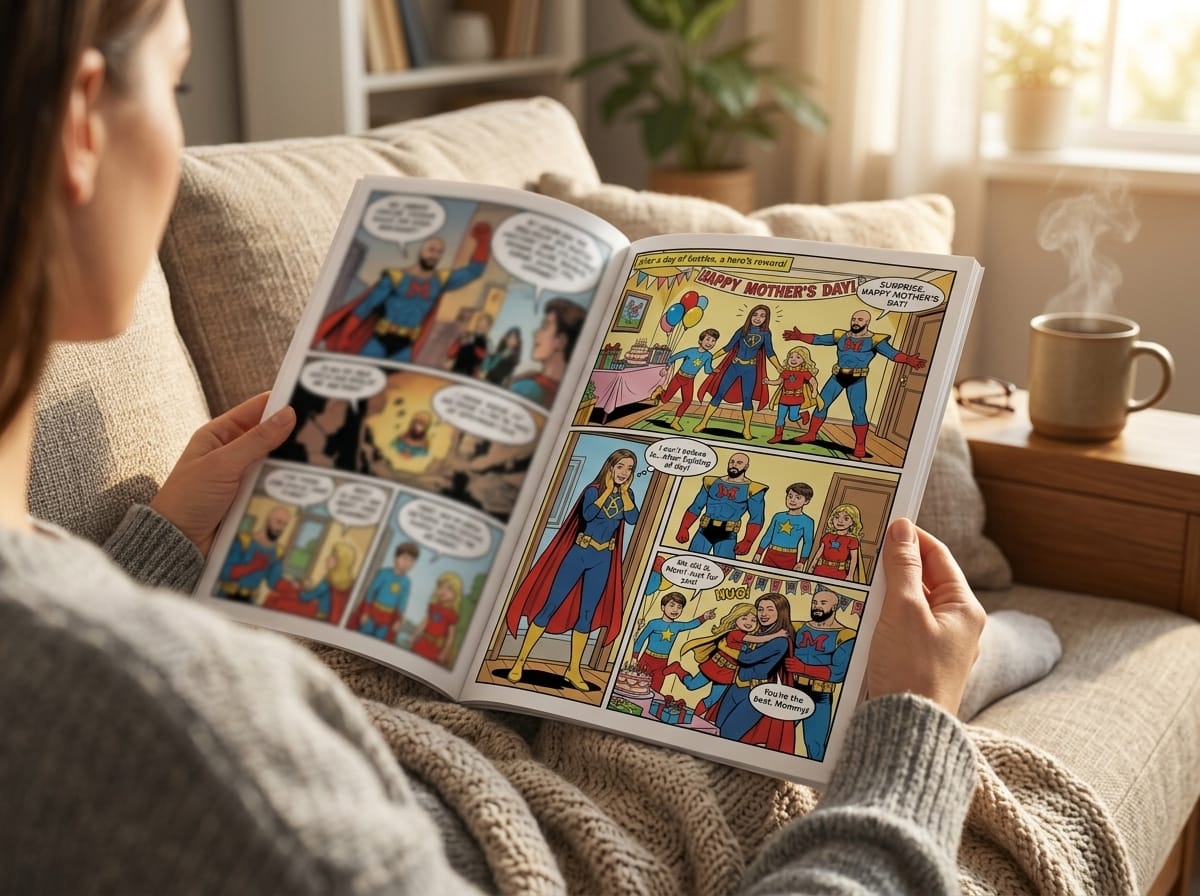
Writers who want to prototype this kind of visual companion can explore tools specifically built for comic creation. If you're curious about that workflow, AI book maker tools for comic-style storytelling show how authors can turn story concepts into illustrated pages without needing to draw.
Why this step is useful
A comic adaptation can serve different purposes.
It can become a bonus product for readers. It can help you test whether your story's visual moments are strong enough for a graphic treatment. It can also sharpen your own sense of scene clarity, because comics expose vagueness fast. If you can't decide what belongs in the panel, the prose may not be as clear as you thought.
For many authors, that's the most interesting part. Adapting prose into panels forces a different kind of storytelling discipline.
Common Questions About Writing with AI
Can ChatGPT write an entire book for me
It can generate enough text to resemble a book. That's not the same as writing a publishable one.
The useful approach is selective collaboration. Let it help with outlines, rough sections, scene variants, and revision passes. Keep authorship with your decisions, your structure, and your rewrite.
Is writing a book with ChatGPT cheating
That depends on how you use it, but in practice the better question is whether the final work reflects real authorship.
If you use AI as a brainstorming and drafting tool, then shape, verify, and rewrite the manuscript yourself, you're still doing the core authorial work. If you paste unreviewed output into a manuscript and publish it as finished, you're not building a serious book. You're shipping generated text.
How do I keep the book from sounding like AI
Use more of your own material earlier. Feed the model your notes, examples, scenes, and opinions instead of asking it to invent everything.
Then edit with intent:
- cut symmetrical, over-explained paragraphs
- replace generic examples with specific ones
- vary rhythm and sentence length
- make stronger choices about tone
- add observations drawn from experience
That's usually the dividing line. AI can help you draft. Only you can make the book feel inhabited.
If you've finished a manuscript and want to see it in a new form, PersonalizedComics offers a practical way to turn story ideas, characters, and scenes into fully illustrated comic pages. It's a strong option for writers who want a visual companion to their book, a graphic prototype, or a one-of-a-kind edition readers can experience in a different medium.
Filed under AI & Tools