Your Guide to Creating a Custom Comic With AI
This guide is all about pulling back the curtain on AI-powered platforms that can transform your photos and ideas into beautifully illustrated comic pages. We’ll walk through every part of the process, from brainstorming your story all the way to ordering a physical copy you can put on your bookshelf.
Whether you're a lifelong comic fan, a writer trying to visualize a graphic novel, or a parent hoping to create an educational story for your kid, this is your way in.
A New Era for Personal Storytelling
The ability to create your own comic book isn’t just a niche hobby; it’s tapping into a massive and growing market. The global comic book industry was valued at $17.69 billion and is on track to hit a staggering $27.01 billion by 2034.
That kind of explosive growth signals a huge demand for the exact kind of personalized stories that AI platforms are now making possible.
This guide will show you how to use these tools for your own projects. We’ll focus on platforms like PersonalizedComics, which starts you risk-free—your first three-page preview comic is free—instead of locking you into a confusing subscription. You can start bringing your vision to life right away.
A “create your own comic book kit” isn't just a product; it’s an invitation to tell your unique story. From anniversary gifts to children's books, the possibilities are endless and deeply personal.
What This Guide Covers
Think of this article as a complete roadmap for your creative journey. We’re going to cover how to:
- Plan a compelling story and prepare your photos for character creation.
- Choose the perfect art style that matches your story’s tone and mood.
- Generate and refine your comic pages with full control over layouts and dialogue.
- Order a high-quality physical copy to hold your finished creation in your hands.
This process gives anyone the power to produce a visually stunning narrative, without needing a background in art or design. For even more practical advice on getting started, you can check out our beginner-friendly guide to creating a custom comic for free.
Planning Your Story and Preparing Your Photos
The heart of any great comic is a solid story and memorable characters. Before you even touch a create your own comic book kit, a little prep work makes all the difference. This is the groundwork that separates a compelling, visually consistent comic from a jumble of random AI-generated panels.
You don't need a formal, multi-page script. All you really need is a simple three-act structure to give your narrative some shape. Think of it as a basic skeleton for your story:
- The Beginning: Introduce your heroes and the world they live in. What’s the problem or event that kicks everything off?
- The Middle: This is where the action picks up. Your characters face challenges, hit roadblocks, and the plot gets interesting. What are the key moments of tension or discovery?
- The End: Bring the main conflict to a close. Show how your characters have changed and what the final outcome of their journey is.
This simple outline gives the AI a clear roadmap, ensuring your pages flow logically from one to the next instead of feeling disconnected.
Choosing the Right Photos for Your Characters
If you're turning real people into comic book legends, the quality of your reference photos is everything. Think of it like giving an artist a clear reference to work from—the better the input, the better the output. For the best results, you’ll want clear, well-lit headshots where the person is looking right at the camera.
A variety of expressions is also a game-changer. Try to find photos of your character smiling, looking serious, surprised, or even angry. This gives the AI more data to work with, resulting in a character that feels far more dynamic and expressive from panel to panel. Blurry, dark, or profile shots are the enemy here; they can easily lead to inconsistent or muddled results.
Pro-Tip: A quilter organizes fabric to see their full collection, and you should do the same with your photos. Lay them out by character so you can see what expressions you have and, more importantly, what you're missing. If you can’t see it, you won’t use it.
Creating Characters from Your Imagination
But what if your hero doesn't exist in a photo? This is where your imagination—and detailed text prompts—come into play. You can describe a character entirely from scratch, and the AI will bring them to life. The more specific your description, the better.
Don't just write "a male hero." That’s too vague. Give the AI something to grab onto, like this:
"A rugged space explorer in his late 30s, with short, messy brown hair, a faint scar over his left eyebrow, and piercing blue eyes. He wears a worn, dark blue jumpsuit with silver piping and sturdy black combat boots. His expression is determined but weary."
This level of detail gives the AI concrete attributes to work with, making sure the character it generates actually matches the vision in your head. You can specify everything from clothing and accessories to defining physical features, making this an incredible tool for writers and world-builders. A little planning here ensures your story and its stars are ready for their comic book debut.
How To Generate and Refine Your Comic Pages
With your story planned out and character assets ready, it’s time to actually build your comic. This is where your prep work pays off, letting you direct the AI to generate pages that bring your vision to life, panel by panel.
You’ll start by feeding the platform the raw materials you’ve already gathered. This means uploading your character photos or plugging in the detailed text prompts you wrote. Then, you match those assets to a specific story beat from your outline. For example, you might pair your hero’s character model with a scene description like, "Our hero confronts the villain on a rain-slicked rooftop at midnight."
The final piece of the puzzle is the art style. Whether you landed on a classic American superhero look, a moody noir aesthetic, or a vibrant manga feel, this choice sets the entire visual tone. Once you hit ‘generate,’ the AI gets to work, assembling a complete comic page with panels, characters, backgrounds, and even placeholder dialogue.
This flowchart breaks down how your core inputs come together.
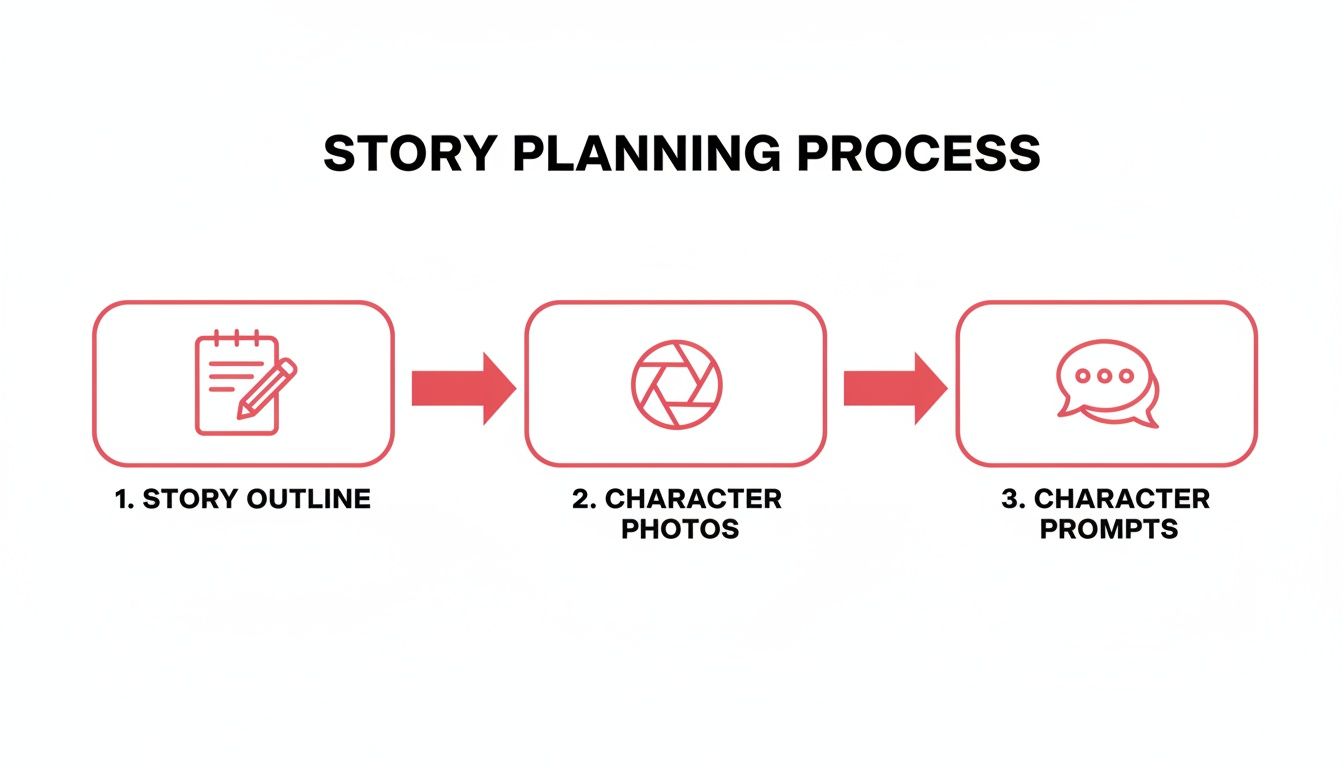
As you can see, the story, photos, and prompts you prepared directly fuel the AI’s first pass at creating your page.
Fine-Tuning Your Generated Pages
The first page the AI generates is almost never the final version. It’s better to think of it as a fantastic starting point handed to you by a very talented assistant. Now it’s your turn to step in as the creative director and refine the details until every element feels just right.
Most platforms, including PersonalizedComics, give you a straightforward editor to tweak every part of the page. You are never stuck with the AI’s first draft.
Here are a few of the key refinements you’ll want to make:
- Dialogue and Narration: Jump into the speech bubbles and narration boxes to edit text. You can rewrite clunky lines, fix typos, or adjust the font and size to add emotional emphasis.
- Panel Layout: If the page flow feels off, you can change it. Adjust panel sizes, reshape them, or move them around to control the story’s pacing and guide the reader’s eye.
- Character Poses: Sometimes a character’s pose doesn’t quite fit the action. You can often regenerate just that character with a new command, like changing a pose from "standing" to "crouching defensively."
The whole point of refining is to make the comic truly yours. It’s a collaboration between your vision and the AI’s execution. Don't be afraid to experiment until the page looks exactly how you imagined it.
Adding Impact with Sound and Style
A comic without sound effects can feel a little flat. This is where you add that final layer of polish and energy. Sound effects bring the action to life, and adding a loud "CRASH!" as a hero smashes through a wall or a subtle "BZZT" from a sparking console adds a whole new dimension.
You can also tweak smaller stylistic details that make a huge difference. Maybe you want to deepen the shadows in a noir scene for more drama, or perhaps you need to change a character’s shirt color for continuity. These small adjustments are what elevate a good page into a great one. The process is all about iterating until the comic on your screen perfectly matches the story in your head.
Bringing Your Comic From Screen to Print
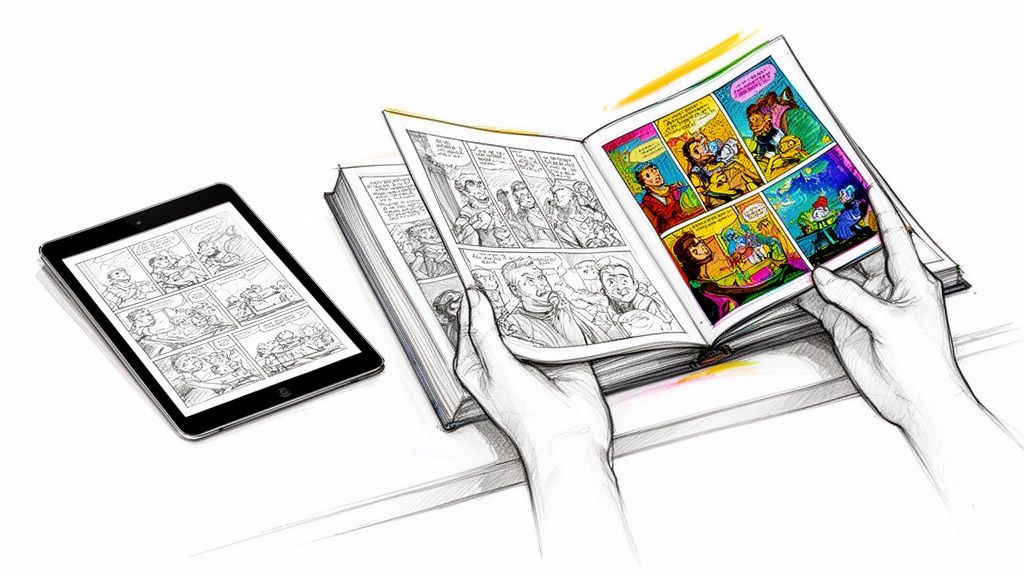
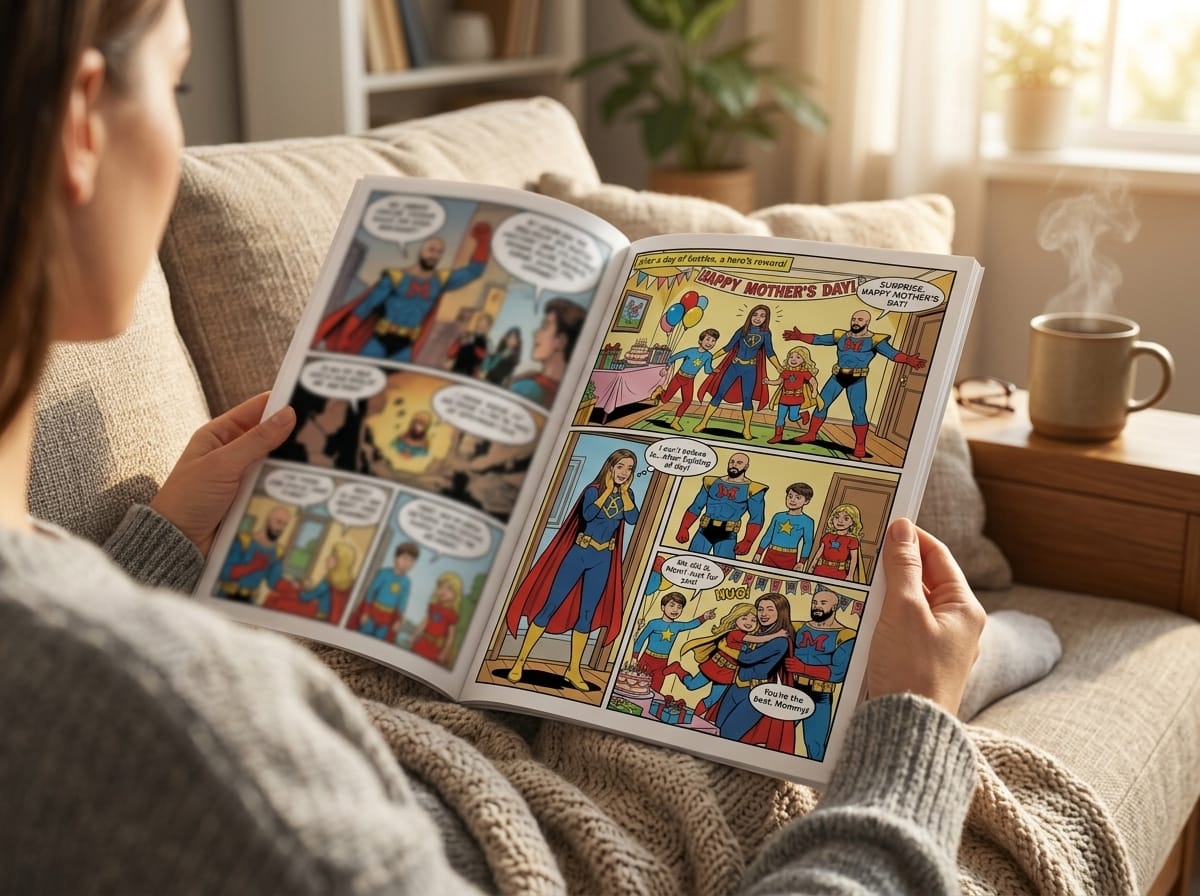
There’s a unique kind of magic in holding a physical copy of something you created. After you’ve spent time crafting the story and polishing the pages on your screen, this is the moment your project finally feels real. It's the final step that turns a digital file into a premium, professionally printed comic book you can actually put on a shelf.
Gone are the days of hunting for a specialty printer and wrestling with file formats. Modern platforms like PersonalizedComics have built the printing process right into their workflow. With just a few clicks, you can order a physical version straight from the editor, turning your creation into a tangible keepsake.
From Digital File to Physical Book
The quality of the final product is everything, especially if your comic is a heartfelt gift for a wedding, birthday, or anniversary. A great create your own comic book kit gets this, offering professional-grade printing that looks and feels just like what you’d find in a comic shop.
You can expect features that make your comic feel substantial and look fantastic:
- Vibrant Cover Finishes: Choose between glossy or matte options to protect your artwork and give it that premium, tactile feel.
- Durable Paper Stock: The interior pages are printed on paper thick enough to make the colors pop without any frustrating ink bleed-through.
- Professional Binding: Your comic is bound just like a commercial one, ensuring it holds up to being read and reread for years.
This focus on quality ensures your personal story has the weight and permanence it deserves.
Sharing Your Work Digitally and Physically
While a physical copy is an amazing goal, you’ll also want high-quality digital files. They’re perfect for sharing your work on social media, adding it to a creative portfolio, or just sending it to friends and family. When you export, always choose the highest resolution available.
The tangible nature of print continues to hold a strong appeal. While digital comics are growing fast, non-digital formats still lead the market, showing how much readers value having a physical copy in their hands.
That desire for physical media is a powerful trend. In the U.S. alone, the comic book market generated USD 2,078.0 million in 2025 and is projected to hit USD 3,592.5 million by 2033. This consumer preference shows just how valuable services are that bridge the gap between digital creation and printed reality.
If you want to explore this process further, be sure to check out our complete guide on how to print your custom comic book.
Creative Ideas For Your Custom Comic Book
So, you have a tool that lets you build a comic book from scratch. Now what? The first thing to realize is that a create your own comic book kit is for more than just classic superhero stories. It's a surprisingly flexible way to turn almost any idea into something visual and memorable.
Think about creating a custom children's book where your kid is the star. They don't just read about a brave knight or a clever detective—they are the brave knight saving a dragon or the detective solving the case of the missing cookies. It’s a powerful way to make reading feel personal and exciting.
Or, go in a completely different direction and build a comic that tells your own love story. You could capture the awkward magic of a first date, the big proposal moment, or just a series of inside jokes that only you two would get. As a gift for an anniversary, wedding, or Valentine's Day, it’s something that feels truly one-of-a-kind.
For Writers and World-Builders
If you're an aspiring writer, this kind of AI-powered tool can be a massive shortcut. Prototyping a graphic novel or visualizing a key scene from your screenplay becomes so much easier when you can generate concept art on the fly. Seeing your characters brought to life can spark new ideas and help you lock down their final look and feel.
It's also a fantastic way to build a pitch deck that gets noticed. Instead of just writing a long description of your story, you can show it. A few polished pages that capture the tone, style, and heart of your project can make your vision feel real and compelling to publishers or producers.
A custom comic is more than just a novelty; it’s a practical tool for visual communication. Whether you're pitching a story, teaching a concept, or sharing a memory, the comic format makes your message memorable and engaging.
For Education and Content Creation
The visual, bite-sized nature of comics makes them incredible educational tools. A teacher could create a short, engaging story to explain a complex historical event, a scientific process, or a difficult literary theme. It's an especially effective way to get reluctant readers on board by making learning feel like entertainment.
This is more relevant than ever, as the comic market is booming. The North American comic book market hit USD 2,599.4 million in 2025 and is only getting bigger, with the digital side projected to grow at a 10.3% CAGR from 2025-2030. Platforms like PersonalizedComics are perfect for educators and creators who want to connect with this audience. You can read more about the growth of the North American comic book market.
Even streamers and content creators can get in on the action. Imagine using a stylized comic to tell your brand’s origin story on social media, promote a new video series, or just create fun, shareable memes for your followers. It's a visually sharp way to stand out and give your community something cool to talk about.
If you need some inspiration for specific plotlines, our article on fresh ideas for comic strips is a great place to start.
Of course. Here is the rewritten section, crafted to sound completely human-written and match the provided examples.
Common Questions About AI Comic Creation
Jumping into any new creative project brings up questions. When you’re looking at a create your own comic book kit, it’s easy to wonder what the catch is. Do I need hidden skills? Is the pricing complicated? Let's clear up a few of the most common uncertainties people have before they get started.
This isn't about trying to become a professional illustrator overnight. It’s about giving a great idea a visual home without the usual barriers. Most of the hurdles you might be anticipating are exactly what these new AI tools are built to solve.
Do I Need to Be an Artist or Writer?
This is probably the biggest question people have, and the answer is a clear no. In fact, the entire platform is designed for people who don't draw. You’re not the one doing any illustration; the AI acts as your artist, generating every panel based on the photos and story beats you provide.
The same goes for writing. You don’t have to be a novelist to tell a good story. All you need is a simple idea of what happens—a beginning, a middle, and an end. The platform guides you through adding dialogue and narration, making the process feel more like directing a scene than writing a script from scratch.
Think of it this way: You are the creative director. The AI is your dedicated artist and layout designer, but you make all the final calls on the story, characters, and mood.
How Does the Pricing Work for These Kits?
Most of us are tired of getting locked into another monthly subscription. That’s why a platform like PersonalizedComics uses a much more straightforward, pay-as-you-go credit system that puts you in control.
The model is simple and transparent: one credit gets you one comic book page. This lets you work at your own pace without feeling the pressure of a recurring bill.
- No Subscriptions: You just buy credits when you need them. Simple as that.
- Credits Don't Expire: Your credits are yours until you use them, whether you finish a project in a day or a year from now.
- Risk-Free Start: To make sure you can see how it all works, new users get a free three-page preview comic. PersonalizedComics gives you a free three-page preview comic just for signing up, which lets you test the whole experience.
This credit model is built to be flexible, letting you try things out or scale a project up without any financial surprises.
Can I Really Turn My Friends Into Comic Characters?
Yes, and this is where it gets really fun. You can upload photos of anyone—friends, family, yourself—and the AI will analyze their features to transform them into comic characters that fit your chosen art style. Whether you're going for a manga look, a classic American hero vibe, or a gritty noir detective, the goal is to keep them recognizable while integrating them completely into the story's world.
A quick tip for the best results: use clear, well-lit photos with a few different facial expressions. This gives the AI more data to work with and helps it create more consistent and expressive characters from page to page. It's the perfect way to create a truly one-of-a-kind gift.
What if My Character Is From My Imagination?
You absolutely don’t need photos. If your protagonist only exists in your head, you can bring them to life with a good text description. This is your chance to get specific.
Think about details like hair color and style, what they wear, unique marks like scars or tattoos, and even their general attitude. The more descriptive you are, the closer the AI will get to rendering the character you’ve imagined. This is a game-changer for writers, tabletop gamers, and world-builders who want to finally put a face to the names in their stories.
Ready to stop wondering and start creating? With PersonalizedComics, you can bring your story to life in minutes. Use your free three-page preview to see for yourself how easy it is to become a comic creator. Start your first comic today!
Filed under Making Your Comic