Fantasy World Building: Master Fantasy Worldbuilding
A lot of fantasy world building stalls before the story even starts. The creator opens a blank document, writes “Kingdoms,” “Magic,” “History,” and then freezes. Suddenly it feels like you need a map, a pantheon, seven trade routes, three extinct empires, and a language family before you're allowed to draw page one.
That's the trap.
Strong worlds rarely begin as encyclopedias. They begin as pressure. A city that can't survive winter. A religion that bans memory. A girl whose glowing eyes reveal the lie her family built a kingdom on. When the world grows from that kind of tension, it feels alive because it's already tied to action.
Comic creators hit a second obstacle that prose writers can often dodge. You don't just need a world that makes sense. You need one that reads instantly on the page. Costume, silhouette, architecture, symbols, weather, creature design, street clutter, all of it has to carry story weight fast. If you can't draw quickly, or don't draw at all, that can make fantasy world building feel closed off.
It isn't. You can build visually, iteratively, and incompletely. In fact, for comics, that's often the smarter path.
Your Guide to Building Worlds That Tell Stories
Most beginners think the problem is lack of imagination. Usually the problem is scale. They're trying to solve the whole world before they've solved the scene.
A working fantasy world starts smaller than people expect, but not in a shallow way. It starts with a handful of elements that create story motion. If your first chapter happens in a flooded shrine-city, you need to know how people move through water, who controls the bridges, what the flood means spiritually, and what your main character risks by crossing the wrong district. You don't need a complete agricultural record for the western continent.
Start with pressure, not inventory
When I look at worlds that feel convincing on the page, they usually answer one immediate question: what makes life difficult, meaningful, or strange here? That question produces usable material. Inventory doesn't.
Try framing your world with one of these story pressures:
- A social pressure: who is forbidden to marry, speak, travel, study, inherit, or use magic?
- An environmental pressure: what terrain, season, curse, or scarcity shapes daily life?
- A symbolic pressure: what mark, color, eye trait, oath, or relic changes how people are treated?
- A political pressure: who benefits from the world staying exactly as it is?
Build the part of the world your character can collide with. Everything else can wait.
That's especially true in comics. Readers don't experience your lore binder. They experience panels. A street market with bone lanterns and prayer masks tells me more than a page of abstract history if those details are connected to conflict.
Depth comes from consequences
New creators often mistake amount for depth. A world doesn't feel rich because it has more nouns. It feels rich because actions have consequences that fit the setting.
If a mountain pass is sacred, then an army marching through it should trigger outrage, taboo, or prophecy. If a city runs on harvested light, then darkness should have an economy. If nobles dye their irises with alchemy, then counterfeit eye color should create fraud, status anxiety, or black-market medicine.
That's the standard worth chasing. Not “more lore.” More cause and effect.
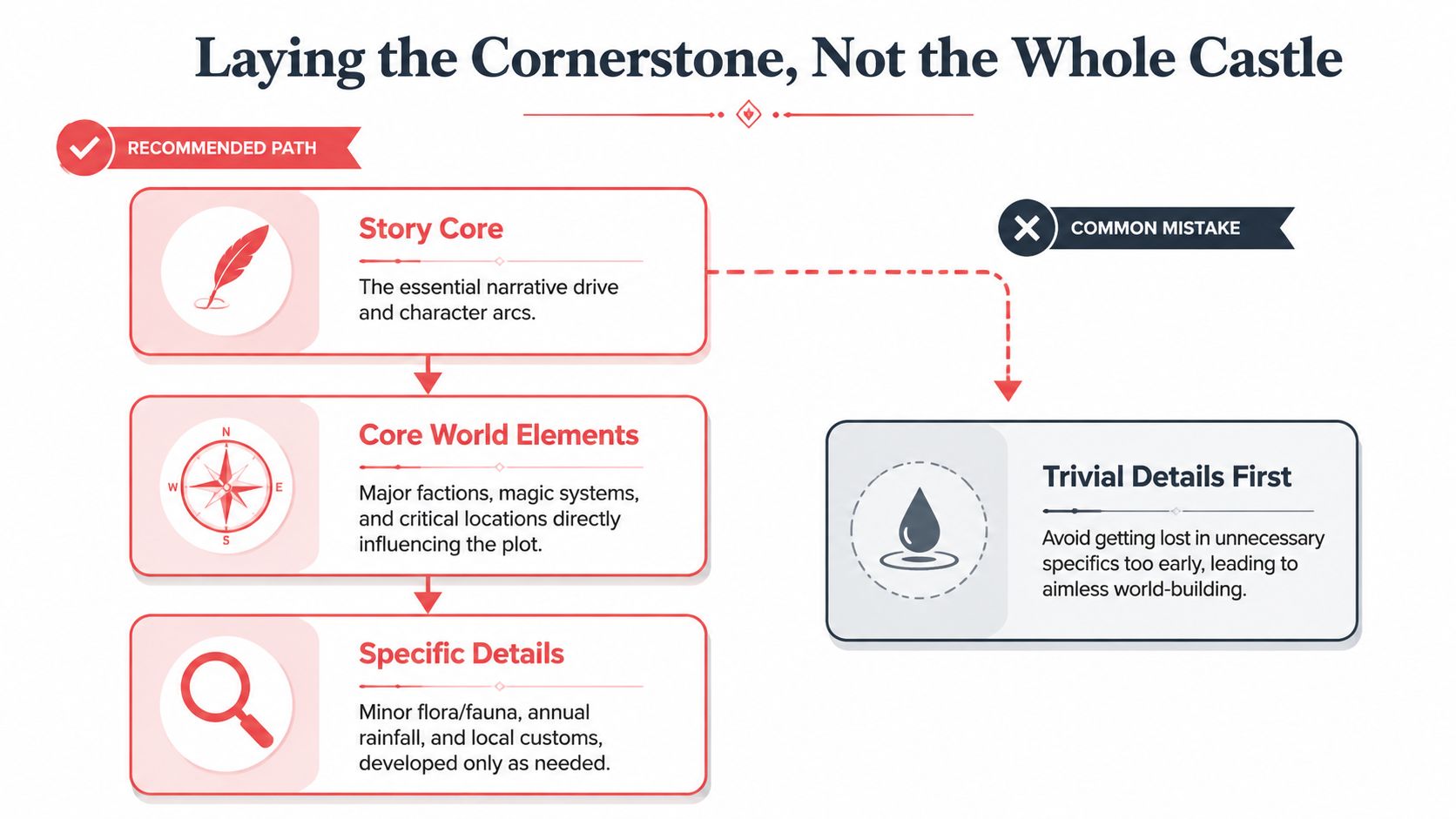
Laying the Cornerstone Not the Whole Castle
The cleanest way to avoid bloated fantasy world building is to choose the story before the furniture. In professional practice, that often looks like Agile Worldbuilding. The method is simple. Define the non-arbitrary core first, then expand only what supports it.
Expert analysis notes that 78% of amateur worldbuilders fail by prioritizing minute geographic details before establishing core narrative pillars, which leads to worldbuilding bloat where 65% of created content never appears in the final story (verified analysis reference).
The five pillars that actually matter
Before you sketch a map, write five lines.
Narrative hook
What's the immediate premise? Not the whole plot. Just the spark. “A courier must deliver a living relic across a kingdom that considers it heresy” is enough.Authorial intent
What are you trying to explore? Grief, class, faith, memory, empire, inheritance. If you don't know this, your world will sprawl sideways.Genre and tone
Dark mythic fantasy behaves differently from adventurous all-ages fantasy. The same floating city can feel wondrous, oppressive, absurd, or tragic depending on tone.Audience experience
What should readers feel while moving through the world? Claustrophobic awe? Playful discovery? Unease? The answer affects panel density, design choices, and how much mystery you preserve.Distinctive element
Choose one standout feature that acts like the visible tip of a larger logic system. A tide-based magic system. Cities grown inside fossilized gods. Judges who wear inherited animal faces.
A fast test for each pillar
If you're unsure whether a choice belongs, ask these questions:
- Does it create conflict? If not, it may be decoration.
- Does it affect behavior? Good world details change what people do.
- Can it appear on the page? If a comic can't show or dramatize it, keep it lighter for now.
- Does it fit the central mood? A whimsical mushroom postal service may not belong in a bleak plague saga.
Practical rule: if a detail doesn't support plot, character, theme, or visual identity, leave it in your scratch file.
Build only the next load-bearing beam
A lot of creators think restraint kills imagination. It does the opposite. Restraint forces invention that matters.
If your protagonist is escaping a tower-city, then you need to design the tower's class structure, surveillance methods, vertical transit, and skyline language. You don't need the tax policy of a desert republic mentioned once in chapter six. Keep asking, “What must exist for the next scene to work?” Build that, then move.
That approach leaves you with a world that feels intentional instead of crowded.
Breathing Life into Your World's Inhabitants
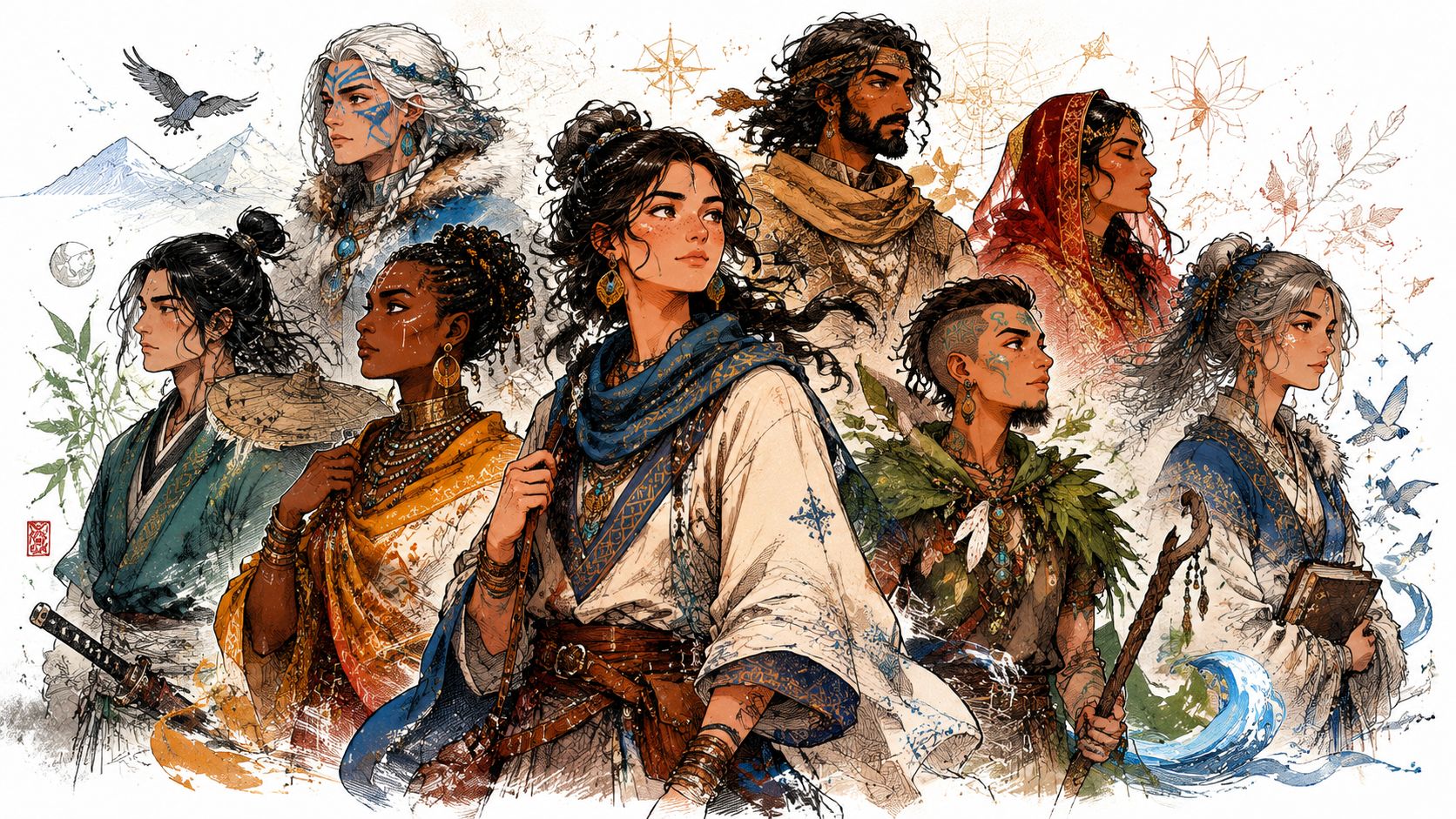
Culture lands hardest in fantasy comics when it shows up on the body. Not as random ornament, but as visible history. A sleeve pattern, ritual scar, ash veil, eye color, jewelry rank, braided wire, weatherproof dye. These details do more than decorate. They signal origin, belief, labor, and taboo at a glance.
Research into fantasy character design shows that 82% of novels feature characters with eye colors that deviate from the human average, and 91% of fantasy authors use geographic isolation to foster unique cultural development (verified analysis reference).
Make appearance do story work
Fantasy gives you permission to use artificial demographics. That means visible traits can carry social meaning beyond real-world naturalism. Eye colors, skin luminescence, patterned birthmarks, mineral veins in the nails, heat-scarring from rite magic. Used well, these become readable social language.
The key is to connect the trait to history and geography.
A few examples:
- River-delta people might develop shell-lacquered nails and flood-mark tattoos tied to seasonal rank.
- Mountain clans might wear polished lenses over pale eyes because snow glare shaped both survival gear and status symbols.
- Volcanic priesthoods might have copper-stained skin from ritual ash, which outsiders mistake for nobility or danger.
None of those details should be arbitrary. They should answer, “Why do these people look this way in this place?”
Geography creates culture faster than lore lists
When creators struggle with culture design, they often write festival calendars first. Start with barriers instead. Coasts, ravines, marshes, trade roads, storm belts, mountain walls. These shape isolation, exchange, prejudice, and adaptation.
That's where visual logic comes from. A people separated by cliffs won't just speak differently. They may climb differently, carry weight differently, layer clothing differently, and build homes with different entrances. Their posture can become world building.
If you're refining cast designs, a guide to comic character design for visual storytelling can help translate those cultural decisions into readable shapes and costume choices.
Design a culture through contrast
Instead of inventing one culture in isolation, pair two neighboring groups and define the friction between them.
| Cultural element | Highland enclave | Tideplain city |
|---|---|---|
| Shelter | Stone, inward-facing | Raised wood, open-air |
| Sacred object | Fire bowl | Water bell |
| Status marker | Scar placement | Fabric layering |
| Common fear | Burial without witness | Drowning without name |
This method keeps cultures from becoming mushy. It also gives you instant scene material. Trade disputes, marriage taboos, misread gestures, inherited suspicion. In comics, that contrast reads immediately.
Weaving Together History Geography and Plot
A dead world sits behind the story like painted scenery. A live world argues with the cast.
That difference usually comes down to process. Many creators still build linearly. First the map, then the timeline, then the plot. In practice, strong fantasy world building often works better as a loop. Plot creates a need. That need reshapes history. History demands geography. Geography then changes the plot again.
Publishing analysis reports that 91% of successful fantasy novels employ a non-linear method where creators revise world elements as the plot evolves, reducing narrative inconsistencies by 68%. Stories where the world actively drives the plot achieve 2.8x higher sales (verified analysis reference).
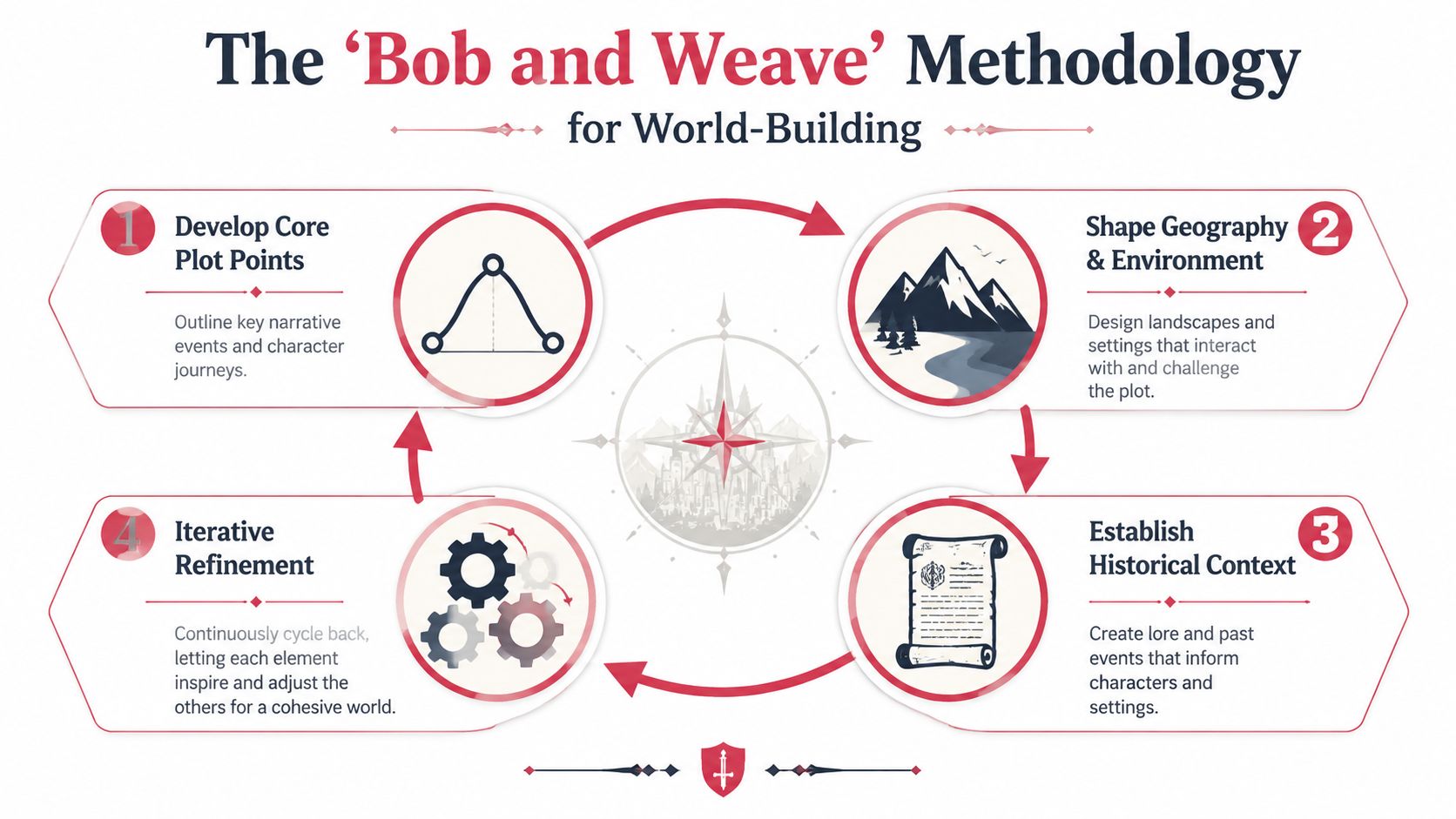
Use the Bob and Weave cycle
Here's what the loop looks like in working form:
A character problem appears
Your lead can't return home safely.That problem demands a world reason
A border closed after an old civil war.That reason needs physical shape
The only crossing is a fortress bridge over a canyon.That physical shape creates new pressures
Smugglers, tariffs, refugees, black-market guides, family betrayals.
Now the setting isn't background. It's generating scenes.
Choose a few focus points and keep returning to them
The Bob and Weave method works best when the world revolves around a small number of thematic focus points. Not twenty. A few.
Good focus points might be:
- Religion shapes law
- Magic leaves visible damage
- Trade routes decide who counts as civilized
- Architecture is built for flood, not comfort
These points help you decide what deserves detail. If a new invention or kingdom doesn't reinforce one of them, it probably belongs in another project.
A map should create obstacles, privileges, and misunderstandings. If it doesn't, it's wallpaper.
Let history leave marks people still live with
History becomes useful when it remains inconvenient. Don't write a glorious ancient war unless someone still pays for it.
You can make past events tangible through:
- Ruins with current legal value
- Inherited curses or debts
- Shrinking forests caused by old campaigns
- Street layouts built around former walls
- Family names that still open or close doors
If you're scripting a comic, graphic novel script structure becomes much easier when each setting detail can trigger action, not just exposition. A fortress bridge isn't only lore. It's a checkpoint, a reunion site, an ambush lane, a confession spot, and a class marker.
That's the standard to keep in mind. Every world element should be available for drama.
The Visual World-Building Loop for Comic Creators
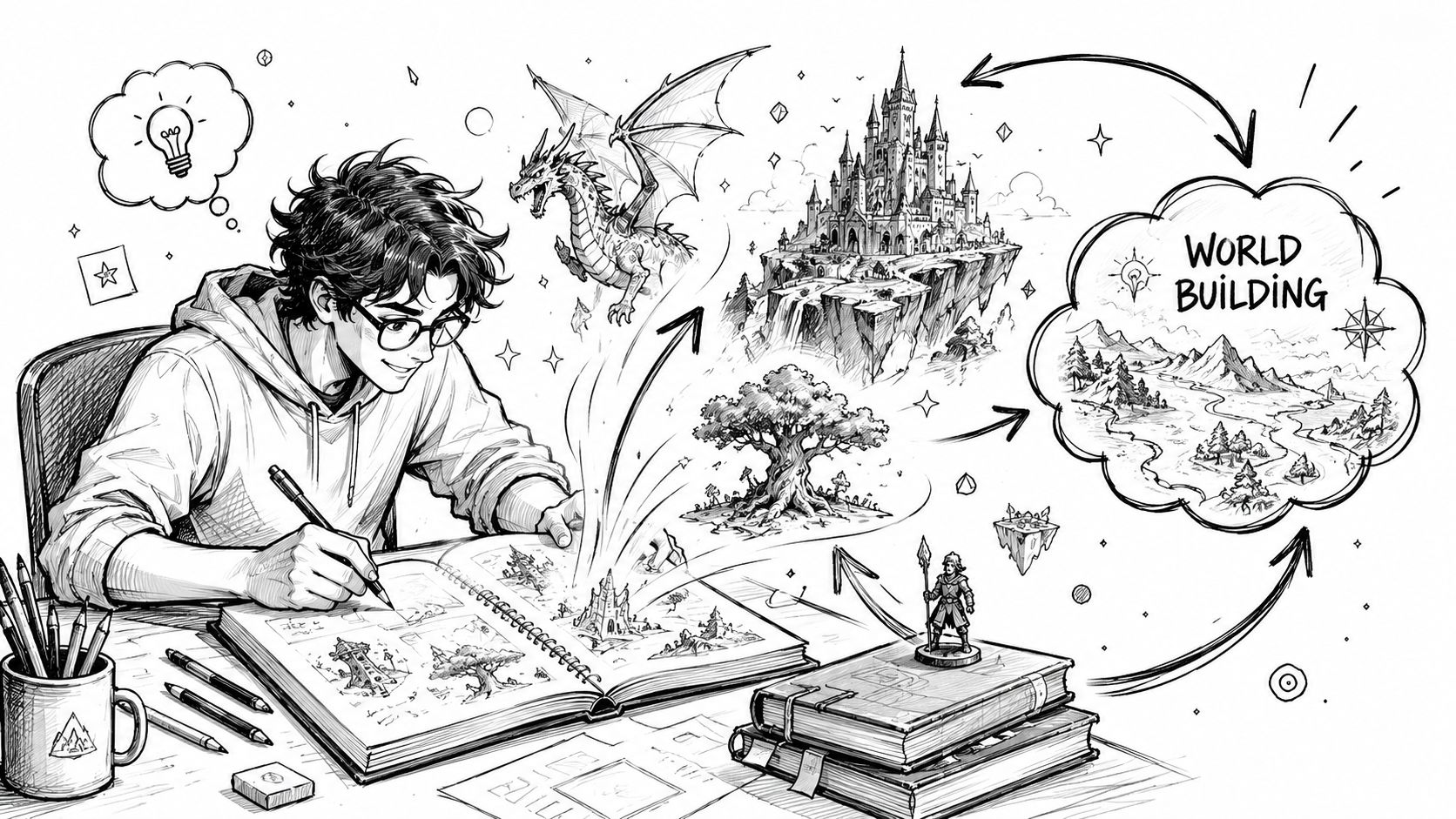
Comics demand iteration. You don't really know whether a shrine, beast, costume, alleyway, or spell effect works until you can see it. That's where many creators lock up. They can write the idea, but they can't sketch ten versions fast enough to discover the strongest one.
That bottleneck is real. It's also why “finish all your lore first” is bad advice for many comic projects.
Emerging creator data shows a 45% rise in open-loop storytelling where intentional gaps in lore are left for later, and this approach has been shown to increase reader engagement by 30% (verified analysis reference). For comic creators, that means you can start with a minimum viable world and let the setting sharpen through pages, panels, and revisions.
Leave useful gaps on purpose
An incomplete world isn't a broken world. It's a world with live edges.
Useful gaps include:
- Unmapped regions that characters rumor about before you define them
- Partially understood magic that ordinary people interpret differently
- Unseen rulers or gods whose influence matters more than their biography
- Cultural customs you imply visually before fully explaining them
What you want to avoid are accidental gaps. Those are contradictions that weaken trust. If moonwater heals in chapter one and poisons in chapter four, you need a reason. If a masked order is sacred in one scene and ignored in the next, the world starts to wobble.
Build from one visual seed
For comics, one strong visual premise often outperforms a broad text brief. Start with a single image-bearing concept and expand outward.
Examples:
- a harbor city built inside the ribs of a dead leviathan
- monks who trap storms in glass prayer wheels
- a noble caste identified by bioluminescent freckles
- forests where paths rearrange themselves around guilt
From there, run a loop:
- Describe the seed
- Generate or sketch variations
- Notice what repeats or surprises you
- Write the world rule implied by the strongest image
- Design a scene that forces a character through that rule
This process is especially helpful if you're exploring comic book style artwork for different fantasy moods. Style changes world logic on the page. Noir fantasy wants different textures and architecture than bright adventure fantasy. Testing visuals early reveals what your premise wants to be.
Don't wait for a final design. Compare rough versions until the world starts revealing its own rules.
AI World-Building Prompts for PersonalizedComics
| World-Building Element | Example Prompt Template |
|---|---|
| Capital city | “Ancient fantasy capital built around a vertical chasm, hanging bridges, candle shrines, class divide visible by elevation, dramatic skyline” |
| Neighborhood culture | “Merchant district in a flood-prone fantasy city, woven awnings, water altars, river-police symbols, bustling comic panel composition” |
| Signature magic | “Rune-based healing magic shown as stitched light under the skin, ceremonial tools, visible cost to the caster, graphic novel style” |
| Character lineage | “Young exile from a mountain priesthood, pale weather-burned eyes, layered wool armor, sacred climbing hooks, quiet but defiant posture” |
| Creature ecology | “Massive marsh predator adapted to shallow reed waters, camouflage fins, shrine scars from local worship, believable fantasy biology” |
| Royal authority | “Court officials wearing lacquered masks tied to legal rank, oppressive palace corridor, ritual symmetry, fantasy comic page mood” |
| Travel route | “Wind-carved desert pass used by smugglers and pilgrims, stone markers, hidden lookouts, sense of danger and sacred history” |
| Everyday life | “Street food stall in a moonlit magical port, glowing shell currency, multilingual signage, practical clothing, crowded sequential-art framing” |
Use visuals as questions, not answers
The biggest advantage of a visual-first loop isn't speed. It's discovery.
A generated image or rough sketch may show you that your “ice kingdom” is more interesting as a thawing canal city. A costume pass may reveal that your warrior order looks too noble and needs signs of labor, poverty, or ritual damage. A creature sheet may show that the world wants more bone than crystal, more cloth than armor, more tide than fire.
When that happens, follow the image. Then tighten the lore around it.
That's how a comic world becomes distinctive even if you're not a trained illustrator. You don't brute-force every answer upfront. You test, react, revise, and keep only what earns its place.
Common World-Building Questions Answered
The questions that slow creators down are usually practical, not philosophical. They want to know whether their world is too generic, too thin, too inconsistent, or too unfinished to begin.
How do I make my world feel original
Don't chase originality at the level of ingredients. Dragons, empires, prophecy, masked priests, all of that has been used before. Originality comes from combination and consequence.
If your magic uses choir harmonies, ask who gets excluded. If your city floats, ask who keeps it floating. If your ruling class glows in the dark, ask what they can't hide. Specific consequences make familiar ingredients feel authored.
How much do I need before I start
You need enough to produce clear conflict on the page. Usually that means:
- A central visual premise
- A few stable rules
- One lived-in location
- A cast whose designs reflect the world
- A conflict that only makes sense in this setting
You don't need a complete atlas, a full theology, or a thousand-year chronology. Start once the first chapter can breathe.
What's the biggest mistake in fantasy world building
The biggest mistake is adding details that don't change anything.
A close second is treating the world as separate from character. If your lead could be dropped into any other fantasy setting without changing the plot, the world isn't doing enough. It should create the character's blind spots, options, fears, and habits.
A good setting doesn't just surround the story. It corners the story into becoming itself.
What if my world has gaps
That's normal. Keep three lists: what is fixed, what is flexible, and what is unknown on purpose. That single habit prevents panic.
Fixed elements are your laws. Flexible elements can adapt as scenes demand. Unknown elements stay open until the story earns them. This keeps your fantasy world building alive without turning it sloppy.
How do I know a detail deserves to stay
Ask one hard question: what job is this detail doing?
If it deepens theme, clarifies conflict, shapes behavior, or strengthens visual identity, keep it. If it only proves you thought a lot about your world, cut it or set it aside. Readers can feel the difference.
If you want to turn a rough fantasy idea into actual comic pages without needing drawing skills, PersonalizedComics is built for exactly that kind of visual iteration. You can test characters, settings, and full story scenes in different art styles, generate polished pages quickly, and start discovering your world by making it visible instead of waiting until every lore question is settled.