Your Free Comic Book Script Template and Pro Guide
You've got a story in your head and a blank document in front of you. That's usually the moment writers either freeze or start typing something that looks half screenplay, half novel, and not very useful to the artist who has to turn it into pages.
A good comic book script template solves that problem. Not by forcing you into one sacred format, but by giving you a structure that keeps the story readable, drawable, and editable. That matters whether you're sending pages to an artist, building a short digital comic, or shaping prompts for an AI-assisted workflow.
The template below is the one I'd hand to any promising apprentice. It's built around professional habits, practical trade-offs, and the one rule that never changes: if the artist, editor, and letterer can understand your intent quickly, your script is doing its job.
Why Your Comic Script Is More Than Just Words
A comic script isn't prose and it isn't a screenplay. It's a production document for visual storytelling.
That distinction changes everything. You're not only writing what happens. You're translating rhythm, staging, space, emotion, and page turns into instructions another person can use. Even when you draw your own comic, the script still acts like a planning tool that catches weak pacing before you spend hours on finished art.
The first useful thing to know is that there is no universally standardized format for comic book scripts. Industry veterans have been saying this for years, and Fred Van Lente's well-known summary of the job is still the best one: CLARITY, CLARITY, and CLARITY in place of a rigid universal template, as discussed in Tim Stout's breakdown of graphic novel script format.
That's good news for beginners. It means you don't need permission to start. It also means you need judgment.
What the script really does
A strong script gives each collaborator the information they need, and no more.
- For the artist: It shows what must be visible in the panel.
- For the letterer: It separates dialogue, captions, and sound effects cleanly.
- For the editor: It makes pacing problems easy to spot.
- For you: It reveals whether the scene works before production begins.
Practical rule: If a panel description reads like a novel paragraph, it's probably too literary. If it reads like a technical note with no emotion, it's probably too dry. Aim for visual precision with feeling.
A lot of early scripts fail because the writer is trying to prove they have a vivid imagination. The artist doesn't need proof. The artist needs decisions. Which character is foregrounded? What action is frozen in this panel? What expression matters? What absolutely must be on the page?
Character work starts before dialogue. If you're still refining who people are, it helps to nail down visual identity alongside the script. A focused character design process like the one discussed in this comic character design guide can stop you from writing scenes your cast can't visually support.
Why flexibility beats fake professionalism
New writers sometimes copy a publisher-specific style and treat it like law. That usually backfires. The “professional” look means nothing if your page is confusing.
What works is a flexible framework:
- page-based numbering
- concise panel descriptions
- clean dialogue blocks
- room for revision
- formatting that helps rather than performs
That's the point of a comic book script template. It isn't there to impress anyone. It's there to keep the story moving from your head to an actual comic page.
The Ready-to-Use Comic Book Script Template
Use this as a clean starting point. Paste it into your document and adjust only when your team has a reason.
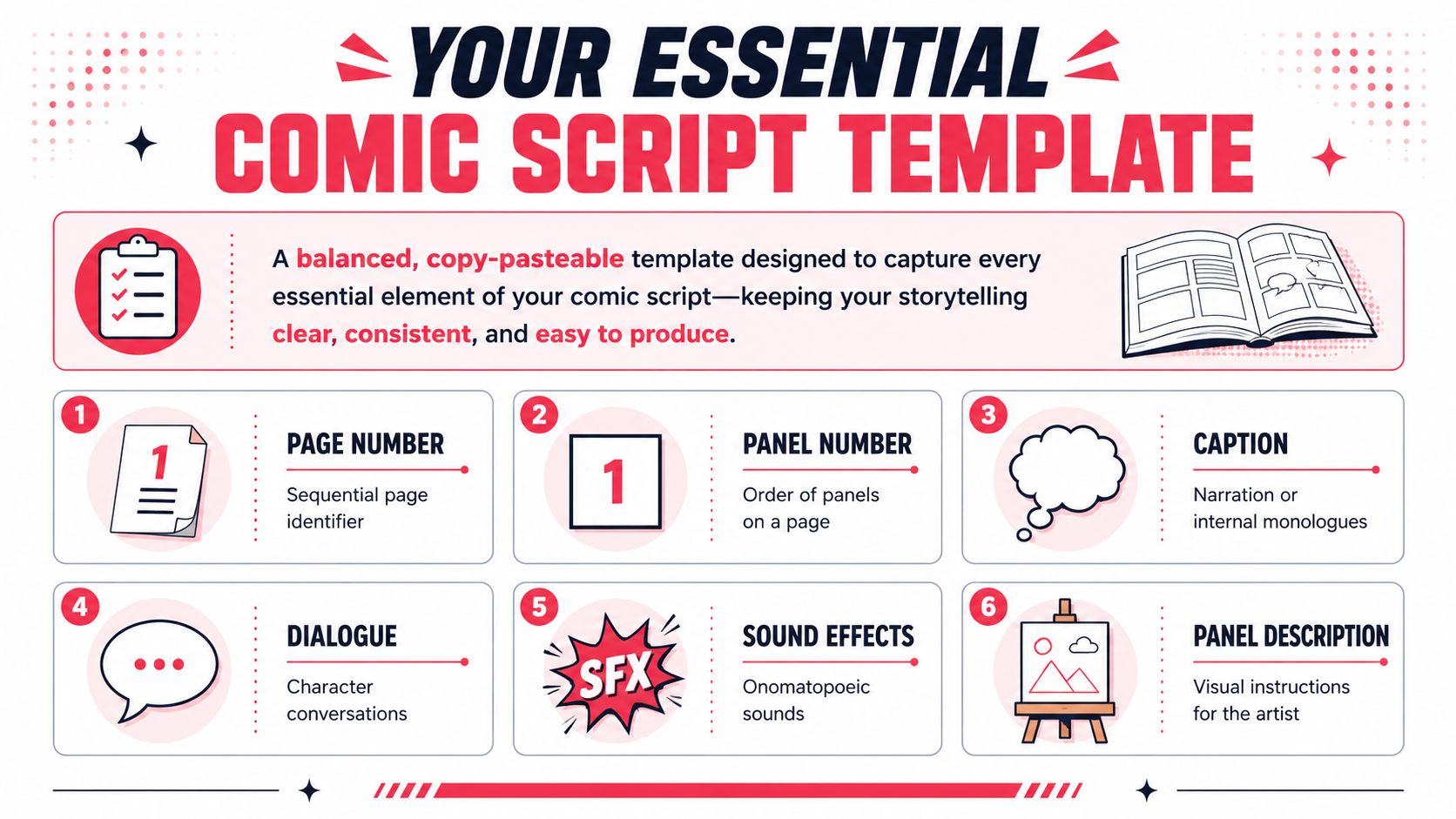
Copy-paste template
TITLE PAGE
Title:
Series or Project:
Version: v1a
Writer:
Artist:
Letterer:
Editor:
Email:
Phone or preferred contact:
Notes:
SCRIPT
PAGE ONE
Panel One
Panel description:
What the artist must show in this panel.
Caption 1:
Dialogue 1 CHARACTER NAME
Text
SFX 1:
Sound effect text
Panel Two
Panel description:
Caption 1:
Dialogue 1 CHARACTER NAME
Text
Dialogue 2 CHARACTER NAME
Text
PAGE TWO
Panel One
Panel description:
Caption 1:
Text
Panel Two
Panel description:
Dialogue 1 CHARACTER NAME
Text
Why this template works
This format does a few things well.
First, it uses page numbers that match comic pages, not document pages. That keeps everyone discussing the same object. When an artist asks about Page Six, they mean the comic page, not whatever your word processor happens to call page six.
Second, it separates the visual instruction from the lettering instruction. A panel description tells the artist what to draw. Dialogue, captions, and sound effects tell the letterer what needs placement.
Third, it leaves room for revision. You can add, cut, or split a panel without rebuilding the entire document.
The title page matters more than beginners think
Professional full-script formats commonly include a title page, version control, team contact information, and a 2.5-inch right margin, often called the “Margin Trick,” because that extra space gives artists room for thumbnails and editors room for notes, as described in this full-script formatting discussion.
If you skip version control, somebody eventually opens the wrong file. That's not theory. That's comic production.
Use labels like:
- v1a for the first draft
- v1b for light revisions
- v2 for a substantial rewrite
The page and panel layer
Here, your comic book script template earns its keep.
| Element | What it does | What to avoid |
|---|---|---|
| Page | Controls pacing and page turns | Treating pages like endless space |
| Panel | Breaks action into readable beats | Combining too many actions in one panel |
| Panel description | Gives visual direction | Writing inner thoughts the artist can't draw |
| Dialogue | Carries voice and conflict | Explaining what the art already shows |
| Caption | Adds narration or context | Using it as a crutch for missing visuals |
| SFX | Supports impact and texture | Adding noise with no visual purpose |
Keep the template boring on purpose. Your storytelling should carry the energy, not the formatting.
A few default habits worth keeping
- Use ALL CAPS for character names in dialogue cues.
- Start each panel on its own line so changes are easy to track.
- Keep panel descriptions in present tense because comics are read as immediate action.
- Leave white space. Dense script pages create reading fatigue before anyone even reaches the drawing stage.
A script template should feel invisible. When it's working, nobody comments on it. They just make the comic.
Writing a Panel Your Artist Can Actually Draw
Most script problems happen at the panel level. The writer knows what they mean. The artist only sees what's written.
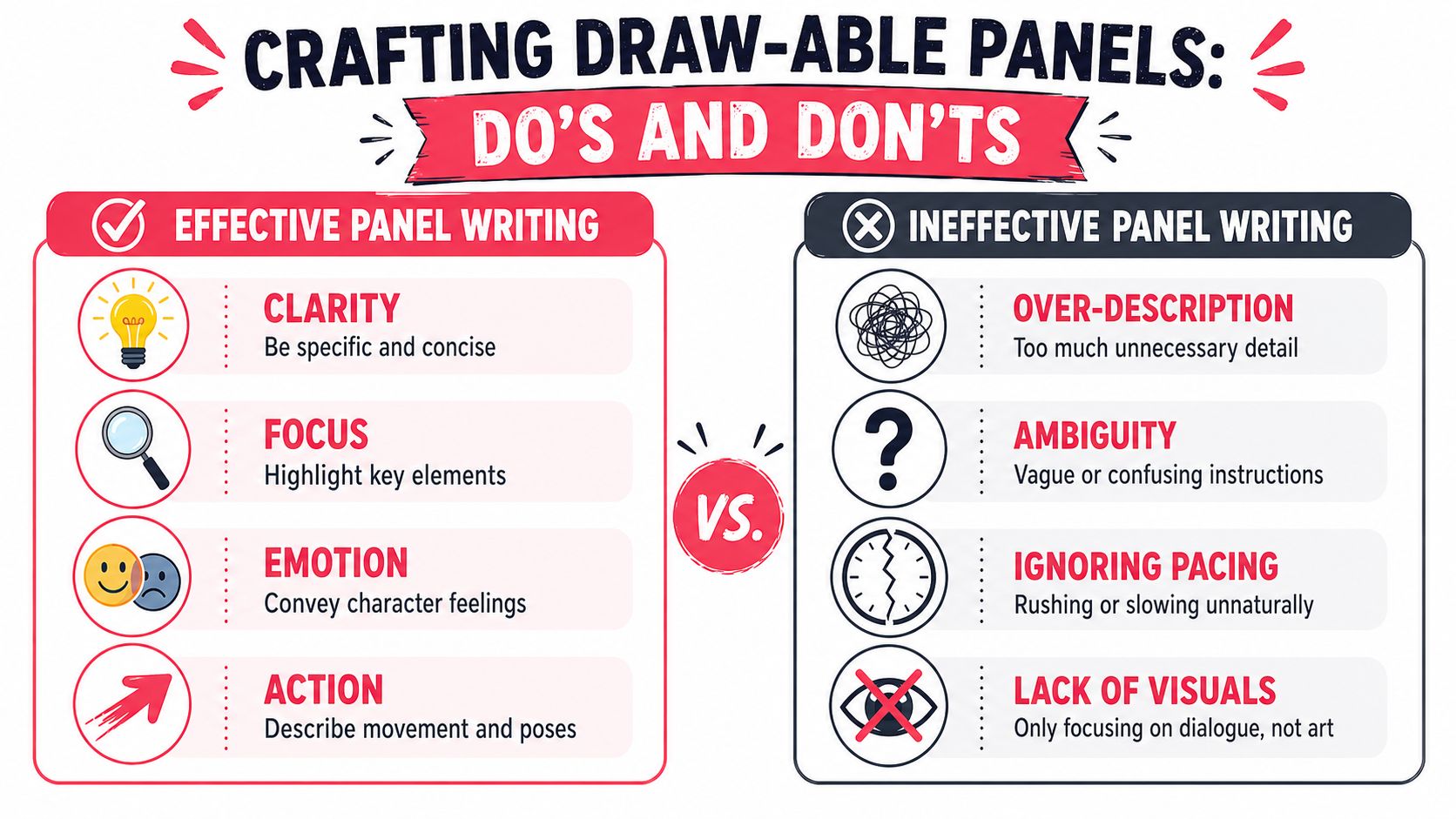
Professional guidelines are stricter here than people expect. Dialogue generally shouldn't be placed in quotation marks, panel descriptions should be short enough to read in a single mental pass, underlining can mark emphasis, and former Marvel editor Mark Paniccia enforced a rule that no speech balloon should exceed three lines of text, according to this comic scripting discussion from working creators.
Bad panel writing and better panel writing
Here's an overwritten version:
Panel One. We see our hero, exhausted and emotionally broken after everything that has happened to him over the course of the evening, stumbling down an alley that seems to symbolize the collapse of his hopes and dreams while rain pours everywhere and neon reflects in puddles and he looks like he might either cry or laugh.
The problem isn't that the image is vivid. The problem is that the artist has to guess what the actual shot is.
A usable version:
Panel One
Rainy alley at night. Neon reflections in puddles. The hero staggers toward us, soaked and glassy-eyed, one hand on the wall for balance.
Now the artist knows the setting, the angle, the body language, and the emotional state.
One panel, one beat
A comic panel captures a moment. If you cram multiple actions into one description, you force the artist to choose what to freeze.
Bad:
- He opens the door, steps inside, notices the blood, drops the keys, and turns toward the window.
Better:
- Panel One: He opens the apartment door.
- Panel Two: He sees blood on the floor just inside.
- Panel Three: His keys slip from his hand.
That's pacing. It also gives the scene impact.
Dialogue has physical weight
The fastest way to clutter a panel is to write dialogue as if the page has unlimited air.
A useful default:
- Keep each balloon around 25 words or fewer
- Split long speeches into multiple balloons
- Let the art do some of the explaining
If you want help thinking visually before drafting pages, a tool focused on layout logic like this comic panel layout generator guide can help you see where a script is trying to do too much in too little space.
The character who speaks first usually needs placement that supports balloon flow. If the first speaker belongs on the left, write the panel so the art can support that.
A fast checklist before you lock a page
Ask these questions panel by panel:
- Can the artist draw this? If the description relies on abstract ideas alone, rewrite it visually.
- Is this one moment? If not, split it.
- Does the dialogue sound spoken? Read it out loud.
- Does the text leave room for art? If not, cut.
- Is emphasis marked clearly? Underline the word that needs stress rather than adding explanation around it.
Good panel writing feels simple. It usually isn't. It takes restraint, and restraint is one of the most professional things a comics writer can learn.
Mapping Your Story Before You Write Page One
A lot of comic scripts die because the writer starts too early.
They open with Page One, Panel One because it feels productive. Then by Page Four they've got no control over pacing, the big reveal lands too soon, and the ending needs twice as much space as they have left.
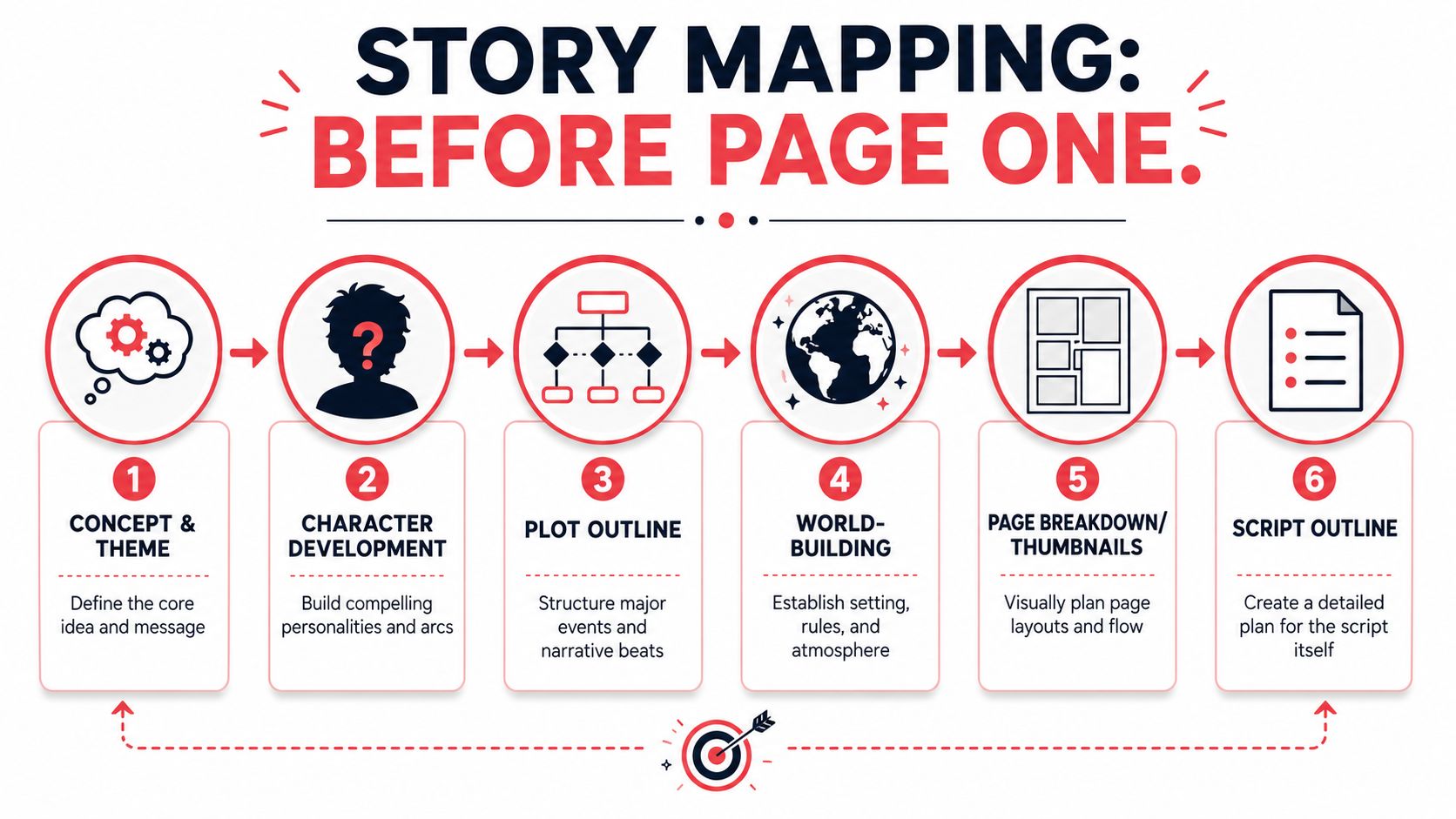
That isn't just an annoyance. A reported 60% of comic projects fail due to narrative disorganization, and the professionals highlighted in this storyboarding and scripting guide avoid that by mapping character arcs and assigning scenes to physical page units before drafting.
Start with movement, not scenes
Before scripting, answer three questions:
Who changes?
Your main character needs a track. Even a short comic should show pressure changing someone's choices, confidence, relationships, or understanding.What must the reader feel at each stage?
Curiosity, dread, relief, embarrassment, suspense. Emotional sequencing helps you decide where to slow down and where to cut fast.How much space does each beat deserve?
A confrontation often needs more room than a simple transition. A reveal needs setup. A joke needs timing.
That's page charting in practice. You're assigning weight before you write lines.
A simple page map that works
Try this rough planning pass before any panel script exists:
- Opening pages: establish problem, tone, and setting
- Middle pages: escalate pressure, add complication, force choice
- Closing pages: pay off the key emotional or plot question
That may sound obvious, but the main trick is attaching each beat to actual pages. A comic isn't pure story. It's story under space constraints.
If a moment matters, give it room. If it doesn't, don't waste a page proving it happened.
The common failure pattern
Here's what usually goes wrong when writers skip mapping:
| Problem | What it looks like in the draft | Fix |
|---|---|---|
| Front-loaded setup | Three pages of exposition before conflict starts | Enter later |
| Mushy middle | Scenes repeat the same tension | Add a turn or cut redundancy |
| Rushed ending | Final reveal and resolution happen on one cramped page | Reserve closing space early |
| Random splash instinct | Big images appear without narrative reason | Tie scale to story importance |
A mapped script doesn't feel mechanical. It feels intentional.
Character arcs belong on the page chart
Don't treat emotional development as a separate layer. Put it right into the plan.
For example:
- Page 1: confidence
- Page 3: doubt appears
- Page 5: public failure
- Page 7: decisive action
- Page 8: transformed response
That kind of progression prevents a familiar beginner mistake: writing cool scenes that don't build on each other.
If you do this work first, scripting gets faster. More important, revision gets smarter. You're no longer guessing why a scene feels off. You can see that the page is carrying the wrong job.
Adapting Your Script for AI Generators and Print
A script written for a human artist and a script written for an AI-assisted image workflow aren't the same document, even when they start from the same story.
The gap matters because current templates often leave modern creators to improvise. The Science Fiction and Fantasy Writers Association notes that there's no single comic script standard, and that this creates confusion for human-AI hybrid workflows, especially as tools like PersonalizedComics become mainstream, as discussed in this SFWA article on writing a comic script.
Human artist versus AI-assisted generator
A human artist reads for intent. An AI system reads for specification.
That means the same panel description should change depending on the workflow.
| Workflow | What the script should emphasize | What happens if you don't |
|---|---|---|
| Human artist | Story beat, mood, key visual facts | The artist asks clarifying questions |
| AI-assisted tool | Character appearance, pose, camera angle, environment, style cues | The output drifts or becomes inconsistent |
| Print production | Legible pacing, balloon room, page-turn logic | Finished pages feel crowded |
| Short digital format | Vertical readability or compressed beats | Scenes feel either rushed or bloated |
One panel written two ways
Base story intent:
A detective enters a nightclub and spots the suspect across the room.
For a human artist:
Panel Three
Wide shot of a crowded nightclub. The detective has just entered and pauses at the edge of the dance floor. Across the room, the suspect sits in a private booth, half-hidden by red light and drifting smoke.
That gives mood and staging but leaves room for interpretation.
For an AI-assisted workflow:
Panel Three
Wide interior shot of a noir nightclub. Foreground left, a tired detective in a wrinkled trench coat stands at the entrance, body turned toward the room. Mid-background right, the suspect sits alone in a semicircular booth under red lighting, partially obscured by cigarette smoke. Dense crowd between them. High contrast lighting, cinematic composition, tense atmosphere.
That version is less elegant as prose. It's more useful as input.
If you're building comics through automated creation tools, it also helps to understand the broader workflow of structured AI storytelling discussed in this AI book maker guide.
AI needs the details a human artist can infer. Human artists need the freedom an AI prompt often removes.
Adapting for print and short-form digital comics
Print pages reward page turns. A reveal at the top of a right-hand page doesn't land the same way as a reveal after a turn.
Short digital comics create a different pressure. You often need cleaner beats, fewer speaking characters per page, and faster visual setup. A four-page digital story can't afford a page of throat-clearing. It needs immediate premise, fast conflict, and a close that feels complete rather than merely cut off.
A practical way to adapt the same script:
- For print: keep suspense around the page turn, vary panel sizes, and preserve reading flow across spreads.
- For short digital: trim supporting beats, condense exposition into visual cues, and make every page deliver a clear narrative step.
- For AI-assisted builds: add repeatable character descriptors so faces, outfits, and environments stay stable page to page.
What not to do
Avoid these common mistakes when adapting your comic book script template:
- Don't write one master draft and assume every workflow can use it unchanged.
- Don't over-specify for a human artist unless the detail is essential to story or continuity.
- Don't under-specify for AI tools when consistency matters.
- Don't ignore lettering space just because the script reads well in plain text.
The best modern script is flexible by design. It preserves the scene's purpose, then adjusts the level of instruction based on who or what will turn it into pages.
Your Next Steps and Comic Writing FAQs
The right next move isn't to polish your template for another week. It's to script a short comic with it.
Start small. Four to eight pages is enough to teach you where your panel descriptions drag, where your dialogue overruns the art, and where your page turns don't pay off. A short project exposes bad habits faster than a sprawling issue one draft.
Three quick sample snippets
Sci-fi
Page One, Panel One
A maintenance worker floats outside a damaged orbital station, city lights glowing on the planet below. One glove is sparking.Caption 1:
Orbit was supposed to be the safe job.
Romance
Page Two, Panel Three
In a crowded train car, Maya notices the doodle in Eli's notebook. It matches the sketch on the flyer in her hand. Their eyes meet.Dialogue 1 MAYA
You drew this?
Comedy
Page One, Panel Four
The barbarian kicks open the treasure room door and freezes. Inside, a tiny dragon sits at a desk wearing glasses and sorting coins into neat stacks.Dialogue 1 DRAGON
We open at noon.
Same template. Different voice. That's how it should be.
FAQ
How do I script a silent panel
Write the visual action with extra care and then leave the lettering lines out. If the silence matters emotionally, say so in the description. For example: “She smiles, but doesn't answer. The silence stretches.”
How do I handle a panel with a lot of characters
Name only the characters the artist must prioritize. Don't describe twelve people with equal weight unless the shot requires it. Focus on foreground, midground, and background jobs. If dialogue flow matters, place speakers clearly in the description.
When can I break the rules
Break them when the page gains clarity or effect, not because the rules annoy you. A dense panel can work if it's intentionally overwhelming. A sparse page can work if the pause is the point. The test is simple: does the change make the comic easier to read and stronger to feel?
A comic book script template is only useful if it gets used. Make a copy. Draft a short piece. Revise after you see what fits on the page.
If you want to turn a script idea into finished comic pages without drawing everything by hand, PersonalizedComics is a practical place to experiment. You can build personalized stories, test visual directions, and move from rough concept to polished comic pages in a workflow that's friendly to hobbyists, gift makers, and writers prototyping larger projects.