Sound Effects in Comics: A Complete Design Guide
You've probably run into this problem already. The panel looks good, the pose is strong, the composition works, but the moment still feels flat. A punch lands and nothing cracks. A door opens in a horror scene and there's no creak, no click, no sense of air moving through the page.
That missing piece is often sound design.
In comics, sound effects aren't just flashy lettering pasted on top of art. They help the reader feel weight, timing, distance, interruption, texture, and mood. A good sound effect can make a panel feel faster, heavier, funnier, colder, or more dangerous. A weak one can make the same panel feel generic.
Beginners often treat sound effects in comics as decoration. Professionals treat them as storytelling instructions. That difference starts long before the letterer or the AI tool places a single word on the page. It starts in the script, where you decide what the reader should “hear,” when they should hear it, and how that sound should shape the moment.
Bringing the Noise to a Silent Medium
Take a simple rooftop landing. If the hero drops into frame and the panel only shows bent knees and scattered debris, the image can still work. But add a low, heavy THOOM, and suddenly the reader feels impact. Change that to tap, and the same pose becomes stealthy or even comedic.
That's why sound effects in comics matter so much. They don't merely label noises. They tell the reader how to experience the scene.
Sound effects carry story weight
A comic has no actual soundtrack, yet readers constantly supply one in their heads. They do that because the page gives them cues. Dialogue tells them what's said. Facial expressions suggest tone. Sound effects tell them what the environment is doing around the characters.
Think of them as the heartbeat of the panel:
- Action cues: A strike, crash, skid, teleport, or engine ignition gains force.
- Mood cues: A tiny click can create more tension than a giant explosion.
- Pacing cues: Short sounds feel abrupt. stretched sounds feel lingering.
- Spatial cues: A distant rumble feels different from a sharp sound right beside the camera.
When readers get confused by sound effects, it's usually because the creator treated them like stickers. The word might be technically correct, but it doesn't match the rhythm, scale, or emotional tone of the panel.
Practical rule: If removing the sound effect doesn't change the storytelling, it was probably decorative.
Why beginners struggle with SFX
Most new creators focus on drawing the event, not directing the reader's internal audio. They'll write a script with dialogue and panel descriptions, then leave the sound effect for later. That often leads to a mismatch. The art says one thing. The lettering says another.
A better approach is to think of every key sound as part of the scene's choreography. If a chain drops before a villain enters, that sound is setup. If a hidden lock clicks open off-panel, that sound is a reveal. If boots echo down a hallway, that sound controls suspense.
The craft of sound effects in comics sits right at the intersection of writing, drawing, and lettering. Once you understand that, your pages stop feeling silent in the wrong way.
The Silent Soundtrack of Comics
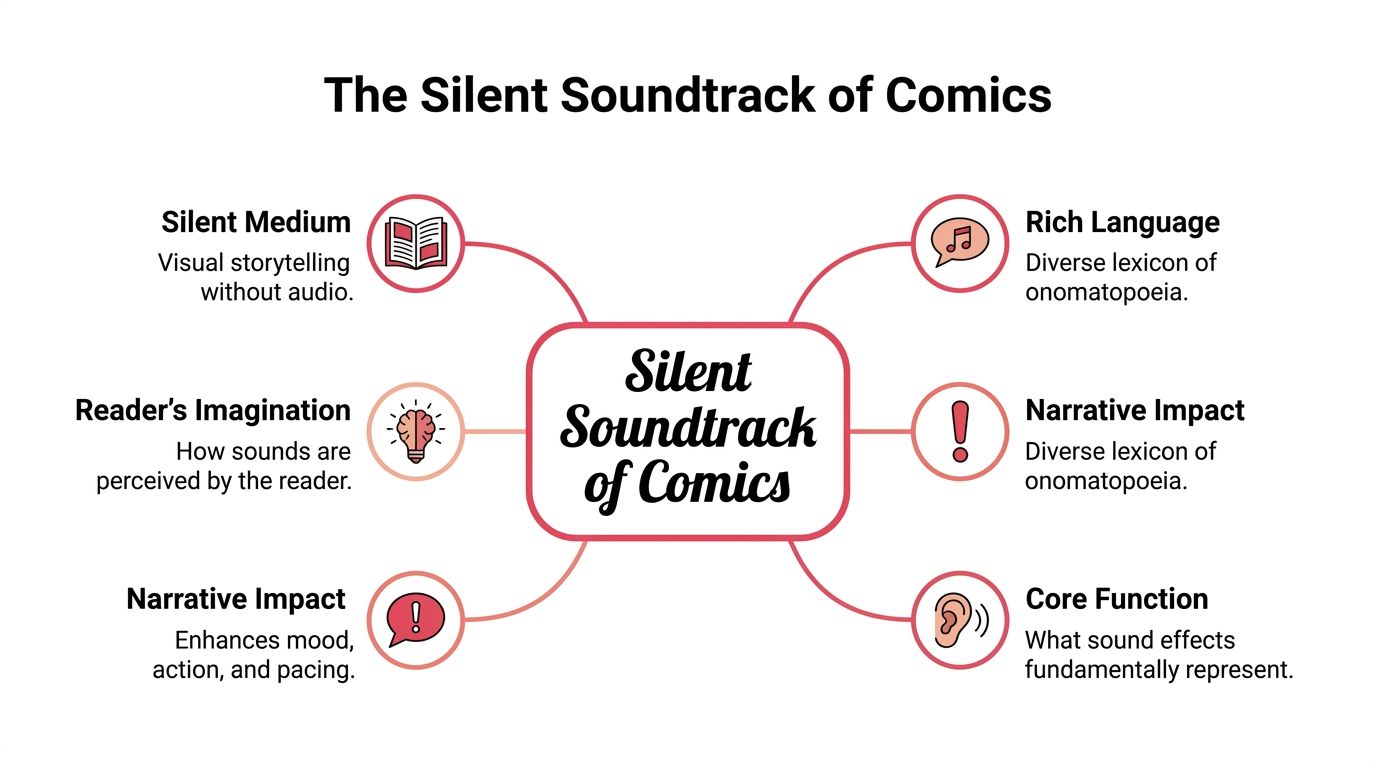
Comics are often called a silent medium, but they aren't silent in the reader's mind. They run on a visual soundtrack made from words, letterforms, symbols, spacing, and placement. The reader looks at ink and mentally converts it into noise.
That conversion is one of the medium's great tricks.
One online database of American comic books contains over 2,500 distinct written sound effects, which shows how large and varied the language of comic sound has become over time, as described in this discussion of how comics make sound on the page.
Readers hear with their eyes
When someone sees KRACK, they don't just decode letters. They infer material, force, speed, and emotional intensity. Wood doesn't crack like lightning. A bone snap doesn't feel like a tree branch breaking. Good sound effects narrow that gap.
That's why onomatopoeia in comics isn't random noise text. It's a grammar.
A few things happen at once when a reader encounters an effect word:
- They identify the source of the sound.
- They judge how loud or soft it is.
- They estimate how long it lasts.
- They connect it to mood and timing.
- They fold it into the panel's movement.
That last point matters. A sound effect often tells the reader where the action “lands” inside the image. It can act like a drumbeat in music. The panel may be static, but the sound effect gives it timing.
Sound effects do more than imitate sound
Beginners often assume a sound effect's only job is to mimic reality. Sometimes that's true. A gunshot should feel like a gunshot. But in comics, sound effects also perform narrative jobs that realistic audio alone can't handle.
They can signal:
- Atmosphere: rain patter, machine hum, floorboard creak
- Character identity: a recurring sound tied to a specific entrance, weapon, or power
- Emphasis: the one noise in a busy panel that matters most
- Transition: a sound that pulls the eye from one panel to the next
- Irony: a silly noise in a serious composition, or the reverse
Comics don't reproduce sound. They stage it.
That's an important mental shift. Once you stop asking, “What noise would this make?” and start asking, “What should the reader feel here?”, your choices improve fast.
A wider vocabulary than POW and BAM
The classic superhero blasts are only one corner of the form. Comics can whisper, scrape, hum, fizz, clatter, cough, shudder, and hiss. A tense scene might rely on almost nothing but tiny mechanical or bodily sounds. A fantasy scene might use invented noises that still feel believable because they fit the world.
The key is function. If the sound sharpens the moment, clarifies action, or deepens atmosphere, it belongs. If it only fills empty space, it doesn't.
Anatomy of a Comic Book Sound
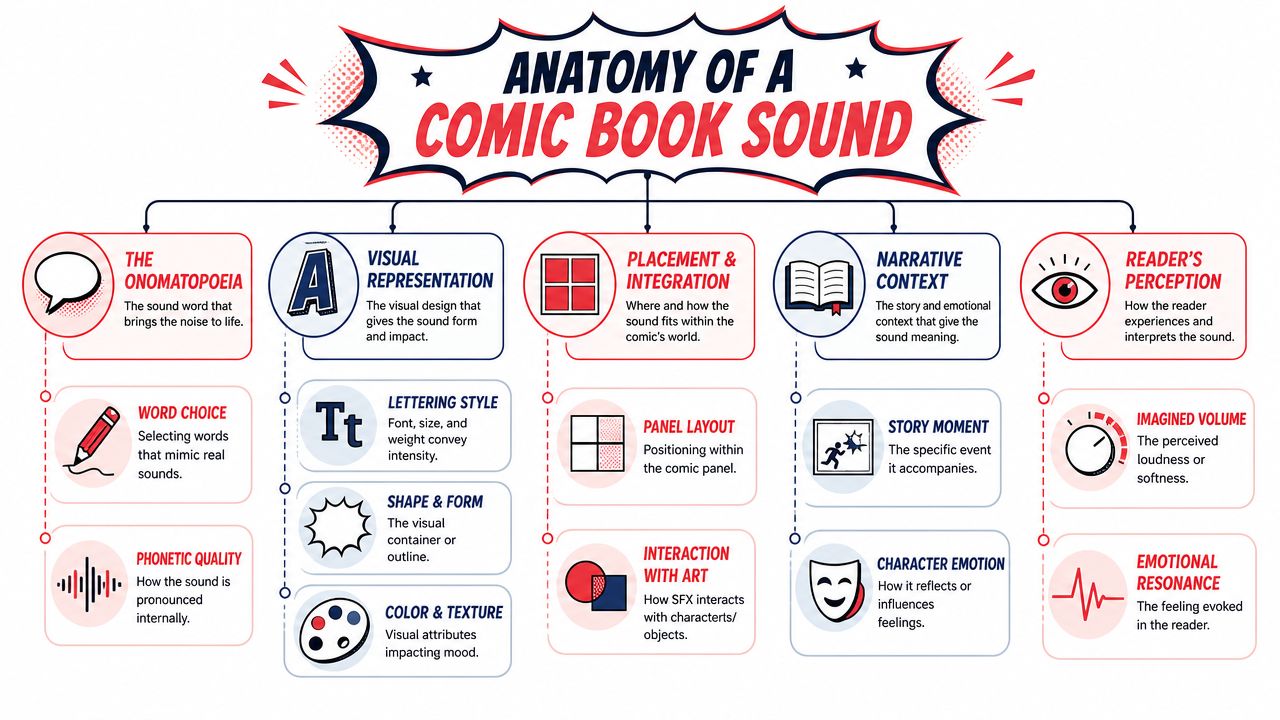
A strong sound effect has several parts working together. The word matters, but so do the lettering, the shape, the interaction with the art, and the emotional context. Change one of those pieces and you can change the whole meaning.
The word itself
The first job is phonetic. Does the word sound like the event when you say it out loud, even roughly? A metal impact might want a hard consonant. A wet collapse might need softer, messier syllables.
If you say the effect aloud and it feels wrong in your mouth, readers will often feel that wrongness on the page too.
A few quick contrasts make the point:
- CLANG feels metallic and rigid.
- THUD feels blunt and heavy.
- SPLASH feels broad and fluid.
- SNAP feels sudden and tight.
- WHUMP feels cushioned but forceful.
None of these are just labels. Each carries texture.
Size and duration are visual rules
Two technical rules matter more than anything else. Text size signals volume, and repeated letters signal duration. San Diego State University's sound effects guide puts it plainly with the example that “BANG” reads as short while “BAAANG” suggests a longer, sustained noise.
That gives creators a direct way to control time on the page.
If a car backfires, BANG works. If a power core is building and discharging, BZZZZZMMMM or SHHHHRAAAAM can stretch the moment. The reader doesn't physically hear a longer sound. They infer a longer sound because the typography takes longer to read and visually occupies more time.
Working shortcut: More letters often means more time. Bigger letters usually means more force.
Shape changes tone
A sound effect's outline and motion can do as much work as the word itself. Jagged forms imply violence, electricity, fracture, or danger. Rounded forms feel softer, wetter, puffier, or more playful.
That's why the same word can behave differently.
A bubbly SPLASH feels friendly or comedic. A torn, spiky SPLASH can feel hazardous, acidic, or explosive. A wobbling RATTLE feels unstable. A perfectly square CLACK feels mechanical and precise.
Placement and scale must match the event
If a building explodes and the effect is tiny, readers feel the mismatch. If a pin drops and the lettering fills half the panel, the page starts lying about the moment. Evan Waterman's guide to lettering sound effects stresses that the scale of the typography should match the scale of the event, and that the effect should phonetically mimic the actual noise.
That's where many pages break. The creator picked a decent word, but the visual treatment doesn't match the action.
Use this checklist when placing an effect:
- Check source location: Put the effect where the sound originates, or deliberately offset it if the scene calls for distance.
- Check visual weight: The effect should feel as big as the moment feels.
- Check legibility: Don't let style destroy readability.
- Check overlap: Let the sound sit in the art, not float as a disconnected label.
Context finishes the job
No sound effect exists alone. A whisper in a horror panel feels different from the same whisper in a comedy. A stomp after a punchline lands differently than a stomp before a betrayal. Meaning comes from context.
That's why sound effects in comics aren't only design objects. They're narrative objects. Every decision should answer the same question: what is this moment supposed to feel like?
Matching SFX to Your Comic Style
A good sound effect can still be the wrong sound effect for the book. Style matters. Genre matters. Rendering matters. The same lettering choice that sings in a retro action page can look ridiculous in a quiet watercolor scene.
The best approach is to make the sound effect feel native to the world around it.
Style should echo the art
When sound effects fight the art style, readers notice the seam. If the art is elegant and understated, giant block letters can shatter the tone. If the art is loud and kinetic, delicate little effects can drain energy from the page.
The medium has a long history of pushing sound design into the story itself. Ben Towle's analysis of comic book sound effects from 1939 to 1985 notes that the visual and narrative sophistication of sound words reached a peak during Walt Simonson's run on Thor, and that this period also helped cement character-specific effects such as Wolverine's SNIKT and Nightcrawler's BAMF.
Those examples matter because they show two different uses of style:
- World-building: the effect belongs to the universe's visual language.
- Character branding: the effect becomes part of how readers recognize a character.
Sound Effect Styles by Comic Genre
| Art Style | SFX Typography | Color Palette | Shape & Placement |
|---|---|---|---|
| Manga | Clean to expressive, often tightly integrated with motion | Often restrained so linework leads | Angled with action flow, sometimes embedded in speed lines |
| Noir | Sparse, sharp, and controlled | Muted or high-contrast to preserve mood | Small, deliberate placement, often used for tension rather than spectacle |
| Retro Pop | Bold, chunky, highly graphic | Bright and punchy | Big bursts, star shapes, obvious overlap with action |
| Fantasy | Ornate or textured depending on magic, metal, or creature sounds | Can shift by element such as fire, stone, or mist | Curved placement around weapons, spells, or environmental effects |
| Graphic Novel | Naturalistic or understated | Often subdued and integrated | Designed to support immersion, not dominate the panel |
Matching by tone, not just genre label
Genre gives you a starting point, but tone gives you the actual answer. A fantasy comedy and a dark fantasy war story shouldn't sound alike. A cyberpunk chase and a cyberpunk romance won't want the same visual noise.
Ask these questions:
- Is this page trying to impress, unsettle, amuse, or immerse?
- Should the reader notice the lettering first, or the event first?
- Does the sound belong to the environment, a character, or the page itself?
A practical example helps. Wolverine's SNIKT works because it's compact, sharp, and memorable. It doesn't just tell you claws came out. It tells you whose claws, and what kind of threat they carry. Nightcrawler's BAMF does something different. It has personality. It feels abrupt, strange, and a little playful even when the action is serious.
If a character, object, or power appears repeatedly, consistency in its sound can become part of its identity.
That doesn't mean every recurring element needs a trademark effect. It means recurring sounds should feel intentionally related. Readers notice patterns faster than many creators expect.
How to Write and Place Sound Effects
Most weak sound effects fail before anyone starts lettering. The script omitted them, treated them vaguely, or left them for someone else to invent. That's a problem because sound is part of storytelling, not an optional surface finish.
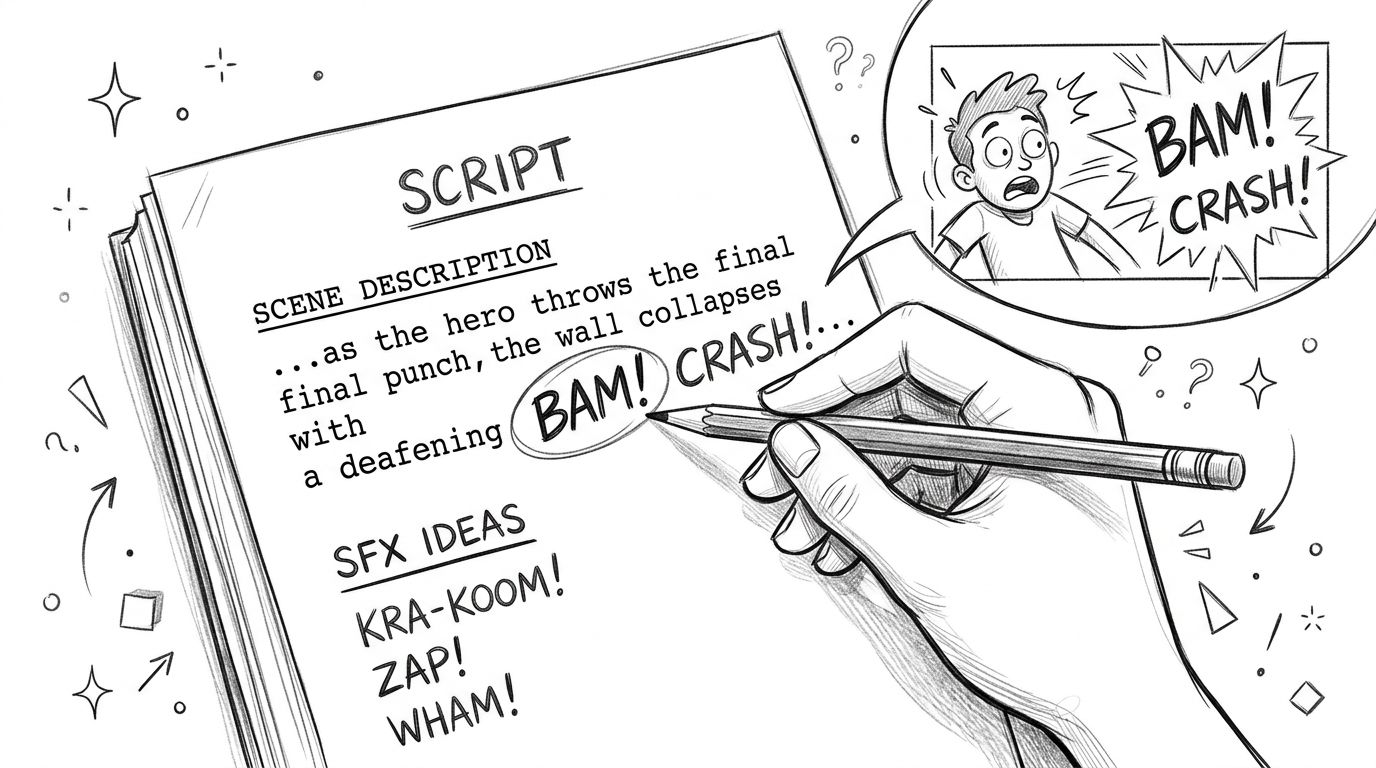
Industry advice says it clearly: “Letterers don't automatically put in sound effects. You should include that in your script. Also, don't leave the actual onomatopeia up to them”, as quoted in this discussion among comic creators.
Write SFX in the script like a director
When you script a panel, don't just describe what's visible. Include what the reader should hear and why it matters.
Weak script note:
- Door opens.
Stronger script note:
- The doorknob turns with a soft klik. The door opens slowly. The sound should feel small but tense, as if the room is too quiet.
The second version gives the artist, letterer, or AI system something useful. It defines the moment's emotional function, not just the physical event.
A simple scripting framework
Use this five-part framework when writing sound effects in comics.
Source
Identify what's making the sound. Sword, boot, chain, rain gutter, power armor joint, breath, static.Action
Name what happens. Scrape, slam, ignite, drip, unfold, burst, lock, teleport.Tone
Decide how it should feel. Harsh, sneaky, eerie, silly, heavy, brittle, ceremonial.Rhythm
Decide whether the sound is abrupt, sustained, repeated, staggered, or building.Placement note
Tell the letterer where it belongs. Off-panel left. Across the top of the frame. Small near the hand. Huge behind the figure.
That may sound like extra work, but it prevents generic choices later.
Test the sound out loud
One of the best habits is embarrassingly simple. Say the effect aloud.
If you're writing a chain dragging across concrete and you write CLANG, you may realize that's only the impact point, not the dragging part. Maybe the scene needs skrrrnk before the hit. If a creature lands and THUD feels too dead, maybe WHUMP gives it more body.
You're not trying to create dictionary words. You're trying to create convincing page sounds.
Say the sound. Then say the panel. If the rhythm doesn't fit the action, rewrite the effect.
Use off-panel sounds for storytelling
One of the most powerful uses of comic sound is to suggest what readers can't see. Mark Crilley's tutorial on using sound effects for unseen action and cinematic effect warns against treating them as decorative and shows how they can imply events outside the frame.
That opens up great storytelling options:
- Suspense: a click from the dark hallway before anyone appears
- Scale: a distant KRAK-THOOM from another room that tells readers the fight is spreading
- Interruption: dialogue cut off by a sudden BLAM
- Atmosphere: unseen pipes ticking in a basement scene
- Comedy: an awkward off-panel bonk after a confident exit
Off-panel sound effects make the comic world feel larger than the panel border.
Placement rules that keep pages readable
Placement isn't just aesthetic. It affects comprehension.
Try these practical habits:
- Lead the eye: Place the effect where the reader naturally encounters the action.
- Support closure: If the sound links one panel to the next, position it so the reader carries it forward.
- Avoid crowding dialogue: A sound effect shouldn't compete with essential speech unless the scene needs that clash.
- Respect silence: Not every panel needs an effect. Silence has shape too.
One more thing matters now that many creators use AI image tools. If you don't specify sound clearly, the system may generate something visually plausible but tonally wrong. You might get a loud superhero-style blast in a subtle drama scene, or a cute comic-pop effect in a grim thriller. That isn't a design problem alone. It's a scripting problem.
Create Your First Comic with Perfect Sound
The easiest way to improve your pages is to start treating sound as part of your first draft. Don't wait until the art is done. When you outline scenes, include the key noises that define mood, timing, and impact.
That means writing notes like these into your story setup:
- “Soft gravel crunch under slow footsteps” for suspense
- “Sharp CLANG as the sword hits stone” for a clean action beat
- “Low electrical hum that grows panel by panel” for tension
- “Tiny latch click off-panel” for a reveal
Those notes help any visual system generate a page with more intention.
A beginner workflow that works
Keep it simple on your first project.
First, pick one scene with clear audio moments. A chase, an argument interrupted by a crash, a stealth entry, or a magical transformation all work well. Second, write the page in plain language. Third, mark only the sounds that affect story clarity or mood. Fourth, read the page aloud and listen for rhythm.
Use this short checklist before you generate or letter the page:
- Does each major sound have a purpose?
- Does the word fit the material and tone?
- Does the rhythm match the action?
- Will the placement help the reader follow the panel?
- Would silence be stronger in any spot?
Beginners usually improve fastest when they use fewer sound effects, not more. A page packed with noise words can feel unfocused. A page with three carefully chosen effects can feel alive.
If you're using an AI comic tool, sound direction becomes even more valuable. The clearer your prompts and script notes are, the more likely the page will feel intentional rather than auto-decorated. Think like a writer, a letterer, and a director at the same time. That's the habit that turns comic sound from ornament into storytelling.
If you want to put these ideas into practice, PersonalizedComics gives you a fast way to turn your script, characters, and sound cues into finished comic pages. You can choose from eight art styles, add dialogue and scene direction, and guide the page so sound effects support the story instead of sitting on top of it. New users get a free three-page preview comic, which makes it easy to test a short scene and hear how your comic reads on the page.