The strongest books don't function as photo storage. They turn a relationship, a memory, or a familiar personality trait into a small illustrated world. The practical decisions matter just as much as the sentiment: which moments belong in the book, what art style suits the recipient, how much dialogue a page can carry, and whether the final print will survive being handled and reread.
Why Custom Birthday Books Make Unforgettable Gifts
A generic present can be useful and still disappear into daily life. A custom birthday book earns a different kind of attention because the recipient sees their own history reflected in it. A child becomes the explorer, a partner becomes the protagonist of an improbable adventure, or a parent appears as the steady figure behind years of family memories.
That distinction separates personalization from storytelling. Adding a name, favorite color, or birth date changes the surface of a template. Building a narrative around the person changes the emotional experience. The book should contain details that could only belong to that recipient, such as a familiar expression, a recurring family joke, a beloved place, or the way they respond when plans go wrong.
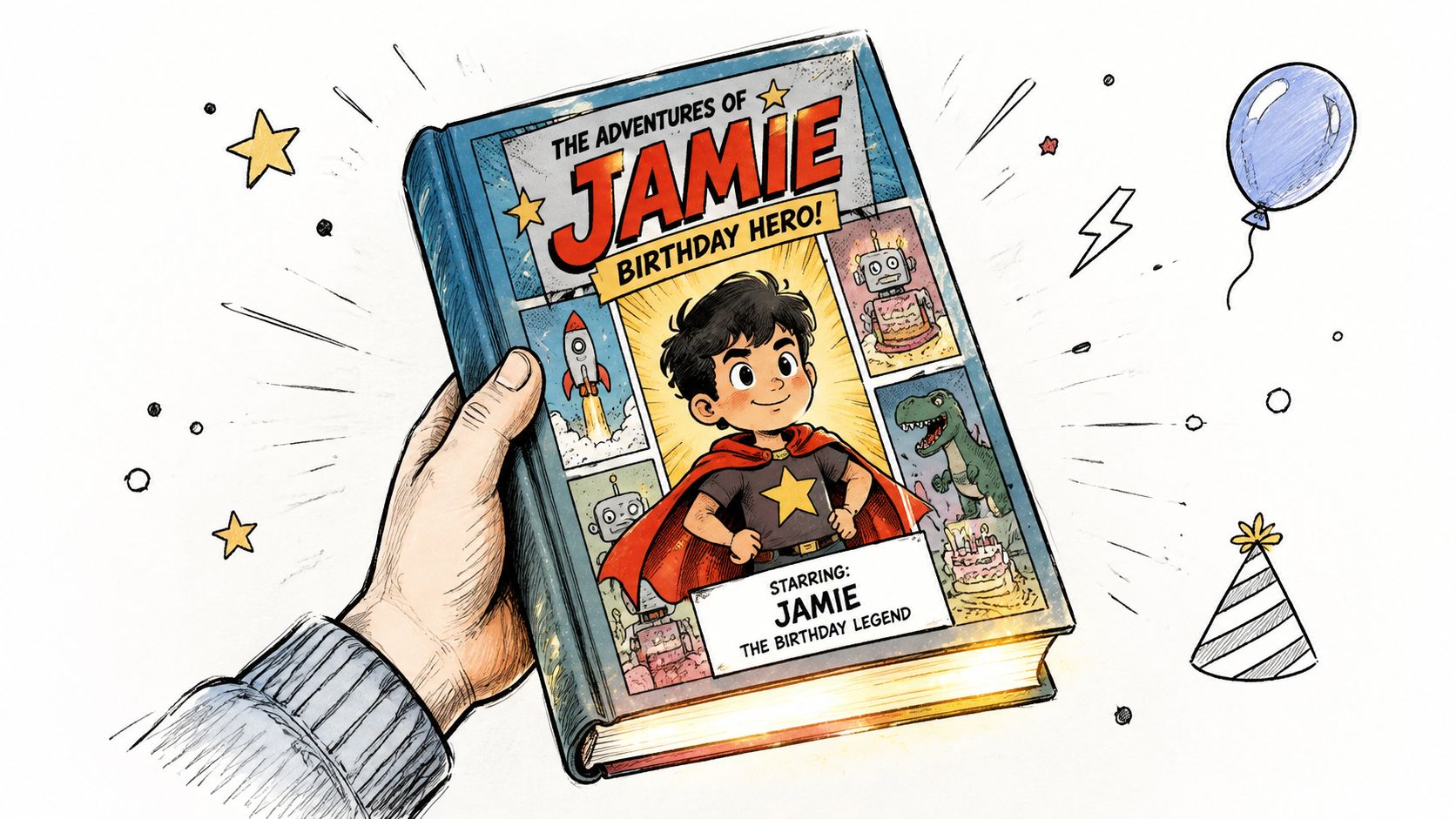
The story matters more than the template
A useful test is to remove the recipient's name mentally. If the plot still works but loses its emotional specificity, you've probably built a story rather than pasted details into a layout. If the plot becomes meaningless, the personalization may be doing all the work.
For example, a birthday comic for a friend could follow the impossible mission of recovering a missing cake before the party begins. The humor comes from recognizable traits, perhaps their inability to arrive anywhere on time or their habit of solving every problem with snacks. A book for a grandparent might use a quieter structure, moving through family memories and showing how ordinary gestures became lasting traditions.
The guide to making a book as a gift is useful for deciding what belongs in the story before you start designing pages. The central question is simple: what should the recipient feel when they reach the final page? Pride, amusement, tenderness, surprise, and gratitude lead to very different choices.
A birthday book can also preserve history
The format has a long editorial precedent. The New York Times Birthday Edition uses a front page from every birthday the recipient has celebrated, alongside a personalized cover, historical introduction, and timeline tracing the newspaper's development since 1851 as described in the product listing. Another version adds a 16-page booklet containing 32 influential front pages dating back to that same foundational year.
That structure shows why chronological birthday books work so well. They connect one person's life to the wider world, turning a gift into both an emotional keepsake and a concrete archival record. Your version doesn't need newspaper pages to use the same principle. It can place family milestones, places, relationships, and cultural memories into an order that makes a life feel legible.
Creative rule: A memorable book doesn't say only, “You are special.” It shows the moments, people, and quirks that make the recipient unmistakably themselves.
The wider personalized-books category reinforces the format's commercial staying power. One industry study values the global personalized books market at US$1,041 million in 2024 and projects US$1,902 million by 2031, while a separate report values the U.S. personalized children's books segment at US$661.49 million in 2024 and projects US$1,128.53 million by 2032 Global personalized books market data. Those figures don't guarantee that every custom book will move someone. They do show that personalized publishing has moved beyond novelty gifting.
Planning Your Birthday Story Structure and Photo Selection
Start with a story decision, not an upload folder. A large collection of photographs gives you options, but it doesn't provide sequence, tension, or meaning. Before choosing images, write one sentence that describes the book's emotional premise.
Try: “This is the story of how Sam turns every small problem into an adventure,” or “This book celebrates the people and places that shaped Mum's life.” That sentence becomes a filter. If a photo doesn't support it, save the image for another project.
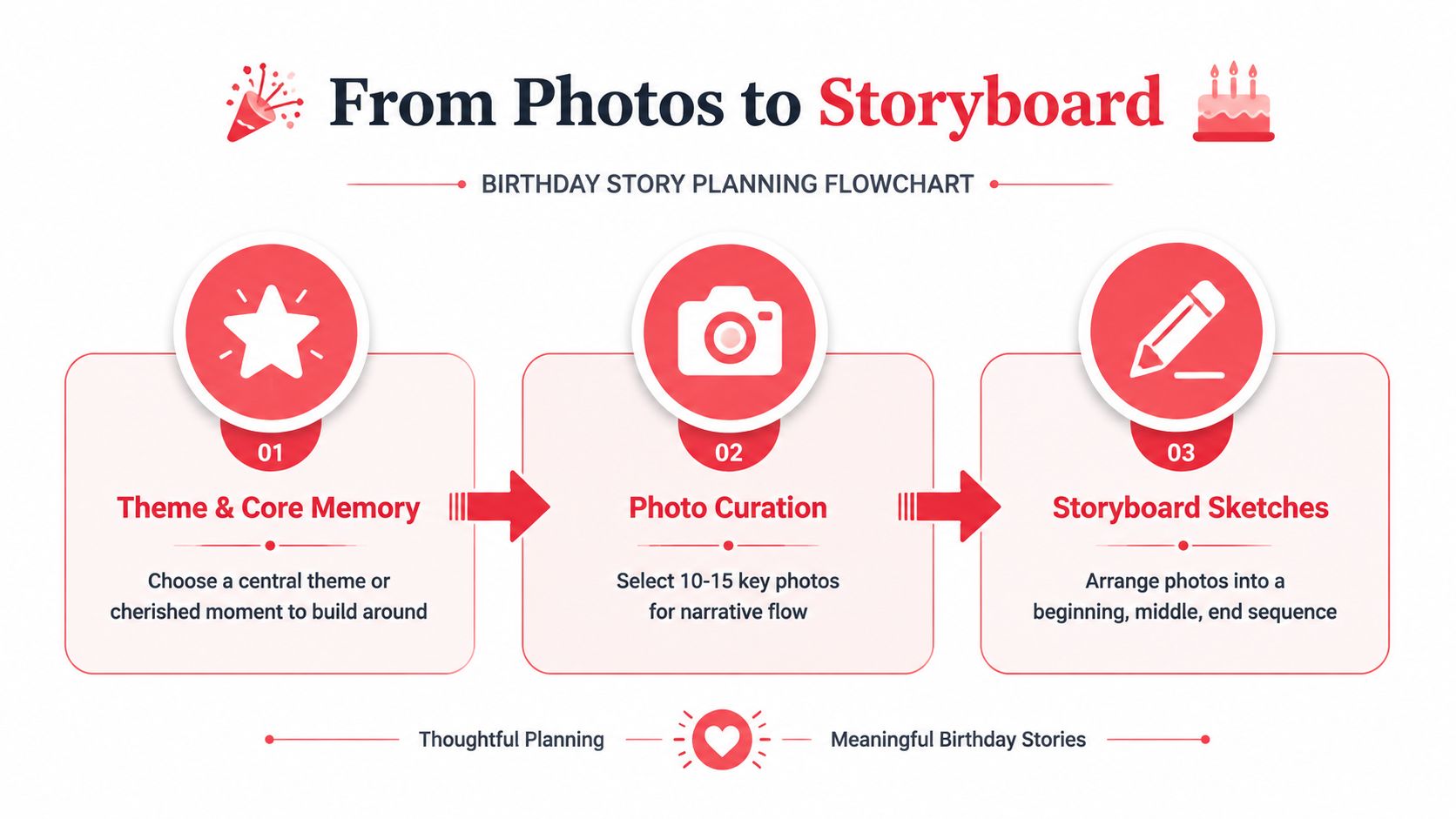
Choose a structure that fits the relationship
A chronological structure works when the gift honors a life, relationship, or shared history. Begin with an origin point, move through formative memories, and end with the present birthday as a continuation rather than a conclusion. This approach suits parents, grandparents, milestone birthdays, and long-term partners.
An adventure structure gives the recipient an active role. They receive a mission, encounter obstacles, use a defining skill, and reach a celebratory ending. It works especially well for children, friends with strong hobbies, and anyone who enjoys playful exaggeration.
A tribute structure is quieter. Each chapter can focus on a quality, place, relationship, or ritual, with photographs providing evidence. This format is effective when the book should feel warm and reflective rather than plot-heavy.
Use this basic page rhythm:
- Opening identity: Establish who the recipient is and what makes them distinctive.
- Inciting moment: Introduce the birthday problem, mission, memory, or question.
- Escalation: Let the character encounter several moments that reveal personality.
- Emotional turn: Include the memory or relationship with the greatest personal weight.
- Resolution: Bring the story back to the birthday and state what the recipient means to the people around them.
The photo comic book planning guide can help you turn that outline into panels rather than treating each photograph as a standalone page.
Curate photos for illustration, not just sentiment
The most meaningful photo isn't always the most useful source image. Illustration systems need clear visual information. Choose images with recognizable faces, visible posture, uncluttered backgrounds, and lighting that separates the subject from the surroundings.
Avoid relying on a sequence of near-identical group shots. They may document the same event, but they give the artist or image system little visual variety. Mix close portraits with wider environmental images, action poses, objects, and locations. A cake, bicycle, suitcase, family kitchen, or favorite jacket can carry narrative information without showing a face.
A practical shortlist might include:
- One defining portrait: Use it to establish the character's appearance.
- Several expressive moments: Laughter, concentration, surprise, or mock seriousness produce stronger panels than neutral poses.
- A few settings: Choose places that explain the relationship or occasion.
- A meaningful object: Include something that acts as a visual motif.
- A closing image: Select a photograph that supports gratitude, celebration, or forward motion.
For a partner, focus on shared rituals and a turning point in the relationship. For a child, use a clear goal and age-appropriate language. For a parent, prioritize continuity and specific acts of care. For a friend, build around a shared joke, trip, hobby, or improbable achievement.
Don't force every image into a panel. A smaller, purposeful selection usually creates a more coherent book than a crowded sequence of memories.
Choosing the Right Art Style for Your Recipient
Art style should reinforce the recipient's personality before it reflects your own taste. The same birthday plot can feel tender, comic, mysterious, or epic depending on its visual treatment. Choose the mood first, then select the style that can sustain it across every page.
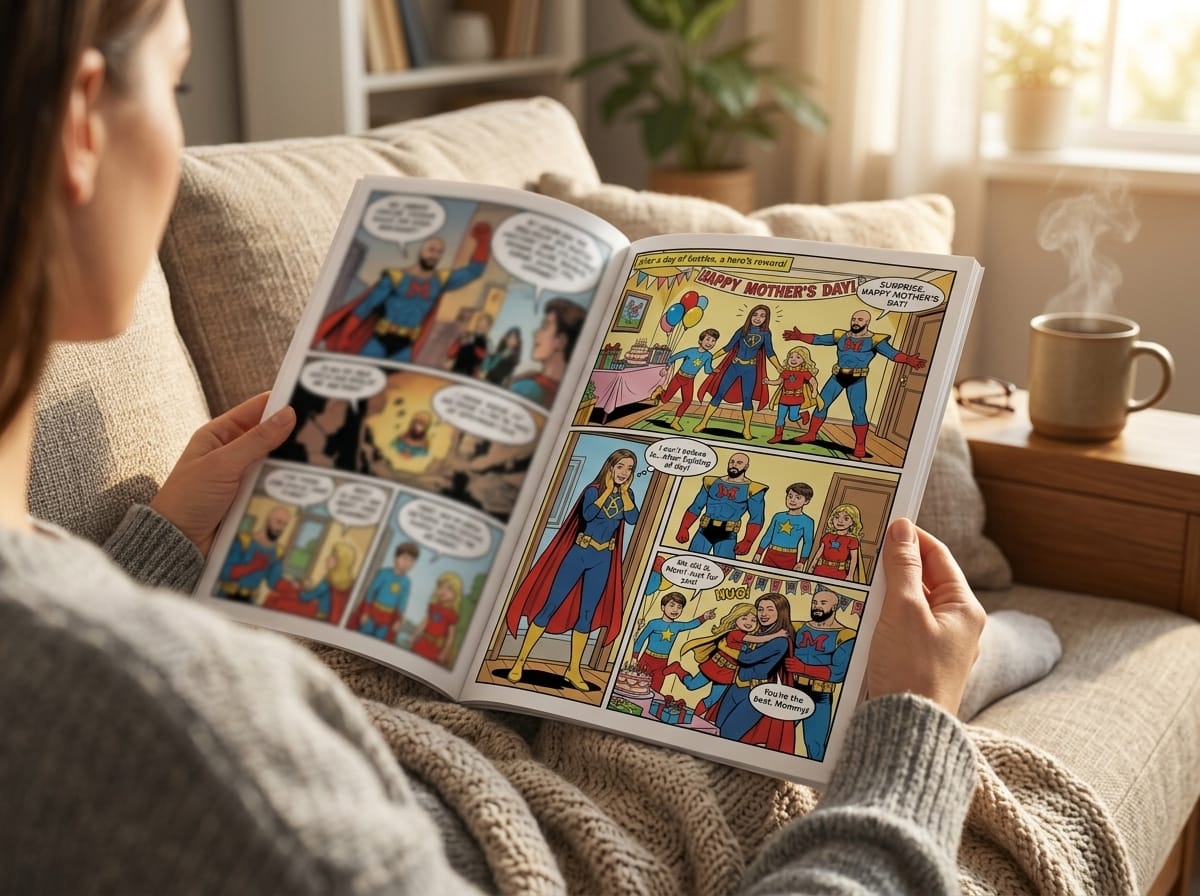
A manga treatment can make a birthday adventure feel energetic and expressive, especially for someone who enjoys anime, fantasy, or heightened reactions. Classic American comics create stronger heroic impact through bold lines, confident poses, and a traditional superhero vocabulary.
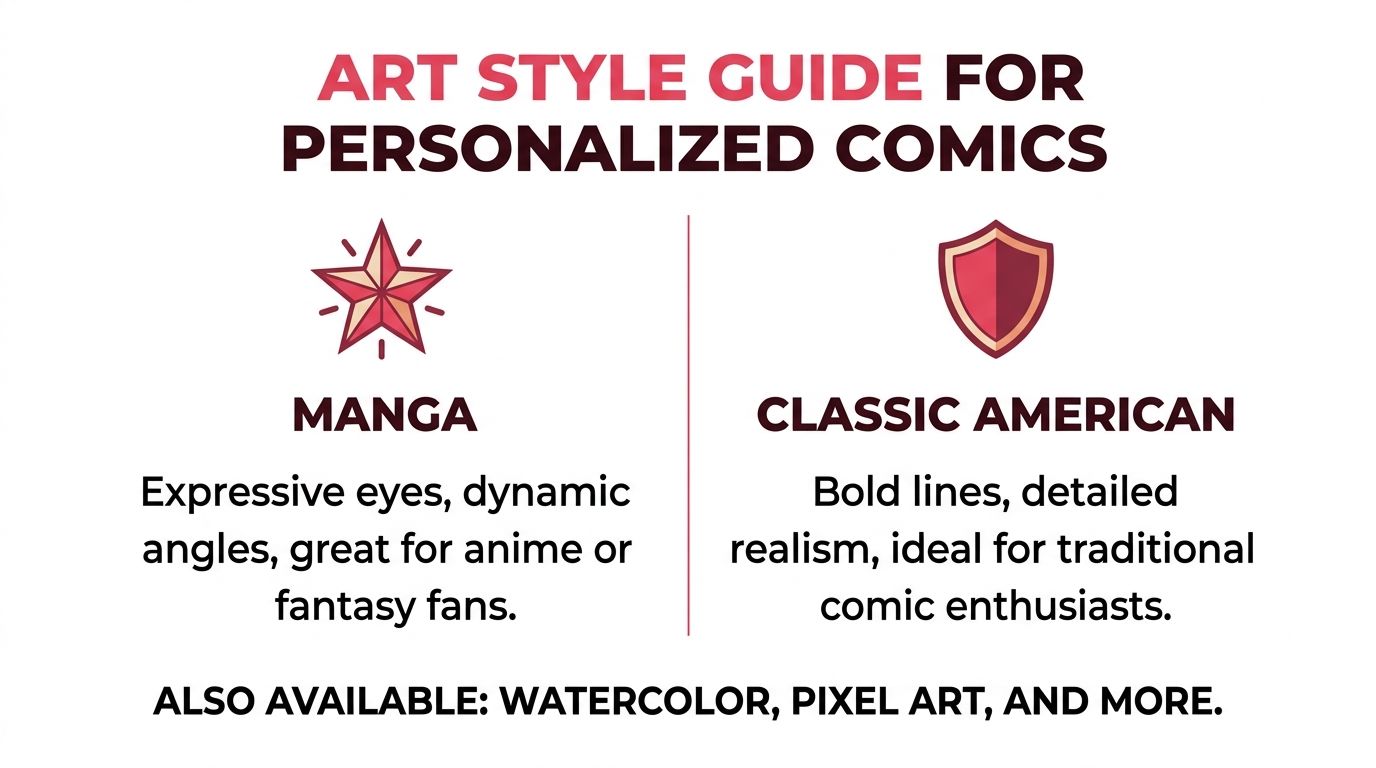
Match visual tone to emotional intent
The eight available directions, manga, classic American, graphic novel, noir, watercolor, cyberpunk, retro pop, and fantasy, are not interchangeable skins. Each one changes the reader's expectations.
| Art direction | Strong fit | Watch for |
|---|---|---|
| Manga | Expressive children's adventures, anime-influenced gifts, emotional comedy | Exaggeration can overpower a quiet tribute |
| Classic American | Heroic birthdays, action stories, comic fans | Bold treatment may feel too grand for a restrained relationship story |
| Graphic novel | Reflective biographies and mature storytelling | Dense visual detail can compete with short text |
| Noir | Mystery, wit, dramatic reveals | Shadows may make cheerful scenes feel unnecessarily serious |
| Watercolor | Romantic gifts, family memories, gentle childhood stories | Softness can reduce impact in action-heavy plots |
| Cyberpunk | Technology fans, futuristic missions, imaginative worldbuilding | The setting can distract from the recipient |
| Retro pop | Playful friends' gifts and colorful party narratives | Strong graphic treatment needs disciplined text |
| Fantasy | Mythical journeys, transformation stories, imaginative children's books | Fantasy elements should serve the person, not replace them |
The different comic art styles guide helps compare these visual languages before you commit. Look at the same scene in contrasting styles if the platform allows previews. A person opening a birthday present might read as intimate in watercolor, triumphant in classic American comics, or suspiciously dramatic in noir.
Keep the character recognizable
Recognition depends on more than facial features. Hair shape, glasses, clothing, posture, favorite colors, and repeated gestures create continuity. Give the character a small set of stable visual identifiers and describe them consistently in every scene.
Style matching also depends on age and relationship. A child who loves space may enjoy a fantasy or cyberpunk setting, but the birthday message should still sound like the people who know them. A romantic book may benefit from watercolor softness, while a shared travel story could suit a graphic novel approach with strong locations and cinematic framing.
Visual test: If the style is the first thing you notice, simplify the scene or choose a quieter treatment. The recipient should remain the subject.
Use props as connective tissue. The same red backpack, camera, football, recipe book, or family dog can appear throughout the story, helping separate scenes while making the book feel designed rather than assembled.
Writing Dialogue and Building Your Comic Pages
A beautiful illustration can't rescue dialogue that sounds like a greeting card. Write speech the way the recipient talks, then edit it for clarity and length. Short exchanges usually create more energy than large blocks of explanation.
Start by assigning each character a purpose on the page. One person may introduce the problem, another may challenge the hero, and a third may deliver the emotional truth. Don't give every character a speech bubble because they appear in the frame.
Build each page around one visual beat
A page should answer one clear question. What has changed by the time the reader reaches the bottom? The answer might be “the birthday hero discovers the missing gift,” “the family arrives,” or “the character understands why the celebration matters.”
Use narration to add context that the image can't show. Don't write, “Alex is running through the park,” beneath an image that already makes that obvious. Instead, add a thought, time shift, memory, or emotional detail that expands the scene.
A reliable page brief includes:
- Setting: Name the place, season, time of day, and important background elements.
- Characters: Describe who appears, what they're wearing, and how they're positioned.
- Action: State the single event the page must communicate.
- Panel flow: Specify whether the page needs a wide establishing panel, close-up, reaction shot, or sequence.
- Text: Provide the exact dialogue, narration, and any sound effect.
- Mood: Define whether the scene should feel playful, tense, tender, or triumphant.
A page about a surprise party might begin with a wide panel showing a darkened room, move to a close-up of someone trying not to laugh, and finish with the birthday character opening the door. The text should support that progression rather than explain the entire surprise in advance.
Treat page credits as storyboard decisions
PersonalizedComics uses a credit model in which 1 credit equals 1 page, with Starter, Creator, and Studio packs offering lifetime platform access, all eight styles, and credits that don't expire. New users get a free three-page preview comic when they sign up, according to the publisher's product information. That makes page planning important before generation, especially when a scene needs multiple attempts.
Draft the text and panel plan first. Use early credits to test a representative page, not the easiest page in the book. A crowded group scene, an emotionally important close-up, or a location with several objects will reveal more about whether your instructions are working.
Preview for three things before approving a page:
- Character continuity: Does the person remain recognizable?
- Reading order: Can the eye move naturally from panel to panel?
- Text balance: Do speech bubbles leave the artwork room to breathe?
Avoid stuffing every memory into dialogue. Let an image carry the joke when possible. Sound effects such as a door creaking, a balloon popping, or a cake being placed on a table can add comic rhythm, but they should mark an action rather than decorate empty space.
Print Quality, Format Decisions, and Delivery Timing
The first format decision is practical, not aesthetic. A digital book is convenient for long-distance gifting and last-minute delivery. A printed book creates a physical object that can be opened, displayed, and revisited, but it adds proofing, production, shipping, and handling risks.
Recent buyer data indicates that roughly two in three customers choose a printed personalized book, with hardcover identified as the most popular format in the personalized-gift data report. That preference makes sense for birthday gifting, where the object often becomes part of a shelf, memory box, or annual ritual. It doesn't mean hardcover is always the right choice. A digital version may be better when timing is uncertain, the recipient lives far away, or the book is intended as a shared screen experience.
Decide between digital and physical delivery
Choose digital when immediacy, portability, or easy sharing matters most. It also gives you a useful fallback if a physical shipment may arrive after the birthday. Choose print when the recipient values tangible keepsakes, when the illustrations deserve page-by-page viewing, or when the gift should remain visible after the celebration.
Hardcover usually makes more sense for a book intended to be reread or preserved. A softer format can suit a casual comic, a prototype, or a gift where cost and flexibility matter more than archival feel. Make the decision before finalizing page dimensions, because format changes can affect cropping, margins, and visual balance.
Proof the file before you order
Print defects can turn a moving story into an awkward object. Common risks include smudging, ghosting, misalignment, inconsistent color, blur, and trimming or binding errors. Guidance from print-quality specialists recommends ordering a printed proof early, keeping generous safe margins, and avoiding low-resolution or manually upscaled images.
Check every page at full size. Look for faces too close to the trim edge, speech bubbles that could be clipped, thin lines that may weaken in print, and dark areas where detail disappears. Compare the proof with the digital preview, but don't assume the screen represents the final paper exactly. Screens emit light. Paper reflects it.
Production rule: Never treat the first exported file as the finished book. Inspect a proof, then approve the version that survives physical handling.
Timing requires a backward plan. Set the birthday date as the final deadline, then allow room for file review, proofing, corrections, production, and delivery. Ask the printer or platform for its current estimates rather than relying on a generic promise, and keep a digital copy ready as a contingency.
Seasonal demand can also affect planning. Custom photo books show search spikes in December and August, patterns that may correspond to holiday and birthday planning windows, as reported in photobook market coverage. If your birthday falls near a busy gifting period, start earlier and avoid making shipping the final step in your plan.
Gift Packaging and Presentation Strategies
The recipient's first impression begins before the cover opens. Packaging should create curiosity without making the book feel like a product launch. Use a simple outer wrap in a color pulled from the artwork, then add a small clue from the story, such as a star map for a space adventure, a mock mission badge for a superhero plot, or a handwritten “Chapter One” tag.
Keep the presentation proportional to the book. A large box filled with unrelated extras can bury the central gift. A rigid mailer, tissue paper, and one personal note often feel more intentional than elaborate packaging that competes with the illustrations.
Turn the reveal into part of the narrative
Give the book at a moment when the recipient can read it. A quiet breakfast, the end of a family meal, or a small pause before the larger celebration gives the gift room to land. For a child, you might read the first pages aloud and let them discover their character gradually. For an adult, place the book beside a familiar object from the story and let the visual connection prompt the reveal.
A short note can frame the book without explaining every page:
- “You've solved harder problems than this one.”
- “Every chapter needed you in it.”
- “This is the version of our story I wanted you to keep.”
For long-distance gifting, send the digital version at the planned reveal time and arrange a video call for the first read. If a physical copy follows, the digital presentation becomes an opening scene rather than a substitute. You can also share a single cover image or selected page with permission, but keep the full book private until the recipient has seen it.
The best packaging decision is the one that extends the book's story. A thoughtful cover, a personal note, and a calm reveal let the recipient understand that the gift wasn't assembled from spare photos. Someone made choices about what to remember.
PersonalizedComics lets you upload photos and ideas, choose from eight art styles, and generate illustrated comic pages with panels, speech bubbles, sound effects, and narration, with digital creation and physical comic ordering available. Visit PersonalizedComics to turn your birthday story into a designed keepsake rather than a generic photo collection.
Filed under Making Your Comic