Your Guide: How to Choose Character Names That Stick
You've got a character sketch you like, a world that finally feels alive, and then the naming problem shows up. Not the fun version. The version where every option sounds too generic, too forced, too similar to someone else in the cast, or too long to fit cleanly in a speech bubble.
Comics make naming more demanding than prose. A name has to read fast, sit comfortably in dialogue, look good in all caps on a cover, and feel right for the genre the second a reader sees it. A noir detective, a magical girl, a cyberpunk courier, and a cosmic villain all ask for different naming logic. If you're learning how to choose character names, the best approach is part storytelling, part design, and part editing discipline.
The good news is that this process doesn't need to stay mystical. A practical naming framework will get you to stronger choices faster, and it will save you from redrawing lettered pages because you realized too late that your lead's name is awkward every time another character shouts it.
The Foundation What Your Character's Name Must Achieve
A character name is a storytelling tool. It isn't decoration, and it isn't a random label you attach after the core creative work is done. In comics, the name starts doing work before the reader knows anything else. They see it on a character sheet, in a caption box, on a cover, or in a speech bubble, and they form expectations instantly.
A good name usually has to handle four jobs at once:
- Genre fit: The name should sound like it belongs in your world.
- Role clarity: A protagonist, sidekick, villain, and comic relief character rarely need the same naming energy.
- Visual usability: The name has to fit inside panels and dialogue balloons without becoming typographic clutter.
- Reader memory: The name must be easy to track when scenes move quickly.
Match the name to the comic's atmosphere
If you're making a hardboiled noir comic, names with blunt edges often work better than ornate ones. “Vera Flint” tells the reader something very different from “Sunbeam Lark.” In fantasy, you have more room for musical or ceremonial names, but they still need internal logic. In superhero comics, names often need a civilian identity and a public-facing alias, and those two names should create a useful contrast.
Here's a quick way to test tone:
| Comic genre | Name style that often works | Name style that often fights the setting |
|---|---|---|
| Noir | Crisp, grounded, slightly hard-edged | Whimsical or overly decorative |
| Fantasy | Layered, mythic, culture-specific | Plain modern office-name energy |
| Cyberpunk | Sleek, modular, tech-adjacent | Overblown fantasy syllables |
| Slice of life manga | Natural, socially believable | Excessively symbolic names |
| Superhero | Memorable civilian name plus strong alias | Names with no rhythm or punch |
Names also need to belong to a wider cast system. If your worldbuilding has a strong cultural identity, every major name should feel like it came from the same social reality. That's one reason solid comic character design principles help. Visual design and naming should reinforce each other, not pull in opposite directions.
Practical rule: If the name and the costume seem to come from two different comics, one of them is wrong.
Ask the parent question, not just the writer question
Writers often ask, “What sounds cool?” A better question is, “Who would have given this character this name?” Even in fantasy or sci-fi, names usually come from families, institutions, class systems, faith traditions, or local habits.
Try this short filter before you lock anything in:
- Who named them? Parent, guardian, lab, military unit, royal line, street crew?
- When were they named? Childhood, rebirth, secret identity creation, title earned later?
- What should the name imply? Familiarity, danger, elegance, status, rebellion?
- What will readers have to say often? First name, surname, codename, nickname?
This keeps you from naming everybody from your own taste instead of from the logic of the world.
Build for the medium, not just the lore
A novel can hide a difficult name inside paragraphs. Comics can't. Every extra syllable competes with art and pacing. If a character gets addressed often, that matters. If they're in argument scenes, chase scenes, or team banter, it matters even more.
That's why the strongest comic names feel intentional at a glance and efficient on the page.
Brainstorming Techniques Beyond the Obvious
Most weak naming happens because the first list is too small. Writers pick from whatever floats up immediately, then over-defend the options because they're tired of searching. Don't hunt for the perfect name first. Build a large candidate pool and judge it later.
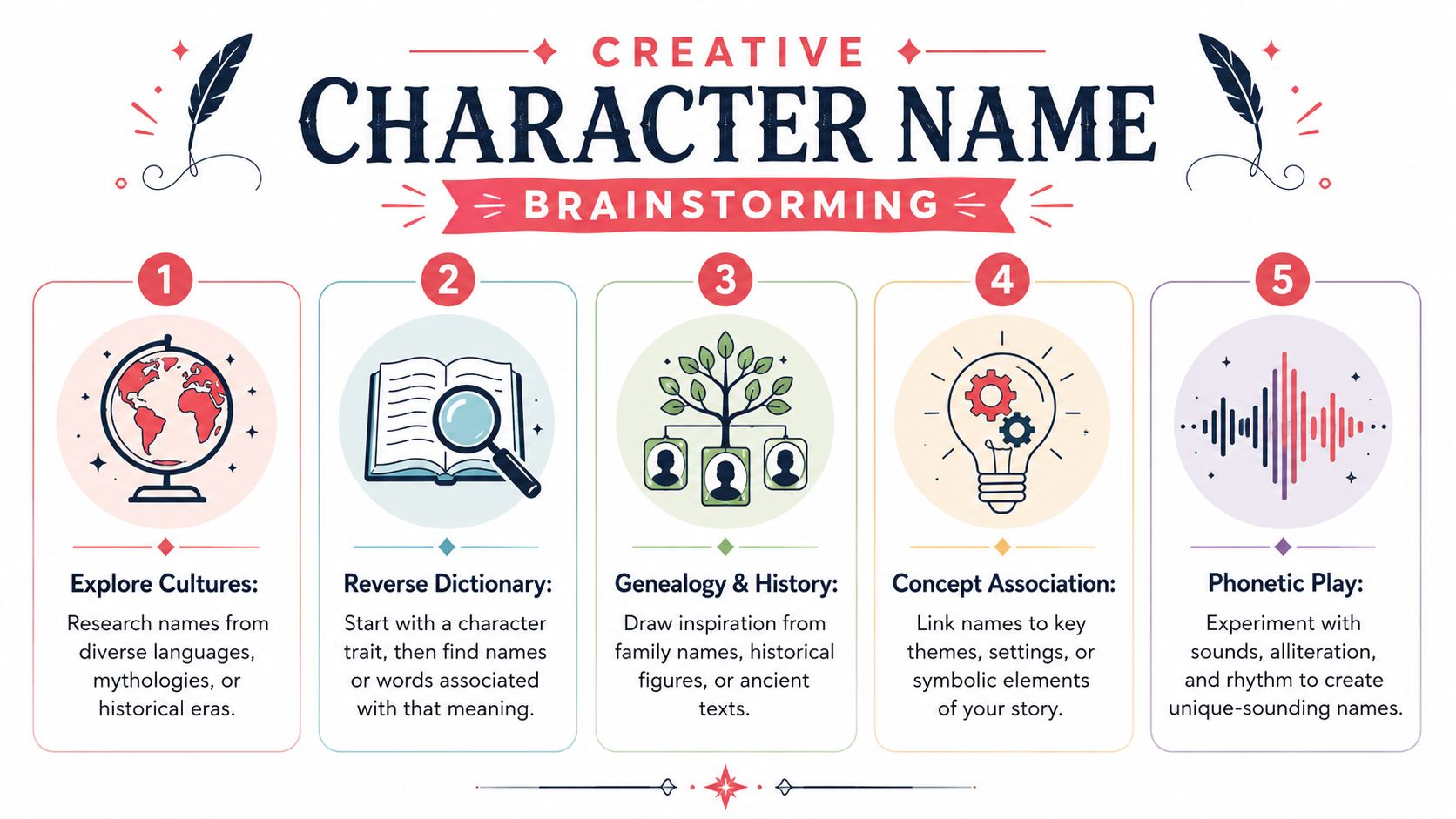
One practical reason to avoid the obvious pool is that name popularity is concentrated in real life. According to U.S. Social Security name data, the top 100 names account for 73.1% of male births and 71.5% of female births, which means familiar names repeat constantly in real datasets and often in fiction too. If every comic uses the same contemporary shortlist, casts start to blur together.
Five methods that produce better raw material
Mine historical databases. Search names by era, not just by style. If your comic is set in the 1970s, a medieval court, or a near-future colony descended from a specific region, names tied to real naming patterns usually feel more believable than random fantasy generation.
Use meaning as a starting point, then move sideways. If your character is stubborn, don't name them “Stone” and call it done. Instead, brainstorm words related to endurance, roots, iron, cliffs, old trees, anchors, or fixed stars. That gets you to subtler choices.
Steal from maps and signage, then reshape. Street names, districts, stations, rivers, and old industrial sites often have excellent rhythm. They can become surnames, code names, or city-specific aliases with a slight tweak.
Pull from domain language. Sci-fi names can emerge from astronomy, engineering, bio labs, telecom, or shipping jargon. Fantasy names can come from old crafts, herbal glossaries, or ritual vocabulary. Noir can borrow from boxing, police slang, jazz clubs, or rail lines.
Build a sound family. Pick one or two vowel-consonant patterns that fit a culture in your world, then generate several names from that sound set. This works especially well when you need a whole town, guild, or alien species to feel coherent.
Use contrast to widen the list
A useful trick is pairing opposites. Write one column for what the character projects and another for what they hide. A cheerful mascot hero with a grim backstory might need a bright public name and a private birth name that lands differently. A cyberpunk hacker may use a compact handle in chat and a more ordinary legal name in family scenes.
That split gives you more options than trying to make one name carry every layer all at once.
Collect names in batches. Ten bland names are harder to judge than thirty varied names with clear tonal differences.
Borrow from process, not from trend
If you're blocked, use prompts from story development instead of trend lists. A simple worksheet from a beginner story writing process can help because names usually improve when you understand role, conflict, and voice first.
Try this quick long-list exercise:
| Prompt | Example output type |
|---|---|
| Core trait | sharp, warm, relentless, secretive |
| Setting cue | neon, cathedral, alley, orchard |
| Social origin | aristocratic, rural, military, corporate |
| Sound target | clipped, lyrical, rough, formal |
| Alternate identity | stage name, codename, title, nickname |
Fill each row with a few words, then combine them into candidates.
Don't judge too early
The first draft of a naming list should be messy. Some entries should be too plain. Some should be too ornate. Some should be weird enough that you laugh and move on. That's healthy.
What doesn't work is pretending inspiration is enough. Good comic names usually come from selection pressure. You generate wide, then cut hard.
Checking for Readability and Memorability
A comic reader meets your character's name under pressure. They are reading dialogue, tracking expressions, following panel flow, and trying to understand who is moving where. If the name slows recognition, the page feels heavier than it should.
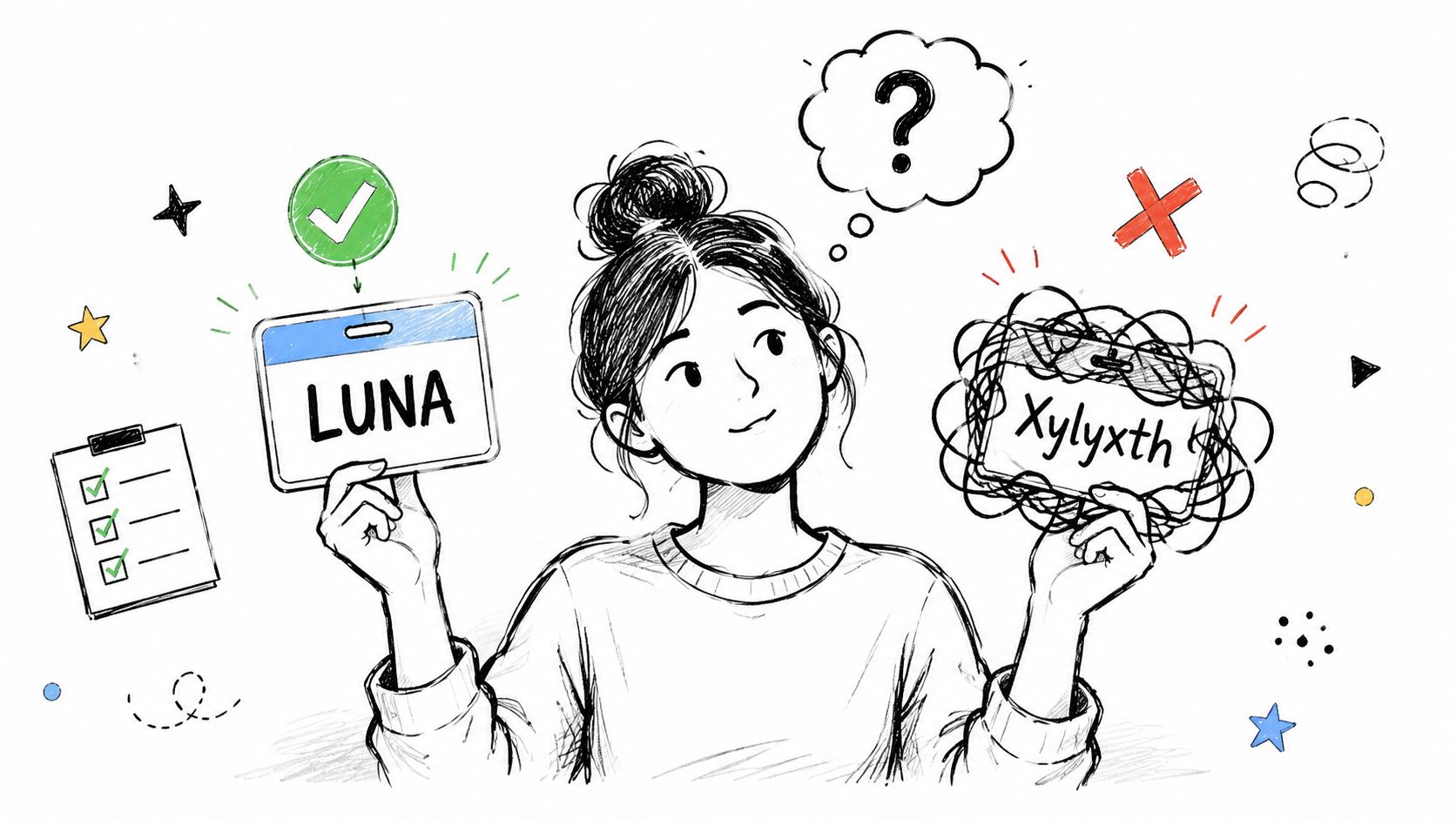
This is one of the biggest differences between naming for prose and naming for comics. In a novel, a reader can absorb a long name inside a paragraph and keep going. In comics, the name has to work inside a balloon, inside a caption, and inside a panel that may already be doing a lot of visual work.
I use a simple test. If a name looks good in a character sheet but feels clumsy in a speech bubble, it is not ready yet.
The first-letter trap
Early cast lists often fail as a group, not as individual names. Mara, Micah, Miko, and Milo may all fit the setting, but they blur once readers hit page three and start reading at speed.
Check the cast in this order:
- Initials. Give main characters different starting letters when you can.
- Opening sounds. Kira and Caden do not share an initial, but they can still crowd each other in dialogue.
- Word shape. Nia, Lia, and Mia are visually compact in almost the same way. In small balloons, that matters.
This matters even more in genres with large ensembles. Superhero teams, school manga, space operas, and fantasy quest books all introduce several characters fast. If you study how manga developed distinct visual storytelling habits, you can see why naming economy matters in crowded pages and recurring cast scenes.
Test names in actual dialogue
A name should survive being spoken under stress, whispered in a close-up, and repeated across a page turn. Testing it once in isolation is too gentle.
Read each candidate out loud in lines like these:
- “Run, ___!”
- “You did this, ___.”
- “Detective ___, look at me.”
- “Is that really you, ___?”
- “We don't have time, ___.”
Listen for speed, clarity, and mouth feel. Some names look striking on a list and become awkward the second a character has to shout them twice in a fight scene.
I also check balloon length. A long ceremonial name may fit a fantasy queen's introduction, then become a nuisance every time her guard addresses her in a cramped panel. In that case, keep the full name for formal scenes and give the cast a shorter spoken version.
Keep complexity where it pays off
Frequent-use characters benefit from clean, repeatable names. Supporting figures can carry more texture if they appear less often. Titles can also do part of the workload.
Here is the standard I use:
| If the character is… | Usually better to favor… |
|---|---|
| Main protagonist | Short, clear, high-recognition name |
| Ensemble side character | Distinctive sound and different initial |
| Mythic figure | Formal full name plus shorter spoken version |
| Villain with title | Strong title, simpler personal name |
| AI or codename user | Sharp visual form and easy repeat value |
Dense consonant clusters also create avoidable drag. A reader can decode them, but comics punish even small slowdowns because panel rhythm depends on quick recognition. If the name looks like a puzzle every time it appears, readers feel that friction.
Use a recall test, not a preference poll
“Do you like this name?” is a weak question. Ask beta readers something more useful after one chapter or even one scene:
- Which character did this name belong to?
- What role did you assume they had?
- Which other name felt too similar?
- Which name did you remember without checking back?
Those answers expose confusion fast. They also show whether the name is doing real work on the page.
The goal is simple. Readers should spend their attention on the story, not on decoding your cast list.
Naming with Cultural and Historical Respect
A name can expose weak research faster than almost anything else in a comic. The panel may look great. The costume may fit the setting. Then a character opens their mouth, another character says their name, and the spell breaks because the choice feels borrowed, flattened, or unsuitable for the person on the page.
Comics make this more visible than prose. Names show up in dialogue balloons, captions, dossier pages, storefront signs, school rosters, and chapter titles. If a culturally specific name is inaccurate, readers do not just notice it once. They see it repeated across the visual rhythm of the story.
Respect starts with specificity. “I liked the sound” is not a strong enough reason to pull a name from a culture, language, or historical period you have not studied. You need to know who uses it, how it is spelled, whether it is tied to religion or ceremony, whether it fits the character's age and family background, and whether it makes sense in the region your story draws from.
I use a simple check before I lock anything in. Could I explain this character's name to an editor in three plain sentences: where it comes from, why this family would use it, and why it fits this exact person? If I cannot do that, the name is still in draft.
A practical verification workflow
Use a repeatable process.
Place the character in a real social context. Pin down birthplace, family history, class, generation, migration pattern, and language at home. A name that fits one community may sound off in another, even within the same country.
Check sources tied to that culture or era. Use government records, census material, museum collections, linguistic references, historical registries, and scholarship. Baby name sites are weak evidence on their own.
Test the family logic. Do the given name and surname belong to the same social world? Would the parents plausibly choose that name at that moment in history? Does a nickname, honorific, or school name change how other characters address them in the comic?
Check for sacred, ceremonial, or high-status usage. Some names carry religious weight, clan significance, or formal status markers that should not be assigned casually.
Get informed review if the culture matters to the story. A sensitivity reader, cultural consultant, historian, or native speaker can catch errors that research alone will miss.
Revise cleanly. If someone points out that the name feels off, fix the page and move on.
Appreciation and appropriation split at context
Stylization is part of comics. So is homage. Problems start when a name is treated like visual decoration instead of social information. If the costume, weapon, or setting does all the cultural signaling, and the name was chosen only because it sounded cool, readers can feel that shortcut.
This comes up often in manga-inspired work. Genre familiarity does not automatically give you Japanese naming instincts, or the instincts of any culture filtered through manga aesthetics. Reading about the origin of manga storytelling traditions helps clarify how much naming is shaped by era, class, formality, and social role, not just by sound.
A good test is simple. Strip away the costume design and genre markers. Would this still read like a believable name for this person, in this family, in this setting?
Historical respect follows the same rule
Historical naming fails when creators chase a vague period flavor instead of actual usage. “Old-fashioned” is not specific enough. A dockworker in 1890s Liverpool, a Taisho-era schoolgirl, and a Harlem jazz singer in the 1940s should not sound like they were all named from the same fantasy list.
For comics, I also check what the period name does on the page. Does it fit in a speech balloon without constant abbreviation? Will formal address matter in courtroom scenes, military scenes, or school scenes? Can letterers handle repeated honorifics, patronymics, or long surnames without cramping the panel? Historical accuracy still has to survive the practical demands of comic storytelling.
That is the standard. Respect the culture. Respect the history. Then make sure the name still works inside the panel.
Weaving Symbolism into Your Character's Name
A symbolic name earns its place when it adds meaning on the page without hijacking the scene. In comics, that standard matters more than it does in prose. Readers see the name in balloons, captions, roster pages, computer screens, and cover copy. If the symbolism is too loud, every repeat makes it feel more forced.
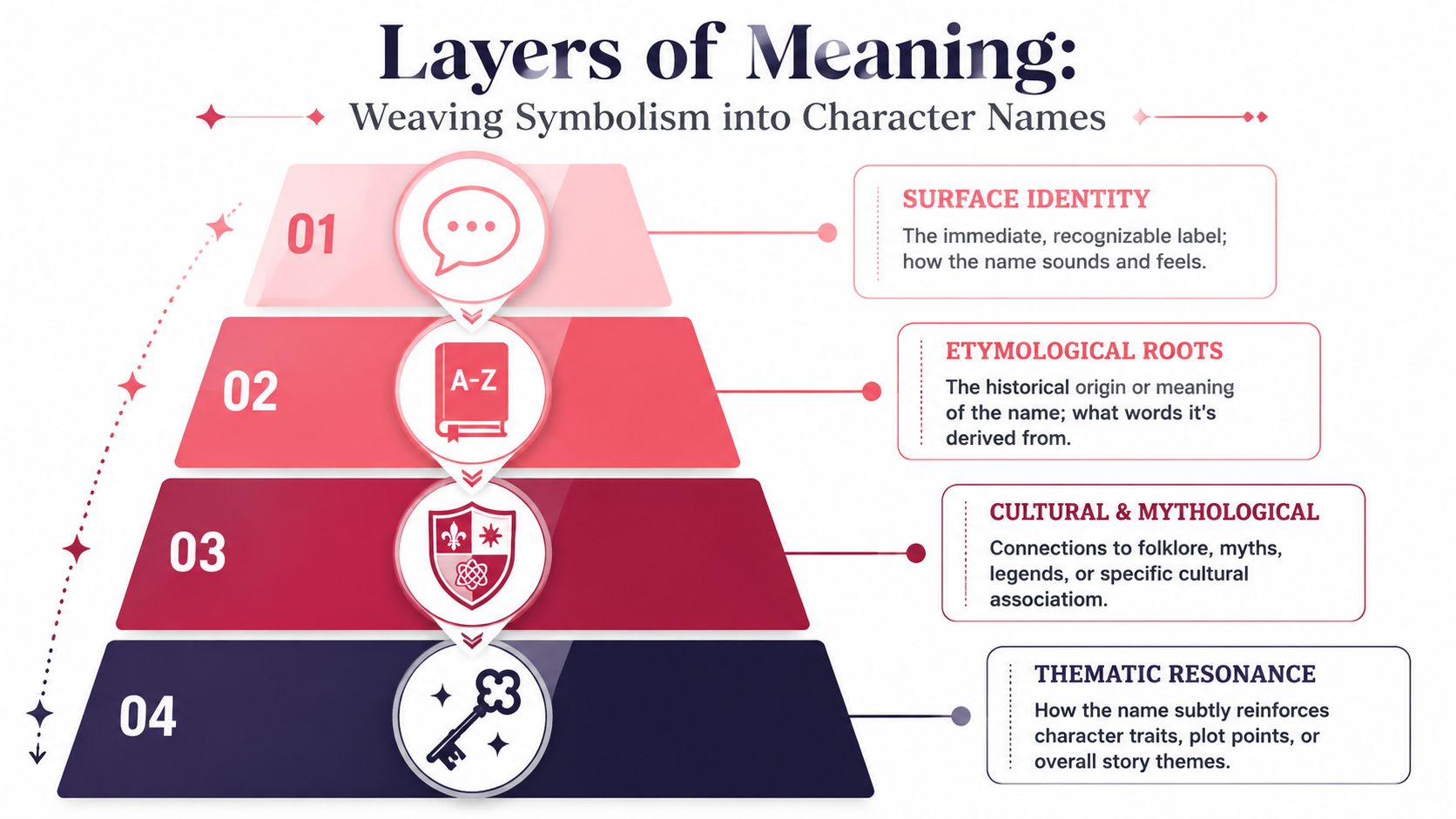
I look for symbolic names that do two jobs at once. They support the story's themes, and they still sound like names a character could carry in their world. A noir detective, a shonen rival, a cosmic horror priestess, and a slice-of-life teen all need different levels of symbolic pressure.
Build in layers, not labels
Useful symbolism usually works on several levels at once:
- Surface sound: Does the name feel clipped, heavy, elegant, artificial, playful?
- Root meaning: Does the etymology point toward an idea tied to the character?
- Cultural association: Does it call up a myth, saint, dynasty, folktale, or archetype?
- Thematic link: Does it reinforce a deeper concern in the comic, such as guilt, inheritance, memory, appetite, freedom, or transformation?
One layer can be enough. Two or three often gives you more staying power.
Names fail here when the symbolism is doing all the characterization by itself. “Mercy Light” tells the reader too much, too early. A quieter choice lets the art, dialogue, and scene work carry their share.
Use symbolism to create tension
The strongest symbolic names often introduce friction instead of agreement. That tension gives a comics character more shape fast, which matters in a medium where page space is tight.
A few reliable patterns:
| Naming move | Result |
|---|---|
| Literal trait naming | Feels flat or broad |
| Indirect thematic naming | Adds depth without announcing itself |
| Contradictory naming | Creates irony, tension, or mystery |
| Too many symbolic signals at once | Feels overbuilt |
A soft, devotional first name on a brutal enforcer suggests a past the script has not explained yet. A grand old-family surname on a broke dropout hints at pressure, shame, or failed expectation. An AI called “Eden” or “Shepherd” can feel unsettling before it says a word.
That kind of symbolic tension works especially well in comics because readers absorb name, design, posture, and context at the same time.
Non-human characters need sharper symbolic control
Many comic creators get sloppy with non-human names. Human naming logic does not transfer cleanly to aliens, yokai, ghosts, kaiju, mascots, demons, biotech organisms, or machine minds. Random apostrophes and syllable piles may look inventive in a notes app, but in a comic they often blur together.
The test is practical. Can a reader recognize the name in a balloon, remember it three pages later, and connect it to the creature's role or presence? If not, the symbolism is too vague to help.
How to name non-human characters with meaning
Use structure. Readers learn patterns quickly, and comics reward that kind of clarity.
- Semantic anchoring: Tie the name to function, habitat, origin, ritual use, or social role.
- Phonetic family: Give each species, faction, or entity class a controlled sound pattern so the cast feels related without becoming identical.
- Human-assigned naming: Let the in-world human name reveal fear, affection, bureaucracy, superstition, or misunderstanding.
- Dual naming: Use a formal or true name plus a shorter call name. This works well for supernatural, sci-fi, and epic fantasy comics where characters need lore depth and balloon efficiency.
I use dual naming a lot in scripts. The ceremonial name can hold the symbolic weight. The spoken name does the day-to-day production work.
For example, a giant fungal monarch in a dark fantasy comic might have an ancient throne name for lore pages and a shorter battlefield name that fits in shouted dialogue. A school comedy with spirits might give each entity a folk-rooted true name, then a nickname students use. A superhero book can give an android a manufactured designation and a chosen personal name, letting the contrast carry the theme.
Check whether the symbolism survives repetition
This is the comics-specific filter many naming guides miss.
Write the name in a threat balloon. Put it in a whispered confession. Put it in a caption box, a case file, a phone screen, and a chapter title. Then ask whether the symbolism still feels clean after the fifth or tenth appearance.
Subtle meaning holds up better than a metaphor that announces itself every time it is read. If the name starts sounding like a thesis statement, pull it back. If it adds a trace of meaning while still reading clean in-panel, you are close.
The Final Vetting Process for Your Comic
A name can feel perfect in a notes app and fall apart the first time it hits a crowded panel. I do a final pass only after I can see the character speaking on the page, because comics punish names that are hard to letter, hard to distinguish, or too close to something readers already know.
Run a uniqueness check
Search the full name, the shortened form, the alias, and any nickname readers or other characters might use. Then search the same terms with your genre attached. A magical-girl lead, a noir detective, and a masked vigilante each compete with different naming baggage.
The goal is simple. Avoid a name that arrives with someone else's shadow on it.
If readers hear the name and immediately think of a major franchise character, celebrity, or famous creator, your character has to fight uphill before the scene even starts.
Test the page fit
Put the name into actual comic situations, not just a draft document. I drop finalist names into a mock script page, a rough lettered panel, and a cover-style title treatment.
Check these pressure points:
- Balloon length: Does the name take too much room when repeated in dialogue?
- Caption appearance: Does it read cleanly in narration boxes, dossiers, case files, and chapter headers?
- Word shape: Does the lettering look clear at a glance, or does it turn into visual mush beside your art style?
- Action readability: Can a reader catch it fast in a fight scene, where balloons get short and the eye moves quickly?
This matters more in comics than in prose. A name might sound great aloud and still be wrong if it keeps forcing tighter balloons or awkward line breaks.
Check the cast as a group
A solid name can still fail once it sits beside the rest of the cast. Put every main character, recurring side character, alias, and team name on one sheet and read across the list like a credits page.
Look for:
- repeated initials
- similar endings
- matching stress patterns
- overlapping nickname sounds
- names from very different traditions that clash without a story reason
I also scan for role confusion. If your scrappy teen hero is Mila, your rival is Miko, and your mentor is Mina, the reader pays a tax every time those names appear in quick succession.
Do a light legal sanity check
If you plan to publish or sell the comic, check whether the exact hero name, team name, or series-facing alias is already heavily used in your category. This comes up constantly with superhero books, webcomic titles, and character names that may end up on covers, store listings, or merch.
This is a sanity check, not a panic spiral. The point is to catch obvious conflicts early, before you letter pages and start building branding around a name you may have to replace.
Use the shout test and the quiet test
Say the name in a fight scene. Say it in a whisper. Put it in a confession, a bad joke, a roll call, and a formal introduction.
Good comic names survive changes in emotional volume.
I also recommend one last production test. Hand the names to a friend, co-writer, or letterer and ask them to read a sample page cold. If they stumble, swap names, or shorten one on instinct, pay attention. That reaction usually predicts what readers will do.
When a name passes all of these checks, it stops feeling chosen and starts feeling inevitable.
If you want to turn a strong character concept into a finished comic without wrestling with layout, art consistency, or page production, PersonalizedComics makes that process much easier. You can build original characters, choose from multiple visual styles, generate complete comic pages with dialogue and panels, and test how your names look inside the medium they're meant for.