That question hides an underlying lesson. Most famous villains become easier to explain over time. Writers pin down the trauma, the accident, the betrayal, the turning point. The Joker keeps slipping away from that treatment. Every time readers think they have him figured out, another version appears and changes the angle.
That is not a mistake in the mythology. It is the mythology.
The origin of the joker matters, but not in the way fans often expect. His history is powerful because it keeps mutating. Sometimes he is a murderer with a grin. Sometimes a theatrical prankster. Sometimes a criminal in a Red Hood. Sometimes a failed comedian broken by catastrophe. Sometimes a liar who invents a fresh past every time he opens his mouth.
For a comic historian, that makes him fascinating. For a writer, it makes him useful. The Joker teaches a strong storytelling principle. A villain can become more frightening when the facts around them stay unstable. Certainty gives readers closure. Ambiguity keeps them unsettled.
If you are building your own antagonist, that is gold. You do not need to copy the Joker’s makeup, laugh, or chemical bath. You need to understand why his shifting backstory keeps working. Once you see that pattern, you can build a villain who feels larger than a plot summary.
The Enduring Mystery of the Joker's Past
Ask ten Batman fans who the Joker is, and you will get ten different answers.
One will call him Batman’s opposite. Another will say he is chaos in human form. Someone else will insist he is a tragic figure who had one terrible day. All of those readings exist because the character resists a single clean biography.
Why the missing answer matters
Most iconic characters gain power from definition. Superman has Krypton. Batman has Crime Alley. Spider-Man has the spider bite and Uncle Ben. Their origins lock their motives into place.
The Joker works differently. He becomes more dangerous when his past stays unstable.
That uncertainty creates three effects:
- It blocks sympathy from becoming comfort. You may understand one version of him, but you never get to settle there.
- It makes every appearance feel volatile. If his story changes, his limits may change too.
- It turns him into an idea, not only a person. He can stand for cruelty, comedy, nihilism, performance, or collapse depending on the era.
Readers sometimes get confused here. They assume “multiple origins” means bad continuity. In the Joker’s case, it often means something smarter. Writers use contradiction as characterization. If no one can pin down where he came from, then no one can fully predict what he means.
Key takeaway: The Joker’s missing definitive past is not an empty space in the myth. It is the engine that keeps the myth alive.
The villain who survives reinterpretation
That flexibility also explains why the Joker keeps returning in new forms without losing his identity.
He can fit horror comics, crime stories, psychological drama, satire, blockbuster films, and animated adventures. The grin stays. The theatricality stays. The moral instability stays. But the explanation behind it keeps shifting.
That is why people never stop debating him. They are not only arguing over continuity. They are arguing over what kind of fear the Joker represents.
And that is the heart of the puzzle. The better question is not “What is the Joker’s true origin?” The better question is “Why does this villain become stronger every time his past slips out of focus?”
From Killer Clown to Harmless Prankster
How does one villain move from smiling murderer to near-comic mischief maker without falling apart as a character?
The answer starts with the Joker’s design. From his earliest stories, he carried two signals at once. He looked theatrical, like a performer who wanted an audience. He also looked wrong, like the performance itself had curdled into something dangerous. That combination gave creators unusual freedom. They could tilt him toward horror, or toward farce, and the character still held together.
His first appearances in Batman’s early years presented a criminal who treated death like a joke. The effect was chilling because the contrast was so clean. Batman stories already dealt in shadows, crime, and pursuit. The Joker added mockery. He did not only threaten people. He turned harm into a spectacle.
That distinction matters.
A standard gangster wants money, power, or escape. The early Joker wanted reaction. Fear was part of the show. Laughter was part of the show. Even before later writers expanded him, the character already worked like a stage villain who understood that performance could be a weapon.
His visual roots help explain why the image endured. The famous grin drew from silent-film horror, not just circus clowning, which is why it lands as more than makeup. It suggests a face fixed in place, almost like emotion has become a mask that cannot come off. For readers, that creates an immediate question: is he laughing, acting, suffering, or all three at once? The Joker becomes memorable because the face refuses to give a stable answer. It is also part of why comic villains own every October; if you are shopping for someone who loves that dark energy, it makes a strong starting point for Halloween gift ideas with a comics twist.
Then comics changed around him.
As editorial standards tightened and superhero comics shifted toward safer, younger-friendly adventure, the Joker drifted away from his earliest lethal edge. Stories gave him trick gadgets, elaborate pranks, and a less brutal tone. The same grin remained, but the emotional use of that grin changed. It sold surprise instead of dread. It invited spectacle instead of pure menace.
You can see the transformation clearly in simple terms:
| Era | What the Joker emphasizes | Why it works |
|---|---|---|
| Early stories | Murder, showmanship, cruelty | He feels like chaos entering a crime comic |
| Mid-century stories | Tricks, gags, pranks | His clown imagery fits lighter storytelling |
| Later interpretations | Humor mixed with threat | Readers never know which version will surface |
This shift was more than censorship history. It revealed the character’s hidden strength. The Joker was flexible because his core idea was never a single crime style. His core idea was instability performed in public. Change the violence level, and that idea still functions. Change the tone, and it still functions. Few villains survive that kind of tonal swing.
For anyone building original characters, that is a powerful lesson. A villain lasts longer when the surface is simple and the inner meaning is open. The grin is simple. What the grin means changes with the story. If you are brainstorming your own cast, these ideas for comic strips that explore character-driven conflict can help you spot which visual hooks can carry more than one emotional tone.
That is also why the Joker’s history matters to creators, not just collectors or continuity experts. His journey from killer clown to prankster shows how a strong concept can survive reinvention. PersonalizedComics readers can use the same principle. Start with a clear image. Attach a contradiction to it. Then ask how that contradiction would behave in a dark story, a funny story, and a story that keeps the audience unsure. The best villains are not built from a list of traits. They are built from tension the reader can feel on sight.
The Joker kept his grin. Everything else could move around it. That is what made him durable.
The Red Hood and The Killing Joke
Why do two very different Joker stories both feel true, even when they do not line up neatly?
Because each one explains a different layer of the character. Detective Comics #168 gives readers a visible transformation. The Killing Joke gives them an emotional script. Put them together, and you get something more useful than a clean biography. You get a villain whose past keeps shifting while his effect stays the same.
The Red Hood gave the Joker a repeatable origin pattern
The Red Hood story matters because it turns the Joker’s appearance into an event. Before that, the grin, the chalk-white skin, and the green hair were striking facts. After Red Hood, they became consequences.
A masked criminal flees Batman. He falls into chemicals. He emerges altered.
The sequence is simple, almost mechanical, and that simplicity is part of its power. It works like a stage magician’s trick. The audience sees the setup, the shocking transformation, and the unforgettable final image. In just a few beats, the story answers a practical question every visual villain raises. Why does he look like that?
It also gives later writers a strong frame to reuse. Even when comics, films, or adaptations change the details around the Joker, they often keep the fall because it compresses so much meaning into one scene. Accident. Rebirth. Public mask.
Why the chemical fall stays with readers
The vat is not memorable only because it is grotesque. It ties body, symbolism, and storytelling economy together.
- It makes inner damage visible. The face becomes a permanent record of catastrophe.
- It fuses origin and design. The look is not decoration. It comes from the story itself.
- It turns randomness into mythology. One terrible moment feels large enough to reshape a whole identity.
That combination is gold for character creation. Readers grasp it instantly. A scar, a costume, or a transformed face can do the work of a full page of explanation if the design carries the history inside it.
The Killing Joke changed the question
Then Alan Moore and Brian Bolland shifted the focus. Instead of asking, “What happened to his face?” the story asks, “What story would make someone become this?”
That is a more dangerous question.
In The Killing Joke, the Joker may have once been a struggling comedian, a husband, and a man crushed by fear, humiliation, and loss. The famous “one bad day” idea grows out of that setup. The argument is not comforting, and the book does not ask you to agree with him. It asks you to sit with the possibility that a person can build an entire worldview out of pain, then use that worldview as a weapon.
A physical origin explains a mask. A psychological origin explains why the mask never comes off.
Why this version had such a long afterlife
Readers did not hold onto The Killing Joke just because it was tragic. Comic readers had seen tragedy before. They held onto it because the story offers intimacy without certainty.
That balance is the secret.
The failed-comedian backstory feels specific enough to hurt. You can picture the apartment, the bad jokes, the pressure, the awful chain of events. But the book also keeps a hand over the evidence. The Joker himself suggests his memories may not be reliable. So the story works like a confession given through cracked glass. You see the outline, but you never know how much distortion is in the telling.
Here is the cleanest way to separate the jobs these two stories perform:
| Story | What it contributes | Why it lasts |
|---|---|---|
| 1951 Red Hood origin | A transformation event | Gives the Joker a vivid visual birth |
| 1988 The Killing Joke | A possible emotional history | Makes the Joker interpretable, but never fully knowable |
That second quality matters more than many readers realize. Ambiguity is not a gap in the writing. It is the engine. If Batman can solve crimes by finding the missing fact, the Joker stays powerful by denying everyone that final fact.
You can see the same principle at work in great cover design. The strongest images reveal enough to hook you and hide enough to keep you staring. A gallery of best comic book covers ever is useful for studying how mystery and iconography can coexist in one frame.
What creators can learn from both versions
These stories do more than explain the Joker. They demonstrate a framework for building memorable villains.
Start with a visual rupture. Give the audience one image they cannot forget.
Then add a possible emotional truth behind it. Not a full case file. A wound, a pressure point, a story the villain might tell about himself.
That “might” is where the magic sits. The Red Hood origin gives creators a hard outline. The Killing Joke softens the center. One provides the scar. The other provides an interpretation of the scar. Together they create a villain who feels legible at a glance and slippery on inspection.
If you are building your own antagonist with PersonalizedComics, that is a useful pattern to borrow. Create a design that suggests history. Pair it with a backstory that explains behavior without draining away mystery. Readers remember villains when they can sense a wound, but cannot fully map it.
That is why these two stories still matter. They do not pin the Joker down. They show how to keep him dangerous by letting every answer feel partial.
A Timeline of the Joker's Shifting Backstory
The easiest way to understand the Joker is to stop looking for a straight line. His history is a chain of reinventions.
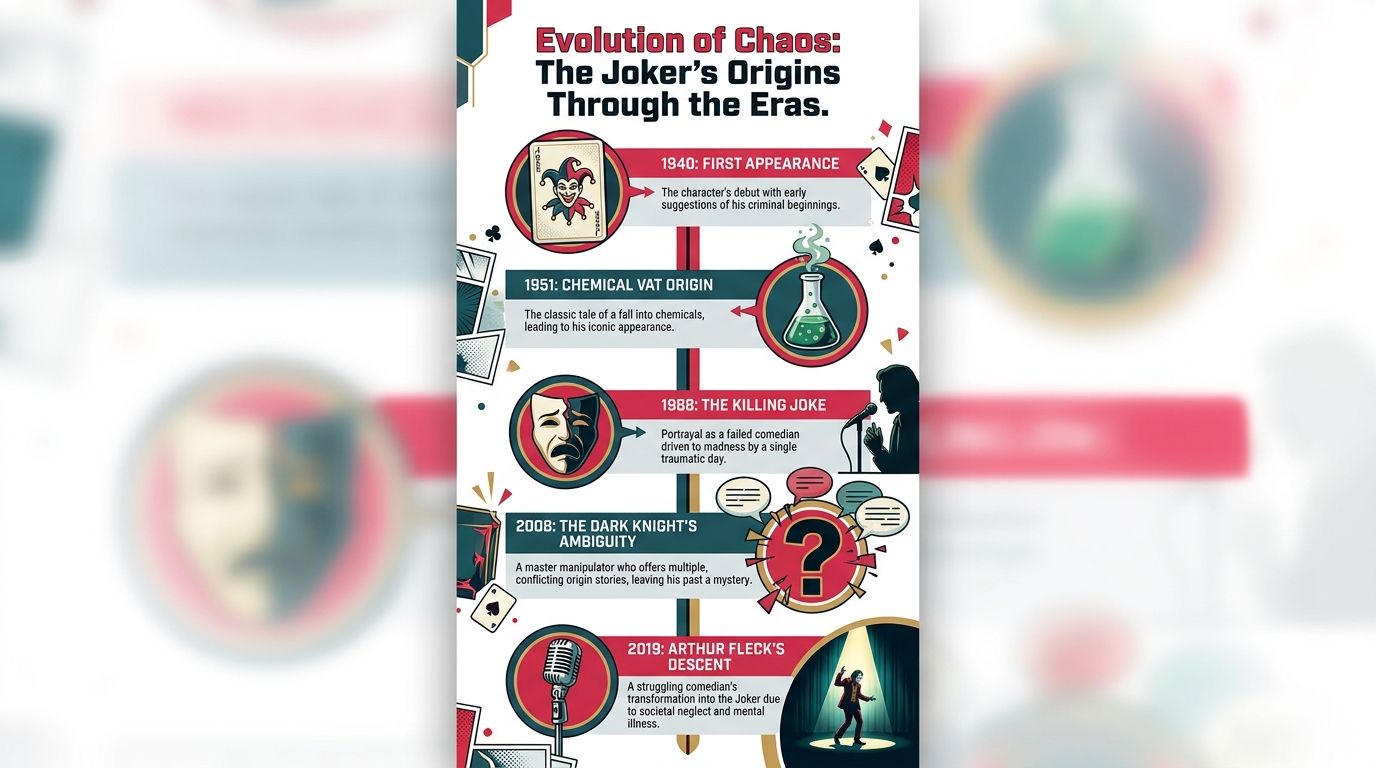
Key turning points across eras
The timeline below helps separate the major versions by what each one adds.
| Era | Version | What changed |
|---|---|---|
| 1940 | First comic appearance | The Joker arrives as a deadly criminal with a theatrical grin |
| 1951 | Red Hood chemical fall | The mythology gains a transformation event |
| 1988 | The Killing Joke | The character gains a tragic psychological reading |
| 2008 | The Dark Knight | Ambiguity itself becomes the origin device |
| 2019 | Joker | The backstory shifts toward social alienation and fractured perception |
How each version reframes him
The earliest comic version gives you the skeleton. He is dangerous, showy, and impossible to ignore.
The Red Hood version adds a before-and-after structure. There was a man, then there was the Joker.
The Killing Joke pushes further by making the “before” emotionally painful. Suddenly the Joker is not only grotesque. He might also be the result of unbearable pressure, loss, and humiliation.
Then film takes the concept in two striking directions.
- Heath Ledger’s Joker in 2008 tells conflicting scar stories, turning origin into manipulation.
- Joaquin Phoenix’s Arthur Fleck in 2019 offers a descent shaped by isolation, pain, and unstable reality.
The pattern hiding in the timeline
These versions differ wildly in mood, but they all preserve one principle. The Joker is most effective when the audience feels they almost understand him.
Not fully. Almost.
That “almost” is the secret ingredient. Too little background and he becomes empty. Too much explanation and he becomes smaller than his legend.
The Joker’s timeline is not a march toward clarity. It is a series of experiments in how much truth a villain can reveal before he stops being frightening.
Once you see the pattern, the history becomes easier to read. Each era is not correcting the previous one. Each era is testing a different answer to the same question. How much should anyone know about the face behind the grin?
The Joker as an Unreliable Narrator in Film and Comics
Modern creators eventually discovered something brilliant. If the Joker’s past keeps changing, then maybe the changes should happen inside the story, not only across decades of publication.
That is how the unreliable narrator version of the Joker becomes so powerful.
The scar stories in The Dark Knight
Christopher Nolan’s The Dark Knight gave the Joker one of his most effective modern tools. He explains his scars more than once, but the stories do not match.
That choice tells us something important. The point is not to solve his face. The point is to show that he uses backstory like a weapon. He watches what another person fears, then tailors a confession to fit the moment.
This approach changes the audience’s role. Instead of receiving information, we become suspicious interpreters. Every detail might be bait.
That makes the Joker feel more active than a villain with a locked biography. He is not only mysterious because writers have not decided. He is mysterious because he keeps deciding to perform a different self.
Arthur Fleck and blurred reality
The 2019 film Joker takes a different route.
Its version of Arthur Fleck offers an origin shaped by pain, fantasy, social humiliation, and emotional collapse. But the film also invites viewers to question what they are seeing and how much of Arthur’s inner life should be trusted at face value.
Readers and viewers often get tangled here. They ask whether the film is “the definitive Joker origin.” That misses the more interesting point.
The film demonstrates how a Joker story can feel intimate and unstable at the same time. You can stay close to the character and still leave with uncertainty. That tension is pure Joker.
Why unreliable narration fits him so well
Some villains lie because they want to escape blame. The Joker lies because contradiction is part of his identity.
He thrives when people cannot fix him in place. A stable autobiography would reduce his range. An unstable one lets him become whatever the scene needs him to be.
Here is why that device works so well for this character:
- It preserves fear. If his story changes, his motives remain slippery.
- It creates audience participation. Viewers start assembling theories, then doubting them.
- It mirrors his worldview. If he believes meaning is fragile, then his own history should feel fragile too.
Comics pushed this idea even further
Later comic interpretations also embraced the idea that the Joker may not be one clean, singular answer. Some stories turn that ambiguity into a direct plot element. Others keep it thematic.
Either way, the effect is the same. The Joker’s past stops being a file to unlock and becomes a hall of mirrors.
That move matters beyond Batman lore. It teaches a broader writing lesson. A villain’s backstory does not only explain them. It can also destabilize the people trying to explain them.
Writing lesson: An origin can function as evidence, confession, disguise, or performance. The Joker is memorable because his backstory can be all four.
The result is a villain who can stand in front of the audience and say, in effect, “You want the truth because you think truth gives you control.” Then he takes that control away.
How to Create a Villain Inspired by the Joker
What makes a Joker-inspired villain linger in a reader’s mind. The smile, the costume, the theatrical entrances. Those are only the surface. The primary engine is tension between what the villain shows, what they claim, and what no one can fully verify.
That is the lesson worth borrowing.
The Joker remains hard to forget because every layer of him supports the same effect. His look promises performance. His actions create dread. His history refuses to settle into one clean answer. A good antagonist works the same way. You are not building a bundle of traits. You are building a pressure system.
Step 1: Start with a wound, then leave room around it
A flat villain backstory explains the person too neatly. A memorable one gives the audience a cause, then leaves a little static in the signal.
Give your character a defining rupture. Then ask a second question. Did that event create the villain, or did it only give them a story they now use?
That distinction matters because readers do not just judge what happened. They judge how a character frames what happened.
A few examples:
- A stage hypnotist loses their career after a public scandal. They call it sabotage. Former coworkers call it fraud.
- A biotech engineer survives a lab accident and emerges visibly altered. Some people see a victim. Others see someone who finally stopped hiding.
- A failed comic blames one humiliating night for everything that followed. The audience is never sure whether that memory is confession or performance.
A wound works like a cracked mirror. It reflects something real, but never from only one angle.
Step 2: Give the villain a change the world cannot ignore
Readers remember transformation when it affects social life, not just appearance. The mark matters because it changes every interaction that follows.
Maybe your villain’s face unsettles strangers. Maybe their voice was damaged and now sounds mechanically calm. Maybe they dress with obsessive precision because disorder reminds them of the moment they lost control. The visual trait should do story work every time it appears.
Here is a useful test:
| Story element | Weak version | Stronger version |
|---|---|---|
| Accident | “She changed after the fire” | The injury makes every conversation feel like a stare-down |
| Costume | Stylish for its own sake | Clothing chosen to conceal, ritualize, or exaggerate the old damage |
| Behavior | Random cruelty | Repeated habits that echo the original break |
The goal is cause and effect the audience can feel. They do not need a medical chart. They need a pattern.
Step 3: Let the villain tell their story like a performer, not a witness
At this point, many original villains go flat. They explain themselves once, clearly, and the mystery dies on the page.
A Joker-inspired antagonist should adjust their autobiography to fit the room. They are not handing over facts. They are managing an audience.
A detective hears the version that sounds pitiable.
A follower hears the version that sounds prophetic.
A rival hears the version designed to wound.
Now the backstory becomes active. It shapes power in the scene instead of sitting in a character bio.
Practical rule: If your villain tells the same origin the same way every time, readers may understand them, but they have less reason to obsess over them.
Step 4: Match the theme to the image
The best comic villains feel unified. Their design is not decoration pasted onto motive. It expresses motive.
If your villain is built around envy, let their style borrow from the people they resent. If they worship purity, make their spaces sterile, symmetrical, almost sacred. If performance is the core idea, treat every entrance like stagecraft, with props, timing, and an awareness of the crowd.
This part often improves when you plan visually instead of writing only in prose. A page-by-page process helps you align reveal, pose, dialogue, and silence. If you want help structuring scenes that way, this guide on how to write a graphic novel script is useful.
Step 5: Build contradiction into your prompts and planning notes
If you are creating a villain with comic tools or PersonalizedComics, avoid flat prompts like “evil clown villain” or “chaotic criminal mastermind.” Those labels describe a role. They do not create dramatic tension.
Use prompts that force opposing signals into the same character:
Interrogation prompt
“Create a noir comic page where a detective questions a villain who gives three different childhood stories, each one emotionally convincing in a different way.”Transformation prompt
“Illustrate a retro-futurist villain after an industrial accident. Their appearance is striking, but their expression is calm enough to make the scene more disturbing.”Public mask prompt
“Show a smiling entertainer addressing a crowd while one panel reveals a private threat aimed at a single listener.”Follower prompt
“Design a graphic novel sequence where a cult leader retells their origin differently to each recruit, making every listener feel uniquely chosen.”
These prompts work because they generate friction. Friction creates curiosity. Curiosity keeps a villain alive in the reader’s mind.
A framework you can use for your own villain
If you want a simple tool, use these four parts:
Scar
What happened that cannot be undone?Mask
What public persona formed around that damage?Story
What explanation does the villain give other people?Gap
What still does not quite line up?
That last part is the secret.
The gap is where your villain starts to feel larger than a case file. It invites interpretation. It gives scenes electricity. And it teaches the same lesson the Joker has taught creators for decades. A villain becomes memorable not when every question gets answered, but when the missing answer becomes part of the character’s power.
Why the Joker's True Origin Is Irrelevant
After all these versions, one conclusion keeps rising to the top. The Joker does not need a single final origin to work. He may need the opposite.
A fixed answer would close the circuit too neatly. It would turn a living myth into a solved case file.
Mystery is the point
Batman is a character of order, preparation, and deduction. The Joker endures because he resists all three.
If Batman can usually track cause and effect, then the Joker functions as a challenge to that logic. He is the villain who refuses to stay explained. Every time someone tries to reduce him to one trauma, one diagnosis, or one biography, some part of the character escapes.
That is why his ambiguity feels right rather than unfinished.
What creators can learn from that
Writers sometimes assume they must answer every question about a villain. They do not.
A villain becomes memorable when the revealed parts and the hidden parts sharpen each other. The Joker’s many histories show how to do that. Give the audience enough to obsess over, but not enough to settle down.
Here is the final lesson in plain language:
- Specific details create texture
- Contradictions create unease
- A missing final answer creates legend
The Joker stays powerful because readers can project their own fears into the blank spaces of his past.
That is why the origin of the joker remains such a rich subject after so many decades. Not because the puzzle is unsolved by accident, but because the puzzle itself is the character.
If you want to turn that storytelling lesson into something of your own, PersonalizedComics gives you a fast way to prototype villains, scenes, and full comic pages from your ideas. You can test conflicting backstories, visual transformations, noir interrogations, or tragic “one bad day” moments without drawing everything by hand, then shape those experiments into a polished comic that feels personal, dramatic, and completely original.
Filed under Comics & Culture