“I could write a book about that.”
Maybe it was after telling the same wild family story for the tenth time. Maybe it came after a breakup, a trip, a friendship saga, a career detour, or a string of ridiculous moments that somehow fit together. The feeling is real. You know there is a story there. The hard part is turning that feeling into something finished. And if the story you keep retelling is really about your dad or grandpa, shaping it into a printed comic is one of the most personal gifts for grandpa a family can give.
A full book can feel huge before you even write the first page. That is why many people stay stuck at the idea stage. A comic gives you a different path. It is smaller, more visual, and easier to shape into scenes you can complete.
That 'I Could Write a Book' Feeling? Let's Make a Comic Instead
Many creators do not fail because they lack stories. They fail because a book is a massive container for a first project.
One verified stat captures that problem well. Data shows that 90% of aspiring authors who start writing a book never finish their manuscript (bookwriters.ca on why 90 percent of people fail to write a book). That does not mean your idea is weak. It usually means the format is too big, too vague, or too lonely to wrestle with.
A comic changes the assignment.
Instead of asking, “Can I write 200 pages?” you ask, “Can I show 10 moments that matter?” That is a completely different creative problem. It is concrete. It has edges. You can see progress quickly.
Why a comic feels more doable
A comic helps you shrink the fog.
- You think in scenes: A funny dinner. A missed train. A first date. A dramatic phone call.
- You tell less, show more: One expression can replace a page of explanation.
- You get momentum fast: A handful of strong pages already feels like a real project.
If you need inspiration for what small comic ideas look like, this roundup of ideas for comic strips is a useful way to see how everyday moments become visual stories.
You do not need to “be a writer” first
This is the part many beginners miss.
A comic is not a lesser version of a book. It is a storytelling format with its own strengths. If your memories come to you as snapshots, conversations, or flashes of emotion, you may be more naturally suited to visual storytelling than to long-form prose.
Tip: If your story lives in moments instead of chapters, start with a comic. You can always expand it later.
Think of a comic as a prototype for your story. It helps you test tone, pacing, and character chemistry without committing to a giant manuscript. You can discover what the story is about by seeing it unfold panel by panel.
That is the fundamental shift behind “i could write a book.” You may not need to write a book first. You may need to see your story first.
Capture Your Story and Find Your Scenes
The biggest early hurdle is not talent. It is blur.
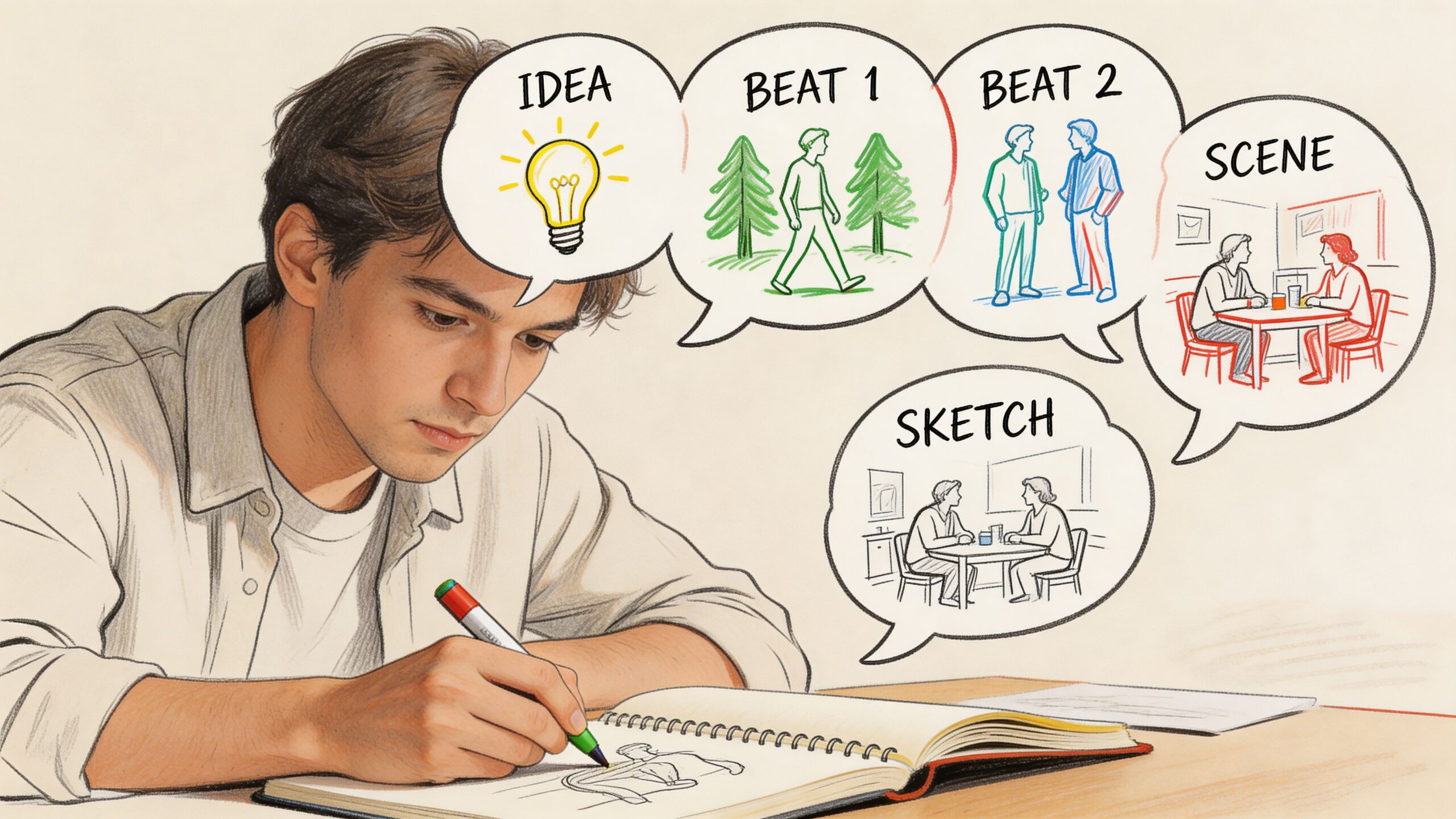
People often have a pile of memories, not a story. They know the feeling they want to share, but not the shape. That is where visual planning helps most.
A 2025 Writer's Digest survey found that 72% of writers abandon their book ideas because they “can't visualize the story” (writingcooperative on cultivating your unique angle as a writer). A comic solves that by forcing the story into visible moments.
Start with moments, not plot
Do not begin with “What is my whole story?”
Start with this question instead. What are the scenes I can already picture?
Write down moments like:
- The opening image: Where does this story begin visually? At a school desk, airport gate, kitchen table, wedding aisle?
- The turn: When did something change?
- The scene everyone asks you to retell: That usually belongs in the comic.
- The emotional beat: Not the most dramatic moment. The one that meant the most.
- The ending image: What final scene gives closure?
You are not writing chapters. You are collecting snapshots.
A simple scene map
Many first-time creators do well with 8 to 12 scenes. That range is enough to feel substantial without becoming overwhelming.
Try this sequence:
| Story part | What to include |
|---|---|
| Beginning | Introduce the person, place, and the normal world |
| Spark | Show the event that starts the story |
| Build | Add a few scenes that complicate things |
| Peak | Include the biggest emotional or funny moment |
| Resolution | Show what changed |
| Final beat | End on a clear image or line |
This is not a rule. It is a support rail.
Turn memories into comic-ready scenes
A memory becomes usable when you can answer three questions:
- Who is in the scene
- Where they are
- What changes by the end of that moment
For example:
- “We had a chaotic vacation” is too broad.
- “Dad tried to pitch a tent in the rain while everyone argued and the dog ran off” is a scene.
That second version gives you faces, action, setting, and emotion. Now it can become panels.
If you want help shaping those moments into page-level storytelling, this guide on how to write a graphic novel script shows how to move from loose idea to panel-by-panel sequence.
Keep the first draft loose
Do not over-organize at this stage. A comic outline can be messy and still work.
Use a notes app, index cards, Trello, Evernote, or plain paper. Put one scene per card or note. Rearrange them until the order feels natural. If two scenes feel repetitive, combine them. If a scene only explains background, cut it unless it adds emotion.
Key takeaway: If you can describe a moment in one or two sentences, you can probably turn it into a page.
Aha moment: you are not “failing to write a book.” You are discovering that your story wants a visual skeleton first.
Assemble Your Cast of Characters
Once your scenes exist, the next question is simple. Who needs to appear on the page?
Characters make or break a comic, especially a personal one. Readers connect through faces, posture, clothing, and expression long before they analyze the wording.
Research indicates that visual aids can boost audience engagement by up to 40% (Wiley on influential manuscript methods and visual engagement). In a comic, that makes your character choices a storytelling tool, not decoration.
Pick photos that help, not photos you merely like
A favorite photo is not always the best source image.
For character creation, useful photos usually have:
- Clear lighting: The face should be easy to read.
- Visible features: Eyes, nose, jawline, and hairline matter.
- Front or near-front angle: Strong profiles are harder to interpret consistently.
- Simple background: Fewer distractions make the subject clearer.
- Natural expression: A real smile or thoughtful look gives personality.
Photos that often create problems include blurry group shots, heavy filters, sunglasses, deep shadows, and cropped faces.
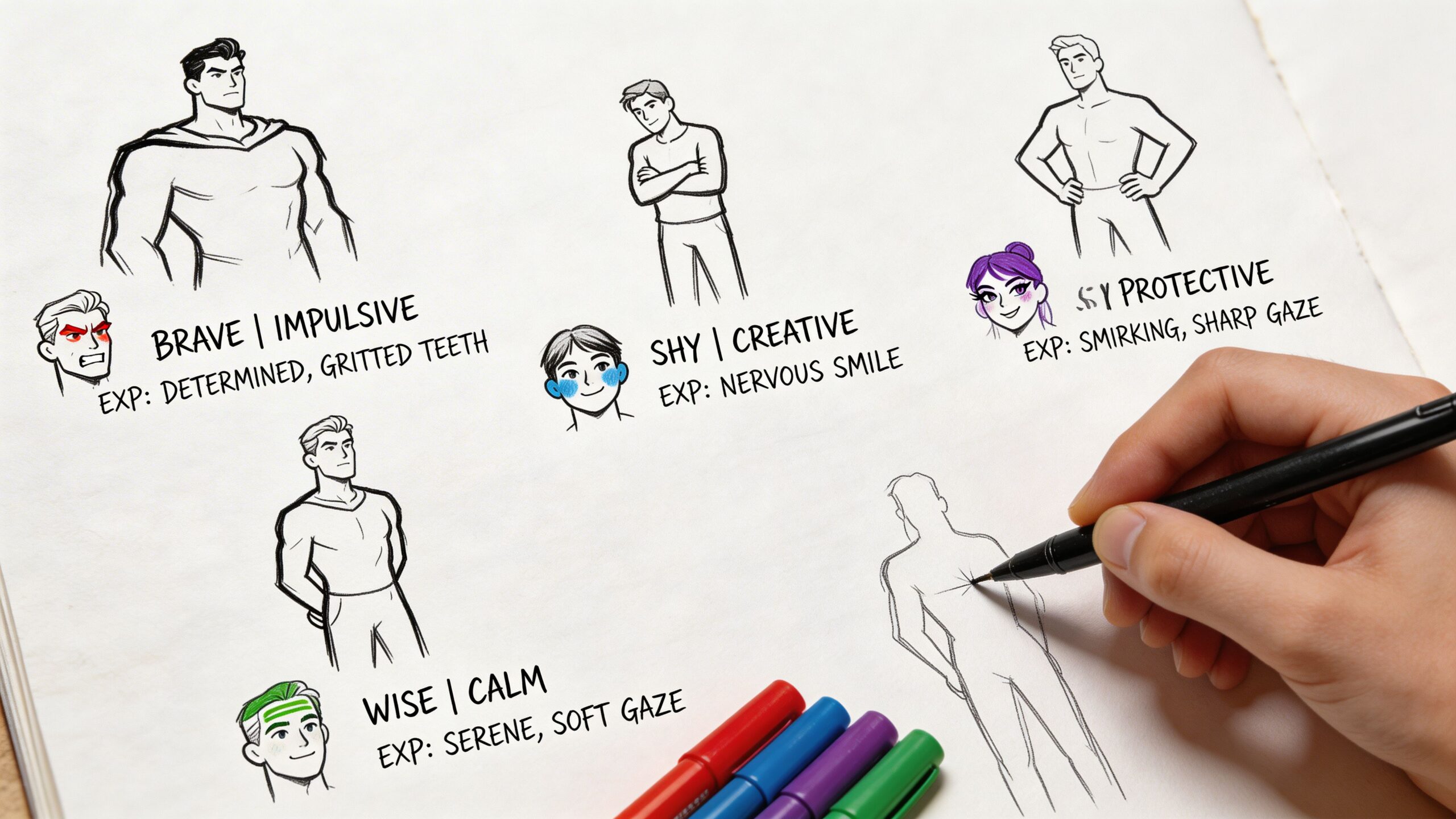
Build a mini casting sheet
Before generating anything, make a tiny profile for each character.
You only need a few notes:
| Character | What to note |
|---|---|
| Main person | Age vibe, hair, typical expression, signature clothing |
| Supporting person | Relationship to main person, energy, visual distinction |
| Minor characters | Only include what readers need to recognize them |
Comics rely on fast recognition. If two people have similar hair, similar outfits, and similar speech patterns, readers may get lost.
You can invent people too
Not every comic is autobiographical. Some stories need fictional heroes, symbolic versions of real people, or dreamlike figures.
If you are describing a character from scratch, write like a costume designer and a director working together. Focus on visible details and emotional impression.
For example, instead of “a cool rebel girl,” try:
- curly dark hair
- oversized band jacket
- worn boots
- direct eye contact
- amused half-smile
- always looks like she knows more than she says
That gives shape, mood, and attitude.
Give each person one memorable trait
Do not overload every character with detail. Pick one anchor trait readers can instantly recognize.
Examples:
- the uncle with dramatic hand gestures
- the friend who always wears bright hoodies
- the quiet kid with a notebook
- the grandmother with perfect posture and sharp one-liners
Those anchors help your pages feel readable.
If you want practical examples of how reference images translate into stylized characters, this walkthrough on turning photos into comic book art is useful.
Tip: Your goal is not photo-perfect realism. Your goal is recognizable, expressive consistency.
That is the sweet spot. A comic character should feel like the person, even when the art style is stylized.
Directing the AI to Draw Your Story
Many beginners freeze at this stage. They think the tool will “just know” what they mean.
It will not. Good results come from good direction.
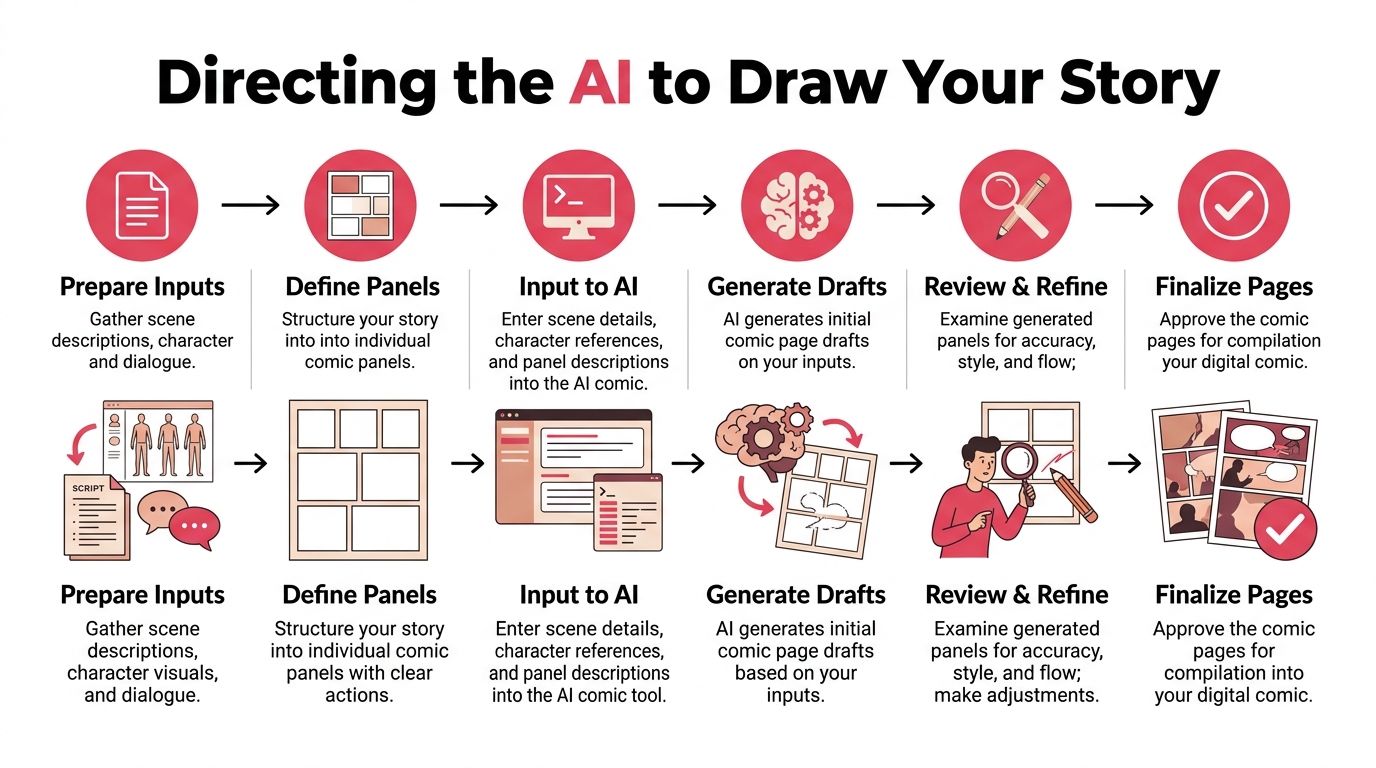
The good news is that direction is easier than drawing. You are not making every line yourself. You are acting like a comic director. You choose the mood, the framing, the action, and the dialogue. The system turns those decisions into pages.
For authors prototyping graphic novels, using an AI comic generator can significantly reduce iteration costs compared to traditional illustration, which makes testing scenes and styles much easier before you commit to a full project.
Choose the style that matches the story
Art style is not cosmetic. It changes how readers feel about the same scene.
Here is a simple decision guide:
| Style direction | Best for |
|---|---|
| Manga | High emotion, youth, speed, romance |
| Noir | Mystery, tension, regret, dramatic shadows |
| Watercolor | Memory, tenderness, family stories |
| Cyberpunk | Bold worlds, future settings, heightened drama |
| Fantasy | Mythic feeling, quests, wonder |
| Classic American | Punchy action, humor, broad readability |
| Graphic novel | Balanced tone, flexible realism |
| Retro pop | Playful energy, bright humor, stylized nostalgia |
If your story is about a heartfelt anniversary, watercolor or graphic novel may fit. If it is a chaotic roommate comedy, retro pop or classic American might land better.
Write prompts like a scene director
A strong comic prompt usually includes four ingredients:
- Setting
- Characters present
- Action
- Emotional tone
Weak prompt:
- “Two friends talking in a café”
Stronger prompt:
- “Small city café on a rainy afternoon. Two longtime friends sit across from each other in a corner booth. One leans in, laughing with relief after a long argument. The other finally smiles. Warm lighting, half-empty coffee mugs, emotional reconciliation.”
That gives the page shape.
Keep dialogue short enough to fit
New creators often write dialogue like prose. Comics need compression.
A speech bubble works best when it sounds like spoken language, not written explanation.
Try this comparison:
- Long version: “I have been thinking about what you said earlier, and I realize now that you were probably right to warn me.”
- Comic version: “You were right. I should’ve listened.”
The second line has energy. It also leaves room for the art to do part of the work.
Use narration only when the image cannot carry it
Narration boxes are useful for:
- time jumps
- inner reflection
- context readers need fast
- a distinctive storyteller voice
They are not useful for repeating what the panel already shows.
If the panel shows a person running through an airport, do not add, “I ran through the airport.” Add something the art cannot provide, such as, “I was already too late, and I knew it.”
Draft pages in layers
Do not try to perfect the entire comic in one pass.
A clean workflow looks like this:
- First pass: Generate rough pages for story flow.
- Second pass: Fix confusing scenes or weak expressions.
- Third pass: Tighten dialogue and captions.
- Final pass: Check visual consistency from page to page.
This approach removes pressure. You are not aiming for magic on page one. You are shaping a draft.
What to check when a page feels “off”
Sometimes the output is technically fine but emotionally wrong. When that happens, inspect these areas:
- Facial expression: Does the character look amused when they should look nervous?
- Body language: Is the pose too stiff for the mood?
- Panel focus: Is the important action too small?
- Background noise: Is the setting distracting from the emotional beat?
- Bubble load: Are there too many words for the page to breathe?
Key takeaway: When the page misses, the fix is usually clearer direction, not more detail everywhere.
That is the beginner breakthrough. You do not need to become an illustrator. You need to become specific.
Bringing Your Comic into the Real World
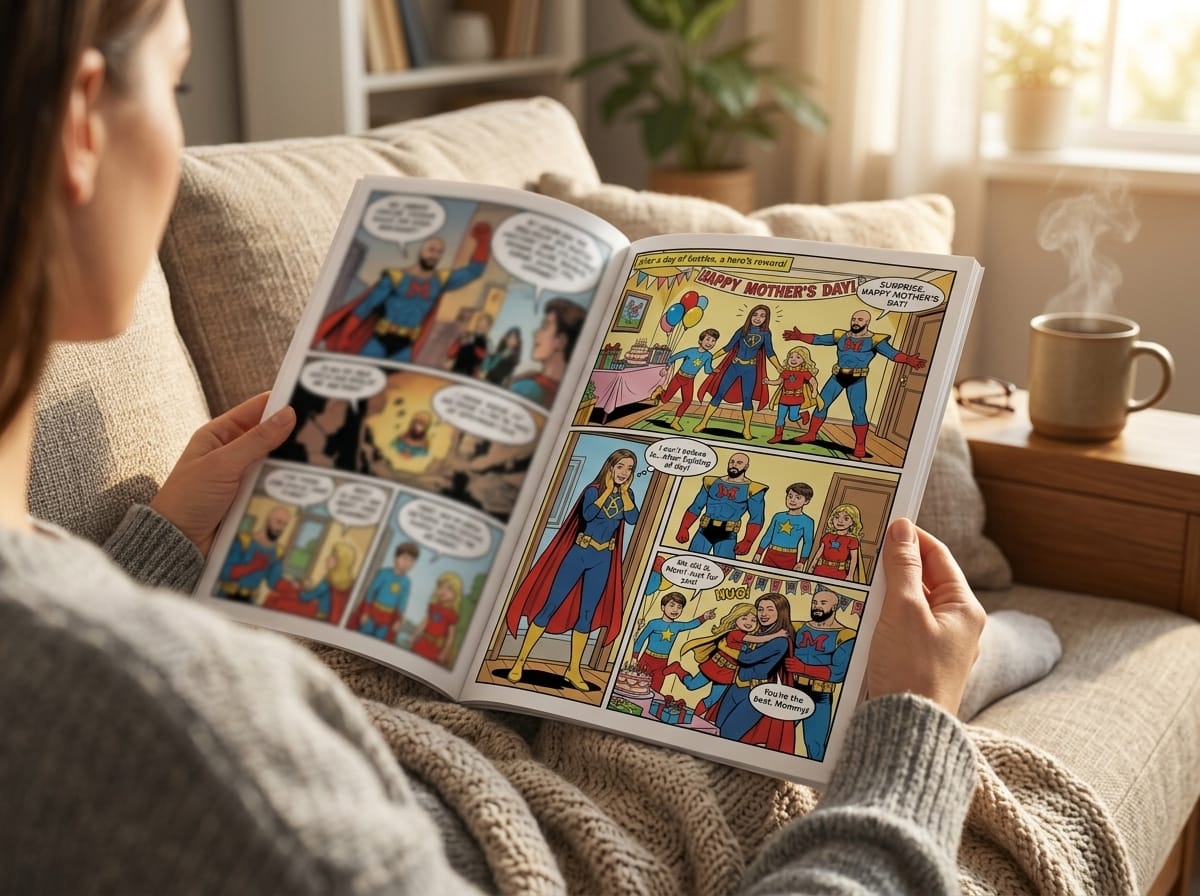
A digital comic already counts as a finished story. Still, something changes when it becomes an object you can hold.
That final stage is where the project stops feeling like an experiment and starts feeling like a keepsake.
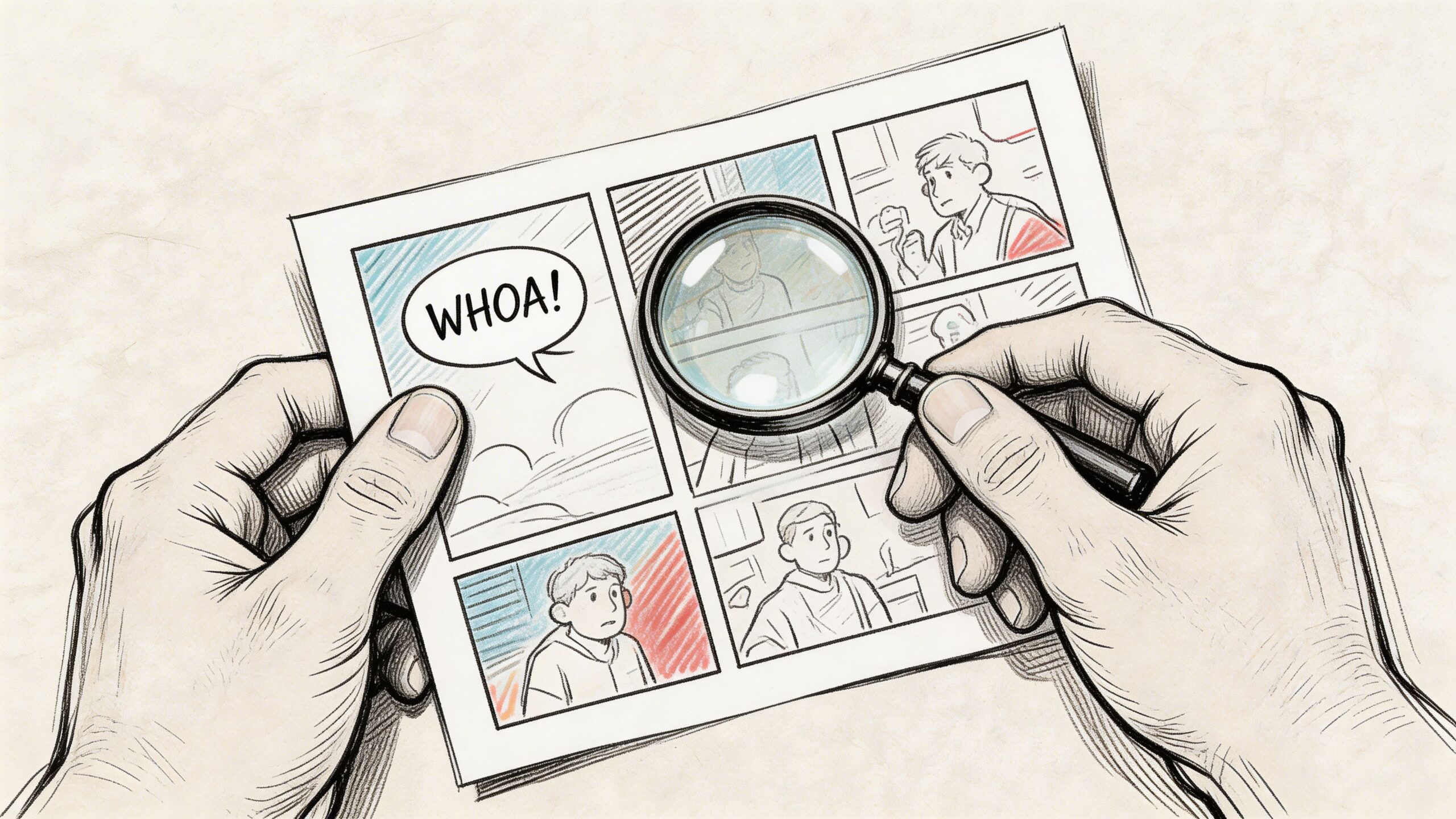
Review it like an editor, not like a critic
Do one calm read-through before printing or sharing.
Check for:
- character names spelled the same way
- speech bubbles in natural reading order
- repeated images where you wanted variety
- page turns that feel abrupt
- small wording fixes that sharpen the emotion
Do not spiral into endless tweaking. If the story lands, it is ready.
The physical copy changes the experience
The emotional payoff gets bigger when the comic exists off-screen. Verified data notes that in major markets like the US and UK, the graphic novel market surpassed $1.2 billion in 2025, and premium physical copies significantly enhance the emotional and perceived value of personalized gifts.
That makes intuitive sense. A printed comic feels intentional. It asks to be opened, held, reread, and shown to someone else.
Stories that work beautifully in print
A personalized comic can become more than a creative exercise.
It can be:
- An anniversary gift: Show how two people met, stumbled, and built a life together.
- A birthday surprise: Turn your friend’s legendary misadventures into a funny short comic.
- A family memory book: Capture a vacation, reunion, or holiday disaster everyone still talks about.
- A proposal with a twist: Tell the relationship story page by page, then end with the question.
- A creator proof of concept: Use it to show collaborators, readers, or clients what your larger story could become.
One of the nicest things about a comic is that it is shareable without needing explanation. Someone can open to page one and understand the idea right away.
Tip: Add a dedication page or short note at the front. A single heartfelt paragraph can make the whole book feel complete.
A comic also invites rereading in a way that long text often does not. People return to favorite panels, expressions, and jokes. They point. They laugh. They pause at one line. That is a different kind of storytelling victory.
You Did It You Are a Comic Creator
That passing thought, “i could write a book,” has now become something much more useful.
Not pressure. Not a someday identity. A finished creative object.
You took a blur of memories and pulled out scenes. You chose who mattered. You shaped dialogue, mood, and visuals. You made decisions a storyteller makes. That is creation, even if you never touched a sketchpad.
What matters most about this process
The primary win is that you no longer need to wait for perfect conditions, perfect artistic skill, or years of writing stamina before your story can exist. You can begin with what you already have: moments, people, emotion, and a point of view.
That is why visual storytelling is such a useful path for first-time creators. It removes a common barrier. Instead of wrestling a giant manuscript into existence, you build something scene by scene.
You can keep going from here
A finished comic can become many things:
- a one-off gift
- a pilot for a longer graphic novel
- a family archive
- a classroom project
- a portfolio piece
- a personal milestone that proves you can finish what you start
And that last one matters.
Many people live with stories they never make. You made one.
Key takeaway: You do not need permission to tell your story. You need a format that helps you finish it.
If you still want to write the full book later, great. Your comic can become the seed. You will already know your strongest scenes, your emotional turning points, and the people readers care about. That is not a detour from writing. It is a shortcut to clarity.
Family stories are the richest source material of all, and for many people they start with a grandparent. If that is where your book idea leads, our roundup of Christmas gifts for grandma shows how the same memories can become a keepsake gift.
If you want an easy way to turn your photos and story ideas into a finished comic, PersonalizedComics gives you a practical starting point. You can choose from eight art styles, generate pages from your characters and scenes, and even order a premium physical copy when you are ready to hold your story in your hands.
Filed under Comic Craft