That gap stops a lot of good comics before page one.
The good news is that how to self publish a comic book is far more accessible than it used to be. The workflow is still real. You still need a strong script, readable pages, clean files, and a sensible launch plan. But the old bottlenecks are no longer absolute barriers, especially if your goal is to make a one-shot, a gift comic, a prototype issue, or a short-run passion project instead of building a full publishing company from day one.
The creators I see finish comics consistently do one thing well. They stop treating publishing like a mysterious industry gate and start treating it like a production pipeline. Story first. Pages next. File prep after that. Distribution after that. Promotion all the way through.
That mindset changes everything.
Your Comic Book Dream is Closer Than You Think
You have a story that already feels real. You can hear the dialogue. You know the scene that should open the book. Then you hit the wall that stops a lot of hobbyists and writers cold: the art.
That is the part traditional self-publishing advice tends to skip. Plenty of guides explain printing, crowdfunding, and selling. Far fewer address directly the question in the middle of the process: how do you finish a comic if you are not a trained illustrator and do not have the budget for a penciler, inker, colorist, and letterer?
For years, that bottleneck killed good projects early. I have seen strong concepts sit in folders for months because the creator was trying to solve writing, visual development, production, and distribution all at once.
A better approach is to treat comic creation like a staged build.
Your project starts as a clear concept. Then it becomes a workable script. Then it becomes page art and lettering. Then it becomes print-ready and digital-ready files. Then it becomes a product readers can buy or share.
That order removes a lot of pressure.
It also makes room for tools that did not exist in the old indie-comics playbook. If your biggest obstacle is art creation, AI-assisted platforms such as PersonalizedComics can help you turn a script into consistent, usable comic pages without hiring a full team from day one. For hobbyists, gift projects, test issues, memoir shorts, and proof-of-concept books, that changes the math in a very practical way.
The trade-off is straightforward. AI can reduce cost, speed up iteration, and help non-artists get to finished pages. It does not replace taste, editing, pacing, or production judgment. You still need to choose strong references, review page clarity, fix weak panel storytelling, and make sure the final book reads well in sequence. The creators who finish polished books use AI as a production tool, not as a substitute for decision-making.
That is good news for writers.
You do not need to become a full one-person studio before you make your first comic. You need a story that fits the format, a script that can be visualized, and a workflow that gets you from draft to pages without stalling. If you need help with the writing side before you generate art, this guide to writing a graphic novel script that artists and production tools can actually use is a strong place to start.
A finished comic still takes work. It just no longer requires the old combination of professional art skills, a large freelance budget, and trial-and-error production knowledge before page one even exists.
From Idea to Script Building Your Comic's Foundation
Strong comics are built long before the final art appears. If the story is muddy, no rendering style will save it. If the script is clear, almost every later decision gets easier.
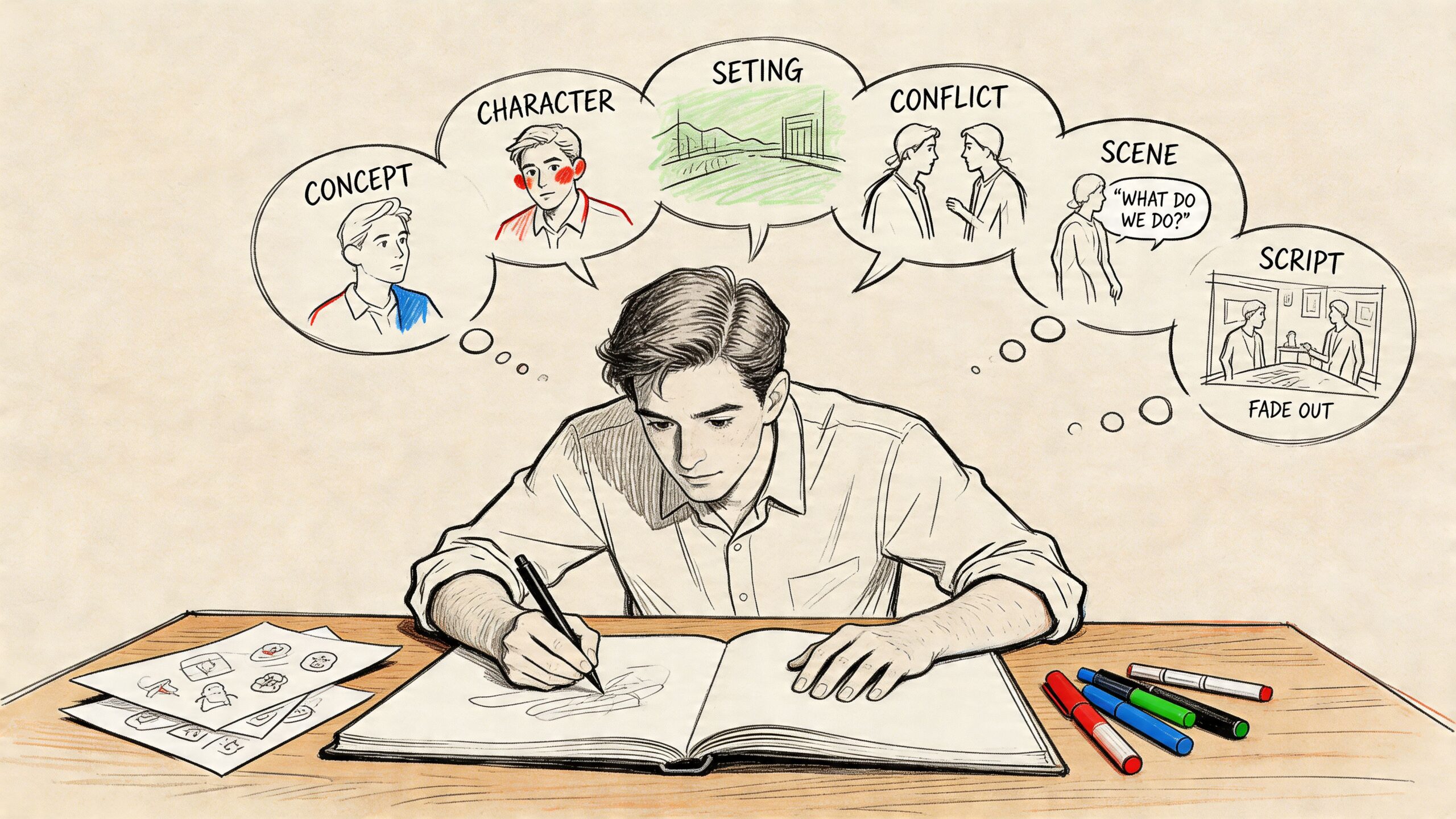
Start with a comic-sized concept
The first mistake I see is scale. New creators often design a universe when they really need a story.
For a first project, define these five things before you write pages:
The core premise
What happens that makes this story worth telling? Keep it short enough to say in one breath.The main character want
What does the protagonist pursue on the page, not just emotionally but physically?The source of conflict
Who or what gets in the way?The setting rules
What makes the world visually distinct and easy to recognize?The ending change
What’s different by the last page?
If you can answer those cleanly, your comic has a spine. If you can’t, keep refining before you script.
Structure for page turns, not just plot beats
Comics don’t behave like prose. They reveal information through panels, page turns, and visual contrast. A solid three-act structure still works, but you have to translate it into page rhythm.
A practical way to outline is this:
- Opening pages establish the normal world, tone, and visual language.
- Early disruption gives the story movement.
- Middle pages escalate complications and force choices.
- Late turn creates the emotional or plot pivot.
- Final pages pay off the setup and leave a memorable closing image.
Think in scenes that can be seen, not explained.
Practical rule: If a beat would be more interesting to watch than to summarize, it belongs in a panel.
Page turns matter too. Reveal surprises on the next page when possible. Put high-tension moments at the bottom of a right-hand page if you’re designing for print. Let silent reaction panels breathe when the emotional weight needs space.
Write a script someone else can execute
Even if you plan to handle production yourself, write a script as if another person has to interpret it. That discipline helps human artists, AI tools, and future collaborators.
A comic script doesn’t need one universal format, but it does need clarity. A simple version looks like this:
- Page number
- Panel number
- Panel description
- Dialogue
- Captions
- Sound effects
Example:
Page 3, Panel 1
A narrow apartment kitchen at sunrise. Maya stands in front of an open fridge, still wearing last night’s clothes. Her phone glows on the counter beside a crumpled flyer.
Caption: Tuesday started with bad coffee and worse timing.
Maya: Tell me that isn’t today.
That’s enough to visualize. It tells the artist or tool what matters and leaves room for staging.
For a deeper breakdown of panel scripting and page formatting, this guide on how to write a graphic novel script is a practical reference.
Keep dialogue tighter than you think
Comics punish overwritten dialogue because balloons occupy physical space. The more text you add, the more art you cover and the slower the page reads.
A few working habits help:
- Read every line aloud. If it sounds written, trim it.
- Cut greetings and filler. Enter late, leave early.
- Give each character a different sentence rhythm. Distinct voices do more than accents.
- Let the art carry obvious information. Don’t have a character narrate what the panel already shows.
Dialogue that works in a screenplay can still feel heavy in a comic. Balloons turn pacing into geometry.
Short scripts also make visual production smoother. Whether you’re briefing an illustrator or generating pages through an AI workflow, specific and concise descriptions create better results than dense paragraphs full of mixed instructions.
Bringing Your Story to Life Art and Page Production
You finish the script, open a blank page, and hit the wall every new comic creator hits. The story exists. The pages do not.
That gap stops more indie projects than weak ideas ever do. Traditional self-publishing advice usually glosses over it. You get told to hire an artist, maybe add a colorist and letterer, then somehow arrive at finished pages. For writers, hobbyists, and first-time creators, art production is the bottleneck.
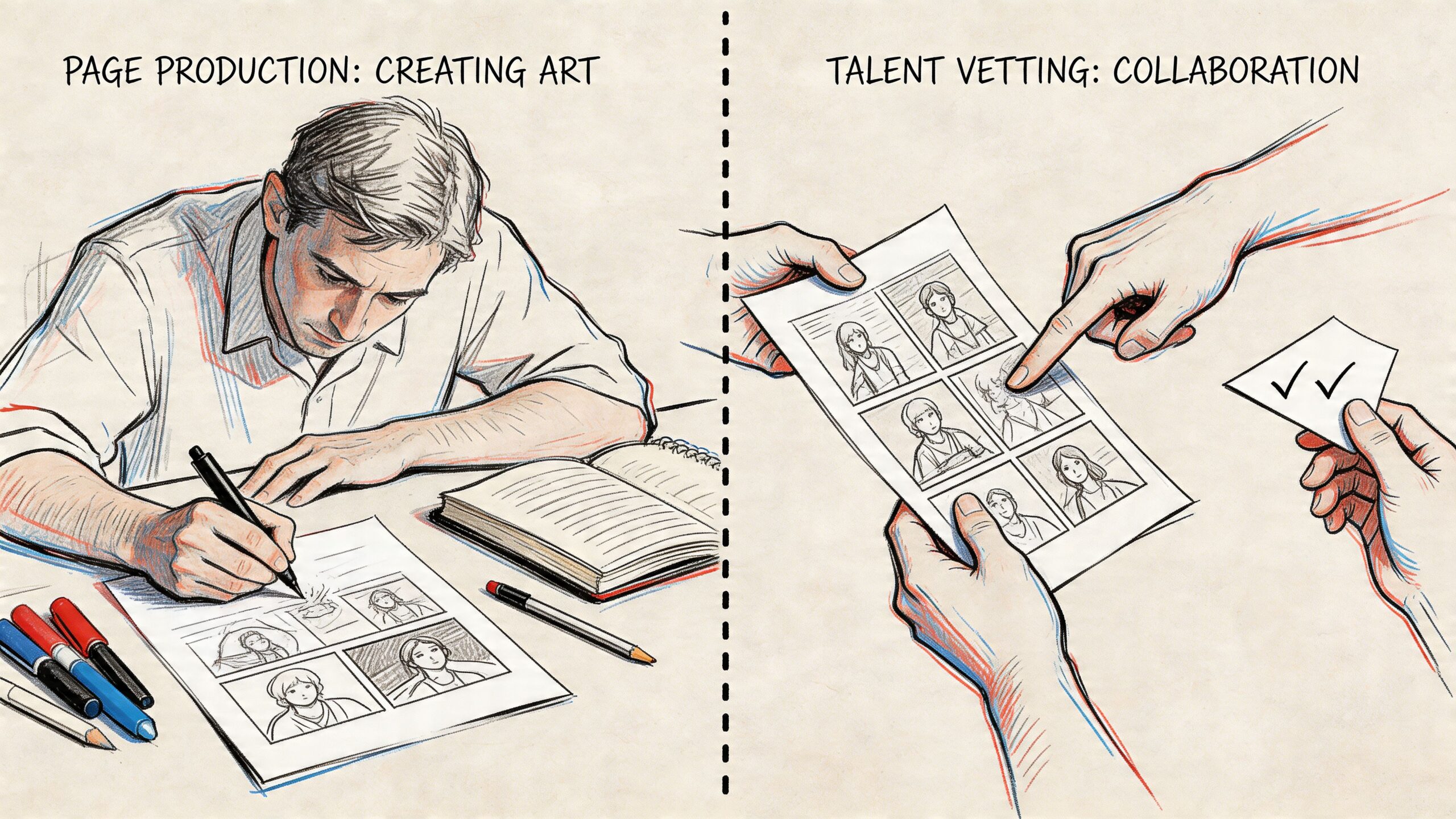
The traditional team route
The classic method is still valid. You hire an artist, or a small team, and build the book the standard way. Depending on budget and scope, that can mean one person handling pencils, inks, colors, and lettering, or separate specialists for each stage.
A good team brings real advantages:
- Visual storytelling skill in posing, composition, panel flow, and scene clarity
- Stronger page acting through facial expression, body language, and staging
- A custom style shaped around your story instead of a generic look
- Editorial feedback from people who know when a page is overcrowded or underexplained
It also asks a lot from the creator.
You need clear references, realistic schedules, revision discipline, and enough budget to keep the project alive until the last page. I have seen solid scripts stall for months because character designs were still being debated, or because page rates looked manageable at issue #1 and impossible by issue #3. Hiring artists is not just a creative decision. It is a production commitment.
Why art is the real bottleneck
Many first-time creators are not blocked by story. They are blocked by execution.
If you cannot draw at publishable quality, and you are not ready to manage freelancers, the project gets stuck in concept mode. That is the part older guides often miss. They assume the art problem is already solved. For a lot of aspiring creators, it is not.
That is why AI matters here.
AI-assisted comic production gives non-artists a practical path to finished pages. It does not replace taste, judgment, or storytelling. It removes the biggest barrier between script and book. Tools like PersonalizedComics are useful because they let a writer direct the comic instead of waiting until they can afford a full art team or learn draftsmanship from scratch.
What the AI-assisted route does well
AI works best as a guided production system. You still decide the cast, the pacing, the tone, the page count, and the emotional beats. The tool handles the heavy visual lift.
A workable process usually looks like this:
| Stage | What you control |
|---|---|
| Story setup | Plot, dialogue, scene order, page count |
| Character definition | Names, appearance, wardrobe, reference images or descriptions |
| Style direction | Genre, mood, linework, coloring approach |
| Page creation | Panel layout, scene framing, speech placement |
| Review and correction | Continuity, dialogue cleanup, visual consistency |
That shift matters. The creator becomes the director and editor rather than the renderer.
For hobbyists, gift creators, parents making a custom story, or writers testing a short issue, that can be the difference between finishing a comic and shelving it for another year.
The trade-offs are real
AI is fast, but it is not magic.
It can struggle with exact hand poses, background continuity, prop consistency, and subtle panel-to-panel acting if your instructions are loose. It also tends to drift when creators change visual style halfway through a project or rewrite characters on the fly. The better your inputs, the better your pages.
Human artists still win on nuanced performance, intentional design choices, and highly specific scene interpretation. If you are producing a flagship series, pitching to publishers, or building a long-term IP with a distinctive art identity, hiring people may still be the stronger route.
But if your main obstacle is getting the first issue made at all, AI often gives you a much shorter path to a readable, coherent comic.
How to get better pages from AI tools
The creators who get usable pages treat AI like production, not lottery tickets.
What helps:
- Lock character descriptions early and keep them consistent
- Work page by page instead of trying to generate an entire issue in one prompt
- Keep scene direction concrete with clear locations, actions, and emotional beats
- Write balloon-friendly dialogue so text fits the art instead of crushing it
- Review every page for continuity before you move on
What hurts quality:
- switching styles mid-book
- feeding in novel-length prompts
- revising character appearance every few pages
- accepting first-pass outputs without cleanup
- treating lettering as an afterthought
If you want a clearer sense of how style control affects the final result, this guide to create stunning comic book style artwork is worth reading.
Page production still needs taste
No tool saves a page with bad visual logic.
A finished comic page needs readable panel flow, clear focal points, and enough breathing room for balloons. That applies whether the art came from a freelancer, your own drawing hand, or an AI platform. Readers forgive a lot. They do not forgive confusion.
Check these before you approve any page:
Reading order
Panels and balloons should guide the eye naturally from left to right and top to bottom.Visual continuity
Characters, clothing, props, and locations should remain stable from panel to panel.Lettering clarity
Fonts must stay legible at print size and on a phone screen.Panel purpose
Every panel should change something. If it does not, cut it or combine it.Text-to-art balance
If dialogue covers the shot, the script or layout needs another pass.
Clean pages feel easy to read. That ease is built, not accidental.
For self-publishers, art and page production is where the comic either becomes real or stays theoretical. If you handle this stage with the same care you gave the script, the rest of the publishing process gets much simpler.
Technical Prep Formatting Files for Print and Digital
You can spend months writing, generating art, lettering pages, and polishing the story, then lose reader trust with bad exports.
That happens more often than new creators expect, especially hobbyists who solved the art bottleneck with AI and assume production files are the easy part. They are not hard, but they do require discipline. PersonalizedComics and similar tools can help you get consistent pages without hiring a full art team. You still need to package those pages correctly for paper and screens.
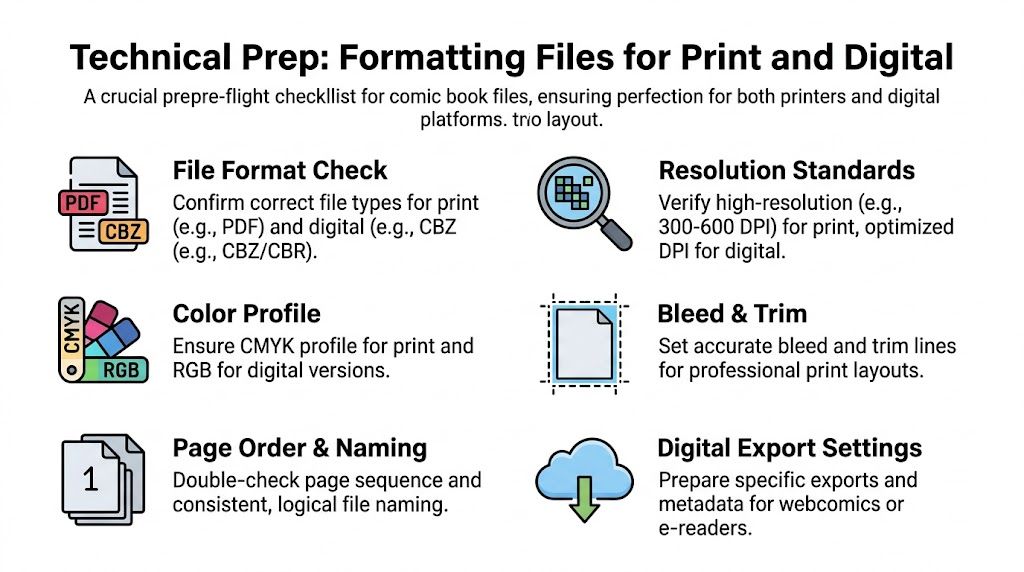
The core print specs
For a standard US comic, start with the printer’s trim size and build every page around it from day one. According to Blurb’s comic self-publishing guidance, a common benchmark is 6.625 x 10.25 inches, with interiors prepared at 300 DPI in CMYK.
That sounds technical. It is also practical. If AI art is generated too small, increasing resolution later will not restore lost detail. If files stay in RGB, printed colors can shift. If bleed is missing, the printer may trim into the art or leave a thin white edge.
Use this baseline checklist before you export anything:
- Trim size matches the exact printer template
- Resolution is print-ready from the start
- Color mode is CMYK for the print edition
- Bleed extends past the cut line
- Safe area keeps balloons, captions, and key art away from the edge
I also recommend building a master page spec before you finalize a single panel. That matters even more with AI-assisted workflows, because image generation often happens before creators have locked the final page dimensions. Set the canvas first. Generate and place art second.
File prep habits that prevent expensive mistakes
Comic production gets messy fast. You are dealing with interiors, covers, credits, ads if you use them, front matter, and often a separate digital version with different sizing needs.
A clean workflow solves a lot of that:
- Export print files as press-ready PDFs if your printer asks for PDF.
- Build a separate digital edition instead of uploading the print file everywhere.
- Check page order by hand before you submit.
- Zoom in on every page to catch compression artifacts, fuzzy lettering, or stray marks.
- Confirm spine width and wraparound cover layout after the final page count is locked.
For physical production details, this guide to printing your own custom comic book is a useful reference.
One hard-earned rule. Never assume the export looks like the working file. Open the final PDF and inspect it page by page.
Choose the right binding
Binding affects both presentation and file setup.
Short single issues usually work best with saddle stitch. Thicker books and collections usually move to perfect binding. That choice affects your cover template, spine requirements, and how much artwork disappears into the gutter.
Choose based on page count, budget, and reading comfort. A stapled issue feels right for a floppy. A thicker collected edition usually reads better as a bound book.
Production note: Binding changes cover setup, spine design, and how interior pages sit near the center fold or gutter.
Proofing catches what your screen misses
Order a proof copy before you approve the book for sale.
Screens hide problems. Paper exposes them immediately. Lettering that felt readable on a monitor can print too small. Dark scenes can muddy up. Spine text can drift. Margins can feel much tighter in hand than they looked in layout view.
Check the proof for:
- Trim errors near text and panel borders
- Color shifts in dark or high-contrast scenes
- Lettering size at actual reading distance
- Gutter loss on interior spreads
- Cover alignment across front, spine, and back
Digital proofing helps. Physical proofing decides whether the book is ready.
Choosing Your Path Distribution and Pricing
A lot of comics stall at this stage.
The script is done. The pages are finally finished. You can hold the PDF in your hands, but you still have to answer the questions that decide whether this becomes a real release or a folder on your desktop. Where will readers buy it? What format makes sense for this project? What price leaves room for profit without scaring people off?
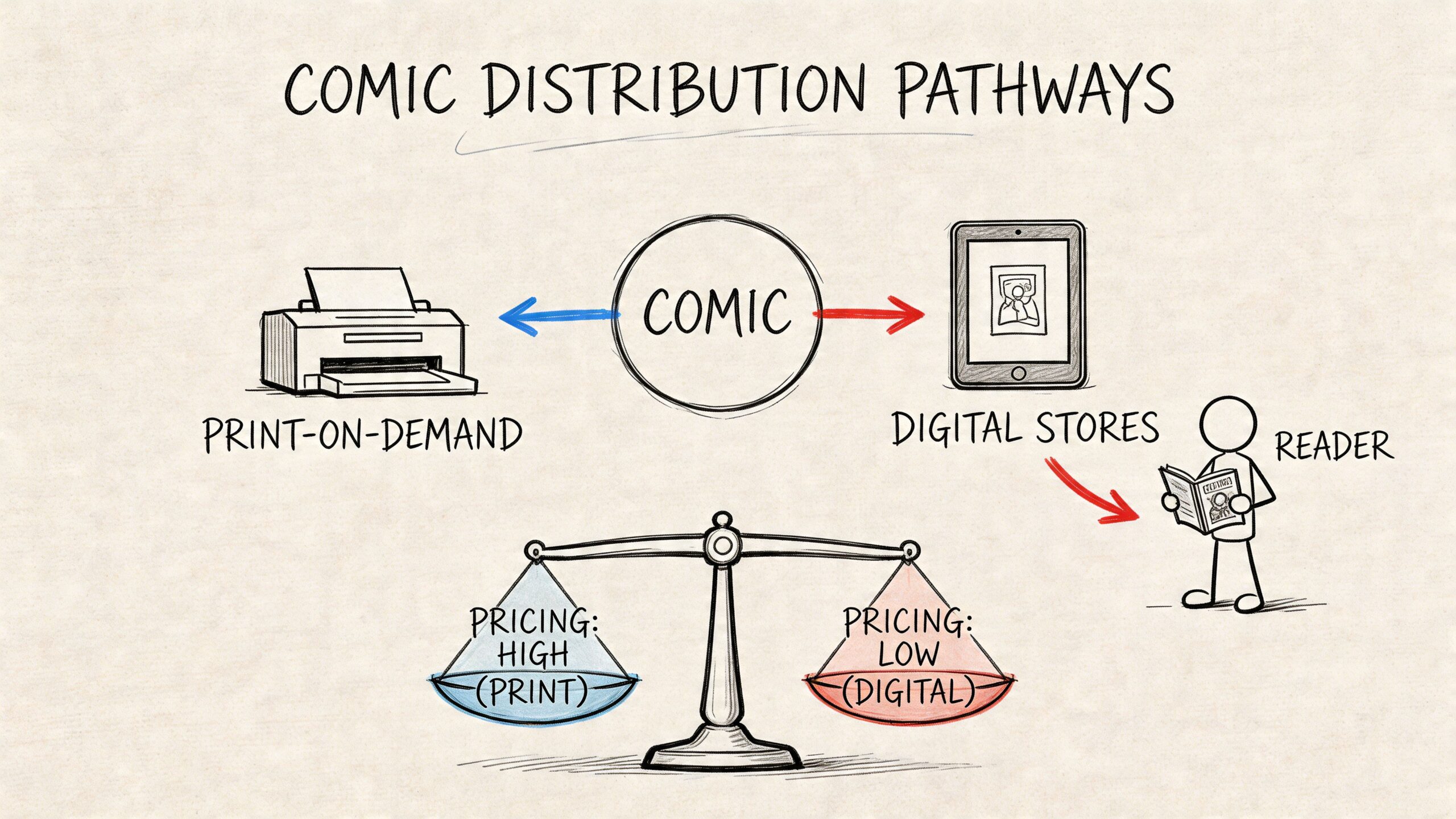
Print first or digital first
Start with the job your comic needs to do.
If the goal is to test an idea, share a first issue, or sell without tying up cash in inventory, print-on-demand and digital usually make more sense than a full offset run. If the goal is convention sales, retailer outreach, or a collected edition you already know you can move, offset becomes more attractive because the per-copy cost drops once volume goes up.
That trade-off matters more than any generic advice.
Creators using AI art tools such as PersonalizedComics often reach this stage faster than older self-publishing guides assume. The big bottleneck used to be getting pages illustrated at all. Once art production is no longer the thing slowing you down, overprinting becomes the new mistake. A lot of first-time creators solve the art problem, then create a warehouse problem. Start small unless demand is already proven.
Cost at a Glance Offset Printing vs. Print-on-Demand POD
| Metric | Offset Printing (500+ copies) | Print-on-Demand (1-499 copies) |
|---|---|---|
| Upfront commitment | Higher, because you pay for a full run | Lower, because single copies are viable |
| Per-unit economics | Lower at scale | Higher per copy |
| Inventory risk | You hold unsold stock | Little to no inventory risk |
| Best fit | Events, store outreach, proven demand | Testing, one-shots, gifts, short runs |
| Typical reality | Better margins if you can sell through the run | Safer cash flow while you learn demand |
I usually frame the choice this way. Offset improves your margin. POD protects your downside.
For a new creator, downside protection is often more valuable.
Digital has a different job
Digital distribution is not just the cheaper version of print. It solves different problems.
Use digital when you want fast release, easy review copies, lower buyer friction, or a way to validate whether readers care before you commit to physical production. It also works well for short comics, experimental concepts, and audience building around a larger print release later.
A hybrid model works especially well for hobbyists and writers using AI-assisted workflows. You can release digitally first, gather feedback, tighten lettering or pacing, then turn the improved version into print. That is a much cleaner path than paying for a large physical run before strangers have shown any interest.
ISBNs, metadata, and retail readiness
If you want broad retail distribution, handle the admin work early.
That includes your ISBN decision, contributor credits, series numbering, categories, keywords, and product description. As noted earlier, retail systems rely on clean metadata. A good book with sloppy listing details is harder to discover, harder to catalog, and harder to stock correctly.
Keep this information consistent everywhere:
- Title and subtitle
- Series name and volume number
- Author and contributor names
- Trim size and format
- Category and keywords
- A short sales description written for readers
This part is dull. It also affects whether your comic looks professionally published or improvised.
One-off comics and serial comics need different pricing logic
This is the part a lot of comic publishing advice skips.
Traditional guides usually assume you are building an ongoing series and already have either drawing skills or the budget to hire an art team. That leaves out a growing group of creators: writers, hobbyists, and gift buyers using AI tools to produce personalized comics, family stories, commemorative books, and one-off projects. Jim Munroe points out a similar blind spot in his comics self-publishing primer.
Those projects should not be priced like standard indie floppies.
If you are publishing a series, pricing should support repeat buying. Keep the entry point reasonable, make it easy to try issue one, and leave room for readers to come back for issue two and three.
If you are creating a custom or personalized comic, the value comes from specificity. The buyer is paying for their characters, their event, their relationship, or their joke turned into a finished book. Page count still matters, but it is not the only thing they are judging. In that case, higher pricing can be justified because the product is closer to commissioned creative work than mass-market entertainment.
A 24-page serialized issue and a 24-page personalized comic may share the same trim size. They are different products with different buyer expectations.
Price for the business model you currently have.
Launching Your Comic Marketing and Building an Audience
The launch doesn’t start when the book goes live. It starts when people first hear about it and decide they care.
A lot of creators wait too long. They work privately for months, upload the comic, then post one announcement and hope the audience appears. That almost never works. Readers need repetition, context, and a reason to pay attention now instead of later.
Build interest before release
Pre-launch marketing for comics works best when it shows the book, not just describes it.
Use what you already have:
- Character reveals posted as simple image carousels
- Panel snippets that show tone, humor, or tension
- Cover drafts or variant ideas to invite conversation
- Short creator notes about the premise, process, or inspiration
- An email signup page with a clear promise of what subscribers get
The goal isn’t to flood every platform. It’s to create a trail of evidence that the comic exists and is worth watching.
Focus on a few channels you can sustain
You don’t need to be everywhere. You need to be consistent somewhere.
For most indie comic creators, a practical mix looks like this:
One visual social platform
Best for panels, covers, and character art.One direct communication channel
Usually email, because you control it.One community layer
That might be a forum, a niche group, a creator network, or local comic spaces.
If you hate a platform, don’t build your entire plan around it. Readers can feel when posts are made out of obligation.
Launch habit: Show the comic in progress while it still matters. Finished work attracts buyers, but visible process attracts early supporters.
Give reviewers and supporters something easy to share
A lot of outreach fails because creators send complicated, unfinished, or badly framed pitches. Keep it simple.
Prepare a lightweight press kit with:
- cover image
- short description
- creator bio
- release format
- where the comic will be available
- a few sample pages
- contact information
Then make a list of indie comic bloggers, podcasters, newsletter curators, and reviewers whose tastes fit your book. Personalize the message. Keep it short. Offer access, not pressure.
You’re not asking for a favor from the entire internet. You’re looking for the right few people to read and talk about the work.
Launch day needs coordination
Launch day is easier when you prepare the assets in advance.
Have these ready before release:
- store links that work
- a short launch post
- a longer email announcement
- graphics sized for your chosen platforms
- sample pages for follow-up posts
- a reply plan for comments, messages, and questions
Then repeat the message across the first week in different forms. One post says “it’s live.” Another shares a page. Another explains what kind of reader will enjoy it. Another highlights a review or reaction.
That’s not repetitive. That’s normal.
Keep the conversation going after the first spike
Post-launch momentum comes from staying present without sounding desperate.
Useful post-launch content includes:
- reader photos with the book
- favorite panel callouts
- behind-the-scenes notes
- process clips
- Q&A answers
- sketches, alternate lines, or unused concepts
- teasers for a sequel, follow-up, or collected edition
If there won’t be a sequel, that’s fine. You can still keep the comic alive by framing it as a complete object worth discovering.
Marketing is much easier when the comic has a clear identity. A strange, specific, emotionally sharp book will usually outperform a generic “my comic is out now” announcement every time.
Common Pitfalls and Creator Questions Answered
You finish the script, get excited, and then hit the part that stops a lot of first-time creators cold. The pages still need to exist. Traditional self-publishing advice usually jumps from “write a good script” to “hire an artist” as if that gap is simple. It is not. For hobbyists, novelists, and solo creators, art production is usually the bottleneck that delays the book, inflates the budget, or kills the project outright.
That bottleneck creates a lot of the mistakes people blame on “inexperience.” Pages get overcrowded because the script was never adjusted to fit visual storytelling. Character designs drift because there was no stable reference system. Lettering gets dropped in at the end because the creator spent all their energy just getting art made.
Common mistakes that hurt comics
The pattern is usually practical, not dramatic:
Writing full prose scenes instead of comic scenes
A comic page has limited space. If a page needs dense captions and heavy dialogue to explain what is happening, the script probably needs to be broken into clearer visual beats.Starting page production without a visual system
Character references, environment notes, tone, and shot choices need consistency from page 1. This matters even more in AI-assisted workflows. Good prompts and locked references save hours of cleanup later.Treating lettering like decoration
Lettering is part of storytelling. If the reader hesitates over balloon order, tiny text, or awkward placement, the page has failed at a basic job.Skipping a proof pass with fresh eyes
A single outside reader can catch continuity errors, confusing panel transitions, and dialogue that sounds fine in script form but feels clunky on the page.Building the book in a way that cannot be revised
Flat exports, messy files, and inconsistent naming make fixes painful. Organized source files matter if you need to correct a typo, prep a print run, or expand into a second issue.Assuming art has to mean either drawing everything yourself or paying for a full creative team
That old choice shuts a lot of people out. AI tools such as PersonalizedComics give non-artists a workable middle path. You can turn a finished script into consistent comic pages, test style directions early, and get to a printable book without waiting until you can draw professionally or fund a long illustrator contract.
Do I really need to copyright my comic?
If you plan to sell it, share it widely, or build on it later, register it.
The practical reason is simple. Formal registration gives you cleaner records, a clearer ownership trail, and better footing if someone reposts, copies, or exploits the work without permission. Keep dated drafts, invoices, prompt records, source files, and exported finals too. Registration helps. Documentation helps just as much.
If you are outside the United States, check the process in your country and handle it before release if possible.
How is lettering and balloon placement usually handled?
On a traditional team, a dedicated letterer may handle it. In a solo workflow, you still need to judge the page like a letterer would.
Review every page with these questions:
- Does the reading order feel obvious?
- Are balloon tails clearly pointing to the right speaker?
- Is there enough padding between text and balloon edges?
- Does the text stay readable at actual print size, not just zoomed in on a screen?
- Are sound effects helping the scene instead of covering important art?
This is one place where creators rush and readers notice immediately.
AI can help generate layouts and dialogue placement, but it does not remove the need for judgment. I have found that creators save the most time when they let AI solve the heavy production work, then do a focused human pass on readability, continuity, and emotional timing.
What’s the best way to plan for a sequel or second print run?
Set up your files like a publisher, even if this is a one-shot.
Keep layered pages. Save your trim settings and export presets. Store character references in one place. Track which pages gave you trouble and which scenes readers mention back to you. If you are using AI art, save the prompt structure and reference inputs that produced the best results. You will want them again.
That preparation pays off in both outcomes. If the first book sells, you can produce the next one faster. If it does not, you still own a clean, reusable production system instead of a pile of disconnected files.
Finish the first comic in a way that makes the second easier, even if you never make it.
Learning how to self publish a comic book comes down to making good decisions in the right order and removing the bottleneck that would otherwise stop the project. For many new creators, that bottleneck is art. If writing is your strength, use tools that let you keep momentum and turn the script into real pages. A finished comic with smart production choices beats an unfinished “someday” project every time.
If you’ve got a comic idea but the art bottleneck keeps stopping you, PersonalizedComics gives you a practical way to turn your story into finished pages without drawing everything yourself. You can choose from professional art styles, upload photos or describe characters, generate complete comic pages with dialogue and narration, and even order a premium physical copy when you’re ready. It’s a strong fit for gift projects, one-off personal comics, and writers prototyping a graphic novel without taking on a full studio pipeline.
Filed under Comic Craft