That question matters, but not in the old fan-war way.
For a creator, the useful version of marvel or dc is simpler. Which storytelling DNA helps your idea work on the page? Do you need grounded tension, personal flaws, street-level pressure, and power that feels expensive to use? Or do you need myth, symbolism, giant ideals, and a world that feels built for legends?
A lot of fans are already shifting from arguing to making. Recent Google Trends data from 2025 shows searches for “Marvel vs DC” declined by 25% year over year, while “create your own comic” and “AI comic generator” rose by 180% since 2024, according to this reported trend summary. That shift makes sense. Debate is fun for an afternoon. Creation gives you something finished.
The best use of Marvel and DC isn't picking a winner. It's borrowing the right instincts. One teaches you how to make superhuman stories feel close to home. The other teaches you how to turn a character into an emblem.
| Creative question | Marvel-leaning answer | DC-leaning answer |
|---|---|---|
| What drives the plot? | Personal problem, pressure, consequence | Ideal, symbol, destiny |
| What does the city feel like? | Recognizable, busy, lived-in | Heightened, iconic, stylized |
| What kind of hero fits best? | Flawed, reactive, emotionally exposed | Archetypal, decisive, larger-than-life |
| Best for which story? | Team friction, origin pain, messy growth | Mythic conflict, moral clarity, legacy |
| Best visual instinct | Motion, impact, crowd energy | Silhouette, mood, monumentality |
Beyond the Rivalry Finding Your Storys DNA
Most new artists don't need an answer to “who's better.” They need an answer to “what fits my story?”
That's a different kind of craft decision. A revenge mystery about a city detective, a cosmic inheritance story, a family team-up comedy, and a tragic transformation tale can all wear capes. They should not all borrow the same narrative engine.
Start with the feeling, not the logo
If your idea begins with a person under pressure, Marvel is often the cleaner reference point. The powers matter, but the friction matters more. The hero misses rent, disappoints a friend, loses control, says the wrong thing, or gets trapped by their own ego. The costume enters a life that was already unstable.
If your idea begins with a symbol, DC often gives stronger guidance. The hero stands for something before the first punch lands. Justice. Hope. Fear. Legacy. Order. Rebellion. The costume is not just clothing. It's a thesis.
Practical rule: Pick the universe that solves your story problem fastest. If you need emotional mess, study Marvel's habits. If you need mythic clarity, study DC's.
Build from genre underneath the cape
A lot of beginner comic concepts improve when you strip away the brand layer and ask a sharper question.
- Mystery first: DC-style DNA usually helps. Brooding leads, symbolic villains, and cities that feel like emotional settings all support detective work.
- Character comedy first: Marvel-style DNA usually lands better. Banter, embarrassment, and interpersonal sparks carry a lighter rhythm.
- Epic inheritance drama: DC gives you stronger tools for legacy, mantle, and generational themes.
- Accident-driven action: Marvel gives you a natural lane for stories where power arrives messily and changes a life before it changes the world.
That's the useful frame for marvel or dc. Not shelf supremacy. Story architecture.
The Two Titans A High-Level Overview
Marvel and DC built two of the strongest storytelling languages in modern comics. They overlap all the time, but their default settings still feel different.
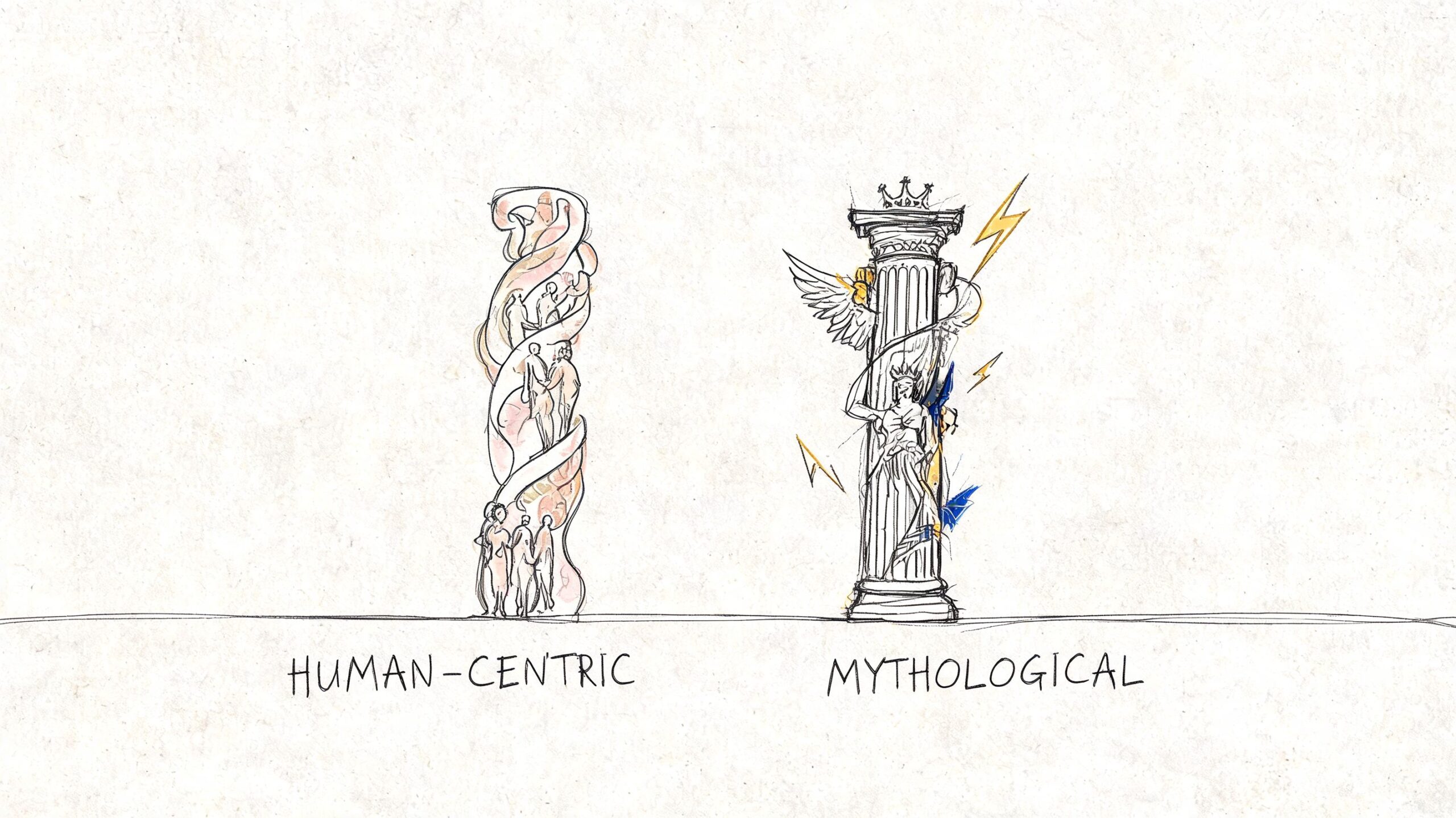
Marvel works close to the skin
Marvel's house style often feels like “the world outside your window,” even when the story gets wild. The city looks familiar. The social texture matters. A hero can save civilians and still go home carrying shame, debt, arrogance, grief, or public distrust.
That makes Marvel especially useful for creators who want readers to feel the drag of daily life. The costume doesn't erase the character's human mess. It amplifies it.
Think of the typical Marvel engine this way:
- Powers create complications
- Relationships create stakes
- The setting keeps things grounded
- Victory often costs something personal
DC thinks in myths and civic symbols
DC's strongest mode is modern mythology. Its heroes often read less like lucky survivors and more like enduring ideas given human form. Cities become stages for moral conflict. Villains often attack not just people, but values, order, faith, memory, or hope itself.
That doesn't mean DC lacks nuance. It means the stories often begin at a higher symbolic pitch. Even the street-level material tends to carry a strong silhouette and a sense of legend.
Some creators need a hero who feels like a neighbor. Others need a hero who feels like a monument. That choice changes everything from dialogue to skyline design.
Their rivalry became canon
The old fan debate became official comic history in the 1996 DC Versus Marvel crossover, where Marvel won 5 matchups to DC's 4 based on fan votes, as documented in DC's recap of the event. That result matters less as proof of superiority and more as a snapshot of how closely matched the two traditions have always been.
For creators, the core lesson from that crossover is this: both universes are strong enough to survive direct comparison because each solves a different storytelling problem well.
Detailed Comparison Worlds Tones and Characters
The broad overview helps, but creators make choices scene by scene. Tone affects panel density. Character type affects dialogue. World-building affects what readers accept without explanation.
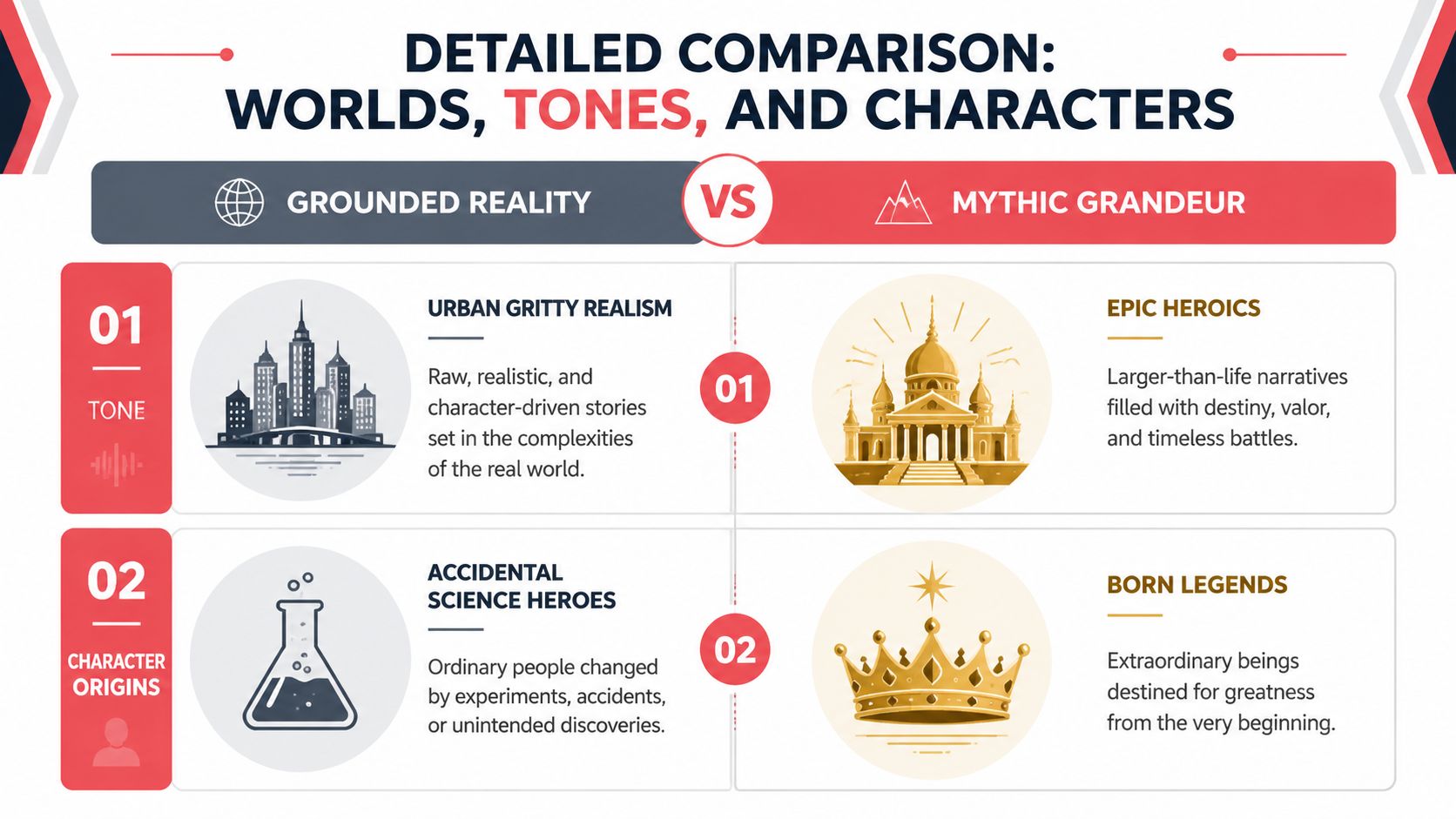
Tone grounded friction or mythic charge
Marvel usually performs best when the tension feels immediate and personal. A lab mistake, a public scandal, a broken friendship, a team argument, or a bad decision can power an entire issue. Even huge threats often work because they crash into unresolved character problems.
DC often shines when the tone carries weight and intent from the start. The city can feel ceremonial. The villain can feel like a test rather than a nuisance. The atmosphere often says, “this matters beyond the moment.”
If you're designing your own story, use this split:
| If your scene needs… | Lean Marvel | Lean DC |
|---|---|---|
| Fast banter during combat | Yes | Sometimes |
| Moral grandeur | Sometimes | Yes |
| Public embarrassment | Yes | Less often |
| Gothic atmosphere | Sometimes | Yes |
| Everyday realism | Yes | Sometimes |
| Operatic confrontation | Sometimes | Yes |
Character types flawed people or iconic figures
Marvel heroes often feel assembled from contradiction. Genius and insecurity. Power and guilt. Courage and selfishness. They're compelling because they can fail in recognizably human ways.
DC heroes often feel designed around a core principle. They may struggle, but the struggle usually tests an already-formed ideal. They don't just ask “Can I do this?” They ask “What does this mean?”
That difference shows up even in data. A character-attribute analysis found DC characters hold higher median Intelligence and Speed, while Marvel characters lead in median Strength and Durability, according to the Marvel vs DC Kaggle dataset analysis. For a creator, that lines up with a practical rule of thumb: DC-style inspiration often suits strategic, fast, high-concept plotting, while Marvel-style inspiration often suits impact-driven combat and physical escalation.
For visual planning, the right comic book style reference can help you translate that difference into line weight, color mood, and character posture.
When a character is Marvel-coded, let them reveal weakness early. When a character is DC-coded, let them reveal purpose early.
World-building real places or emotional cities
Marvel often gets mileage from proximity to our world. Familiar institutions, media pressure, neighborhoods, and social visibility all make the absurd feel oddly plausible. The superhuman enters a place that already has traffic, rent, class tension, and headlines.
DC often uses fictional cities with stronger thematic shaping. Gotham isn't just a location. It's an argument about corruption, fear, and theatrical crime. Metropolis isn't just downtown glass and steel. It's aspiration rendered as skyline.
That matters for beginner creators because setting is often where a story either gels or turns generic.
Use a Marvel-leaning setting when:
- You want readers to recognize the social rules immediately
- You need civilian life to push back on the hero
- You want the absurd premise to feel anchored
Use a DC-leaning setting when:
- You want architecture and mood to carry symbolism
- The city itself should act like part of the cast
- Your villain reflects the soul of the setting
What works and what tends to fail
Creators usually get better results when they commit instead of blending too early.
What works:
- A clear tonal spine
- A hero design that matches the setting
- Conflict that grows from the chosen universe's logic
What fails:
- Marvel-style quips inside a solemn mythic story with no tonal control
- DC-style monologues in a messy ensemble comedy
- A realistic city paired with purely symbolic stakes that never touch ordinary people
The strongest original comics don't copy either publisher. They choose one set of instincts first, then customize from there.
The Comic Book Source Code From Classics to Alternate Worlds
Movies train people to think in brands. Comics train creators to think in variations.
That matters because the deepest inspiration doesn't usually come from the most famous version of a hero. It comes from the strange side roads. Reboots. Alternate timelines. One-off visions. The stories where creators ask, “What if this character started from a different emotional truth?”
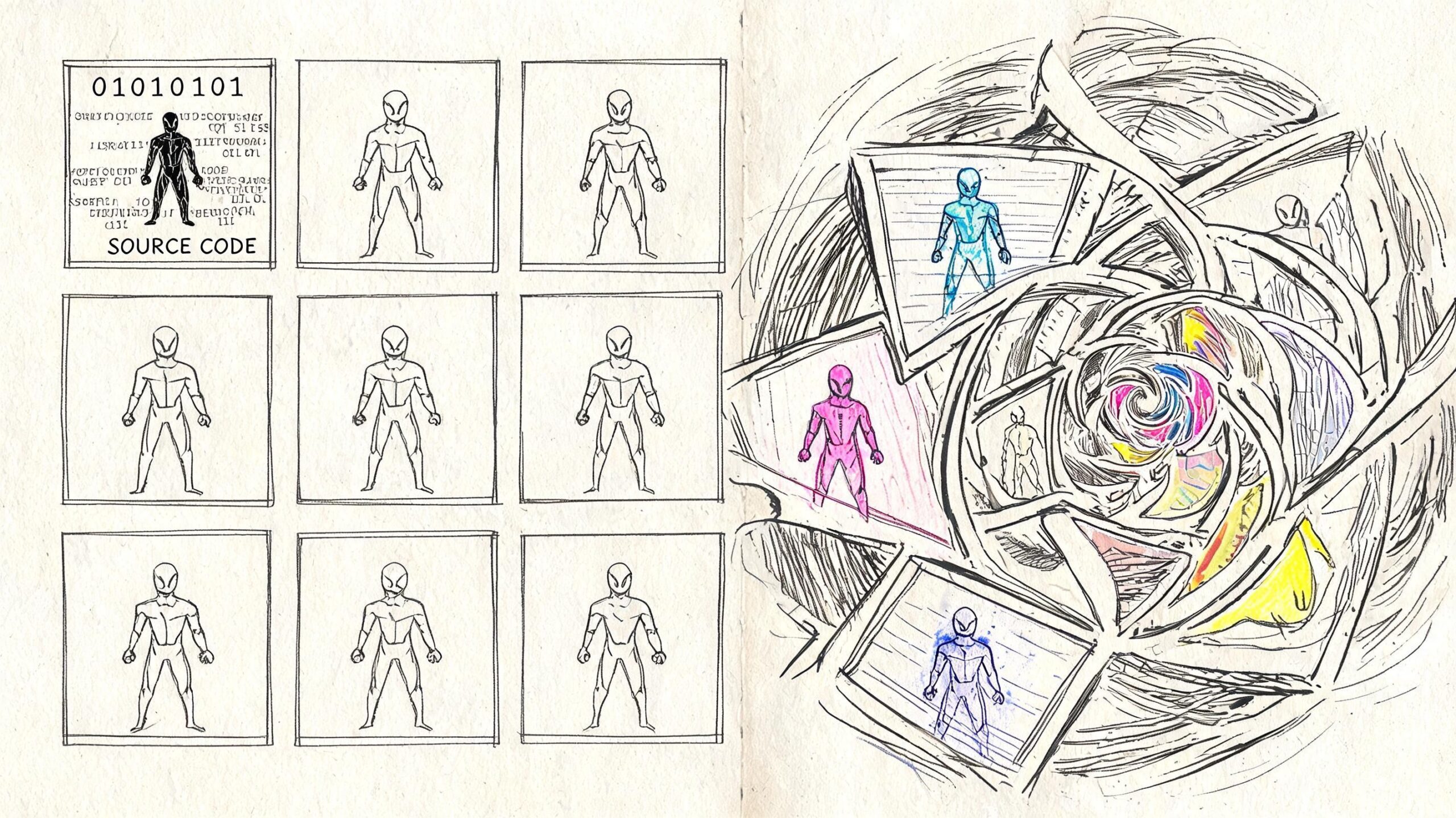
Alternate worlds are where creators learn fastest
If you want raw source code for your own project, study the comics where continuity loosens up. Marvel's Ultimate line and DC's Elseworlds and newer Absolute line all show how durable a character concept really is. Strip away habit, rebuild the premise, keep the core spark.
That's useful for any custom comic idea because your job isn't to preserve canon. Your job is to identify what makes a premise survive reinvention.
A few practical questions help:
- What is the untouchable core? A mission, a wound, a code, a fear?
- What can change safely? Era, costume logic, supporting cast, visual genre?
- What gets stronger when transplanted? Noir? Sci-fi? Fantasy? Family comedy?
Current comics already reward reinvention
Recent sales talk makes that point clearly. In Q4 2025, Absolute Batman sold 150,000 units while Ultimate Spider-Man sold 75,000, according to this sales analysis of the Absolute and Ultimate lines. The takeaway isn't that one company permanently solved alternate continuity. It's that readers respond when a reinvention feels focused, character-driven, and confident.
That should encourage new artists. You don't need to retell the most canonical version of anything. Readers often connect harder with a version that picks a lane and commits.
If you want to see how a long-running icon can mutate across tone and interpretation, a character study like the origin of the Joker across comic history is a useful reminder that even the most familiar figures stay alive by changing shape.
Study the versions that break expectation cleanly. They teach more than the versions that simply repeat a formula.
A better question than canon accuracy
For your own project, stop asking whether an idea is “accurate enough.” Ask whether it's coherent enough. If your hero becomes a cosmic knight in one draft and a local vigilante in the next, choose the version with the stronger emotional center.
Comics history supports that move. Reinvention isn't cheating. It's the medium working as intended.
Translating Inspiration to Your PersonalizedComic
Once you know whether your project leans Marvel or DC, the next step is practical translation. Many hobbyists stall at this point. They know the vibe they want, but they don't know how to turn that vibe into design choices.
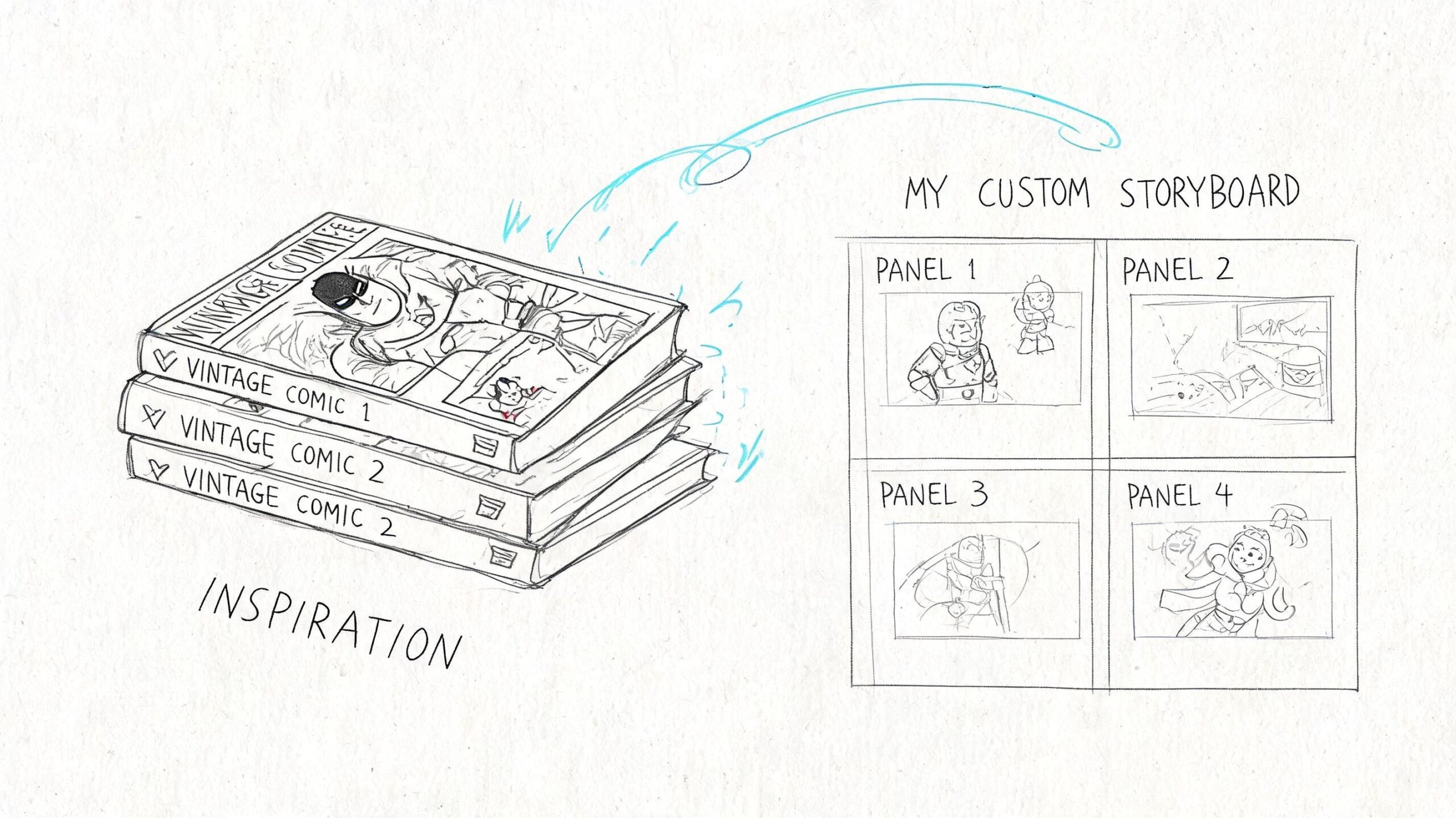
Match the visual style to the story engine
If your story leans Marvel, favor motion, clutter, expressive faces, and crowded panels. The world should feel lived in. Backgrounds should imply pressure. Characters should interrupt each other. Costumes can be sleek, but they shouldn't feel too ceremonial unless that contrast is the point.
If your story leans DC, simplify for impact. Strong silhouettes matter more. Entrances matter more. Environment should echo theme. A staircase, gargoyle, rooftop ledge, cathedral window, or impossible skyline can do a lot of narrative work.
A practical design pass looks like this:
- Marvel-leaning page: more reaction shots, more body language, more environmental mess
- DC-leaning page: more iconic framing, more negative space, more formal composition
Pick a plot shape before writing dialogue
Writers often draft dialogue too early. Start with the plot shape.
For a Marvel-coded comic, strong options include:
- The unstable origin
- The team mission that exposes personality clashes
- The public disaster that becomes personal
For a DC-coded comic, these usually work better:
- The citywide moral test
- The inheritance of a mantle
- The clash between symbol and corruption
When people customize a superhero concept from scratch, they usually get farther by choosing one conflict sentence first. If you need help thinking through how a self-insert or photo-based hero should read on the page, this guide on how to customize a superhero offers useful creative prompts.
Build your hero from one internal flaw and one visual promise
This is the cleanest method I know for original character design.
Start with an internal flaw:
- avoidance
- pride
- rage
- guilt
- naivety
- control
Then pair it with a visual promise:
- detective silhouette
- radiant guardian
- armored bruiser
- impossible speedster
- occult wanderer
- urban acrobat
Those two elements create tension. A guilty cosmic hero feels different from a proud detective. A naive speedster feels different from a control-obsessed vigilante.
Studio note: If you can describe your hero in one flaw and one image, you can usually design the first page.
What works for gifts and personal projects
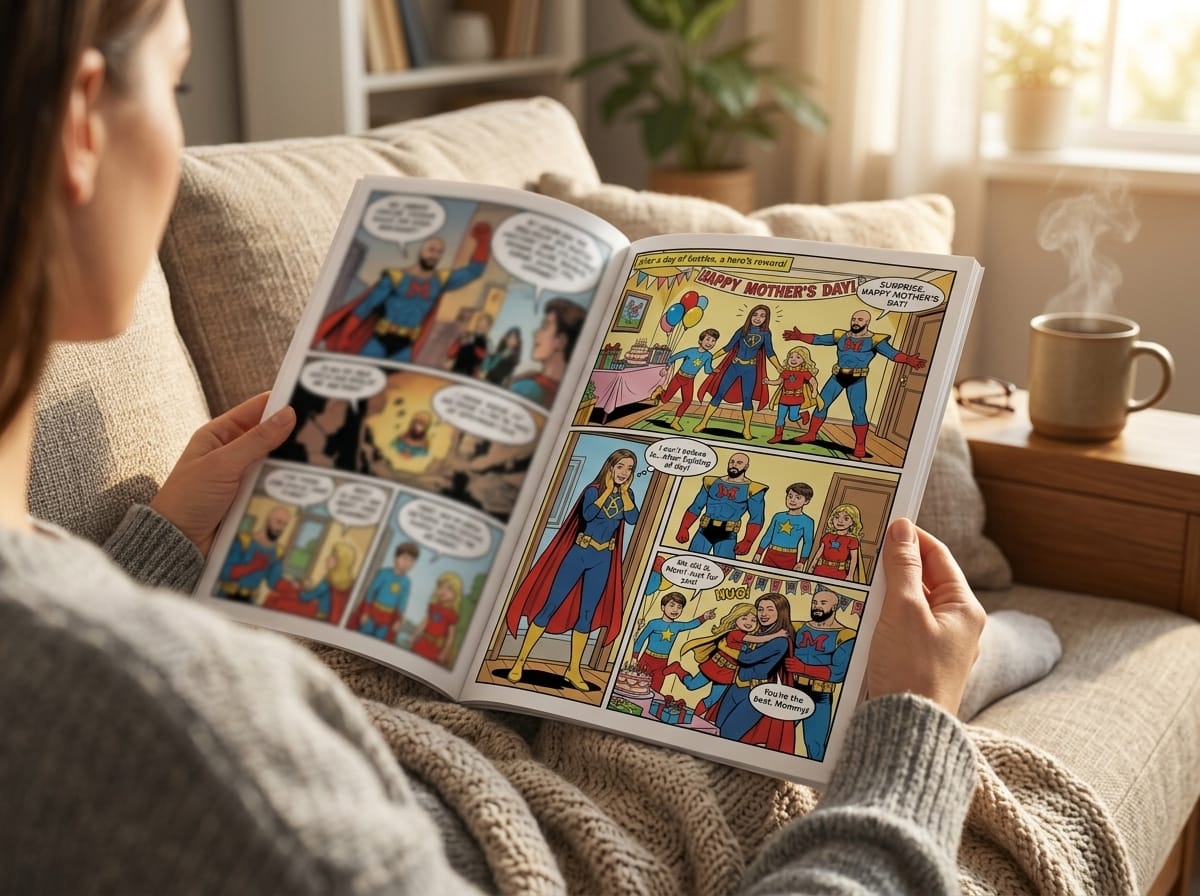
For a gift comic, clarity beats lore depth. Use an easy emotional hook. Birthday rescue. Anniversary team-up. Family fantasy quest. Friends as rival champions who become allies.
For a personal portfolio piece, push harder on atmosphere and theme. One strong scene can carry the whole concept if the world feels specific.
What usually doesn't work:
- Too many powers
- Too much backstory before page one
- Direct copies of famous costumes
- A tone that switches every scene
Pick a lane. Then make that lane personal.
Creating Homages Safely Legal and Creative Guardrails
A smart homage doesn't trace over someone else's character. It identifies the underlying appeal, then rebuilds it with fresh choices.
That's the safer path creatively, and it's usually the stronger one artistically. A brooding detective, idealistic alien protector, unstable tech genius, or sarcastic street acrobat are all broad archetypes. The trouble starts when the design, name, supporting cast, insignia, and story beats line up too closely with a protected character.
Use inspiration at the level of function
Borrow the function, not the packaging.
Safe approach: “A nocturnal investigator whose city reflects his trauma.”
Unsafe approach: using Batman's name, bat iconography, rogues, origin pattern, and recognizable suit structure.
Safe approach: “A brilliant hero whose inventions worsen his personal life.”
Unsafe approach: copying Iron Man's exact armor profile, branding logic, and alter ego framing.
Originality solves more than legal risk
There's a reason this matters in crossover history too. Access, the obscure character created in 1996 to keep Marvel and DC separate, remains a reminder that the official border between those universes has always been complicated, as discussed in this overview of Access and Marvel-DC continuity. His near-disappearance from modern discussion says a lot. The cleaner route for personal projects is usually to create a new character inspired by familiar traditions rather than trying to wedge your story into someone else's canon.
A good homage asks, “What do I love here?” Then it answers with original design.
The safest character is often the most memorable one, because you were forced to make real choices instead of leaning on recognition.
Conclusion Your Universe Awaits
The useful answer to marvel or dc is never just a publisher name.
It's a set of creative instincts. Marvel gives you friction, flaws, recognizable pressure, and heroes who can feel gloriously unfinished. DC gives you myth, symbolism, legible ideals, and characters who can carry a story like living architecture. Both can teach you a lot. Neither needs to be copied exactly.
If your idea wants sarcasm, speed, collateral damage, emotional mess, and a city that feels busy enough to ignore a hero until it suddenly can't, follow the Marvel side of the map. If your idea wants ritual, silhouette, legacy, moral scale, and a setting that looks like a dream someone carved from stone and weather, follow the DC side.
The victory comes when you stop asking which universe you should belong to and start asking what kind of universe only you would make.
That's where beginner concepts stop feeling derivative. That's where a gift becomes personal. That's where a fan project starts acting like a comic.
If you're ready to turn that inspiration into finished pages, PersonalizedComics is a practical place to start. You can upload photos, choose from eight visual styles, shape your own hero, and turn a rough idea into a polished comic without drawing everything by hand. Whether you want Marvel-like energy, DC-like grandeur, or something that blends both into your own original voice, it gives you a fast way to build a comic that feels personal from panel one.
Filed under Comics & Culture