That's the part most guides skip. They tell you a flip book is “fun” and “easy,” then jump straight to upload buttons. The better approach starts much earlier. A strong printed keepsake depends on story planning, smart source footage, the right visual style, careful page generation, and production choices that fit how the book will be handled.
A personalized flip book works best when you treat it like a miniature film and a printed object at the same time. That mindset changes everything.
Planning Your Perfect Flip Book Story
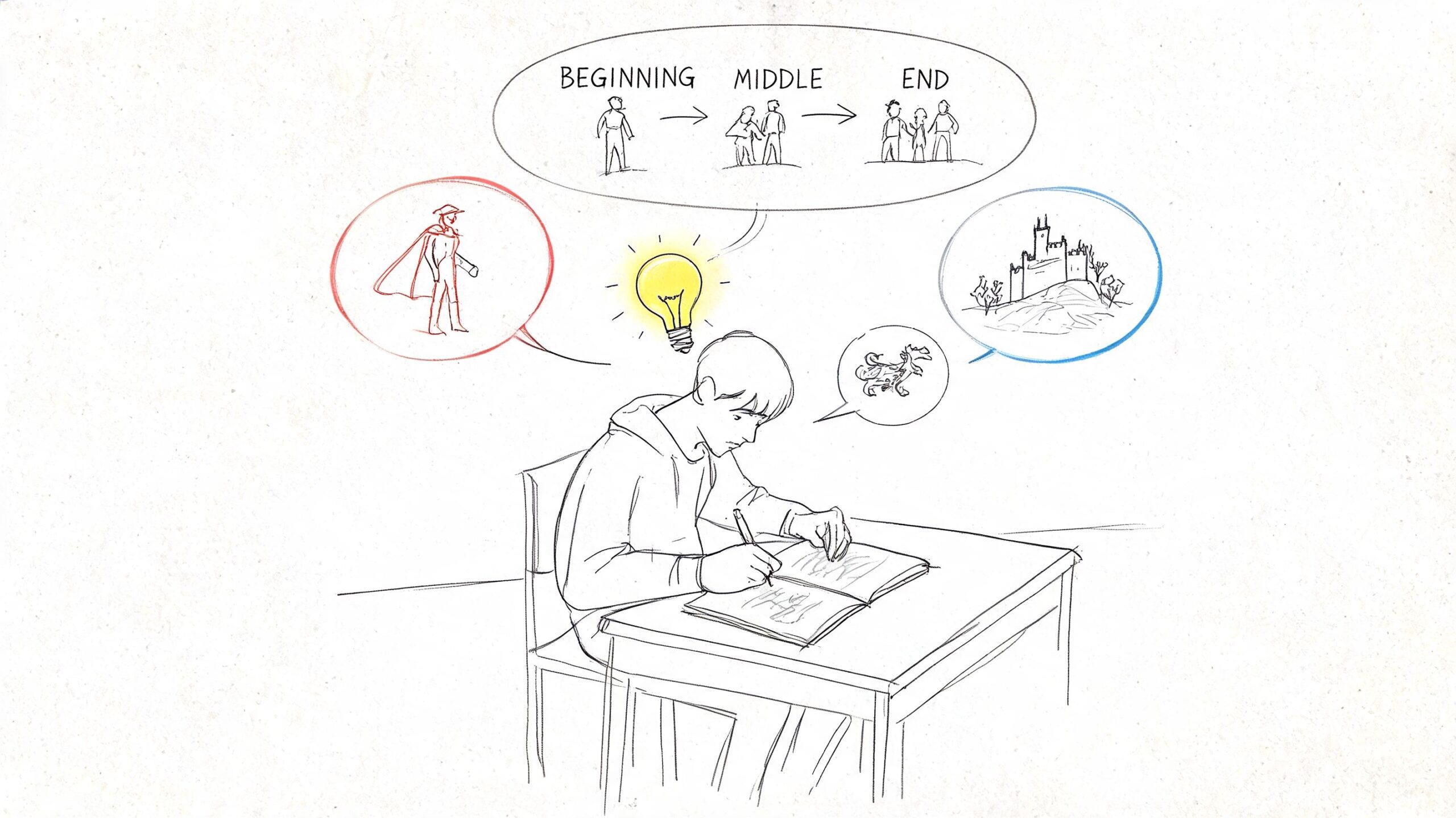
The strongest flip books start with restraint. One moment. One beat. One emotional payoff.
If you try to cram a whole vacation, a full love story, or a child's entire first year into a short flipping sequence, the motion gets muddy and the emotional point disappears. A printed flip book doesn't need a sprawling plot. It needs a clean arc with a beginning, a shift, and an ending.
Start with the moment, not the medium
Pick the emotional center first. Good candidates include:
- A reveal like a proposal, pregnancy announcement, or surprise gift
- A transformation like a costume change, haircut, dance move, or child learning something new
- A reaction like laughter, a double take, a hug, or a pet recognizing someone
- An inside joke with a setup only your recipient will understand
If you're making this as a gift, it helps to think in one sentence. “I want them to flip this and instantly relive that exact moment.” That sentence keeps you from choosing footage just because it exists.
For more gift-focused story ideas, this guide on how to create a book for a gift is useful because it pushes you toward a clear emotional premise instead of generic customization.
Build a tiny story arc
A flip book doesn't need dialogue to feel complete. It needs sequence.
Try this simple structure:
- Opening frame
Establish who or what we're watching. Keep it legible. - Motion phase
The action should move in one clear direction. A turn, wave, jump, kiss, step, or reveal. - Payoff frame
End on the expression or final pose people want to revisit.
That payoff matters more than people think. If the final frames are awkward, blurred, or cut off, the whole object feels unfinished even if the middle section moves nicely.
Practical rule: If you can describe the action with one strong verb, it usually works. If you need three sentences to explain what's happening, it probably won't.
Use footage that was made for flipping
Many projects go off track at this stage. People assume any phone video can become a satisfying personalized flip book. It can't.
As noted by Flipboku's custom flipbook guidance, motion quality is a common challenge, and short clips plus scene simplicity are vital for a smooth effect. Fast camera movement, low light, and complex backgrounds can ruin the animation.
That lines up with what works in practice. The best source material usually has:
- Stable camera work so the subject moves, not the whole frame
- Simple backgrounds that don't compete with the action
- Good lighting so facial features and outlines stay readable
- Short duration because flip books reward concise motion
- One subject focus instead of several people crossing each other
A slow spin in daylight beats a dimly lit restaurant video every time. A child waving at the camera beats a chaotic playground clip. A side-profile kiss often prints more clearly than a front-facing group shot.
Storyboard before you touch any software
Use paper. Eight to twelve rough boxes is enough.
Sketch where the motion begins, where it peaks, and where it ends. You're not drawing art. You're checking clarity. If those little boxes make sense at a glance, the finished sequence usually will too.
A quick preflight checklist helps:
- Check framing: Keep heads, hands, or key props away from the edges.
- Check readability: Zoom in on still frames from your phone. If the face already looks muddy there, print won't rescue it.
- Check motion direction: Side-to-side or forward movement is easier to read than erratic motion.
- Check ending: Make sure the final image is display-worthy on its own.
Most disappointing flip books aren't ruined by bad technology. They're ruined by weak planning. Get the story and footage right first, and the rest of the process becomes much easier.
Choosing Your Art Style and Motion
After the sequence is established, the next choice involves the visual tone. The project now stops feeling like a technical conversion and begins to feel authored.
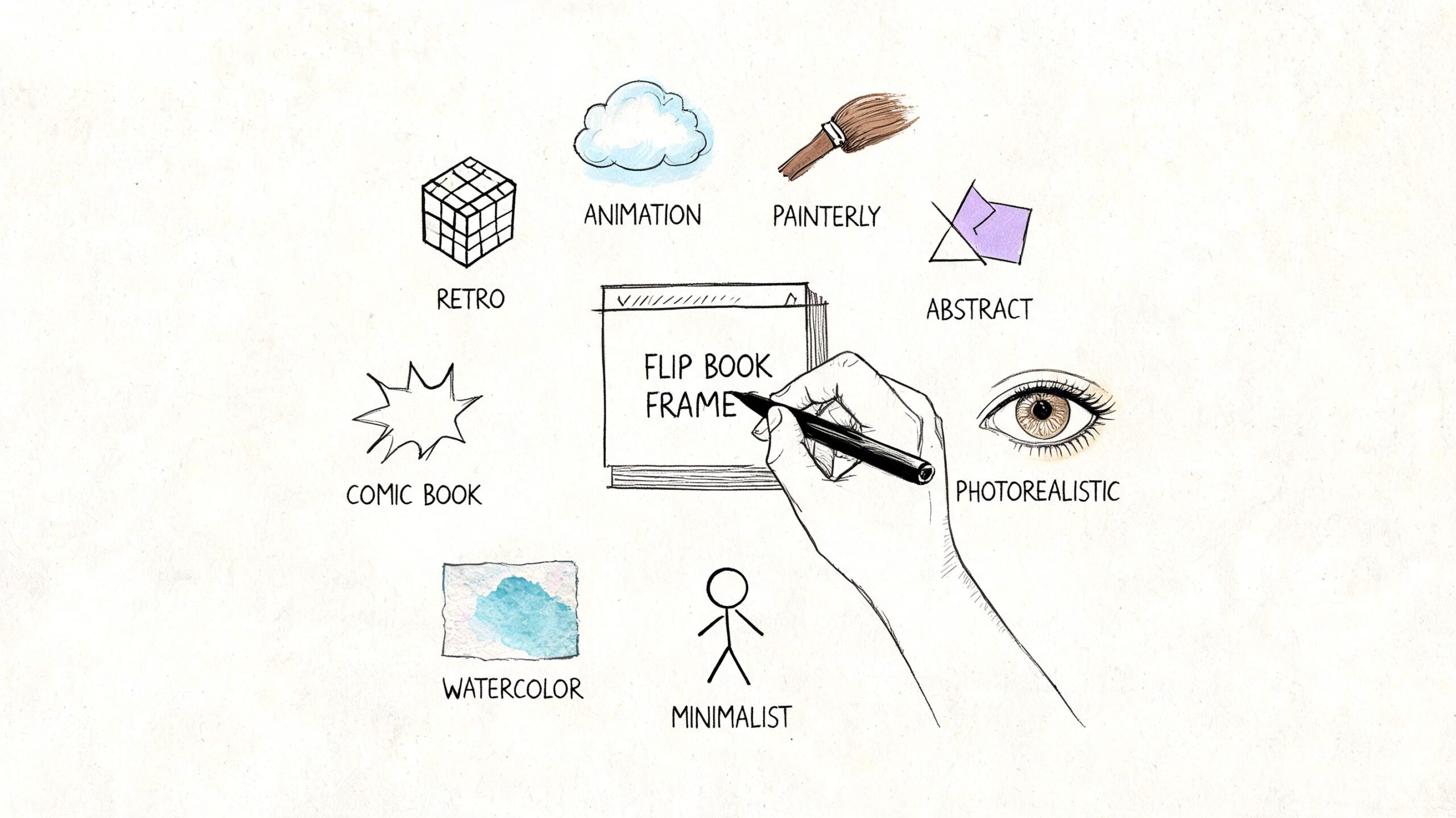
A personalized flip book can tell the exact same story in completely different emotional registers depending on style. A wedding twirl rendered in watercolor feels romantic and airy. The same twirl in noir feels cinematic and moody. In retro pop, it becomes playful. In fantasy, it starts to feel mythic.
Match style to emotional intent
Here's the simplest way to choose. Don't ask which style looks coolest in isolation. Ask which style makes your moment feel more like itself.
A few reliable pairings:
| Story type | Style direction that often fits | Why it works |
|---|---|---|
| Proposal or anniversary | Watercolor, fantasy | Softness, warmth, romance |
| Birthday surprise or family joke | Retro pop, classic American | Bright energy and readable expressions |
| Dramatic reveal or cosplay | Graphic novel, cyberpunk | Strong contrast and cinematic edge |
| Mystery tone or black-and-white nostalgia | Noir | Mood, shadows, tension |
| Heroic child or pet adventure | Fantasy, classic American | Bold silhouettes and playful storytelling |
If you want to compare visual directions before committing, this breakdown of different comic art styles helps translate genre language into actual creative choices.
Don't let style fight the motion
Some looks flatter certain footage better than others. Delicate painterly treatment can be beautiful, but if your source clip already has lots of movement or visual clutter, a bolder style often reads better in print. Strong outlines and cleaner shapes usually hold up better when pages move quickly under the thumb.
That doesn't mean subtle styles are worse. It means they need cleaner input.
A flip book is viewed in motion, but each page still has to survive as a still image.
That's why I usually make the style choice after checking three or four representative frames. If the expression is clear, the pose reads instantly, and the background doesn't turn noisy, the style is a good fit.
Understand motion without overthinking frame rate
For a physical flip book, you're not chasing a technical spec. You're chasing the feeling of fluid movement.
What matters is consistency. Too few useful images, and the action stutters. Too many near-identical frames, and the book feels sluggish. The sweet spot is a sequence where each page shows a visible change from the one before it.
Use this practical filter when selecting frames:
- Keep frames with meaningful movement
- Drop frames that look almost identical
- Preserve the key poses
- Protect the ending expression
If someone raises a hand to wave, you want the resting hand, the lift, the peak, and the finish. You don't need every tiny in-between if those pages don't add clarity.
The broader market is moving in this direction too. According to Paperturn's review of flipbook software in 2026, the U.S. flipbook software market is projected to grow from USD 392.1 million in 2026 to USD 617.4 million by 2033, which tells you buyers increasingly expect more refined digital and print storytelling tools.
That expectation shows up in taste. People don't just want a novelty. They want motion, style, and print quality to feel intentional.
Using AI to Generate Your Flip Book Pages
This is the step people usually expect to be difficult. In practice, it's only difficult when the preparation was sloppy.
If your source images are clean, your story beat is obvious, and your style choice supports the action, AI generation becomes a sorting and refinement job, not a rescue mission. That's the difference between getting a draft you can polish and getting a pile of pages that all need fixing.
Set up your input like an editor
Before generating anything, narrow your material down. Don't upload every photo from the day or every second of a long video. Pull only the frames that support the motion arc you already chose.
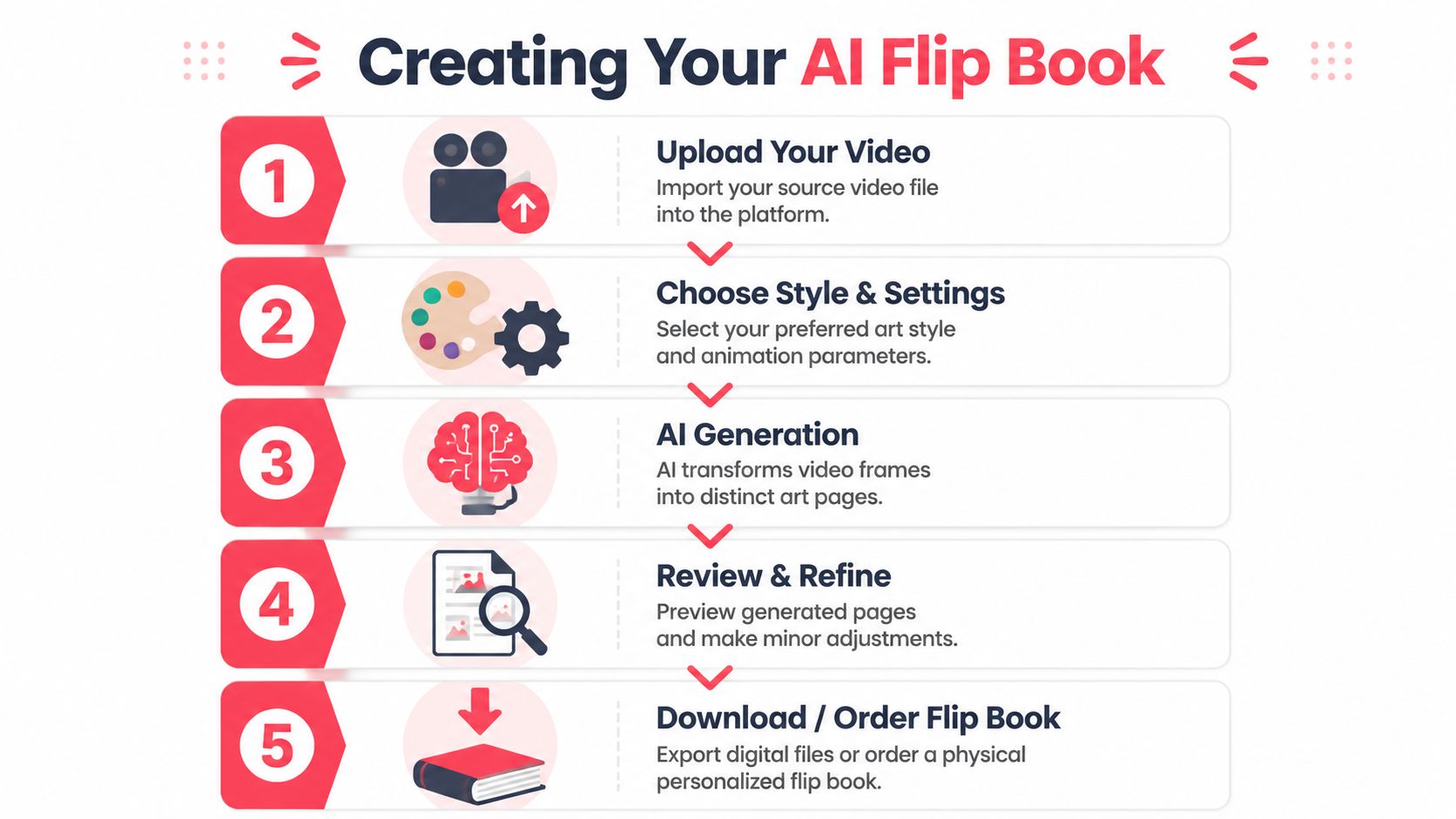
The cleanest workflow usually looks like this:
- Choose your source clip or image sequence
- Trim it to the core action
- Extract or select the frames that matter
- Put them in order before upload
- Name them sequentially if the platform supports that
That simple prep prevents one of the most common AI mistakes, which is treating a sentimental but messy collection of media as if software can magically impose pacing on it.
A guided platform can speed this up. If you want a practical look at that kind of workflow, AI book maker tools show how image upload, style selection, and page generation can come together in one sequence.
A simplified process looks like this:
Prompt for consistency, not fireworks
When AI is involved, many people overdirect. They ask for dramatic backgrounds, extra props, new costumes, cinematic lighting changes, and stylized effects all at once. For a printed flip book, that usually hurts continuity.
Your prompt or setup choices should protect these elements:
- Character identity so the person still looks like the person
- Pose progression so motion remains readable
- Background stability so pages don't flicker visually
- Style consistency so the sequence feels like one object
If you're adding text, keep it sparse. Speech bubbles and narration work better in a comic page than in a pure motion flip sequence. For a personalized flip book, too much text interrupts the hand-feel of flipping.
Review pages in sequence, not one by one
This is the biggest mindset shift. A single page can look fantastic and still be wrong for the book.
Lay the pages out in order and judge the sequence on four criteria:
| Check | What to look for |
|---|---|
| Motion clarity | Can you tell what action is happening without explanation? |
| Character consistency | Does the person stay recognizably the same from page to page? |
| Rhythm | Do the pages move at an even pace, or are there sudden jumps? |
| Ending strength | Does the final page feel gift-worthy on its own? |
If page 7 is gorgeous but breaks the motion path, replace it. If page 12 has a slightly less impressive rendering but improves the sequence, keep it.
The best AI-generated flip books aren't the ones with the flashiest individual pages. They're the ones people want to flip twice.
Use digital preview as a creative test
There's a smart way to reduce waste before you print. Share a digital preview privately, then watch how people move through it.
According to Publitas on flipbook performance metrics, interactive catalogs should be measured as a funnel using signals like read depth and interaction events. For a personalized flip book, that translates into a practical test. You can share a preview and see which pages hold attention longest before you commit to print.
That's useful because pacing problems show up quickly. If viewers linger around the reveal, revisit the ending, or stop early, you learn something concrete about the sequence.
Refine with a print mindset
Before export or ordering, make a final pass with physical production in mind.
- Tighten weak openings: If the first pages feel too similar, start later.
- Remove visual clutter: Busy backgrounds often look worse on paper than on screen.
- Strengthen page turns: Favor frames with clear silhouette changes.
- Check crop safety: Don't let important features sit too close to the trim edge.
People think AI is the magic. It isn't. The magic is seeing your own idea become structured, stylized, and printable without losing the original feeling. AI just makes that transformation fast enough to iterate.
Ordering Your High-Quality Printed Flip Book
A digital preview is helpful. The printed object is the payoff.
A personalized flip book stops being a novelty file and becomes something people hold onto. Production choices matter more than many buyers expect, because the same sequence can feel cheap, precious, sturdy, or collectible depending on paper, trim, binding, and finishing.
Know what kind of object you're buying
Not all flip books are built for the same job. Some are one-time party favors. Some are made to live on a desk and be handled often. Others are closer to keepsakes you revisit carefully and store with other mementos.
That distinction matters. As explained by Formax Printing's overview of flip books, the market is fragmented by intent. Some products are disposable novelties, while others are durable, archival keepsakes. Customers need clarity on print quality, binding, and storage expectations.
So ask practical questions before ordering:
- Will this be flipped often or mainly displayed?
- Does it need to survive being passed around at an event?
- Is this a sentimental archive piece or a casual gift extra?
- Will the recipient store it in a box, on a shelf, or in a bag?
Those answers should guide your print choices more than trend language ever will.
What to look for in print production
For a premium-feeling result, pay attention to the basics people usually skip.
Paper stock affects more than appearance. It changes how the pages fan under the thumb. Too thin, and the book feels flimsy. Too stiff, and the flipping action can feel awkward.
Binding matters just as much. A secure, durable bind keeps repeated use from turning the edge ragged too quickly. If the book is intended as a collectible, finishing quality at the spine or edge makes a visible difference.
Cover design deserves restraint. The cover should identify the moment and set the mood, not compete with the animation inside. Usually the strongest cover uses one memorable frame, a short title, and a clean visual hierarchy.
If you want the piece to feel like a keepsake, design for the hand first and the screen second.
Use credits carefully when planning page count
Some creation platforms use a straightforward page-credit model. In that setup, 1 credit equals 1 page, which is easy to budget because your storytelling choices directly affect cost.
Here's a simple planning format you can use before you buy anything:
| Pack Name | Credits Included | Price (Example) | Best For |
|---|---|---|---|
| Starter | Small credit pack | Varies by provider | A short motion test or first-time gift |
| Creator | Mid-size credit pack | Varies by provider | A fuller sequence with room for revisions |
| Studio | Large credit pack | Varies by provider | Longer stories, multiple versions, or batch projects |
Because providers structure pack names and pricing differently, the best way to use a table like this is as a decision lens. If your sequence is short and tightly edited, start small. If you know you'll test multiple cuts, alternate covers, or several style passes, choose a larger pack so you don't edit too aggressively just to save pages.
Final order checks before you click buy
Run through these before approving the print job:
- Flipability check
Make sure the motion still reads when pages are viewed in order. - Trim check
Watch for faces, hands, rings, or props near the edge. - Cover check
Confirm the front gives the object a clear identity. - Storage check
If this is an archival gift, choose packaging and handling expectations accordingly.
The difference between a throwaway flip book and one people keep isn't sentiment alone. It's whether the physical object was produced to match the importance of the moment.
Creative Use Cases and Pro Tips
The nicest thing about a personalized flip book is how flexible it is. It can be heartfelt, funny, dramatic, nostalgic, or delightfully weird, depending on the source moment and the way you frame it.
Some of the best projects don't come from “big” life milestones. They come from very specific memories that already carry emotion. A couple's first dance works because the movement is elegant and recognizable. A grandparent opening a handwritten note works because the reaction lands at the end. A dog sprinting toward the front door works because everyone in the family already knows what that motion means.
Moments that translate beautifully
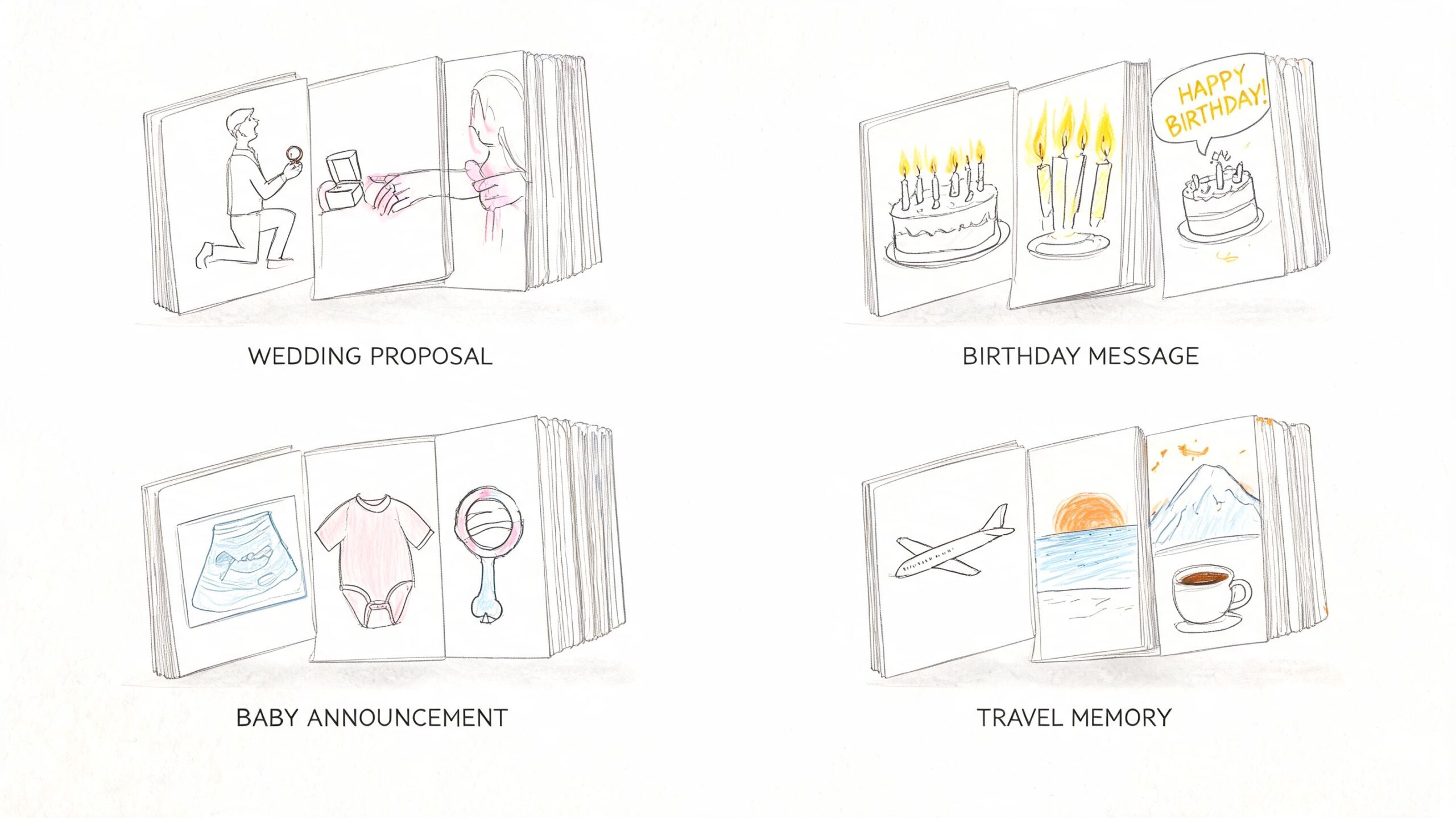
A few use cases consistently deliver strong results.
Wedding and anniversary gifts often work best when they focus on a single movement. The turn into a first dance. The second before a kiss. The laugh right after someone says yes. Those moments already have built-in pacing.
Baby milestones are ideal when the action is simple. A first step toward the camera. A clap. A wave. A messy grin after cake. Tiny movements read well and feel emotionally huge.
Pet keepsakes shine when you avoid chaos. A head tilt, jump, tail-wag greeting, or proud toy parade gives you a readable motion loop and a very giftable ending frame.
Travel memories work when there's one dominant action. Tossing a hat in the air, turning toward a landmark, stepping into ocean foam. Don't try to summarize the whole trip.
A few creative formats worth stealing
You don't have to treat every project like a straightforward animation.
- Silent film mode uses minimal or no text, with one strong title card on the cover.
- Chapter set turns several small books into a series. One for dating, one for engagement, one for the wedding.
- Reveal sequence saves the emotional information for the last pages, like a baby announcement or surprise message.
- Character version stylizes real people more heavily so the keepsake feels like part memory, part illustrated mythology.
One smart move is to test a private digital version before printing. As shown in Publuu's guide to analyzing flipbook statistics, modern digital flipbooks can track views, page-by-page engagement, and time spent. For a gift project, that means you can share a preview with a trusted circle and notice which part of the story resonates most before you produce the physical copy.
Sometimes the page you love most as the creator isn't the page other people return to. Previewing can reveal where the real emotional beat lives.
Pro tips that make the finished piece feel special
These are the small choices that separate a generic novelty from a thoughtful keepsake:
- Open late: Start the sequence just before the action begins. Early dead space weakens the flip.
- End on a frame worth displaying: The last page should look good even when the book is closed.
- Use one visual motif: A shared color, prop, or wardrobe element makes the sequence feel designed.
- Keep text rare: A single caption can add charm. Too many words make the motion feel interrupted.
- Make the cover earn its spot: Treat it like packaging for a gift, not an afterthought.
- Save alternate cuts: One version can be playful, another more sentimental. Different recipients respond differently.
The most memorable personalized flip books feel intimate because they're specific. Not “our relationship.” The shoulder turn before the laugh. Not “our dog.” The exact bounce at the door. That's what gives the object replay value.
If you're ready to turn photos, ideas, or a short clip into a printed keepsake that feels polished instead of generic, PersonalizedComics makes that process much easier. You can choose from eight comic art styles, generate pages without drawing skills, test your story visually, and order a premium physical copy when the sequence feels right.
Filed under Making Your Comic