Comic Book Scripting: A Guide for Aspiring Creators
You've got a scene in your head that feels alive already. A hero kicks through a door. Two exes argue on a rooftop. A kid finds a strange key at the bottom of a cereal box and nothing is normal after that. Then you sit down to “write the comic,” and suddenly the fun idea becomes a technical puzzle.
How many panels go on a page? What do you tell the artist? How much dialogue is too much? If you're using an AI comic generator, a new worry shows up fast. Why does your character look right in one panel and like a cousin in the next?
That stuck feeling is normal. Most new creators don't lack imagination. They lack a blueprint.
Your Great Idea Needs a Great Blueprint
A comic script is that blueprint. It's not a bureaucratic hurdle between you and the fun part. It is the fun part, because in it your story becomes visible.
Think about a simple moment. A detective opens a locker and finds a bloodstained glove. In prose, you can write the discovery as a paragraph. In film, a director and camera crew solve the visual choices. In comics, you make those choices on the page. You decide whether the reader sees the hallway first, the trembling hand second, and the glove on the page turn. That's scripting.
A lot of beginners freeze because they think comic book scripting means learning a secret industry code. It doesn't. It means learning how to communicate clearly so the story lands the way you intend. If you're working with an artist, the script tells them what matters most. If you're working alone, it keeps you from wandering. If you're working with AI, it becomes the instruction set that protects your story from visual chaos.
A comic script isn't there to impress anyone. It's there to make the comic readable, drawable, and emotionally sharp.
If you're still developing the bones of your story, it helps to get the premise solid before you worry about page mechanics. A beginner-friendly guide to how to write a story for beginners can help you pin down conflict, character, and momentum before you start chopping scenes into panels.
The good news is that scripting is learnable. You don't need to be born with some rare “comic brain.” You need a process, a few practical limits, and the willingness to think in pictures instead of paragraphs.
The Anatomy of a Comic Book Script
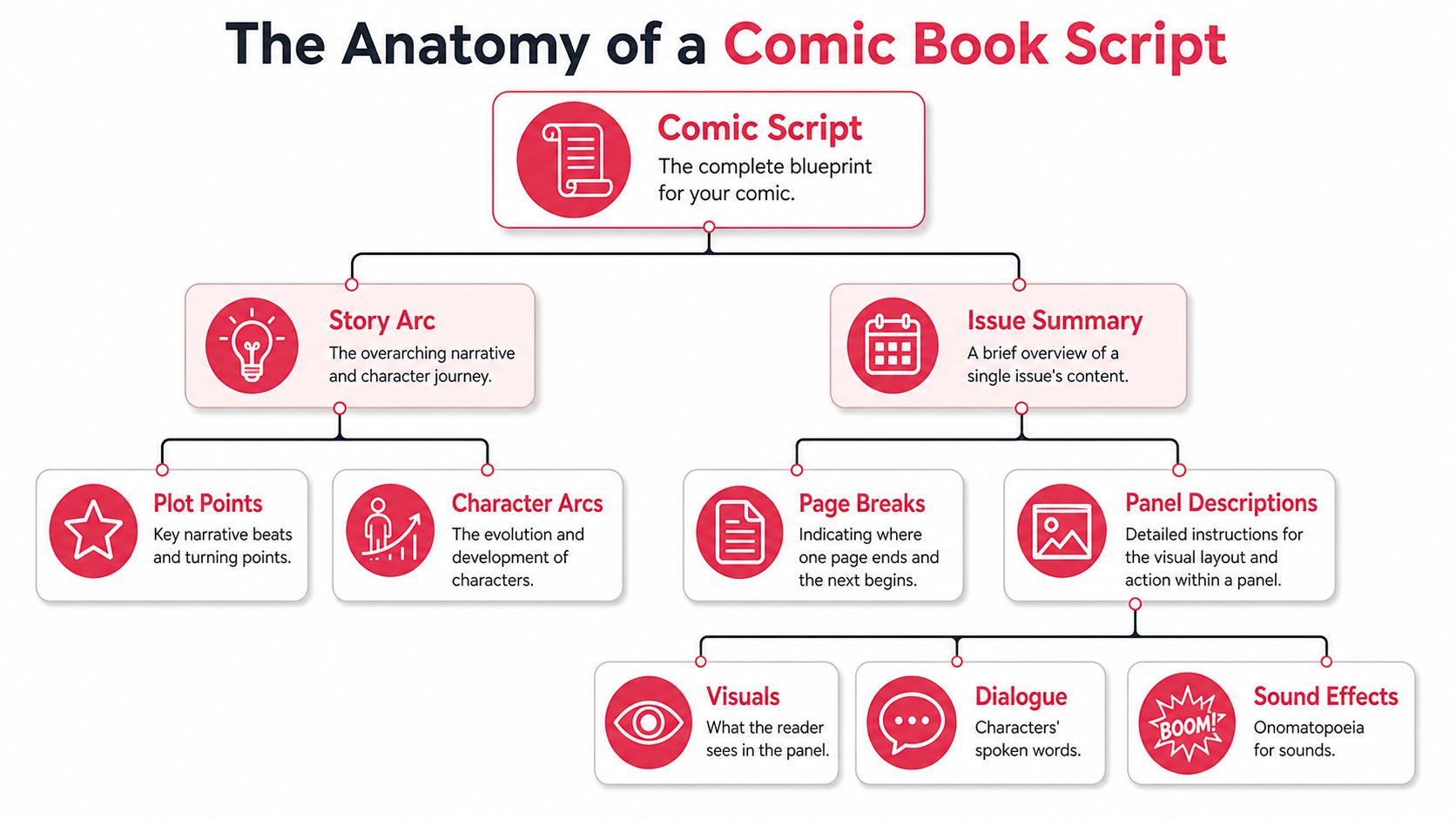
Most professional comic book scripting falls into two mainstream methods. The full script gives the writer control over each page and panel, while the plot script gives the artist more freedom to shape pacing and visual breakdown before dialogue is added, as outlined in Wikipedia's overview of comics scripting styles).
For beginners, the full script is usually the best teacher. It forces you to think clearly.
The core parts on the page
A full script is built from a few repeating units. Once you understand them, the format stops feeling mysterious.
| Part | What it does | Simple example |
|---|---|---|
| Page | Controls pacing and page turns | Page 3 ends on the hand reaching for the door |
| Panel | Defines one visual beat | Panel 2 shows the door handle turning |
| Description | Tells what the reader sees | Narrow hallway, flickering light, tense posture |
| Dialogue | Gives spoken words to characters | “Don't open it.” |
| Caption | Adds narration, time, or inner voice | “Ten minutes earlier.” |
| SFX | Makes sound visible | KRAK, THUD, CLICK |
A comic script isn't trying to sound literary. It's trying to be usable. That means each panel description should answer basic visual questions: who is here, what are they doing, and what is the reader looking at?
Here's a stripped-down example:
Page 1
Panel 1: Wide shot. Empty school hallway at dusk. Lockers on both sides. Maya stands alone at the far end, clutching a folded note.
Caption: Last bell. No witnesses.
Panel 2: Medium shot. Maya unfolds the note. Her face drops.
Maya: You've got to be kidding me.
That's already enough to draw. It's clear, visual, and readable.
Why pages matter as much as panels
New writers often focus only on individual moments. Professionals think in pages. A page is a unit of rhythm. It can build tension, deliver a reveal, or give the reader a breath between intense beats.
That means “Page 5” is not just where more story happens. It's a storytelling container. The last panel on a page has special power because the reader has to turn the page to learn what comes next.
Practical rule: If a panel could be moved to another page with no effect, you probably haven't used page rhythm yet.
What a professional script usually includes
Even for a small project, a clean script benefits from basic organization.
- Title page: Include the project title and clear contact information.
- Version label: Use simple version control such as v1a or v1b so collaborators know which draft is current.
- Issue summary: Add a brief overview so everyone understands the scene's purpose before diving into panel detail.
- Page-by-page breakdown: Keep each page distinct rather than dumping the whole scene in one block.
Good format doesn't make you rigid. It makes you collaborative. When your script is easy to scan, the visual storytelling gets stronger because nobody is guessing what matters.
Mastering Panel Descriptions and Pacing
Comic writing starts to feel like directing. Not in a flashy sense. In a practical one. You're deciding what the reader sees first, what they miss until later, and how quickly the story moves from beat to beat.
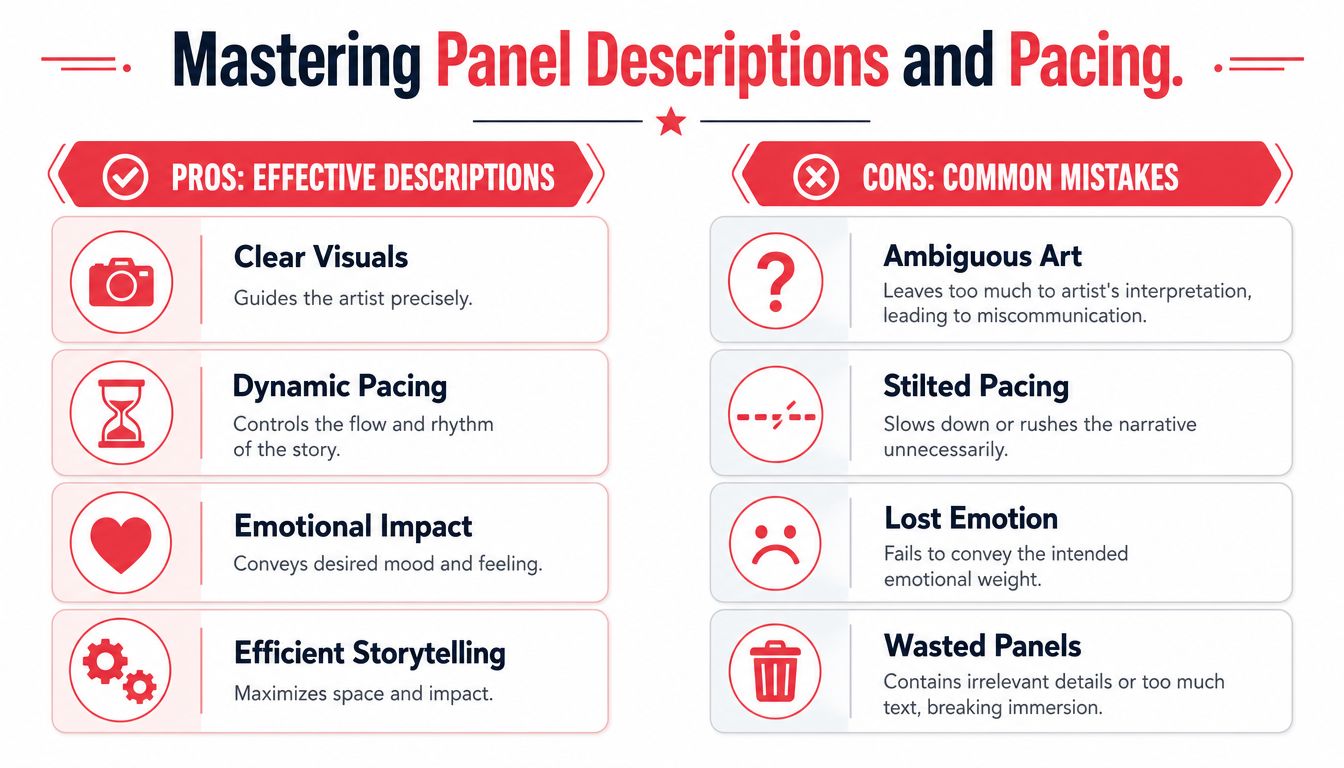
The most useful shift is this: don't write what happened. Write what can be drawn.
Write for the eye first
A weak panel description often sounds like a novel summary.
Weak: “Jordan feels trapped by the pressure of his family's expectations.”
That may be true, but it isn't visual.
Better: “Jordan sits at the dinner table between his parents. Their trophies fill a shelf behind him. He stares at an untouched acceptance letter.”
Now the artist knows what to draw, and the reader feels the pressure without being told how to interpret it.
Useful panel descriptions usually include these ingredients:
- Character presence: Who's in the panel?
- Visible action: What are they physically doing?
- Setting clues: What in the environment matters?
- Framing: Is this wide, medium, or close-up?
- Emotional focus: What should the image emphasize?
If you want help thinking about visual rhythm, a comic panel layout generator guide can help you connect script beats to page design choices.
Pacing lives in the panel count
Panel count changes how a reader experiences time. A fight broken into several small panels feels sharp and fast. A lonely reveal in one large panel feels heavy and deliberate.
A strong technical benchmark is 4 to 6 panels per page, with a useful ceiling of 20 to 25 words per speech balloon and 120 to 150 words total per page, according to this guide on graphic novel scripting benchmarks. Go beyond that too often, and the art starts fighting the text for space.
Here's how that plays out in practice:
- Use fewer, larger panels for awe, dread, intimacy, or shock.
- Use more, smaller panels for action, comedy timing, or procedural steps.
- Cut dialogue early when the page already carries dense action.
- Let one panel breathe if the emotional beat matters more than speed.
If your panel description is clear but the page still feels crowded, the problem often isn't the drawing. It's the number of ideas competing for the same space.
Shot choice changes meaning
A panel is not just information. It's emphasis.
| Shot type | Best use | Effect |
|---|---|---|
| Establishing shot | Start a scene | Orients the reader in place |
| Medium shot | Conversation and action | Balances body language and clarity |
| Close-up | Emotion, clues, reactions | Forces attention |
| High angle | Vulnerability | Makes a character feel diminished |
| Low angle | Power or threat | Gives weight and dominance |
A beginner mistake is to write every panel at the same visual distance. If every shot is medium, the page feels flat. Change the framing when the emotional priority changes.
And always think about the page turn. A reveal hidden until the next page has more force than a reveal handed over too early. Comics reward patience.
Writing Dialogue That Pops and Captions That Guide
Dialogue in comics lives inside a cramped little house called the balloon. That house has strict rent rules. If your line rambles, the artwork pays the price.
This hasn't been true only since modern comics. The reintroduction of speech balloons in 1895 by Richard F. Outcault in The Yellow Kid helped establish the modern convention of placing dialogue directly inside the visual narrative of the panel, as noted in Wikipedia's history of comics. Once words moved into the panel itself, comic writers had to think spatially, not just verbally.
Let the art do part of the job
A common beginner habit is saying exactly what the drawing already shows.
Redundant:
“Look, the room is on fire!”
If the panel clearly shows flames swallowing the curtains, that line isn't helping much.
Stronger:
“Where's my sister?”
Now the words add urgency the art alone can't provide. The panel shows danger. The dialogue shows what matters emotionally.
That's the partnership you want. Art handles what's visible. Text handles voice, meaning, contrast, and selective information.
What good comic dialogue usually sounds like
Good comic dialogue is compressed speech. Not realistic speech in full. Real people wander, repeat themselves, and stall. Comic characters can do that too, but only when the moment earns it.
Use this quick filter before keeping a line:
- Does it sound like this character, or just like me?
- Does it add something the art doesn't already provide?
- Can I cut a few words without losing meaning?
- Would a reader understand it in one pass?
Here's a fast example.
Flat version:
“I am upset that you lied to me, and I don't know whether I can trust you anymore.”
Stronger version:
“You lied. That changes everything.”
The second line is shorter, cleaner, and leaves room for facial expression to finish the scene.
Short dialogue gives the artist room to act.
Captions are not leftovers
Captions can do several jobs well. They can place the scene in time, create a narrator's voice, or reveal a thought the character wouldn't say aloud.
They become weak when they explain instead of sharpen.
| Caption type | Useful when | Example |
|---|---|---|
| Time and place | The scene needs orientation | “Three hours earlier.” |
| Narration | A distinct storyteller is speaking | “Heroes always arrive late.” |
| Inner voice | The character's mind differs from their face | “Smile. Don't let him see you panic.” |
A good test is simple. Remove the caption. If the panel becomes confusing, the caption may be necessary. If the panel still works and the caption only repeats it, cut it.
The best comic text respects the image. It doesn't compete with it.
Common Scripting Pitfalls and How to Avoid Them
Most new writers don't fail because they lack talent. They fail because they assume passion can replace page discipline. It can't. A powerful scene still falls apart if the script overloads the art, ignores pacing, or leaves visual choices too vague.
A standard 22-page comic often uses 4 to 5 pages for the hook, 10 to 12 for escalation, 4 to 5 for the climax, and 1 to 2 for the cliffhanger, according to this article on writing comic book structure and pacing. That same piece also recommends reviewing panel descriptions without dialogue to judge visual flow on its own. That advice is gold.
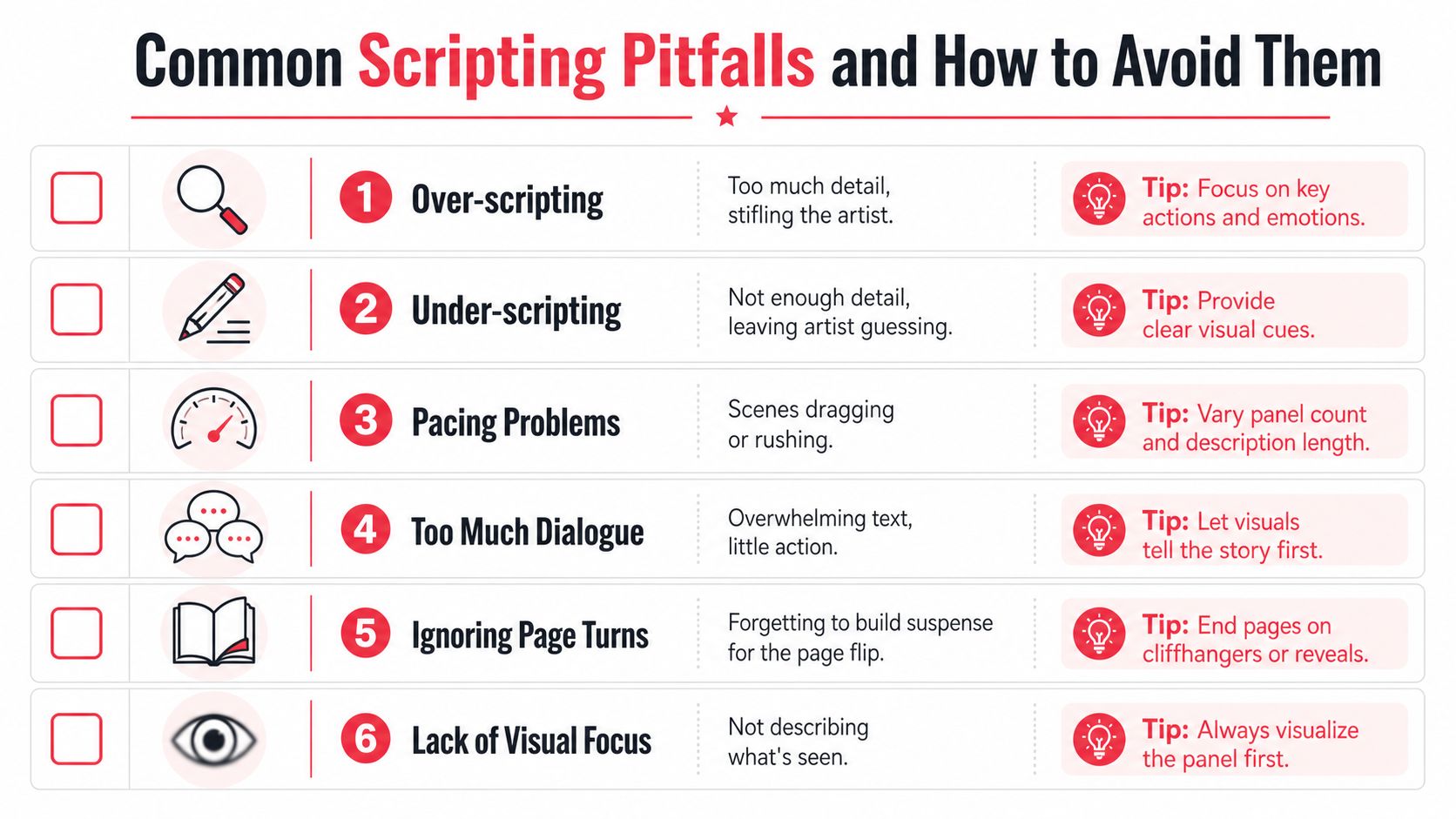
Five mistakes that show up constantly
Some errors are so common that you can catch them with a short self-edit pass.
- Overwriting the panel description: If your panel note reads like a page from a novel, the artist has to dig for the actual instruction. Keep the sensory focus on what can be seen.
- Underwriting the panel description: “They fight” is too thin if the choreography or emotional turn matters. Give enough visual direction to anchor the moment.
- Stuffing every thought into dialogue: Characters don't need to narrate what readers can already infer from posture, setting, or facial expression.
- Forgetting the page turn: A reveal in the middle of a page often lands softer than the same reveal placed after a turn.
- Losing the page's purpose: If nothing changes on a page, the page may be decorative rather than dramatic.
Before and after fixes
Problem: overwritten panel
Before:
“Elaine, who has spent years feeling ignored by everyone in her life and is now finally on the edge of a personal breakthrough, stands in a kitchen that reflects her deep isolation.”
After:
“Elaine stands alone in a spotless kitchen. Three untouched place settings sit behind her. She grips the phone but doesn't answer it.”
The second version gives the artist something usable.
Problem: dialogue pile-up
Before:
“I know you're angry with me because I kept the letter from you, but I had my reasons and I thought I was protecting you from finding out in a way that would hurt you even more.”
After:
“I hid the letter. I thought I was protecting you.”
Same beat. Far more drawable.
A simple page-level check
Try this before sending a script to anyone:
- Read only the panel descriptions. Does the story still make visual sense?
- Identify the page's micro-goal. What changes by the end of the page?
- Circle the anchor image. Which panel deserves the most emphasis?
- Check the ending beat. Does the last panel invite the next page?
Your script should still feel like a coherent silent comic before the dialogue goes back in.
That one habit catches an astonishing amount of clutter.
Adapting Your Script for AI Comic Generators
Traditional scripting teaches clarity. AI comic generation demands clarity plus consistency. That's the difference.
There's a real gap here. Guidance on scripting for AI visuals is still thin, and creators regularly complain that their characters or scenes look different from panel to panel. This need for a standardized, AI-optimized scripting approach is highlighted in ComicInk's discussion of AI comic scripting frustrations.

What changes when AI is the visual partner
A human artist can infer, interpret, and ask follow-up questions. An AI system responds to what you specify. If you don't lock down key visual traits, the model may improvise in ways that damage continuity.
That means your script should carry a second layer of information beyond story action.
For AI work, each important panel benefits from consistent notes about:
- Character identity: hair, clothing, age cues, defining accessories
- Expression and pose: angry, slumped, running, pointing, whispering
- Environment continuity: same alley, same classroom, same spaceship bridge
- Style language: noir, manga, retro pop, watercolor, and so on
- Composition priority: close-up, wide shot, over-the-shoulder, dramatic silhouette
A standard comic script might say, “Nina enters the lab.” An AI-ready script is stronger if it says, “Nina, same short silver hair, yellow raincoat, round glasses, enters the dim lab from left frame, cautious posture, blue monitor glow, graphic novel style.”
That extra specificity is not bloat. It is continuity control.
A practical AI-optimized panel template
You don't need a whole new art form. You need a slightly upgraded script format.
Use a panel note like this:
| Field | What to include |
|---|---|
| Story beat | What happens in the panel |
| Character lock | Repeated identity markers |
| Pose and emotion | Body language and facial expression |
| Setting lock | Repeated environmental traits |
| Shot and framing | Wide, medium, close-up, angle |
| Style cues | The chosen visual style and mood |
| Text | Dialogue, caption, SFX |
Here's an example:
Panel 3
Story beat: Omar sees the missing poster and realizes the face is his sister.
Character lock: Omar, teen boy, curly black hair, green varsity jacket, scar on left eyebrow.
Pose and emotion: Frozen mid-step, eyes wide, poster clenched in one hand.
Setting lock: Bus stop at night, wet pavement, flickering ad screen, same downtown street as previous panel.
Shot and framing: Medium close-up, poster visible in foreground.
Style cues: Moody noir lighting, strong shadows, realistic comic style.
Dialogue: “No. No, no, no.”
SFX: FLAP.
That format gives AI far fewer chances to drift.
The hidden rule is repetition
With AI, repetition helps. If a detail must remain stable, repeat it cleanly. Don't assume the system “remembers” your intent the way a human collaborator would.
Use a reference sheet for your main cast and world. Keep names, clothing, physical traits, and style tags consistent across the whole script. If your heroine has a red bomber jacket in scene one, don't switch to “crimson coat” in scene four unless you want the visual to change.
If you're exploring tools that turn ideas into illustrated books, this guide to an AI book maker is a helpful next stop for understanding how scripted inputs become finished pages.
The surprising part is that old-school discipline makes AI results better. Clear pages, visual priorities, concise dialogue, and stable character cues all come from the same underlying craft. Good comic book scripting still wins. AI just punishes vagueness faster.
If you want to turn a script into finished pages without drawing everything yourself, PersonalizedComics is built for exactly that. You can choose from eight art styles, upload photos or describe original characters, and generate complete comic pages with panels, dialogue, narration, and sound effects. It's a practical way to prototype a graphic novel, create a one-of-a-kind gift, or finally see your story exist as a comic instead of a folder of notes.