The problem usually isn’t effort. It’s format. Most personalized gifts customize the object, not the memory behind it. Great friendships aren’t built from initials alone. They’re built from shared trips, recurring jokes, disasters that became legends, late-night pep talks, and the one story you both tell better every time.
That’s why the most memorable unique personalized gifts for friends have started moving away from static customization and toward gifts with motion, context, and personality. The best ones don’t just say, “This belongs to you.” They say, “This is us.”
Moving Beyond Mugs to Meaningful Moments
Personalization is no longer a niche add-on. It’s a major category. The global personalized gifts market was valued at USD 29.85 billion in 2024 and is projected to reach USD 52.90 billion by 2035, with a 5.4% CAGR, according to Market Research Future’s personalized gifts market report. In the U.S., which accounts for half the market, consumers are willing to pay 20% to 50% more for one-of-a-kind gifts.
That matters because it confirms something gift buyers already feel in practice. People don’t want more stuff. They want better meaning.
Why static personalization often misses
Traditional personalized gifts still work in some situations. An engraved bracelet can be lovely. A custom tote can be useful. A monogrammed notebook can feel polished. But these formats tend to hit a ceiling fast because they usually personalize the surface, not the relationship.
A friend doesn’t remember your bond as a set of initials. They remember:
- The running joke that makes no sense to anyone else
- The turning-point moment when one of you showed up for the other
- The shared obsession with a genre, fandom, trip, or ritual
- The version of themselves they become around you
That’s where story-driven gifts change the game. Instead of putting a name on an item, they turn a friendship into a scene, a sequence, or a narrative keepsake.
Practical rule: If the gift could be given to ten different people with only the name changed, it probably isn’t personal enough.
What works better now
The strongest gifts for friends tend to do one of three things well:
| Gift type | What it does well | Where it falls short |
|---|---|---|
| Engraved or monogrammed item | Durable, simple, easy to order | Often generic after the first reaction |
| Photo-based gift | Familiar, sentimental, visually direct | Can feel expected or repetitive |
| Story-driven gift | Captures personality, memory, and tone | Takes more thought to create |
That extra thought is usually the point. A good friend can tell when you picked something convenient. They can also tell when you built something around your actual history together.
Brainstorming Gifts That Tell Your Friend's Story
The best gift concepts rarely start with the product. They start with a scene.
Before you decide whether the final gift should be a comic, a storybook, a framed print, or something handmade, figure out what the emotional core is. Many skip this and go straight to shopping. That’s how they end up with a customized object that looks personal but feels generic.
Data backs the instinct to go deeper. 80% of consumers believe personalized gifts are more thoughtful than generic ones, and 42% plan to purchase more of them in the future, according to Gift A Feeling’s gift-giving statistics.

Start with a memory, not a product
A strong brainstorming session usually begins with a small set of prompts. Don’t ask, “What should I buy?” Ask questions that surface story material.
Try these:
- What story do we always retell?
- What phase of life did we survive together?
- What tiny detail would make them laugh immediately?
- If our friendship were a movie, what genre would it be?
- What version of them do I want this gift to reflect?
Those answers usually reveal the angle. Maybe your friendship is road-trip chaos. Maybe it’s cozy and nostalgic. Maybe it’s two people who process life through memes, coffee, and dramatic commentary.
Four reliable story seeds
When people get stuck, I usually see them trying to invent something dramatic. They don’t need to. Small stories land harder because they feel true.
The origin story
How you met, why you clicked, what was weird about the beginning.The recurring bit
A shared phrase, fake rivalry, playlist theme, restaurant order, or annual tradition.The adventure arc
A trip, concert, apartment era, bad job, move, or chaotic season you got through together.The alternate-universe version
Your friend as a detective, wizard, space captain, noir antihero, or manga lead.
The more specific the memory, the less “gift shop” the result feels.
A quick filter for better ideas
Once you’ve got a few possibilities, test them against these three questions:
| Question | Good sign | Warning sign |
|---|---|---|
| Will they recognize it instantly? | It connects to a shared reference | It needs explanation |
| Does it sound like them? | The tone matches their personality | It sounds like you forced sentiment |
| Can it become a keepsake? | They’ll revisit it later | It’s funny once and then done |
If you need inspiration after that, it can help to look at broad gift lists like this roundup of best friends gifts on Amazon only to notice what’s missing. Most lists are full of useful items, matching accessories, and novelty pieces. The gap is usually story.
That gap is where your best idea is hiding.
Choosing Your Personalization Method
Once you know the story, the next decision is format. It is at this stage that many gifts either sharpen or fall apart.
A good personalization method should fit the material. A short inside joke might work beautifully on a keychain or embroidered cap. A layered friendship story usually needs more room. If you try to squeeze a rich memory into a format built for one line of text, the result feels cramped.
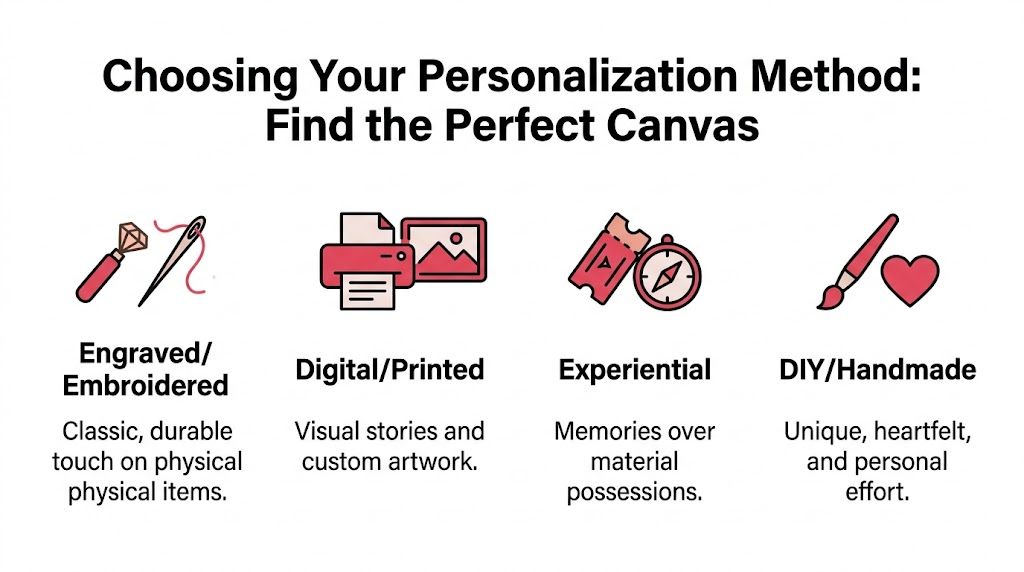
The four main formats
Here’s the clearest way to think about the options.
| Method | Best for | Strength | Limitation |
|---|---|---|---|
| Engraved or embroidered | Names, dates, short phrases | Durable and classic | Limited storytelling space |
| Digital or printed artwork | Visual moments, portraits, scenes | Strong visual impact | Can become decorative more than narrative |
| Experiential gifts | Shared plans and new memories | Feels alive and generous | Harder to preserve |
| DIY or handmade | Deeply personal effort | High emotional value | Quality depends on time and skill |
Each one can work. The mistake is assuming they’re interchangeable.
Static personalization versus narrative personalization
Static personalization changes the item. Narrative personalization builds an experience around the recipient.
A necklace with initials is static. A custom illustrated sequence of the day your friend dragged you through a rainstorm to get dumplings after a breakup is narrative. A photo mug says, “I chose your picture.” A story gift says, “I paid attention to who we are together.”
That difference becomes obvious when the friendship itself has texture. If your bond includes distinct characters, favorite genres, or episodes you both revisit, narrative formats usually outperform the classics.
Matching format to friendship style
The fastest way to choose is to match the method to your friend’s personality.
For the minimalist friend
Go small and elegant. An engraved item, a text-based print, or a subtle custom accessory works best. They may love sentiment, but they don’t want clutter or visual noise.
For the expressive friend
Use a format with room for color, scenes, and personality. Printed art, illustrated stories, or stylized visual gifts give you space to reflect how vivid they are.
For the friend who loves shared lore
Choose narrative. This is where custom storybooks, travel maps with context, and illustrated comics shine. You’re not just preserving a memory. You’re staging it.
Choose the canvas that can hold the emotion. Don’t force a big story into a tiny format.
What usually works and what usually doesn’t
A few trade-offs show up over and over:
- Works well: a simple concept in the right medium
- Misses the mark: a complex concept crammed into a novelty object
- Works well: one strong shared reference with clear tone
- Misses the mark: too many memories jammed together
- Works well: visual format for visual friendships
- Misses the mark: text-heavy gift for someone who responds to images and humor
When people ask for unique personalized gifts for friends, they often mean they want something no one else would think to make. In practice, that usually means choosing a format that can carry a real story.
Creating a Narrative Gift With AI and Photos
Narrative gifts used to be difficult to pull off unless you could draw, design layouts, or write clean scenes. That’s changed. AI tools now make it possible to turn photos and memory fragments into polished visual storytelling without needing illustration skills.
That’s especially useful for comic-style gifts, where consistency matters. A gift stops feeling premium fast if your friend’s face changes from panel to panel or the story drifts halfway through.
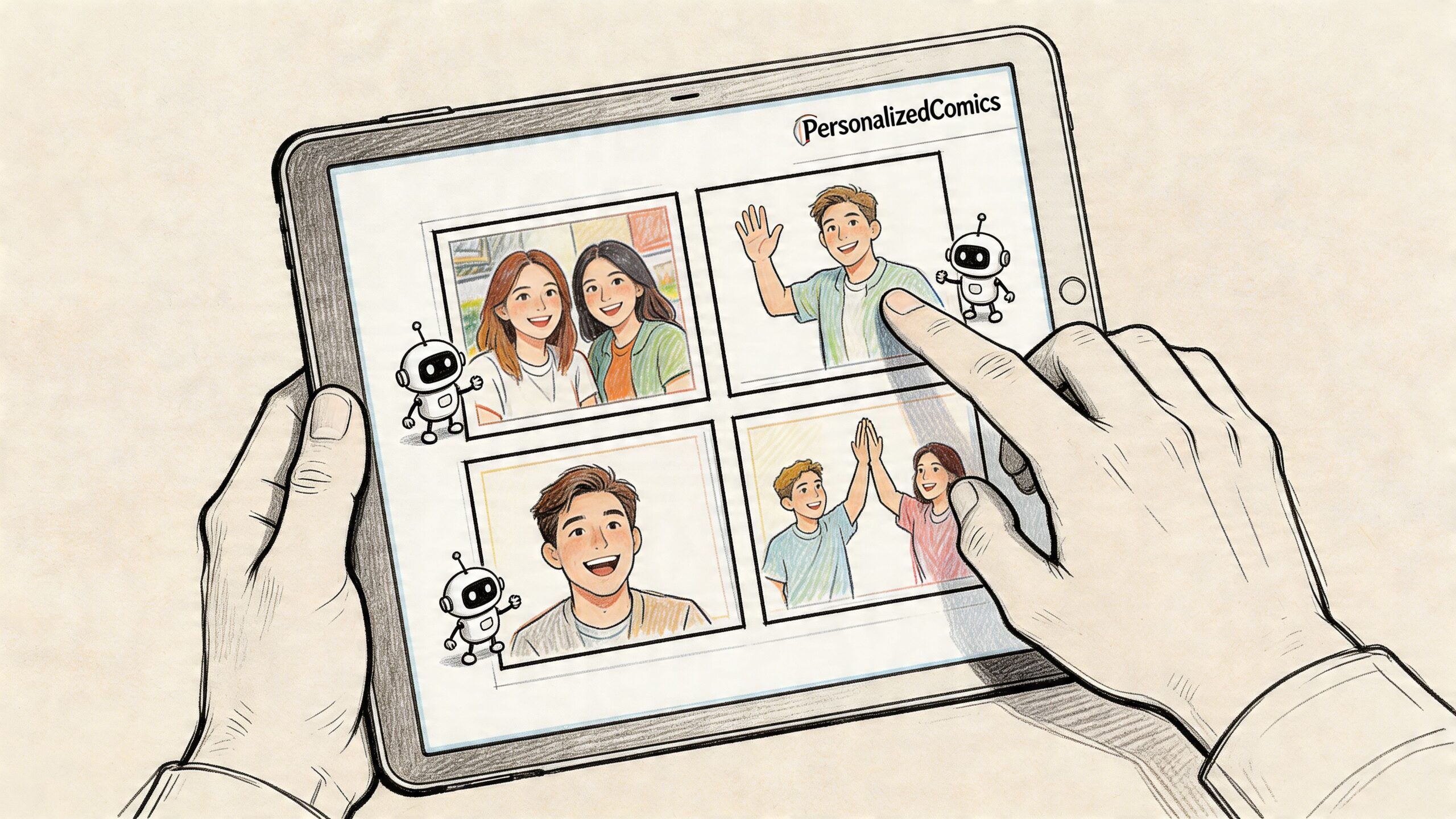
According to this breakdown of how algorithms create customized gifts, platforms in this category report 85% to 95% user satisfaction in emotional resonance, and they use neural networks to transform photos into stylized characters with less than 2% feature drift across pages. That consistency is what makes a comic feel intentional instead of gimmicky.
Gather the right inputs
You don’t need a giant folder. You need a clean starter set.
Collect:
- A few strong photos where your friend’s face is clear
- One or two supporting images for hairstyles, outfits, or shared settings
- A short story summary in plain language
- A tone reference such as funny, heartfelt, noir, chaotic, fantasy, or slice-of-life
This is the point where people overcomplicate things. They think more detail always means better output. It doesn’t. Better detail means better output.
Pick a visual style that fits the person
Style choice is not cosmetic. It changes how the whole gift feels.
If your friend loves anime, manga-inspired art may feel natural. If they love moody mysteries, a noir treatment can enhance a simple memory. If the friendship is playful and bright, retro pop or watercolor can soften the edges and make the piece feel giftable rather than intense.
A common mistake is choosing the style you like instead of the one they’d instantly claim as theirs.
Keep the plot simple
A gift comic doesn’t need a complicated arc. In fact, short and clean usually wins.
Here’s a reliable structure:
Set the scene
Introduce your friend and the moment. Keep it recognizable.Escalate the bit
Add the running joke, mini-conflict, or exaggerated version of what happened.Land the emotional beat
End on warmth, triumph, absurdity, or a line that only the two of you would understand.
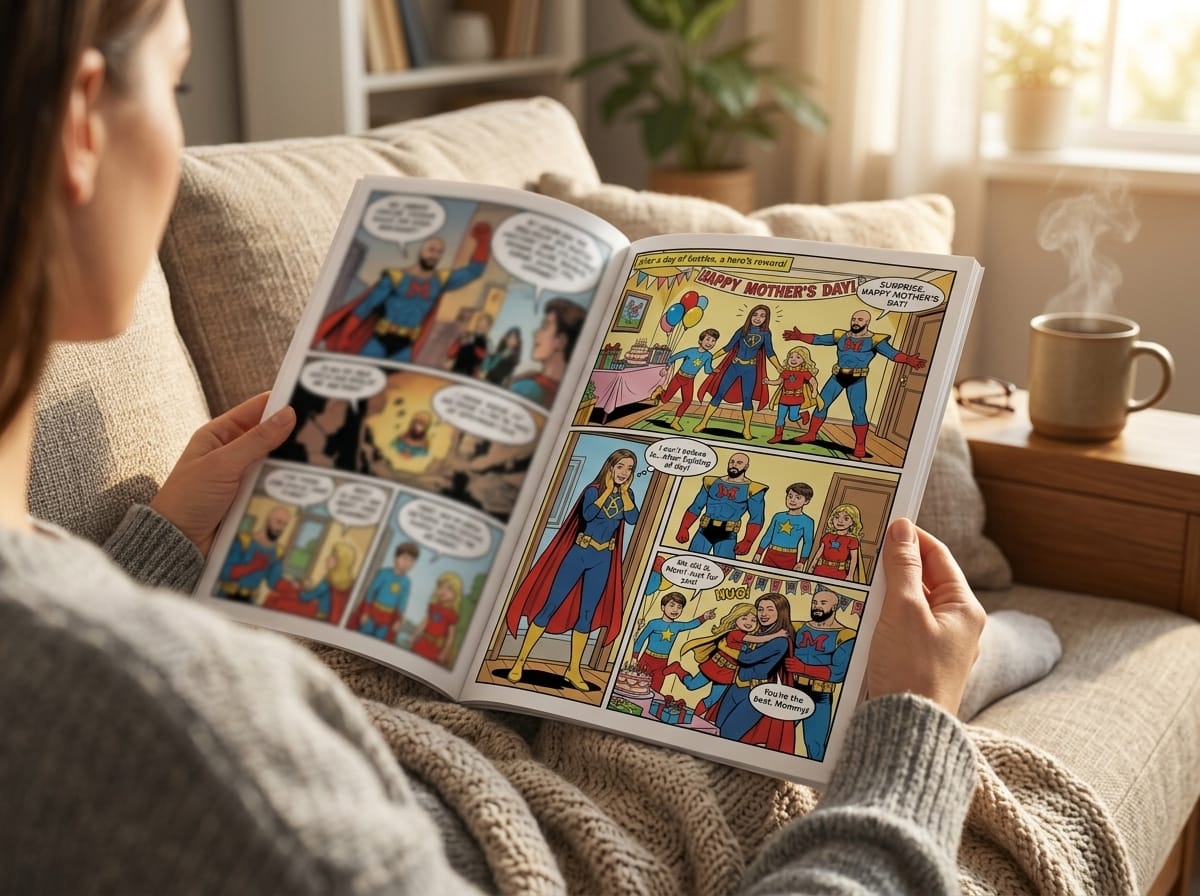
That’s enough. If you want a working sense of the format, this look at personalized comic books shows the range these story-driven gifts can take.
Short stories are easier to personalize well. A focused memory beats an overstuffed epic every time.
Write prompts like a director
Prompt quality matters because vague instructions create generic scenes. You want direction, not volume.
Compare these:
Weak prompt
“Make a comic about my friend and me having fun.”Better prompt
“Turn my friend into a deadpan sci-fi captain and me into the overconfident first officer. We’re trying to find the best iced coffee in the galaxy. Include our habit of arguing over directions and the phrase ‘trust the process’ as a recurring joke.”
The second prompt gives the system role, tone, visual world, and relationship dynamics. That’s why it produces something with identity.
Review like a gift editor
Once the pages are generated, don’t just scan for errors. Review for feeling.
Check these points:
| Element | What to look for |
|---|---|
| Character likeness | Does your friend feel recognizable in the chosen style? |
| Dialogue | Does it sound like your actual dynamic? |
| Inside references | Are they clear enough to land, but not so obscure that the scene breaks? |
| Ending | Does the last page feel like a payoff? |
If something feels flat, the fix is usually one of three things. Tighten the prompt, simplify the scene, or swap the art style.
The most successful AI-made gifts still need human judgment. The tool can generate pages. You still decide what deserves to be remembered.
Perfecting the Details for Maximum Impact
A decent personalized gift gets a smile. A sharply detailed one gets the immediate reaction you’re after: laughter, silence, a second look, then “Wait, you included that?”
That reaction usually comes from the refinements others overlook.
Use details that belong only to your friendship
A generic prompt can produce a competent result. It won’t produce your result.
Take the difference between these two approaches:
“Two best friends go on an adventure through the city.”
That’s usable, but broad.
Now compare it to this:
“Two best friends race across the city after missing brunch again. One is always early but somehow still unprepared. The other insists every problem can be fixed with coffee. Include the yellow raincoat, the cursed group chat, and the line ‘This is why we can’t do normal things.’”
The second version has social texture. It names habits, props, and a sentence with built-in rhythm. Those tiny specifics do most of the emotional work.
Tone matters more than sentimentality
People often assume meaningful gifts have to be serious. That’s not true. They have to be accurate.
If your friendship is built on sarcasm, don’t force a soft poetic script. If your friend loves dramatic fantasy, don’t flatten everything into realism. Match the emotional language they already use in life.
A few pairings tend to work well:
- Dry and funny for friends who bond through commentary
- Warm and nostalgic for long-distance or longtime friendships
- Action-heavy and exaggerated for fandom-based friendships
- Low-key and observational for quieter bonds
For visual inspiration, seeing how creators turn photos into comic book art can help you notice how mood shifts with style, color, and framing.
Add background references, not just main-scene references
Many personalize the obvious parts. They name the characters, describe the central event, and stop there. The strongest gifts personalize the edges too.
Use background details such as:
- A coffee cup label with a nickname
- A poster on the wall referencing a trip or fandom
- A phone notification from the friend group chat
- A pet cameo stealing the scene
- A recurring object like a tote, camera, hoodie, or snack
These details make the gift feel observed. That’s different from merely customized.
Cut anything that sounds too polished
A friendship gift should sound like you know each other, not like a motivational calendar wrote it.
If a line feels performative, trim it. If a joke needs explanation, replace it. If every panel tries to be deep, the whole thing gets stiff. Leave room for weirdness, understatement, and one line that only matters because the two of you know why it matters.
The final pass should answer one question: could this belong to any friendship, or only yours?
If the answer is “only ours,” you’re close.
Finalizing and Presenting Your Custom Gift
The creative part is only half the job. A brilliant idea can still fizzle if the print quality is weak, the delivery is rushed, or the presentation feels like an afterthought.
Practical decisions matter.
Decide whether this should stay digital or become physical
A digital gift can work when speed matters or when the reveal is happening long-distance. But many story-based gifts become much more effective as physical objects. They feel finished. They invite rereading. They can sit on a shelf instead of disappearing into a camera roll.
That preference shows up in buyer behavior too. 62% of gift buyers in the US and EU prefer tangible personalized items, according to this Etsy market page discussing personalized friendship gifts.
Get the logistics right
Before you place any order, check the basics:
- Timeline: Leave room for revisions, proofing, printing, and shipping.
- Budget model: Some platforms charge per item, others by page or creation credits.
- Reprint flexibility: If the gift is a hit, you may want another copy later.
- Presentation quality: Paper stock, cover finish, and print sharpness affect perceived value.
A custom gift feels premium when the physical finish matches the care behind the idea.
Make the reveal part of the gift
Presentation can amplify the story instead of just containing it.
If the gift has a noir theme, package it like evidence. Use a manila envelope, typed label, and black ribbon. If it’s fantasy-inspired, use textured paper, a wax-seal style sticker, or a note written as if it came from a guild archive. If the story is funny, hide the gift behind a fake “normal” present for a stronger reveal.
A few presentation ideas that work well:
| Gift tone | Presentation idea |
|---|---|
| Noir or mystery | Evidence envelope, stamp, monochrome wrap |
| Cozy or nostalgic | Kraft paper, twine, handwritten note |
| Sci-fi or cyberpunk | Metallic tissue, bold label, bright accent card |
| Comedic | Decoy box, fake warning label, ridiculous cover note |
Include a short note
Don’t overexplain the gift. One or two lines is enough.
Good note:
“I wanted to make you something that felt like one of our stories, not just another customized thing.”
That framing helps the friend understand why this particular gift exists. It also slows the moment down, which often makes the reaction stronger.
Give a Gift That Becomes a Cherished Memory
The strongest unique personalized gifts for friends don’t start with a catalog. They start with attention. You notice the story, choose a format that can carry it, shape the details so it sounds and looks right, and then present it like it matters.
That’s why story-driven gifts keep landing harder than static ones. They don’t just mark an occasion. They preserve a relationship in a form your friend can revisit.
If you’ve been stuck between generic personalized items and vague “experience gift” ideas, go smaller and more specific. Pick one memory. One tone. One shared piece of lore. Build from there.
That’s usually enough to create the kind of gift your friend talks about for years.
If you want to turn your photos, inside jokes, and shared memories into a polished comic-style keepsake, PersonalizedComics makes that process unusually easy. You can choose from eight art styles, build page by page with a credit-based system, use the free three-page preview to test your idea, and order a premium physical copy when you’re ready. It’s a smart option for anyone who wants a gift that feels personal, visual, and impossible to duplicate.
Shopping for the holidays? Our guide to personalized Christmas gifts rounds up 25 custom ideas, from engraved keepsakes to a comic book starring the recipient.
And if the friend you are shopping for is a veteran, these Veterans Day gift ideas offer another meaningful occasion to show your appreciation.
Shopping in December instead? Our funny Christmas gifts guide covers 25 laugh-first ideas for friends, family, and coworkers.
Filed under Gift Guides