Marvel Create a Comic: An AI-Powered Guide (2026)
You've probably had this thought already. You know exactly what kind of comic you want to make. There's a masked hero, a city in trouble, a villain with a personal grudge, and a final-page reveal that would fit right into a big shared universe. But then the process stalls because you can't draw, you don't know how to lay out pages, and every tutorial seems to assume you're ready to spend years learning anatomy and perspective.
That's the gap most fans run into. A lot of “make a comic” advice stays focused on drawing, while people often need help turning an idea into finished pages without classical illustration skills. Marvel's own teaching material leans heavily into perspective, gesture, head construction, and composition, which leaves a real gap for readers asking how to create a comic if they can't draw. That's also why AI-powered comic tools have become so useful for personalized storytelling, as noted in Marvel's drawing-focused instructional approach on YouTube.
The good news is that marvel create a comic no longer has to mean “learn to ink like a pro first.” It can mean building a strong concept, shaping a tight plot, guiding the visuals with smart prompts, and editing the result like a real comics creator. If your goal is a personalized Marvel-style story, the modern workflow is much closer to directing than drawing.
Your Dream of Making a Marvel Comic Is Now Reality
The fantasy is simple. You want your own superhero comic, something with dramatic action, bold personalities, and that feeling that this story belongs to a bigger world. Maybe you want to put yourself in the book. Maybe you want to turn a friend, partner, or kid into the lead character. Maybe you've had an origin story in your head for years and never found a workable way to produce it.
That's why the old barrier matters so much. Traditional comic production asks one person, or a small team, to handle concept design, writing, staging, drawing, page composition, lettering, and revision. If you're missing the art side, the whole thing can feel blocked before page one exists.
AI changes that. It doesn't remove creativity. It moves your creative job to higher-value decisions.
Instead of asking, “Can I draw this hero from five angles?” you ask, “What visual traits make this hero memorable?” Instead of thumbnailing every page by hand, you decide what each scene needs to communicate. Instead of wrestling with polished anatomy, you spend your time on pacing, mood, and clarity.
What actually matters in a Marvel-style comic
A Marvel-style story usually lands because of a few things working together:
- A sharp premise: one strong “what if?” idea
- A lead with tension: power alone isn't enough. The character needs conflict.
- Clean escalation: each page should increase pressure
- Big visual moments: reveals, impacts, reactions, and turns
- Readable dialogue: short, distinct, and easy to place in panels
The first-time creator mistake isn't lack of drawing skill. It's trying to invent a universe before proving a single scene works.
That's why the practical path is smaller and smarter. Build a short comic first. Give it one hero, one problem, one setting cluster, and one payoff. Once that works, expanding the world gets much easier.
Think like a writer-director, not a penciler
If you want the best result from an AI-powered workflow, act like the person calling the shots. You decide:
- Who the story is about
- What changes for them
- Which scenes deserve a full page beat
- How much text each panel can carry
- What tone the visuals should support
This is the crucial element. You don't need to be the illustrator to make a comic that feels personal and polished. You need a concept worth following and a workflow that turns ideas into pages without losing momentum.
Develop Your Core Concept and Cast of Characters
The strongest Marvel-style comics usually start with a premise that can be said in one sentence. Not the whole lore. Not the timeline. One sentence.
“A paramedic discovers she can absorb impact energy and becomes the only person who can stop a living earthquake.”
That kind of sentence gives you genre, stakes, and visual identity at once. It also gives your AI workflow something specific to build around.
Since 1961, Marvel has published what Douglas Wolk describes as “the longest continuous, self-contained work of fiction ever created,” spanning over half a million pages, which is a useful reminder that huge comic universes grow from strong core concepts, not from random detail piles. That observation comes from Douglas Wolk's discussion of Marvel's shared story.
Start with the right kind of premise
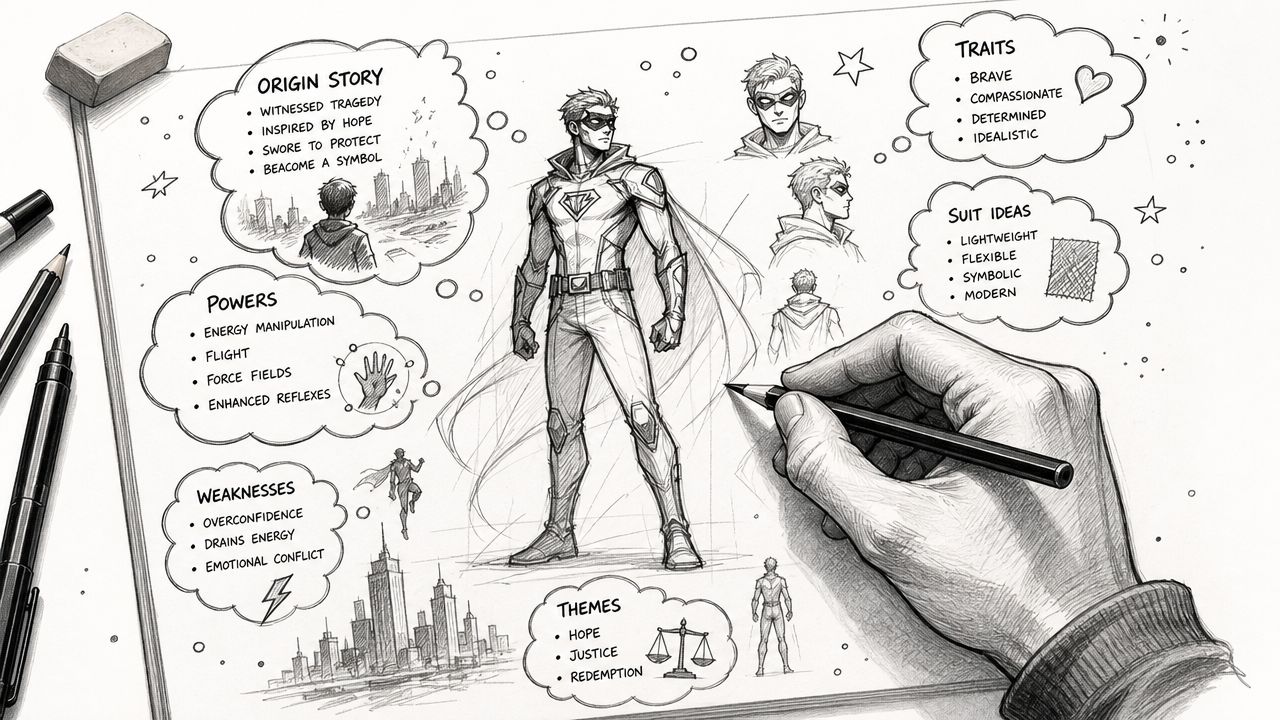
A usable concept usually answers four questions fast:
- Who is the lead
- What power, skill, or strange condition defines them
- What pressure hits them first
- Why this conflict matters emotionally
Try these prompt starters:
- What if a museum curator bonded with alien armor that only activates around lies?
- What if a teenager could rewind the last few seconds, but each use erased a memory?
- What if your family dog became the guardian of a portal hidden under the subway?
These work because they imply scenes. You can already imagine the reveal, the confusion, the first test, and the first failure.
Two ways to build your cast
If you're making a personalized comic, there are two excellent paths.
Turn real people into comic characters
This is perfect for gifts, family stories, birthday comics, wedding keepsakes, or fan-made “you as the hero” adventures. You start from photos, then push the visual design toward comic-book clarity.
Focus your character notes on features that survive stylization:
- Signature silhouette: cape, jacket, visor, oversized gauntlets, sharp hair shape
- Color identity: two or three dominant colors
- Emotional read: confident, awkward, intense, sarcastic, warm
- Role in the story: leader, skeptic, rival, sidekick, mentor
If you want help shaping a more iconic hero identity, this guide on how to customize a superhero is a smart place to refine costume logic and character framing.
Create original heroes from text
This path is better when you want a fresh world or don't want the comic tied to real faces. The key is to write prompts like a casting brief, not a novel.
Good character prompt:
“Afrofuturist teen inventor, athletic build, luminous blue energy gloves, short natural hair, yellow field jacket, skeptical expression, urban rooftop setting, heroic but not grim.”
Weak character prompt:
“Cool superhero with powers who looks awesome and futuristic and kind of like a genius.”
Specific prompts produce consistent characters. Vague prompts produce drift.
Keep your roster small
A first comic doesn't need a sprawling ensemble. It needs a cast that the reader can track immediately.
Use this rule of thumb:
| Story role | What they do |
|---|---|
| Hero | carries the emotional change |
| Antagonist | creates the central problem |
| Support character | reveals personality through interaction |
| Witness or crowd | helps sell scale when needed |
If two characters serve the same function, merge them. Comics gain power when every face on the page earns the space it takes up.
Build for consistency, not complexity
When fans search for “marvel create a comic,” they often chase spectacle first. I'd do the opposite. Lock the hero look, define one memorable villain trait, and choose a setting palette before you write long scenes. Consistency beats complexity every time in early drafts.
Script Your Story Using the Marvel Method
Most beginners freeze when they think they need a full screenplay-style comic script. You don't. For a Marvel-style workflow, a lighter structure often works better.
The classic Marvel Method breaks creation into three stages: a one-page plot outline, artist-led penciling and layouts, and post-art dialogue. Accounts of the method emphasize that Stan Lee often began from a compact outline rather than a full script, giving the artist room to shape pacing and page turns. That production logic is described in this breakdown of the Marvel Method and why it works.
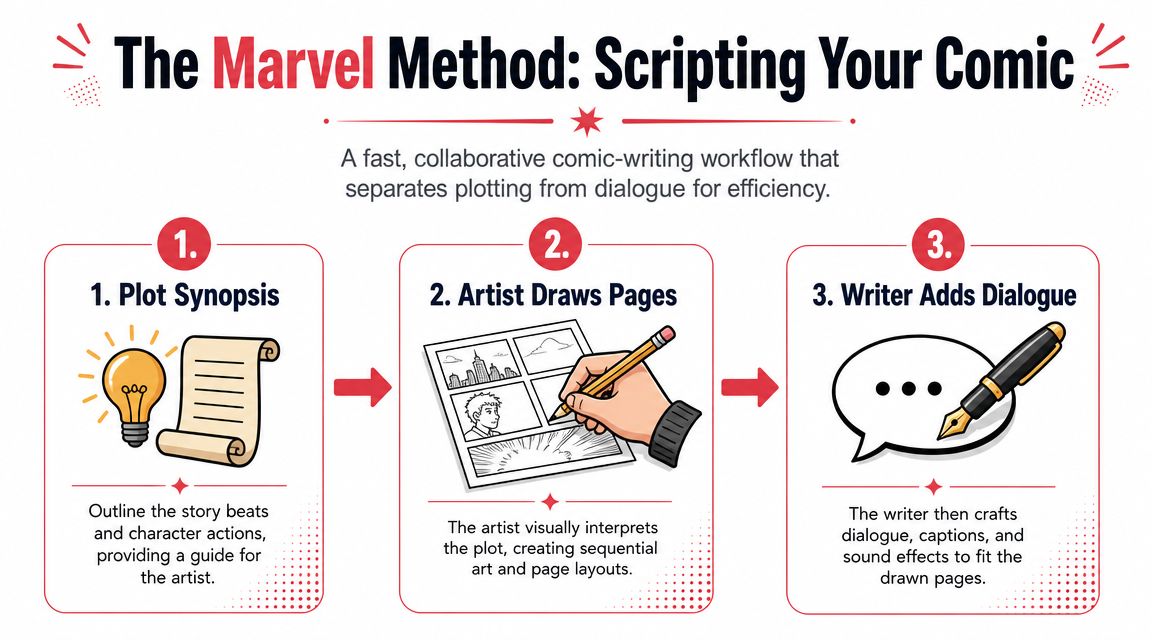
Use a beat sheet, not a brick of script
For AI comic generation, this method is ideal because you're telling the system what needs to happen without choking the visuals under rigid panel instructions.
A practical beat sheet for a short comic might look like this:
Opening image
Show the hero in ordinary life, with one hint that something is off.Inciting event
A threat, accident, discovery, or confrontation changes the stakes.First power or action reveal
The reader gets a clear visual payoff.Complication
The hero's success creates a new problem.Midpoint turn
New information changes the goal.Lowest point
The hero fails, doubts themselves, or loses something important.Climax
The key confrontation resolves the central conflict.Final image
End with change. A teaser is fine, but emotional closure matters more.
That structure gives the art room to breathe while keeping the story focused.
Write action in images
When you prepare prompts or scene notes, think in visible moments.
Good scene note:
“The villain tears open the subway roof. Rain pours in. Passengers panic. The hero lands awkwardly, shielding a child with one glowing arm.”
Weak scene note:
“The stakes are rising and everything feels dangerous as people start to understand the villain is powerful.”
The second line may be true, but it doesn't tell the image generator what to draw. Comics are built from what can be shown.
If you want a cleaner starting template, this article on how to write a comic book script pairs well with a Marvel Method workflow.
Leave room for visual pacing
One reason this method has lasted is that page rhythm often improves when visuals aren't trapped inside over-explained scripts. A reveal page needs space. A punchline reaction needs framing. A horror beat needs silence.
That's true whether a human artist draws the page or an AI system interprets your scene.
Practical rule: If a panel contains a major reveal, don't also force it to carry your longest speech.
Don't over-script after the art exists
A major failure point in this workflow is adding too much dialogue once the page is already composed. Creators who prefer the Marvel Method warn against over-cluttering panels and stress that the artist needs enough visual space to tell the story. Readability and word-density control are the actual constraints, as discussed in this creator-focused note on why the Marvel Method works better than full script for some comics.
Use this quick filter before finalizing dialogue:
- Cut repeated information: if the panel already shows it, don't explain it again
- Trim speeches: one strong line beats a dense paragraph
- Assign distinct voices: the hero, villain, and side character shouldn't sound interchangeable
- Save exposition for captions sparingly: dialogue should feel spoken, not encyclopedic
“If the art already does the heavy lifting, let the words support the moment instead of sitting on top of it.”
That advice saves pages. It also makes the finished comic feel more professional.
Choose Your Art Style and Generate the Pages
Style selection is where a Marvel-inspired comic either locks in or falls apart. You can have a good premise and a solid beat sheet, then lose impact because the visual approach fights the story.
The useful way to choose isn't “Which style looks coolest?” It's “Which style helps this exact story read clearly?” Action-heavy pages need one kind of line and contrast. Emotional origin stories need another. Noir mysteries ask for different shadow logic than cosmic battles.
Match tone before detail
If your script leans toward bright heroics, don't force it into a murky style just because it looks dramatic in a sample. If your story depends on menace and secrecy, don't pick a playful style that undercuts tension.
Panel readability matters more than novelty. That's especially true because word-density and visual clarity can clash fast when a page is busy. Keep the earlier warning in mind: if panels are already doing a lot of work, a style with cleaner shapes and stronger separation usually gives dialogue more room to sit comfortably.
Here's a fast comparison for the eight style options.
PersonalizedComics Art Style Guide for a Marvel Feel
| Art Style | Best For Marvel-Style Stories Like… | Key Visual Characteristic |
|---|---|---|
| Classic American | team-up action, city battles, bright heroic origins | bold contours, familiar mainstream comic energy |
| Manga | fast motion, emotional intensity, young heroes | expressive faces, speed emphasis, dynamic exaggeration |
| Graphic Novel | mature character drama, grounded sci-fi, layered tone | cinematic framing, textured realism, moodier rendering |
| Noir | vigilante mysteries, corrupt-city stories, secret identities | heavy shadow, contrast, tension-first atmosphere |
| Watercolor | dreamlike magic, sentimental gifts, softer fantasy | painterly blends, gentle edges, lyrical feel |
| Cyberpunk | tech conspiracies, neon futures, hacked cityscapes | luminous color, dense urban detail, synthetic mood |
| Retro Pop | playful adventures, campy villains, lighter comedy | punchy color blocks, stylized nostalgia, graphic simplicity |
| Fantasy | mythic artifacts, cosmic prophecy, enchanted realms | ornate design, epic costuming, high-imagination environments |
If you want a deeper feel for the visual differences, this overview of different comic art styles can help you choose with more intent.
How to prompt for page generation
Once the style is chosen, your job is to feed the system the right level of instruction. Too little and the page drifts. Too much and the images become stiff.
A strong page-generation prompt usually includes:
- Scene purpose: what must happen emotionally or narratively
- Character presence: who is in the scene and what they're doing
- Environment: rooftop, alley, lab, courtroom, subway tunnel
- Mood: triumphant, anxious, eerie, chaotic
- Shot priorities: close reaction, wide reveal, low-angle confrontation
Example:
“Classic American style. Rooftop confrontation at dusk. Hero in red-and-gold armored jacket lands hard after first flight attempt. Villain stands near neon billboard with stolen energy core. Strong wind, dramatic city skyline, readable action, bold facial expressions.”
That prompt gives genre, staging, and emphasis without dictating every panel.
What works and what doesn't
What works:
- short scene summaries with strong visual verbs
- recurring descriptors for the same character
- clear environment labels
- one tonal direction per scene
What doesn't work:
- references stacked from too many different franchises
- costume descriptions that change every page
- giant paragraphs of lore
- asking one page to cover too many beats
A comic page isn't a storage unit for every idea you had. It's a delivery system for the next emotional hit.
The best generated pages usually come from scripts that understand momentum. One page should do one or two important things well. Once you respect that limit, the visuals get sharper and the reading experience gets better.
Assemble Pages and Optimize Your Panels and Dialogue
The first generated draft is not the finished comic. It's the raw cut, where creator judgment matters most.
A lot of beginners assume the hard part ends once the pages exist. In practice, the book then starts to feel intentional. Small edits fix pacing. Small cuts fix clutter. A single page reorder can improve a reveal more than rewriting half the script.
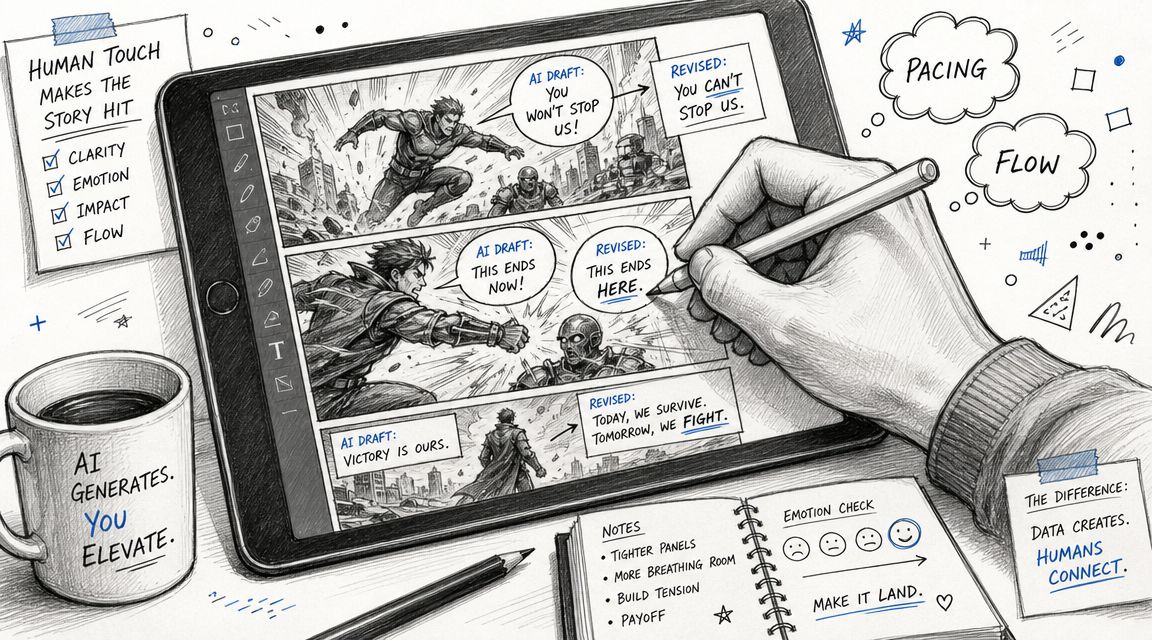
Edit page order like a storyteller
Read the comic straight through once without touching anything. Mark only three things:
- where you got confused
- where the energy dipped
- where a reveal arrived too early or too late
Then adjust page order if needed. Sometimes the strongest opening isn't the one you wrote first. Sometimes a villain teaser belongs before the hero's daily life scene. Sometimes a reaction shot needs to land on the next page so the turn has weight.
If a dramatic entrance feels weak, check whether the setup page telegraphed too much.
Tighten dialogue after the visuals exist
At this point, many Marvel-style fan comics improve fast. Once you can see the page, you'll notice that some lines are doing work the art already handles.
Cut aggressively.
A few practical fixes:
- Shorten speech balloons: spoken lines should sound like breath, not essays
- Use captions for transitions: location shifts or internal reflection can sit better in narration boxes
- Protect reaction panels: don't bury a face under text if the expression is the point
- Let silence win sometimes: a stare, impact, or reveal panel can carry itself
Improve eye flow and panel rhythm
Even a good-looking page can read awkwardly if the eye doesn't move cleanly. Watch for speech balloons that pull attention backward or captions that distract from the focal action.
Use this review pass:
| Check | What to look for |
|---|---|
| Balloon placement | does the reading order feel natural |
| Panel emphasis | is the biggest story beat getting the largest visual weight |
| Caption restraint | are narration boxes helping, not narrating the obvious |
| Scene continuity | do costumes, lighting, and locations stay coherent |
The cleanest comic pages don't explain how to read themselves. They guide the reader so smoothly that the effort disappears.
Polish like an editor, not a perfectionist
There's a difference between improving a page and endlessly fiddling with it. If a page clearly communicates the moment, supports the tone, and keeps the story moving, it's doing its job.
The highest-impact edits usually happen in this order:
- Fix confusion
- Reduce text
- Strengthen page turns
- Unify character appearance
- Adjust wording for voice
That sequence keeps you from wasting time polishing lines on pages that still have structural problems. Good comic editing is practical. It protects momentum first.
Finalize Pricing Printing and Branding Legally
Once the story reads well on screen, the final decisions are practical. How many pages do you want to generate, whether you want a digital-only version or a printed copy, and how closely your branding should echo Marvel without crossing legal lines.
For pricing, a credit-based model is the cleanest setup for hobbyists because you can build page by page instead of committing to a subscription. The useful details here are simple: 1 credit equals 1 page, credits never expire, and new users can create a free three-page preview comic to test the format. Physical print options also matter more than people think. A personalized comic becomes a much stronger gift, keepsake, or portfolio sample once it exists as an actual printed book.
The legal side deserves caution. Marvel's history shows how valuable and protected that intellectual property is. The company was founded in 1939 by Martin Goodman, and MARVEL COMICS #1 was released on August 31, 1939, a launch that eventually grew into a major entertainment brand under Disney ownership, as outlined in Marvel's history of its 85th anniversary.
Safe inspiration versus infringement
Use Marvel as a storytelling influence, not as a branding shortcut.
Do this:
- Borrow structural lessons: origin tension, team dynamics, escalating stakes
- Use genre cues: cosmic, street-level, mutant-like outsider themes in a general sense
- Create original names, logos, costumes, and symbols
- Make your own universe rules
Don't do this:
- Use Marvel character names
- Copy costume designs or logos
- Market your comic as official or affiliated
- Recreate trademarked branding elements
A good rule is simple. You can aim for a Marvel-style feeling. You can't present the work as Marvel's property.
If you respect that line, your comic can still feel energetic, heroic, and personal without stepping into obvious infringement.
If you're ready to turn your idea into actual pages, PersonalizedComics gives you a practical path from concept to finished book. You can build a Marvel-style story from photos or original prompts, generate pages in multiple art styles, refine dialogue and layouts, and order a premium physical copy without needing drawing skills or a subscription.